- Home
- What Is Partnership?
- Unit-Based Teams
- Your Role
- Regions
- Stories and Videos
- Tools
- eStore
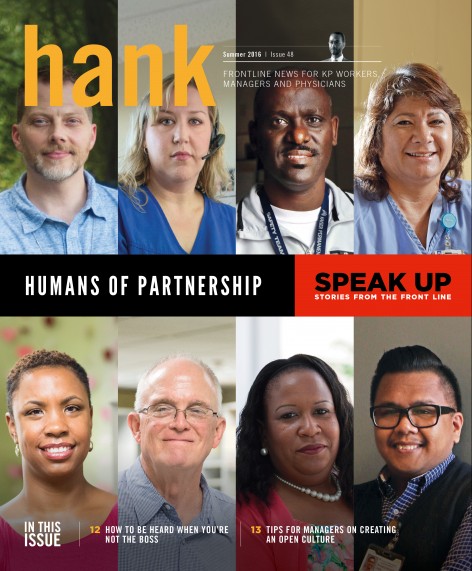
Summer Hank
This issue is all about learning from small failures that often are the lead up to big success. Health care, it seems, is populated with perfectionists. That’s a good thing. Correct, timely diagnoses can make the difference between life and death.
But a little lack of perfection here and there might be just what the doctor ordered. A UBT’s ability to learn from mistakes can speed it on its way to high performance.
Inside the summer 2010 Hank you’ll find:
The “tests of change” that unit-based teams conduct are mini-experiments. If a test fails to produce the desired outcome, the failed experiment needs to be considered an opportunity—not a failure. The only failure would be to not incorporate that knowledge into the team’s work going forward.
How will UBTs get the support they need? San Diego and Fontana have come up with facilitator pools; Colorado is taking that model and tweaking it; Northern California has another approach. Find out what different locations are doing to solve the equation.
EVS departments teams in Southern California and the Northwest are proving that partnership can make the workplace safer.
The Post-Anesthesia Care team wasn’t happy with the fact that only 60 percent of their patients left their unit with “tolerable” pain levels. Using the Rapid Improvement Model, they jumped that up to 95 percent.
Got a problem to solve? Don’t go getting all complex in trying to solve it, says Hank’s resident columnist.
Looking for an improvement in clinical outcomes? Unit-based teams can get you there, and this excerpt from The Permanente Journal explains why.
Past Issues