TOOLS
UBT Sponsorship
Format:
PDF
Size:
8.5" x 11"
Intended audience:
UBT co-leads
Best used:
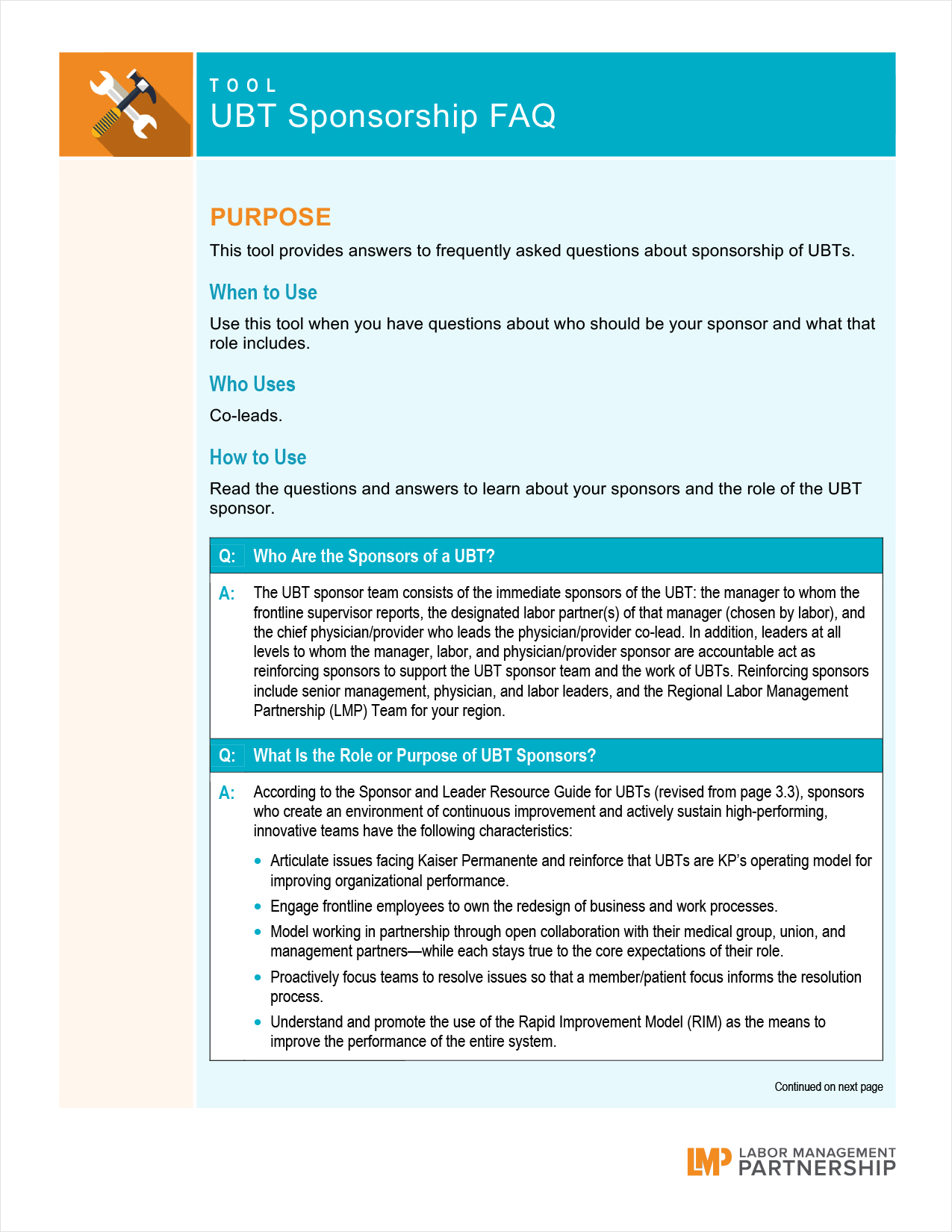
This guide answers your questions about who should be your sponsor and what that role includes.
This short animated video explains how to find and use our powerful how-to guides
Does your team want to improve service? Or clinical quality? If you don't know where to start, check out the team-tested practices on the LMP website. This short video shows you how.
Having trouble using the search function? Check out this short video to help you search like a pro!
Need to find a checklist, template or puzzle? Don't know where to start? Check out this short video to find the tools you need on the LMP website with just a few clicks.
Format:
PDF
Size:
8.5" x 11"
Intended audience:
UBT co-leads
Best used:
This guide answers your questions about who should be your sponsor and what that role includes.
Format:
Word document
Size:
8.5" x 11"
Intended audience:
UBT sponsors
Best used:
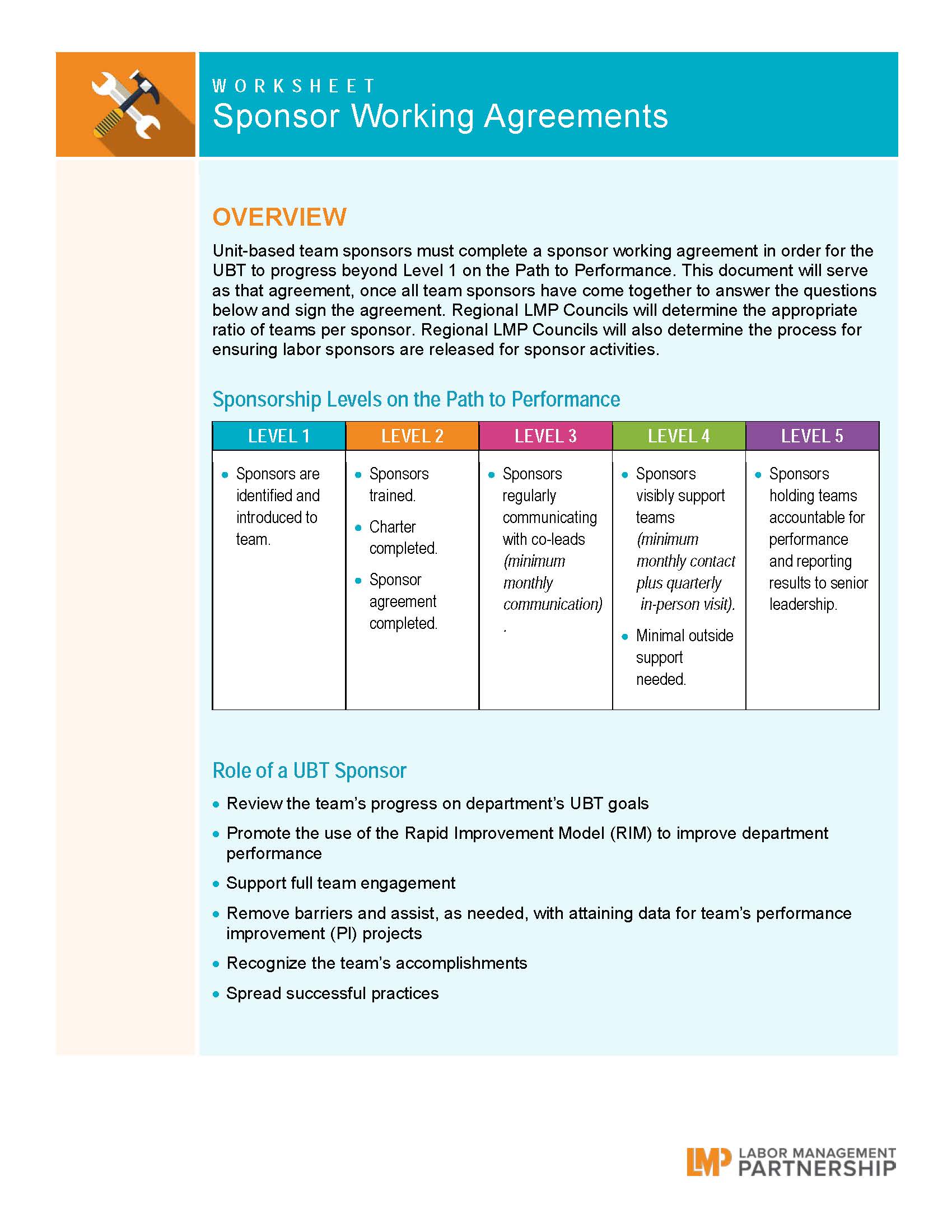
When you begin to work with a UBT, use these questions to help you and your co-sponsor(s) develop working agreements about how you will collaborate to support the team.
I am one of the chairs the LMP leadership team, along with a union colleague from UFCW and two management leaders. I’m also the co-lead of the Woodland Hills’ union coalition. In addition, I’m a full-time certified registered nurse anesthetist in the operating room. To be an effective labor co-lead takes three things: time, collaboration and planning.
I have been doing partnership work at Woodland Hills for 10 years. People respect the time I’ve invested. You have to be on fire for this because it’s an enormous responsibility. It’s going to cost you time, angst and effort. And you can’t build relationships passing in the hall. You have to make the investment of face time. That means showing up at the LMP council meetings, monthly, from 8:00 a.m. to noon.
It is important to bring in and plan for new blood. At Woodland Hills, we rotate the labor co-chair in our leadership team every two years. I believe this allows everyone to have a say. It builds trust and experience. And it ensures buy-in from each union—and each segment of each union. We build-in mentorship. For three months, the new person sits in and the current co-lead shows that person the ropes.
We also did this in the Kaiser Permanente Nurse Anesthetist Association when I was president in 2006. I would go with new facility reps to meetings.
We really foster union efforts at the medical center level. We’ve got a group of long-term union coalition people and our unions speak with a single, powerful voice. There have been issues between unions, and we had to work things out until cooler heads prevailed. People say ‘I’m sorry’ and move on.
Working with management is both easy and difficult. It’s easy because they are so partnership oriented and respectful of the unions, and they welcome input. They lead by influence—not by authority by virtue of where they are on the food chain—just like we do. It is difficult sometimes because it requires us to work hard as partners. Sometimes it would be easier to just go along with their recommendations, but then we wouldn’t really be doing our jobs as union leaders. At certain points, you have to say, ‘Well, let me think about that,’ and ask your constituents what they think.
Hospitals are traditionally very hierarchical. The partnership is such an opportunity to have a voice.
I have worked at Kaiser Permanente for 33 years, starting as a distribution worker in materials management. Being on the front lines helped me better understand the challenges staff face—and helped me, in my current role, see what it takes to spread and sustain change in a complex organization.
When we launched our first unit-based teams in 2007, I knew they could give our managers and teams a powerful tool for change. But to achieve their full potential, UBTs need the support of leaders at every level. In working with UBTs every day, I have found five practices that can help teams achieve their goals, and have helped me be a more effective leader.
I’m not a patient person by nature, and it took a visit to the world-class health care system in Jonkoping, Sweden, for me to see that it takes patience to sustain meaningful change. When you’re solving problems in a team-based workplace, real systemic change takes time. But it also takes hold deeper into the organization.
Spend time with a UBT, or hear teams present their test of change, to understand what they’re working on and how you can support them. There’s no way you can feel the excitement and energy from the team members and not feel proud and motivated by their work.
In Orange County—which has two large hospitals, in Irvine and Anaheim—we expect all teams to continually test and then spread their ideas and successful practices. We call it “One OC” and we talk about it all the time. You’re never going to achieve greatness globally if you don’t spread good work locally.
Early on we formed an Integrated Leaders group of senior labor and management leaders who meet monthly to monitor and assist our 107 UBTs. If a team is struggling, the IL group doesn’t descend on them and try to fix the problem. We provide tools and resources that help the team work through a problem and get results. For instance, we put together a UBT Start-up Toolkit with information on everything from setting up teams to finding training. We’re also looking at toolkits on fishbone diagramming, conducting small tests of change and providing rewards and recognition. And we’re asking how to make it easier for teams to access resources quickly—for instance by identifying go-to people for questions on budgeting, patient satisfaction metrics and so on.
I have a saying: “Hire great people, give them the coaching and mentoring they need, then get the heck out of their way and let them do what they were hired to do.” I think that works at all levels of the organization, whether or not people are your direct hires. You don’t tell people to make a change or streamline a process without any encouragement or support, but you don’t need to micromanage them either. Delivering great health care is not just a job. It is a calling. Whether you’re a housekeeper preventing infection or a surgeon treating cancer, people’s lives are in our hands. That shared mission drives us to be the best.

Formats:
Word document, PDF
Size:
8.5" x 11"
Intended audience:
UBT co-leads
Best used:
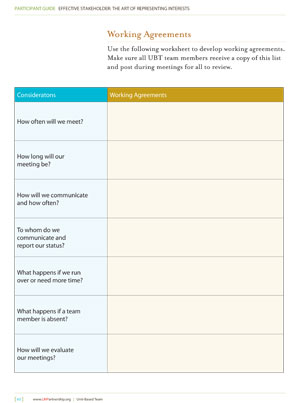
This worksheet can help you and your co-leads craft successful working agreements to plan, run and evaluate meetings.
Format:
GIF, one-color (black)
Best used:
This small file format uses the minimum amount of information possible. Use it for web and multimedia such as PowerPoint presentations. The .gif format provides the option of saving with transparent background. You can also use it for simple animations on the web.
Format:
PDF
Size:
8.5" x 11"
Intended audience:
Co-leads
Best used:
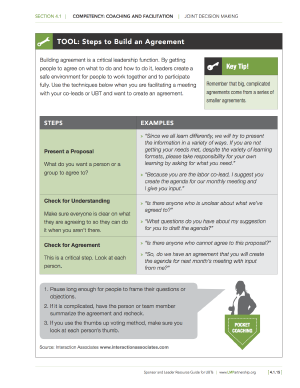
Building agreement is a critical leadership function. This table suggests techniques you can use when you are facilitating a meeting with your co-leads or UBT and want to create an agreement.
How we bargain our National Agreements is as important as what we bargain. We use an interest-based problem-solving approach. This is a collaborative approach to solving problems that strives to meet the most critical needs of all parties. It also aims to preserve — and improve — workplace relationships and partnership. It’s not about “giving in,” but rather is a process to negotiate differences amicably and reach results that will be lasting and durable.
Traditional, adversarial bargaining usually begins with each side staking out its position. In contrast, interest-based bargaining begins with all parties discussing what their needs are. Both parties work on an issue together, explore options and find a solution that meets the key interests. That sense of shared ownership smoothes the way for successfully implementing the agreement. This approach also opens the door to collaborative problem solving — as opposed to competition or compromise — and leads to creative, mutually beneficial solutions.
Interest-based bargaining works best when both sides share information, focus on key issues, listen actively, are open to different options and trust one another. We’ve found that this approach addresses the needs of union members and helps the organization improve performance — which ultimately benefits our health plan members and the communities we serve.
This agreement, reached in 1999, provides retraining and redeploying for workers displaced by emerging technology or workforce changes.
Download a 6-page PDF of this agreement.
Summary of the 1999 Employment Security Agreement
In 1998, Kaiser Permanente and the Labor partners acknowledged their mutual obligation and intention to maximize employment and income security for Kaiser Permanente employees by avoiding displacement of Kaiser Permanente employees. Employment security and workforce engagement are crucial to a common Partnership goal of market leading performance.
Accomplishing employment and income security requires increased union flexibility through locating alternatives for displaced employees and adjusting contracts to maximize opportunities during transition times. The parties must also focus on managing "people" resources through proactive problem solving and allowing necessary time to process solutions.
The parties will develop a workforce planning strategy and implementation plan, managed by the Senior Partnership Committee.
If a displaced employee cannot secure a position in the same classification previously held, he/she will be placed into a position in the most comparable classification possible, maintaining current rate of pay, for a transition period.
To instill a culture of workforce engagement and joint problem solving, all parties will engage in defining and resolving issues: management will be inclusive in the solution finding process, and unions/employees will help find solutions.
Each Region will develop and utilize a Partnership appeal mechanism and adhere to an impasse resolution mechanism to review difficulties achieving employment security goals or failure to adhere to mutual agreements.
Clarification of Employment Security Principles and Application October 20, 1999
Labor Management Partnership Equation Performance = Security + Governance + Rewards
Partnership Agreement Goal:
"Provide Kaiser Permanente employees with the maximum possible employment and income security within Kaiser Permanente and/or the health care field."
Partnership Agreement Language
"The parties acknowledge a mutual obligation and intention to maximize employment security for Kaiser Permanente employees. As such, it is the intent of the parties of the Partnership to avoid the displacement of any Kaiser Permanente employee. We recognize that there could be circumstances when such a commitment cannot be achieved. In such cases, the Partnership will make use of attrition, growth of the business, aggressive job matching, short-term training efforts and other mechanisms agreed upon by the Partnership participants. There will be no loss of employment to any employee because of participation in a Partnership program at the worksite."
The National Labor-Management Partnership Agreement unites Kaiser Permanente and signatory labor organizations in a common goal to make Kaiser Permanente the pre-eminent deliverer of health care in the United States. We are jointly committed to demonstrating that labor-management collaboration produces superior health care outcomes, market leading competitive performance and a superior workplace for Kaiser Permanente employees.
Employment Security is a goal of the Partnership and one of the cornerstones of workforce engagement and, as such, is an integral part of the Partnership commitment to market leading performance. It represents an expression of the vision of Kaiser Permanente and the Unions to provide a new level of commitment to employment and income security for Kaiser Permanente employees covered by the Partnership, with a goal of doing everything reasonably possible to avoid the permanent displacement of personnel.
It is our belief that workforce engagement is critical to the success of changing the way we do work, resulting in better quality, greater efficiencies and increased growth. It is unrealistic, however, to expect employees to participate in process improvements if as a result they redesign themselves out of a job or if the result is their co-workers lose their jobs.
Our commitment is to re-deploy, not lay-off, employees who are displaced. Accomplishing our Employment Security goal will require new behaviors and approaches from both Kaiser Permanente and the Unions, including:
Turnover will provide opportunities to allow displaced persons to return to their former classification. However, the parties recognize that an employee's ability to return to his/her former classification may not always be possible due to rapid changes in technology and the health care environment.
The following is what it will minimally require to achieve the employment and income security in all situations other than those defined as extraordinary circumstances, and is intended to assist the parties in implementing the Employment and Income Security provision. The parties are encouraged to use creativity in adapting these principles to respond to local situations.
The Partnership Agreement recognizes that extraordinary circumstances, as deemed by Program level Health Plan/Hospitals leadership and Permanente Medical Group leadership, could present situations which would require the parties to come together for a high level joint review to examine what is appropriate for that situation. Examples of extraordinary circumstances are those which impact a significant number of employees and could include closure or divestiture of KP operations, severe KP membership or financial losses, technological changes which impact job classifications, legislative or regulatory changes which broadly affect operations, etc.
Collectively, the parties will develop and oversee a comprehensive workforce planning strategy and implementation plan. Oversight responsibility for the plan elements and results relating to Employment Security will reside with the Senior Partnership Committee (SPC). Regions, together with their union partners and with Human Resources and Labor Relations, will have accountability in their areas of responsibility for developing and implementing plans which are integrated with the overall strategic business plans and consistent with Employment Security goals.
Workforce planning includes:
The workforce planning strategy is expected to define roles and responsibilities, including both tasks and needed changes in awareness levels. Everyone, both management and union, must view potential vacancies as redeployment opportunities and be held accountable for achieving employment and income security goals.
Employment security for re-deployment purposes is defined as:
In situations where a comparable classification is not available, work as nearly comparable as possible will be provided, with the intent of re-assigning the employee to his/her former classification when and if such work becomes available.
In some situations, it may not be possible to provide comparability in all dimensions outlined above. Managers and unions within regions are advised to develop a process to handle such situations. An effective process will include a methodology for allowing employees to prioritize the dimensions that are most critical to them and for insuring that seniority of displaced employees is used in determining choice of available positions.
A displaced employee who cannot secure a position in the same classification previously held will be placed into an available position in the most comparable classification for which he/she qualifies. The employee's current rate of pay will be maintained during a transition period of one year or longer, if mutually agreed to. (Individuals placed in a higher classification will be paid the higher wage rate.) The purpose of transition status is to maintain employment and income for an affected employee for a temporary period of time with the intent of returning to the previous classification when an appropriate vacancy becomes available. While in transition status, an employee will maintain the benefits status he/she held prior to transition.
During transition status, the Employer and the employee have a mutual accountability to monitor vacancies for potential placement back into the previously held position. Whenever possible, employees on transition status should have preference for such vacancies. Employees are expected to accept opportunities for a comparable position, or the privileges of the transition status will be forfeited. In the event there is a strong likelihood that the previous classification will no longer be available, the employee is expected to actively seek education and training to qualify for a different position. It is the intent of the parties to provide reasonable education and training opportunities for employees to pursue.
To effectively place employees out of the "transition status", a workforce planning strategy must be employed to plan for and capture potential vacancies. A joint process to review the situations of employees on transition status is recommended. The employer, the union and the employee have a mutual and continuing accountability to actively utilize the transition period to achieve return to the previous classification or to explore other avenues which help meet employment security goals.
At the end of one year, employees who have not returned to their prior classification will be paid in accordance with the wage scale of the position they occupy. Management and the unions in each Region are also encouraged to consider other options which may be mutually agreeable and which provide a reasonable transition. Examples include "red circle" formulas, "grandfathering", or other solutions. However, to assure appropriate consistency and fairness, the parties are encouraged to select a single option to apply to the current situation, or at a minimum, to clarify up front which option will apply in given circumstances. Existing contract language may also provide or define appropriate solutions.
The Partnership Agreement outlines the intent of Kaiser Permanente and the signatory unions to instill a culture of workforce engagement and joint problem solving. This means that when a problem or issue is identified, whether by management, unions or the workforce, all parties will engage in defining the problem and its resolution. This engagement means that management will need to be more inclusive in the solution finding process and the unions and employees will need to be more responsive in helping find the solutions. These employment security principles are intended to insure that the parties freely and creatively enter into problem solving.
It is hoped that these principles will assist the parties in exploring all reasonable efforts for redeployment and transition for employees impacted by changes. It is expected that each Region will develop and utilize a Partnership appeal mechanism to review any situations in which achieving employment security goals is particularly challenging or in which either party feels there is a failure to adhere to the mutual commitments regarding employment security. The following are suggested for inclusion in such a review:
An impasse resolution mechanism will be defined by the parties in advance to address situations where the parties cannot reach agreement on the above. Suggestions include the use of a third-party neutral or a small panel that is empowered to reach a decision. The panel could be composed of local representatives, representatives from the SPC or Office of Labor-Management Partnership (OLMP) or any other qualified representatives acceptable to both parties.