Hawaii

Help Video

How to Find UBT Basics on the LMP Website

Learn how to use the LMP website:

LMP Website Overview

Learn how to use the LMP website:

How to Find How-To Guides

This short animated video explains how to find and use our powerful how-to guides

Learn how to use the LMP website:

How to Find and Use Team-Tested Practices

Does your team want to improve service? Or clinical quality? If you don't know where to start, check out the team-tested practices on the LMP website. This short video shows you how. 

Learn how to use the LMP website:

How to Use the Search Function on the LMP Website

Having trouble using the search function? Check out this short video to help you search like a pro!

Learn how to use the LMP website:

How to Find the Tools on the LMP Website

Need to find a checklist, template or puzzle? Don't know where to start? Check out this short video to find the tools you need on the LMP website with just a few clicks. 

Learn how to use the LMP website:

Questionnaire Shaves Wait Times for Gastrointestinal Patients

  • Creating a questionnaire and training staff on the new process
  • Partnering with the business office supervisor and asking the receptionists to hand the form to all GI procedure patients at check-in
  • Decreasing/minimizing the RN time to review the entire document in detail and focus on patients' specific questions
  • Giving patients a choice between RN discharge or MD discharge

What can your team do to improve efficiencies in your department? What else could your team do to help shorten patients' wait times?


Around the Regions (Winter 2016)

Deck: 
Newsy bits from the landscape of Kaiser Permanente

Story body part 1: 

Colorado

The Colorado region is improving patient care and saving millions by providing high-risk patients extra attention after discharge, leading to a reduction in readmission rates. In the Post Acute Care Transitions (PACT) program, nurse practitioners visit patients in their homes after discharge from a hospital or skilled nursing facility, giving them a chance to alter the patient’s care plan if needed. The PACT team has visited approximately 4,200 high-risk patients since the program began in January 2013. At that time, 22 percent of high-risk patients were readmitted within 30 days, at a cost of $11.7 million. The PACT team has reduced readmission rates by 50 percent, saving Kaiser Permanente approximately $6 million since the program began.

Georgia

To make sure no good deed goes uncopied, the Georgia region launched a Spread and Sustain system to move best practices throughout the region—and showed off the results to KP’s board of directors at a UBT fair early last summer. Georgia took a spread blueprint from the Southern California region and fine-tuned it to meet its needs. Now its unit-based teams, sponsors and regional leaders identify projects with good spread potential, determine other locations where the new process could work, share the practice and check back to see how they’re being sustained. Several projects have been successfully spread region-wide—addressing such issues as hypertension, HPV vaccinations and lab specimen collection.

Hawaii

Hawaii is a beautiful place to live, but Kaiser Permanente members who live on the less-populated islands sometimes find it challenging to get the care they need. To address that, KP offers a special benefit called Travel Concierge Service. If health plan members need medical care that isn’t available on their island, KP assists them in traveling to the Moanalua Medical Center in Oahu or to a specialty care medical office. KP makes the travel arrangements and picks up the tab for travel, including airfare, shuttle service and discounted hotel rates. For minors who need specialty care, KP also pays for companion travel. “Our members love this service,” says Lori Nanone, a sales and account manager in the region.

Mid-Atlantic States

For several years, co-leads in the Mid-Atlantic States have compiled monthly reports of their UBT activities, goals and progress using Microsoft Word and Excel. Now, the region is rolling out a dashboard that automatically compiles the same information from UBT Tracker into an easy-to-reference SharePoint site, Kaiser Permanente’s new online social collaboration tool. The new dashboard will encourage more frequent updates to UBT Tracker and eliminate the need for co-leads to create separate documents, says Jennifer Walker, lead UBT consultant and improvement advisor. “Now the information we get is more timely and easier to assess,” Walker says. “Before, the information was up to a month old.”

Northern California

The Santa Rosa Medical Center Diversity Design committee is equipping employees with tools to help them provide better service to Spanish-speaking patients. The group, composed of labor and management, has been piloting a handout featuring a list of common Spanish phrases, such as ¿Necesita un intérprete? (“Do you need an interpreter?”), as well as instructions on using the phone interpreter system. The idea came from a Spanish-speaking patient on the facility’s Latino patient advisory committee, who recalled the time she was lost in the facility and no one could direct her in Spanish. The Spanish language flier is the latest in the committee’s work to help ensure all patients receive the same optimal service and care.

Northwest

Unit-based teams in the Continuing Care Services department are focusing on improving the experience for some of Kaiser Permanente’s most vulnerable members: those in skilled nursing facilities or receiving home health, hospice or palliative care. Teams are focusing on ensuring better transitions for patients as they go from inpatient to ambulatory care. By identifying issues before they become problems, labor and management hope to coordinate care more effectively, reduce emergency department visits and cut down on outside medical costs.

Southern California

Harmony comes easily when you use the tools of partnership. Just ask the Biohazards, a band of union members and a manager that uses partnership principles to guide performances. “We call ourselves an LMP project,” says Mary Anne Umekubo, a clinical laboratory scientist and Regional Laboratory assistant director who sings and plays percussion and guitar. She is among six band members who represent a variety of departments, shifts and unions, including SEIU-UHW and UFCW Local 770. Performing for friends and colleagues, band members use consensus decision making to choose songs, interest-based problem solving to fix mistakes and the Rapid Improvement Model to tweak performances. “We’re from different departments,” says drummer Eric Cuarez, a regional courier driver and SEIU-UHW member. “We come together to play music.”

Around the Regions (Fall 2015)

Deck: 
Tidbits from KP regions, coast to coast

Story body part 1: 

Colorado

Unit-based teams are hitting their stride, with 190 out of 261 teams reaching a Level 4 or 5 on the five-point Path to Performance. Teams are engaged in several types of projects, including those that save the organization money. The region will see a financial savings of $1.85 million this year through the 175 affordability projects of UBTs. The five UBT consultants in the region are coaching teams impacted by regional restructuring and helping those teams rebound quickly. Teams also are focusing on workplace safety, patient safety and HEDIS measures (Healthcare Effectiveness Data and Information Set).

Georgia

Starting in May and running through December 2015, Georgia medical centers are conducting an experiment. This region-wide test involves using greeters to usher in members. During the trial period, 15 greeters will make the member feel welcomed and convey the message they are important to Kaiser Permanente. Greeters also will answer questions, escort members to their appointments, maintain waiting rooms, ensure wheelchairs are available and welcome members with a smile. “They will provide a concierge-type member experience,” says Elizabeth Ramsey, the Georgia region’s senior manager of loyalty and retention.

Hawaii

The Hawaii region recently re-set its 57 unit-based teams’ scores on the Path to Performance to Level 1. Three consultants—two also are registered nurses and one is a project manager—will help teams quickly advance as they meet such core requirements as sponsor training. The region is unique in that, for now, one union (Hawaii Nurses Association/OPEIU Local 50) is in the Coalition of Kaiser Permanente Unions, while other unions are not. Although that can be challenging, consultants say teams still focus on the patient and want to do improvement work. “We help each other work through obstacles with our teams and understand the data,” says Lisa Kane, UBT consultant and project manager.

Mid-Atlantic States

In February, when home health orders came in to Health Information Management Services Northern Virginia, the average turnaround time was 4.4 days. By creating red folders for the orders, adding a cover sheet that says “stat” and date stamping the order as soon as it arrives, the team cut turnaround time to three days by April 2015—even as the number of orders went up from 673 in February to 747 in April. “This was important to the workflow, because when home health agencies called to follow up on the orders it interrupted our work,” says LaShawnda Powell, a senior health information management assistant in Woodbridge, Virginia, and member of OPEIU Local 2. “We have determined that our new process is successful and we’ve adopted it.” 

Northern California

Last year, unit-based team consultants and union partnership representatives formed a regional UBT to work on issues related to consistency and accountability for Northern California’s 1,300 frontline teams. Now the group has established three subgroups to review the 2015 National Agreement, which includes new provisions for UBTs. Each subgroup has a distinct focus area: sponsorship, UBT validation and assessment, and tools to support contract expectations. The subgroups will develop recommendations for review by a committee of labor members and management representatives. The regional co-leads will submit final recommendations to the regional LMP Leadership Council by year’s end.

Northwest

UBT Resource Team members have been busy refining the region’s new process for assessing teams on the Path to Performance. Co-leads and sponsors of 415 unit-based teams in the Northwest work with their consultant to ensure each team advances or sustains high performance throughout the year. Improvement Advisors help co-leads create action plans and provide direct training to move teams along or refer them to the appropriate subject matter experts. A majority of teams at Levels 2 and 3 will advance to high performance within the next 90 days due in large part to the work of the UBT Resource Team.

Southern California

Playing games at work usually is considered taboo. But that’s exactly how a group of regional UBT staff members spent a recent afternoon when they learned to play the “Leading Innovation Game.” Created by Kaiser Permanente’s Innovation and Advanced Technology team, the board game is designed to help employees overcome challenges that can doom the best ideas. Starting this fall, regional UBT staff will train team co-leads and sponsors, who will share the game with unit-based teams at their facilities. “Most teams come up with great ideas but they aren’t always aware of potential pitfalls,” says Rosalyn Evans, UBT practice leader for Southern California. “This board game gives them hands-on experience to develop innovation in a risk-free environment.”

Walking With Every Patient Prevents Falls

Deck: 
Nurses at Moanalua Medical Center adopt a successful practice to keep patients safe

Story body part 1: 

“The idea came from our manager, when one of our young, alert patients fell and got an injury. We were all upset,” says Jenalyn Andres, RN, one of the union co-leads for her department’s UBT.

That incident spurred nurses on the 4 East-Malama West unit-based team at Moanalua Medical Center in Hawaii to set a goal to cut the number of falls in half within 12 months—from 18 in 2013 to nine or fewer by the end of 2014. The team exceeded its goal and had only six patient falls in 2014.

Steps to success

Team members adopted the No One Walks Alone falls prevention program, pioneered at the San Diego Medical Center, to help them reach their goal. The team set up a standard process to ensure success. Some of the elements of the plan included:

  • checking that all bed alarms are on at the start of shift and during the shift
  • having alarm pads for chairs readily available in rooms, ready for patients who get out of bed and into a chair
  • placing nonskid socks on patients’ feet
  • positioning call lights within reach
  • using walkers to help patients become mobile

Andres, a member of Hawaii Nurses Association, OPEIU Local 50, says the team educated patients and families by sharing literature with them that included tips on preventing falls and information about the No One Walks Alone protocol. The protocol starts with the assumption that all patients are fall risks, instead of nurses trying to identify which patients are at risk. Patients are accompanied every time they get up, especially to and from the bathroom, which is when most falls occur.

Troubleshooting “hot spots”

As part of the team’s process improvement, it identified “hot spots”—things that could happen that could prevent success. For example, the team quickly discovered that it had different types of patient beds on the unit, with different bed alarms. Some of those alarms weren’t wired into the nurse call system, so staff members had to follow the sound of the alarm to figure out which patient needed assistance—which meant it took longer to get to the patient.

The UBT worked to get the issue fixed, and as a result, “a project was opened with facility maintenance and beds have been switched to a universal cord, which resolves the problem,” says Manlee Velasco, the unit’s manager and management co-lead. “In the few cases where the cord wasn’t compatible, new beds have been ordered.”

The team has had five falls so far this year, which came before the cord issue was resolved. 

Spreading a successful practice

The overall success of the prototcol has been noticed by other teams and “all of the inpatient units at the Moanalua Medical Center are now using the program," says Kim Lu, RN, the 4-East unit’s other UBT union co-lead and also a Hawaii Nurses Association member. 

The practice is a great example of spread for another reason: The “No One Walks Alone” slogan and program was created by a San Diego Medical Center UBT in Southern California that was involved in a Joint Commission pilot in 2012.

TOOLS

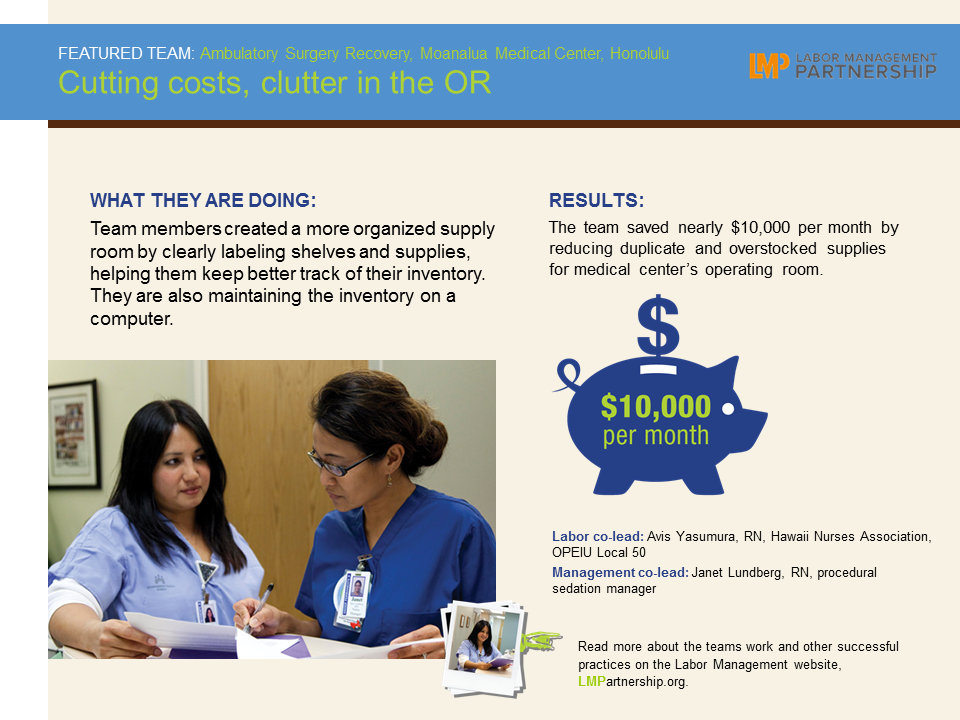
Poster: Inpatient Pediatrics Team Reduces Linen Costs

Format:
PDF (color and black and white)

Size:
8.5” x 11”

Intended audience:
Frontline employees, managers and physicians

Best used:
Hang this poster highlighting a UBT that reduced linen costs while maintaining a proper supply on bulletin boards, in break rooms and other staff areas. Share with teams to spark ideas about how they can save.


Related tools:

TOOLS

PPT: Hawaii Team Cuts Wait Times in Half

Format:
PPT

Size:
1 slide

Intended audience:
LMP staff, UBT consultants and improvement advisers

Best used:
This PowerPoint slide features a team at the Honolulu Clinic that reduced patient wait times by making one nurse responsible for giving injections each day. Use in presentations to show some of the methods used and the measurable results being achieved by unit-based teams across Kaiser Permanente.

Related tools:

TOOLS

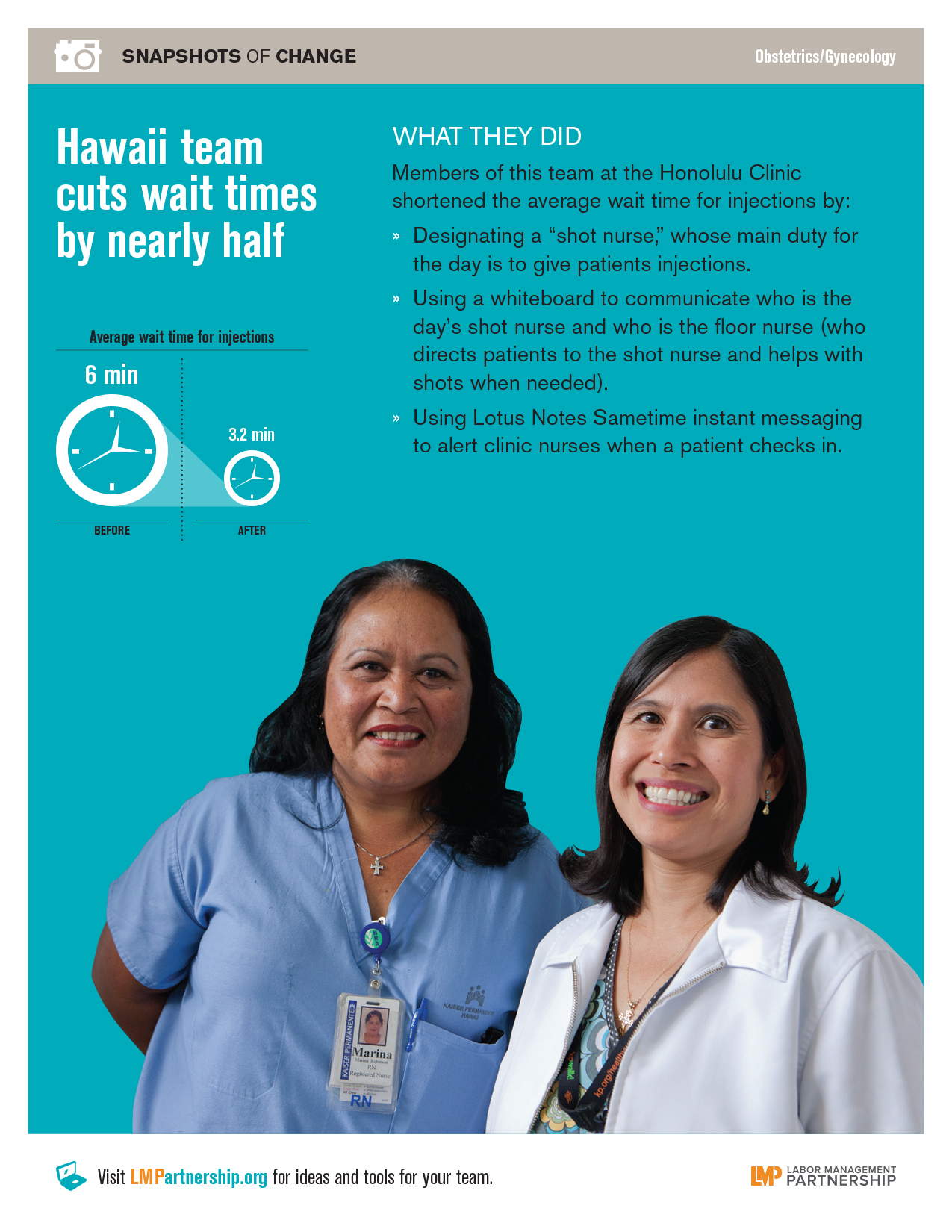
Poster: Hawaii Team Cuts Wait Times in Half

Format:
PDF (color and black and white)

Size:
8.5" x 11"

Intended audience:
Frontline employees, managers and physicians

Best used:
Post on bulletin boards in break rooms and other staff areas—how can your UBT emulate this OB/Gyn team and reduce patient wait times?


Related tools:

Videos

Huddle Power

Loading the player...

(4:45)

Successful unit-based teams, those that continuously improve performance and lead change, use huddles to share information and stay on top of team business. This video highlights two KP teams that regularly huddle to tackle day-to-day issues, advance performance improvement projects and give "snaps" to colleagues who go the extra mile. See how huddles and snapping have helped these teams improve communication, morale and best of all—patient care.


TOOLS

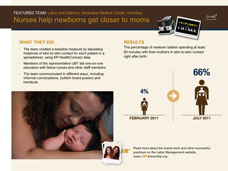
Powerpoint: Nurses Help Newborns Get Closer to Moms

Format:
PPT

Size:
1 slide

Intended audience:
LMP staff, UBT consultants, performance improvement advisers

Best used:
This Powerpoint slide highlights a team that increased the percentage of newborns spending at least 60 minutes with their mothers in skin-to-skin contact right after birth. Use in presentations to show some of the methods used and the measurable results being achieved by unit-based teams across Kaiser Permanente.

Related tools:

Pages

Subscribe to RSS - Hawaii