Quality

Help Video

How to Find UBT Basics on the LMP Website

Learn how to use the LMP website:

LMP Website Overview

Learn how to use the LMP website:

How to Find How-To Guides

This short animated video explains how to find and use our powerful how-to guides

Learn how to use the LMP website:

How to Find and Use Team-Tested Practices

Does your team want to improve service? Or clinical quality? If you don't know where to start, check out the team-tested practices on the LMP website. This short video shows you how. 

Learn how to use the LMP website:

How to Use the Search Function on the LMP Website

Having trouble using the search function? Check out this short video to help you search like a pro!

Learn how to use the LMP website:

How to Find the Tools on the LMP Website

Need to find a checklist, template or puzzle? Don't know where to start? Check out this short video to find the tools you need on the LMP website with just a few clicks. 

Learn how to use the LMP website:

When Something Goes Wrong

Story body part 1: 

An open, supportive environment is one aspect of a workplace where workers can point out problems when they see them.

But to ensure the support doesn’t evaporate in the stress of a busy day, there needs to be more than the expectation that people will do the right thing. There needs to be a solid system in place that formalizes the commitment to speak up.

A Radiation Oncology team in Northern California knows this firsthand. From the time the South San Francisco Cancer Treatment Center opened in May 2009, its leaders worked to establish a culture that encouraged staff members to speak up when they saw something wrong and to provide input on process improvements. The center didn’t have a clear-cut mechanism for doing this, however; it was fostered through leaders’ encouragement and role modeling.

Then in 2010, a mistake was made—relatively small, but a HIPAA violation: A patient was accidentally given a printout with the personal information of another patient. The member returned the paper to the receptionist, and no lasting harm was done. But it highlighted the fact that staff members needed a way to record process failures, empowering them to address issues large and small, says Marcy A. Kaufman, the center’s Radiation Oncology administrator.

A protocol that calls for submitting a Responsible Report form was already in place for those times when an error reaches the patient. “But we wanted to create something where everyone can give input at all parts of the process,” Kaufman says.

Stop the Line

So the unit-based team created what its members call Stop the Line. If a radiation therapist or anyone else in the department encounters anything that deviates from the workflow or compromises care, he or she first acts to ensure patient safety, if such action is needed—and then fills out the Stop the Line form to document the incident. The focus is not on individual error but on what can be done to improve the system to prevent similar mistakes in the future.

“It’s a chance to look at the system to see if it is doing its job—are the checks and balances working? Or do we need to bring to the UBT and come up with a different workflow?” Kaufman says.

At monthly staff meetings, the team pulls out a binder with the Stop the Line reports and discusses the incidents and any follow-up actions taken. That discussion is important not only as a way to close the loop but also because it demonstrates to staff members that their voices were heard. The forms don’t drop into a black hole never to be heard of again.

“You have to constantly be talking about this to keep the momentum going,” Kaufman says.

The process applies to all staff, including physicians.

“In the field of medicine where, in general, it is quite hierarchical, it’s even more imperative we have a system like this to encourage every member of the department to speak up, regardless of title, to make sure we’re giving the best patient care,” says Amy Gillis, MD, the center’s chief of Radiation Oncology.

Dr. Gillis recalled the wrong-patient information episode. The initial assumption was that one of the medical assistants, who normally handle such paperwork, had made the mistake. This time, however, the culprit was a physician.

Staff members hesitated, Dr. Gillis says, wondering, “ ‘Should I really write up a physician?’ ” As she notes, however, “We all need to have a greater awareness.”

“It really does take everyone’s buy-in to make it happen and be successful,” she says. In this case, what it took to convince staff was input from the physicians themselves, with the doctors saying, “Yes, please write that up.”

Successful practice spreads

Stop the Line has been so popular that the cancer center’s four sister centers in Northern California have adopted the practice.

South San Francisco Radiology also adopted the Stop the Line form and process, adapting it to meet its specific needs. The department does hundreds of thousands of scans a year, from mammograms to basic X-rays to CT scans. With such high volume, radiologic technologists often feel pressure to keep patients moving through in a steady flow.

“We needed to give technicians permission to do the right thing,” says radiologic technologist Donna Hayes, the department’s UBT union co-lead and an SEIU UHW member. “We wanted them to know it’s OK to stop the process for this. I think it helped that it also came from management.”

As at the cancer center, the process is not used in a punitive way. Instead, it’s used as a way to highlight and address glitches in the workflow—not only within the department, but also in other departments.

“We’ve been able to take the data back to the orthopedics chief or take ED-related issues back to ED,” says Ann Allen, the Radiology director. “We funnel back to those departments that are partners so they can help us make changes.”
Admissions: Let Patients Know Your Role

Deck: 
Being helpful is a start, and a gift doesn't hurt

During the normal stress of being admitted to the hospital, it's not always clear to patients and their families who does what.

And if a nurse or clerk can’t answer a question on admissions, the patient can get frustrated.

So it was in the admitting department at Fremont Medical Center in Northern California, where patients gave low satisfaction scores regarding the process.

“Many different staff use the word ‘admitting,’ so we needed to make sure we stood out, and that patients knew when their admission officially began and ended,” says labor co-lead and admitting representative Joanna Nelson.

Team members thought one of their biggest challenges was making sure patients knew when they were dealing with admitting staff versus other employees.

They first tried using scripted language, the “Right Words at Right Time” (RWRT) approach to let patients know when the actual admission process had started and the representative’s role.

When that failed, the UBT added another level of patient service and rounding, which included a small gift and card.

The gifts were mostly Kaiser Permanente brand items including cups, tablets, aprons, vases or plants. Admitting representatives also gave personal cards to each patient.

“We came up with an extra-special plan for our new admissions. Once the patient was admitted, the Admitting rep went back up to the room—either later that same day or the next day—and gave our patients a welcome gift,” shop steward and OPEIU Local 29 member Nelson says, describing the gesture as a “thank you for choosing our hospital.”

And it worked.

In four quarters, polite and professional customer service scores improved 21 points, and efficient and easy customer service scores picked up three points.

The team also helped by letting patients know how all the pieces fit together.

“Personalize your admitting process,” says Fonda Faye Carlisle, manager, Admitting and Patient Financial Services. “Since the admitting department is not the only voice that says, ‘I will be admitting you,’ admitting needs to personalize so the patient can differentiate between them and others, such as nursing.”

There were team benefits, as well, beyond the scores. Department morale and attendance also increased.

“Our satisfaction is seeing our patients happy and watching our scores improve,” Nelson says.

TOOLS

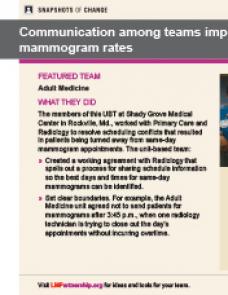
PPT: Communication Improves Mammogram Rates

Format:
PPT

Size:
1 Slide

Intended audience:
LMP employees, UBT consultants, improvement advisers

Best used: 
This PowerPoint slide features a Maryland team that improved mammogram rates through better communication. Use in presentations to show some of the methods used and the measurable results being achieved by unit-based teams across Kaiser Permanente. 

Related tools:

TOOLS

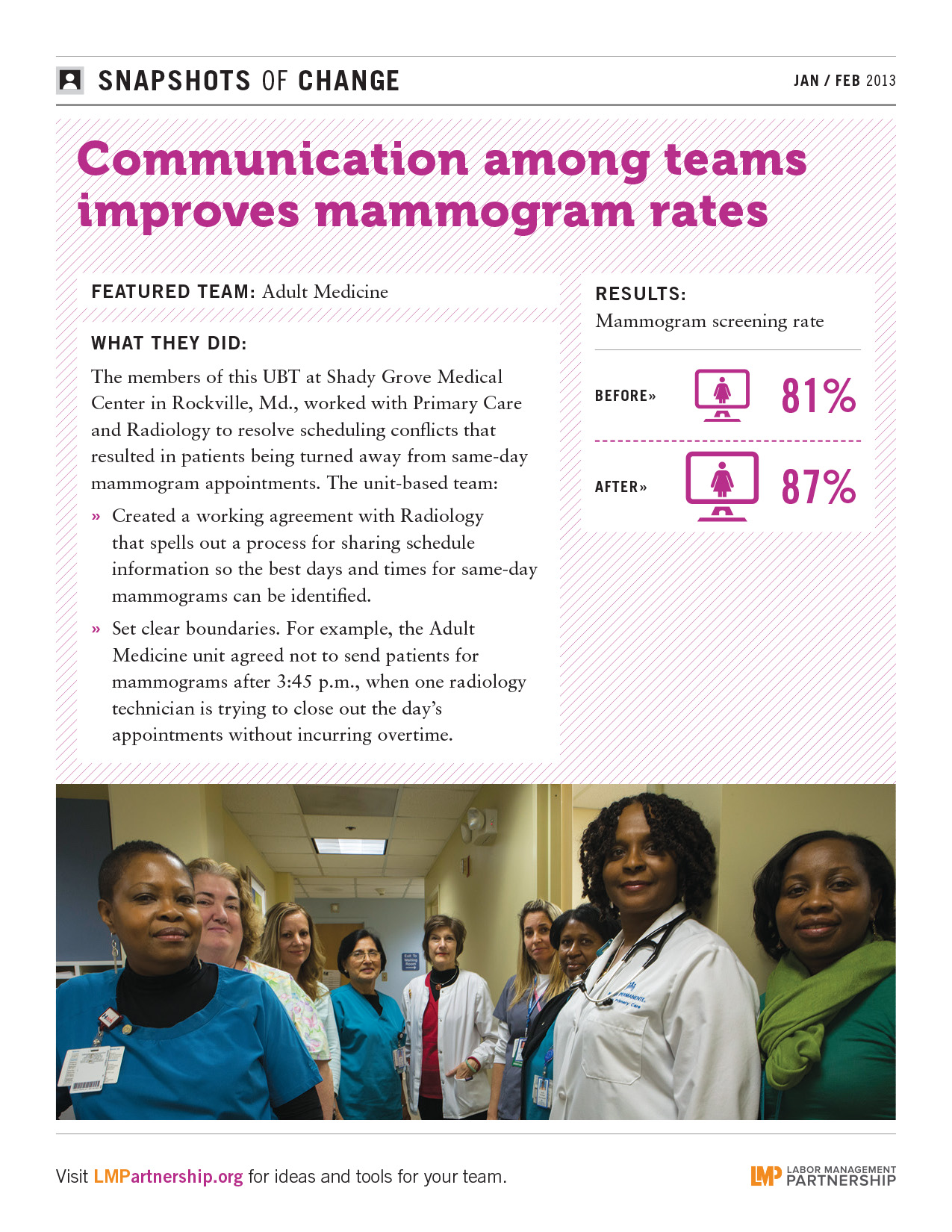
Poster: Improving Mammogram Rates

Format:
PDF

Size:
8.5” x 11”

Intended audience:
Frontline employees, managers and physicians

Best used:
Post on bulletin boards, in break rooms and other staff areas to share with your team how effective communication keeps the patient at the center of our work.


Related tools:

Reducing Duplicate Meds Is Good Patient Care

Deck: 
Team looks to avoid errors and costly hospital stays

An accurate list of a patient’s prescriptions is critical to maintaining continuity of care.

It also helps to decrease medication errors, and one of the Joint Commission’s national patient safety goals requires medication reconciliation at hospitals and clinics.

So, in order to protect patient safety, it's crucial caregivers compare the medications a patient is taking (and should be taking) with newly ordered medications.

The Infectious Disease/Oncology team at Cumberland Medical Office Building in Atlanta had a high percentage of patient records in KP HealthConnect that listed duplicate medications.

To improve medication reconciliation, the team did a manual cleanup of patient charts over a period of several weeks. Then it instituted a new process for checking medication. They had the licensed practical nurses (LPNs) and medical assistants (MAs) call patients and ask them to bring their bottles of medication to their office visit.

During the initial workup, the MAs and LPNs reviewed patient medications, and checked off in the members’ charts which medications the patients were and were not taking.

The providers then confirmed medications once again with the member and removed all possible duplicate oncology meds from the patient’s record.

In collaboration with the clinical pharmacist, the MAs printed out a snapshot of the patient’s medications and gave it to the nurse practitioner for review and removal of any expired medication.

As they found success, the team included more medications in the process.

For instance, the team members reviewed patient records for infusion medications and one-time-only meds a patient might need to take before a procedure. Infectious disease pharmacists also began removing duplicate medications for their overlapping oncology patients.

Team members reviewed statistics for duplicate medications from KP’s National Reporting Portal, analyzed the data at huddles and posted it in the department.

They also monitored whether providers increased the number of times they had to reorder medications (which would indicate they were too aggressive in deleting prescriptions). As it turned out, the reorder rate was unaffected by the project.

The percentage of duplicate medications fell to 15 percent, far exceeding the team’s goal. And by avoiding hospital admissions due to inadequate medication reconciliation, the team saved $90,000 in three months.

It also created better communication with patients.

“Knowledge is power,” says Gwendolyn Brown, the team’s management co-lead. “It helped patients and their families ask more questions.”

And a full team effort helped the project succeed, as they moved from Level 2 to 4 in Path to Performance.

“It is tiring and frustrating when you are the only person doing the work,” says Brown. “Here, everyone is involved.”

For more about this team's work to share with your team and spark performance improvement ideas, download a poster or powerpoint.


TOOLS

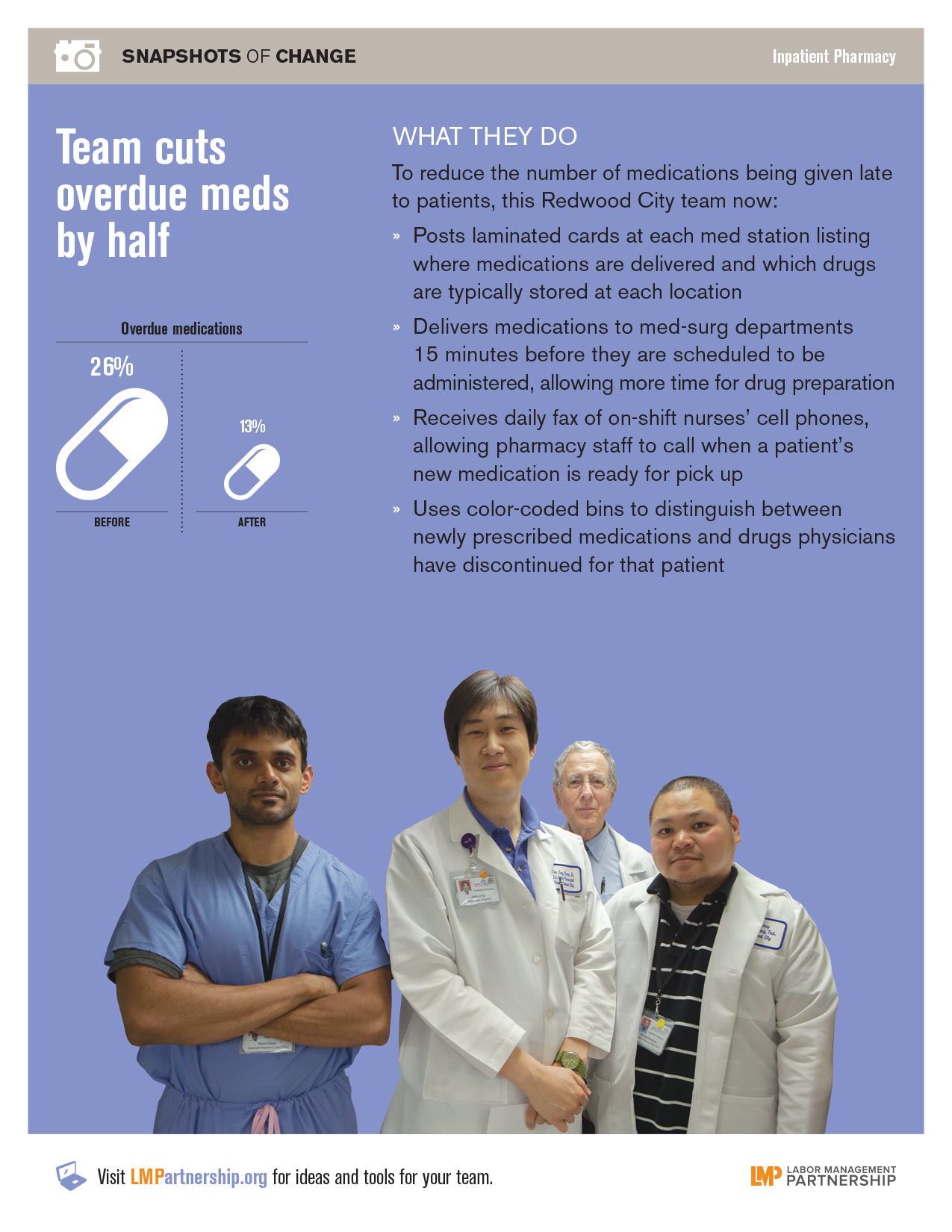
Poster: Team Cuts Overdue Meds by Half

Format:
PDF

Size:
8.5" x 11"

Intended audience:
Frontline employees, managers and physicians

Best used:
This poster features a Northern California team that found a way to get medications to patients in the hospital more quickly. Post on bulletin boards, in break rooms and other staff areas.

Related tools:

Beyond Retail: Optician Saves Member’s Sight

Story body part 1: 

When Webster Parker brought his prescription glasses back to the clinic in Redlands (Southern California), he thought he just needed to replace a lens that had fallen out. But when Parker reported his eye was watering excessively, optician Alicia Rendon spotted a red flag in Parker’s Kaiser Permanente HealthConnect™ record and, within the hour, set up an eye-saving appointment with an ophthalmologist.

“The prescription was fine,” says Rendon, a Teamsters Local 166 member whose unit-based team recently embraced a new workflow, including use of KP’s electronic health record system, to troubleshoot their redos—instances where patients return eyewear purchases. “Once I looked into HealthConnect, there was this big stop sign.”

Her review of the record suggested that Parker, 85, might need a common surgical procedure to lower the intraocular pressure in his right eye, a condition often associated with glaucoma. An old eye injury exacerbated the problem, and Parker’s ophthalmologist had set up a flag in the system to watch for changes to the eye.

“I had surgery that week,” says Parker, a retired pharmacist who once ran a drugstore with his pharmacist wife. “The eye feels better. It feels normal. They did a wonderful job.”

Looking at the whole system

Focusing on redos not only saves KP in terms of the cost of materials and labor but also helps improve service scores. By bringing in ophthalmologists and optometrists, who examine eyes to treat disease as well as prescribe the lenses that opticians dispense, the team could better identify redos linked to eye-health problems rather than product defects—as in Parker’s case.

But opticians, used to handling paper charts and focusing on frame styles, were reluctant to try one of the team’s first tests of change: using KP HealthConnect to rule out medical reasons for unsatisfactory eyeglasses.

“We got buy-in” to overcome the initial resistance, says management co-lead Darren Smith, site supervisor for optical dispensing and a former optician. “It takes just two or three to really commit and spread the practice. Now, it’s not just a retail store where you come and buy something. Here, we are talking about your health.”

Educating patients and staff

To protect patient privacy, opticians' access in HealthConnect was mostly limited to conditions related to eyeglasses' prescriptions rather than a broader range of eye issues. Now the optometrists and ophthalmologists help the optical UBT members spot problems and counsel patients on practices that will protect their eyesight and enhance their eye care.

“Not everyone is going to be able to see 20/20,” says Trissy Bastin, business line manager for Vision Essentials. She directs the service area’s five optical clinics and serves as sponsor for the UBT. “The patients have to be reminded of that. You have to be able to see what kind of eye conditions they have.”

Parker has been a KP member for just seven years. But three decades in the health care industry fostered his appreciation for the electronic patient record—and cooperation and coordination among caregivers.

“What makes Kaiser special is that any doctor can have your complete record at his fingertips,” Parker says. “They can track problems and make recommendations.”

TOOLS

PPT: Bolder Communication Helps Diagnose Malnutrition

Format:
PPT

Size:
1 Slide

Intended audience:
Frontline employees, managers and physicians; LMP staff, UBT consultants, and improvement advisers

Best used:
This poster features a Northern California team that improved communication and its ability to diagnose malnutrition. Use in presentations to show some of the methods used and the measurable results being achieved by unit-based teams across Kaiser Permanente. 

Related tools:

TOOLS

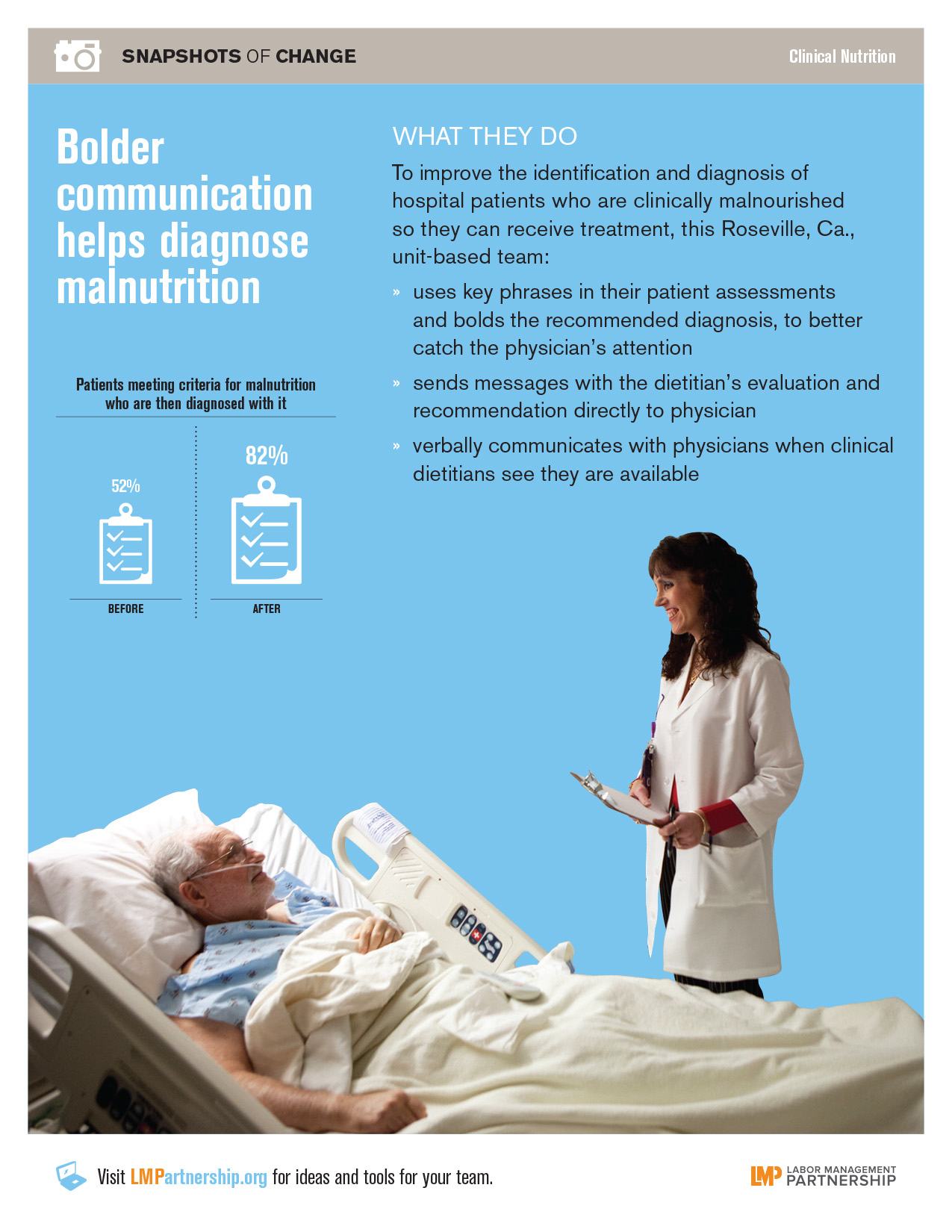
Poster: Bolder Communication Helps Diagnose Malnutrition

Format:
PDF

Size:
8.5" x 11"

Intended audience:
Frontline employees, managers and physicians

Best used:
Gain inspiration from this Northern California team that improved communication and its ability to diagnose malnutrition.

Related tools:

Pages

Subscribe to RSS - Quality