Frontline Physicians

Help Video

How to Find UBT Basics on the LMP Website

Learn how to use the LMP website:

LMP Website Overview

Learn how to use the LMP website:

How to Find How-To Guides

This short animated video explains how to find and use our powerful how-to guides

Learn how to use the LMP website:

How to Find and Use Team-Tested Practices

Does your team want to improve service? Or clinical quality? If you don't know where to start, check out the team-tested practices on the LMP website. This short video shows you how. 

Learn how to use the LMP website:

How to Use the Search Function on the LMP Website

Having trouble using the search function? Check out this short video to help you search like a pro!

Learn how to use the LMP website:

How to Find the Tools on the LMP Website

Need to find a checklist, template or puzzle? Don't know where to start? Check out this short video to find the tools you need on the LMP website with just a few clicks. 

Learn how to use the LMP website:

TOOLS

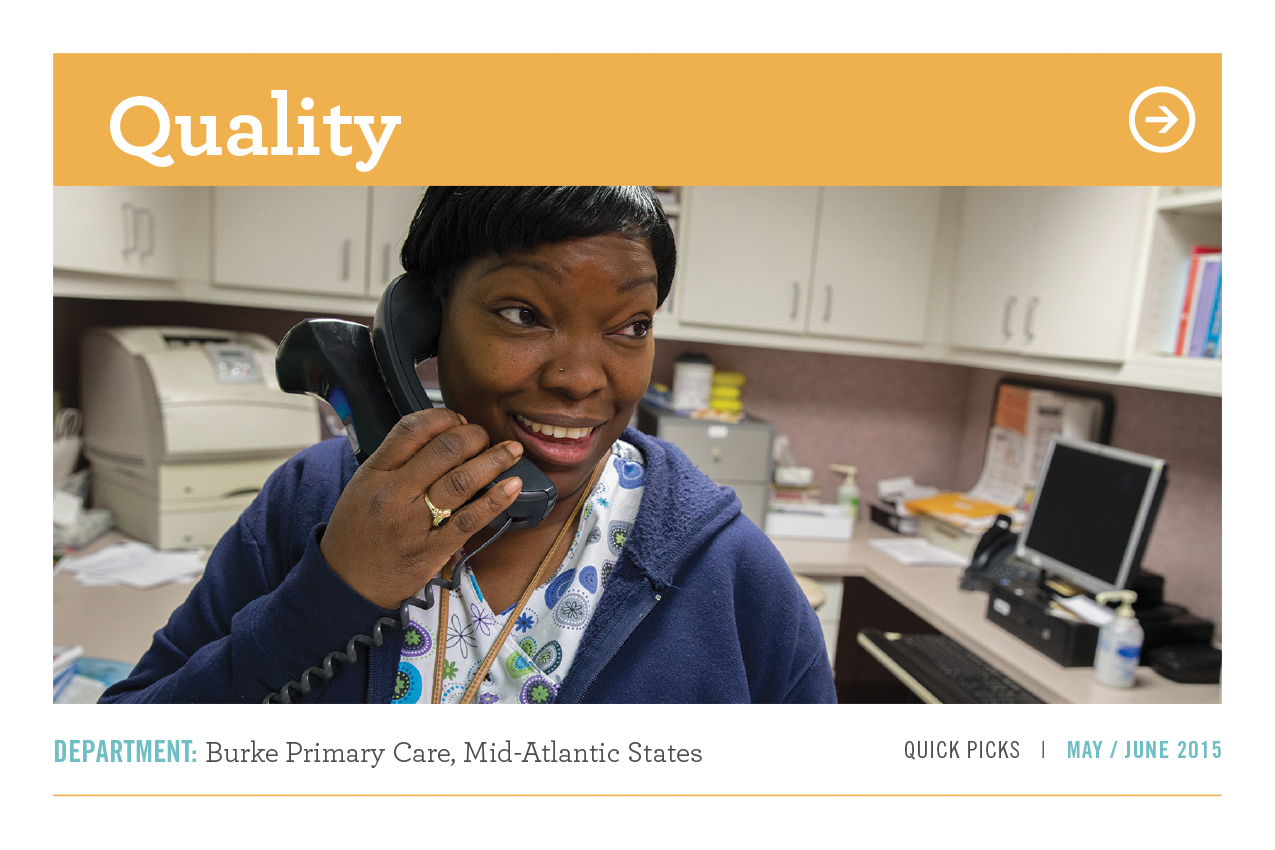
Postcard: Quality: Mid-Atlantic States Primary Care

Format:
PDF

Size:
8.5” x 11”

Intended audience:
Frontline employees, managers and physicians

Best used:
Share this on bulletin boards, in break rooms and other staff areas to gain ideas for increasing the percentage of patients whose blood pressure is under control. 

Read the story and share the PPT on this team's work.

Related tools:

The Three Cs to Success

Deck: 
Consistency, collaboration and communication pay off for Woodland Hills ICU team

Story body part 1: 

Elizabeth Rollice, RN, always knew that the Intensive Care Unit at the Woodland Hills Medical Center in Southern California was a great place to work.

As a staff nurse there, she and her co-workers enjoy good teamwork and excellent communication, and they deliver high-quality care to the sickest patients.

Now they have proof of their success.

This spring, the unit received the Gold Beacon Award for Excellence from the American Association of Critical-Care Nurses, the world’s largest specialty nursing organization. The award recognizes hospital units that demonstrate exceptional care through improved outcomes and greater overall patient satisfaction.

The team will be honored at the National Teaching Institute & Critical Care Exposition in San Diego, May 18-21.

“I knew that we did a good job and that everyone worked well together,” says Rollice, a member of UNAC/UHCP and a representative on the department’s unit-based team. “This award validates the quality of our work and tells us, ‘Yes, we are doing a pretty good job.’ ”

What’s best for the patient

Superb communication and a culture of collaboration among all members of the care team are key to the team’s success, enabling the consistent practice of evidenced-based medicine that has improved the quality of care.

Daily multidisciplinary rounds, for example, involve everyone on the care team who touches the patient.

“It’s about working in partnership with physicians, nurses and other staff to deliver high-quality care based on the newest evidence,” said Lynne Scott, RN, a clinical nurse specialist for the Critical Care and the Definitive Observation Unit. “We’re constantly moving forward.”

Nurses say team rounding gives them an opportunity to speak up and influence care decisions that affect their patients.

“We’re able to talk together about what’s best for the patient,” said Erica Bruce, RN, a UNAC/UHCP member who is the team's union co-lead. “If I feel that something is inappropriate, then I get a chance to ask the doctor. Family members get to ask questions about their concerns, too.”

Multidisciplinary rounding has produced an unintended benefit—higher member satisfaction. “I started in the ICU in 2002. We didn’t have a big rounding team at the time. Families sometimes felt unsupported,” recalls Paramjeet Dhanoa, RN, a staff nurse and UNAC/UHCP member. “Now that we have a big team, our families are more satisfied, because they feel they are not alone in making decisions. They are more comfortable.”

Open communication

Communication is vital in a department where staff members work around the clock in rotating shifts. To ensure information is consistently shared from shift to shift, the team:

  • practices Nurse Knowledge Exchange Plus (NKE Plus)
  • holds monthly UBT meetings, with members of the representative team responsible for sharing information with individual staff members
  • holds quarterly staff meetings; those who miss the meeting must review the staff meeting binder and sign a form indicating they’ve read it
  • uses a bulletin board to post important news and activities

The bulletin board, sandwiched between the nurses’ station and the staff restroom, attracts passersby with colorful fliers and posters.

“Your eyes are drawn to that communication board,” Rollice says. “You pass by a wall full of fliers, notes and postings, you can’t help but stop and look. It’s in a prime location.”

Conducted at the patient’s bedside, NKE Plus provides nurses with a template for patient safety and communication.

“It helps promote open communication and it helps us understand what’s going on with the patient,” says Judy Stone, RN, a staff nurse and UNAC/UHCP member, of the structured, in-depth, face-to-face handoff between the outgoing and the incoming nurse.

Stone says an additional itemized checklist “forces us, as nurses, to have all the pieces of the puzzle ready in the morning for multidisciplinary rounding. It really focuses us on everything that is going on with the patient so that we can deliver the best care that we possibly can.”

Clinical successes

Building the culture of collaboration and openness has had a big payoff:

  • No ICU patient has contracted VAP since the first quarter of 2011.
  • There have been no central line-associated bloodstream infections since the fourth quarter of 2011.
  • The unit achieved the 86th percentile on the HCAHPS (Hospital Consumer Assessment of Healthcare Providers and Systems) patient satisfaction survey from January 2013 through August 2014.

“To consistently deliver the best patient outcomes, you must have the processes and structures in place,” says Kareem Younes, RN, nursing project coordinator for Woodland Hills. “It’s about doing the right thing at the right time, every time.”

Going for the gold

While earning the Beacon Award was hard work, completing the 50-page application was perhaps even tougher for the Woodland Hills ICU team.

Few on the six-member representative UBT had writing experience, and they were at a loss when it came to telling their story in a way that would satisfy the award committee.

That’s when the team turned to in-house consultants Scott and Younes. Even with their expert help, the team faced data collection challenges and grappled with complex questions about the quality of their clinical practice.

At times they failed to meet, making it difficult to complete the application. And at one point, members were forced to make a “course correction” and rewrite the application when the guidelines changed unexpectedly.

“The rewrites were really painful,” recalls Sharon Kent, RN, the department’s administrator and UBT management co-lead. “It was like writing a thesis.”

Despite the challenges, team members said the process was rewarding because it enabled them to see their work in a different light.

“It made us take a closer look at the work we do,” says Rollice. “It motivated us to do better. It made us want to achieve the gold-level standard of care.”

 

Process Curbs VAP and Central Line Infections

Deck: 
Teamwork helps fight potentially harmful conditions

Like ICUs around the country, the Woodland Hills team struggled to protect patients from contracting ventilator-associated pneumonia (VAP) and central line-associated bloodstream infections.

Both conditions, among the most common hospital-acquired infections, can lengthen hospital stays, complicate recovery and even cause death.

But care improved dramatically after the team took steps that focused on patient safety and quality, and they credited a culture of collaboration as the key component to their success.

“It’s about working in partnership with physicians, nurses and other staff to deliver high-quality care based on the newest evidence,” says Lynne Scott, RN, a clinical nurse specialist for the Critical Care and the Definitive Observation Unit. “We’re constantly moving forward.”

They had their nurses place patients at the optimal angle of 30 degrees to ensure that fluids didn’t collect in their lungs, and also made sure that patients received routine oral care.

For greater oversight, two nurses changed the dressing 24 hours after the line was placed and were responsible for changing it weekly. The charge nurses were also involved, checking the dressing, IV tubing and injection ports twice a day.

And in further support, ICU employees held daily multidisciplinary rounds. This involved everyone on the care team who touched the patient, including physicians, nurses, dietitians, pharmacists, medical social workers and family members.

As of this writing, the results were nearly immediate with no patients contracting VAP or central line-associated bloodstream infections since late 2011.

Their efforts netted the team the 2015 Gold Beacon Award for Excellence from the American Association of Critical-Care Nurses, the world’s largest specialty nursing organization. The award recognizes hospital units that demonstrate exceptional care through improved outcomes and greater overall patient satisfaction.

Read more about what the team did to improve communication and collaboration.

What's the Deal With Bargaining?

Deck: 
Interest-based bargaining is radically different from the traditional

Story body part 1: 

Fists pounding on tables, demands, showdowns, strikes. So went traditional collective bargaining: Each side fighting for a bigger slice of the same pie. Each side gunning for a narrowly drawn agreement on pay and working conditions, leaving mutual concerns about patient care, quality and affordability unaddressed.

But Kaiser Permanente and the Coalition of Kaiser Permanente Unions abandoned the traditional approach in 1997, when they founded the Labor Management Partnership.

Our negotiations feature committees, observers and flip charts of options. Since 2000, KP workers, managers and physicians have worked together to craft four National Agreements and one reopener amid relative labor peace. On March 30, some 150 representatives will begin to negotiate a fifth agreement. Assuming all goes according to schedule, the new contract for the 100,000 workers represented by 28 locals in the coalition will be ready to go into effect when the 2012 National Agreement expires Sept. 30.

In an age of growing health care costs and increased competition, the joint goal is to provide our health plan members and patients with better, faster, less expensive and more personal care and to maintain and improve the best health care jobs in the United States.

With Collective Wisdom, You Can Achieve Anything

Deck: 
The only doctor on the 2012 Common Issues Committee had an unusual vantage point

Story body part 1: 

When I was asked to represent The Permanente Medical Group at 2012 bargaining, I leapt at the opportunity. My own experience with partnership at Fresno Medical Center showed me what great things could be accomplished with collective problem solving.

I sat on the subgroup that looked at how to improve partnership to enhance performance and Kaiser Permanente’s operational agility. I was amazed at seeing so many people with different backgrounds sharing their thoughts and shaping the outcomes. From the highest levels of Kaiser Permanente and union leadership to the front line, everybody was around the table, and they were all equal in this venue. Everyone was heard and engaged.

I personally learned a lot from the different perspectives voiced by all of the individuals representing their fields. I strongly believe that collective wisdom is better than individual wisdom, and that with collective wisdom you can achieve anything in life. Interest-based bargaining, which assembles voices from all levels and reaches of Kaiser Permanente, is a great example of collective wisdom.

Another thing that struck me—how much folks craved the physician perspective. When I spoke, all 25 to 30 people in that subgroup really listened. And there were issues where a physician perspective was critical. That was a strong message I brought back to physicians. In most unit-based teams at Fresno, there is physician involvement. The intention is to bring those perspectives together to enhance the care for our members and patients. But does that mean if I walk into a UBT meeting I’ll see a doctor? Maybe yes, maybe no.

I’ve worked at Kaiser Permanente for 34 years, and I saw the pre-partnership years. They were contentious ones. We’ve had relative peace with coalition unions since partnership. That’s not to say that working in partnership is perfect in every way. It can’t be done without trusting each other. And how do you develop trust? Through transparency. The whole bargaining process was about transparency; essentially, everybody could share everything. That doesn’t mean people didn’t disagree.

The interest-based, collective approach takes into account everyone’s perspectives to reach a better outcome, which is ultimately a common goal—superior care for our members and patients.

TOOLS

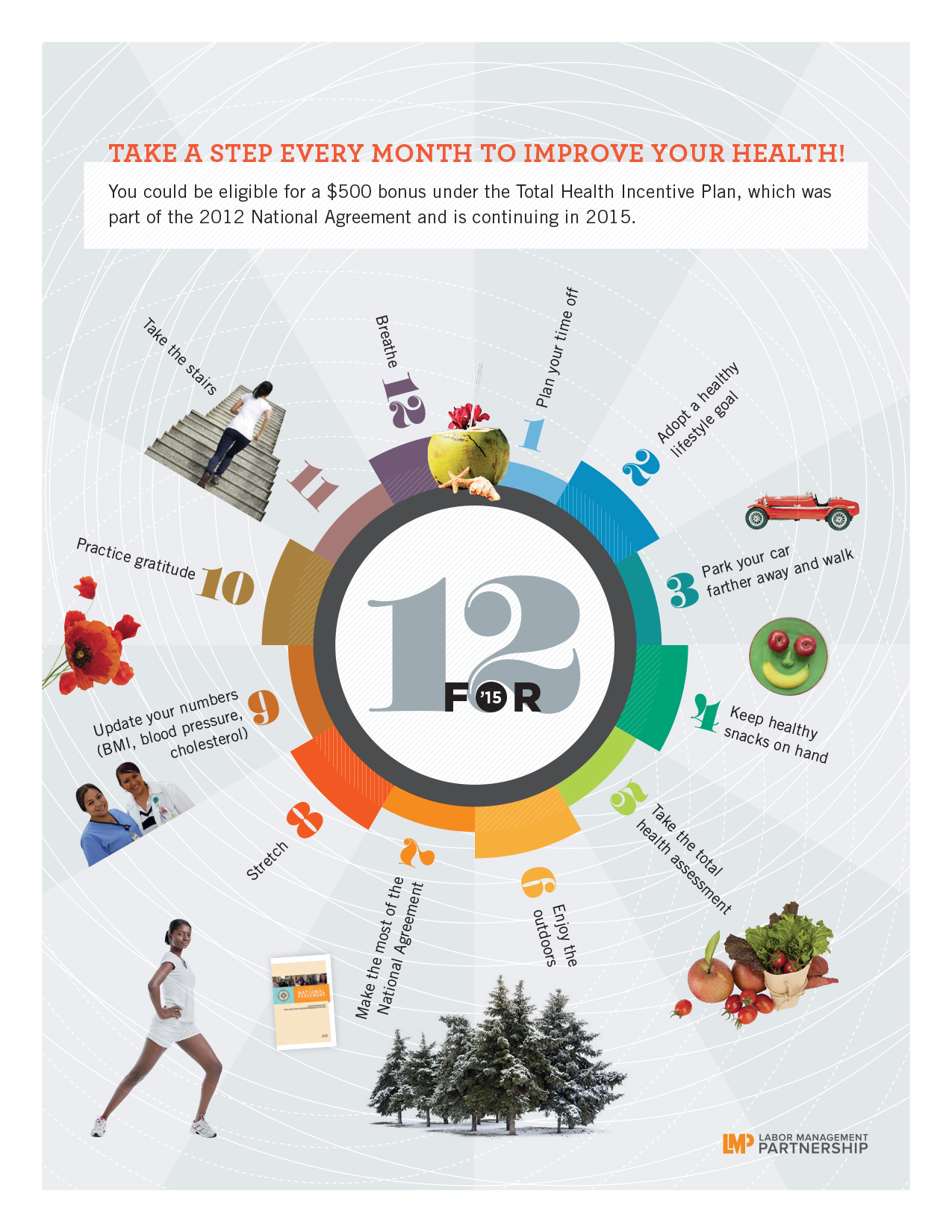
Poster: Take a Step to Improve Your Health

Format:
PDF (color and black and white)

Size:
8.5” x 11”

Intended audience:
Frontline employees, managers and physicians

Best used:
This poster has an idea for every month on how you can improve your health. Post on bulletin boards, in break rooms and other staff areas.


Related tools:

TOOLS

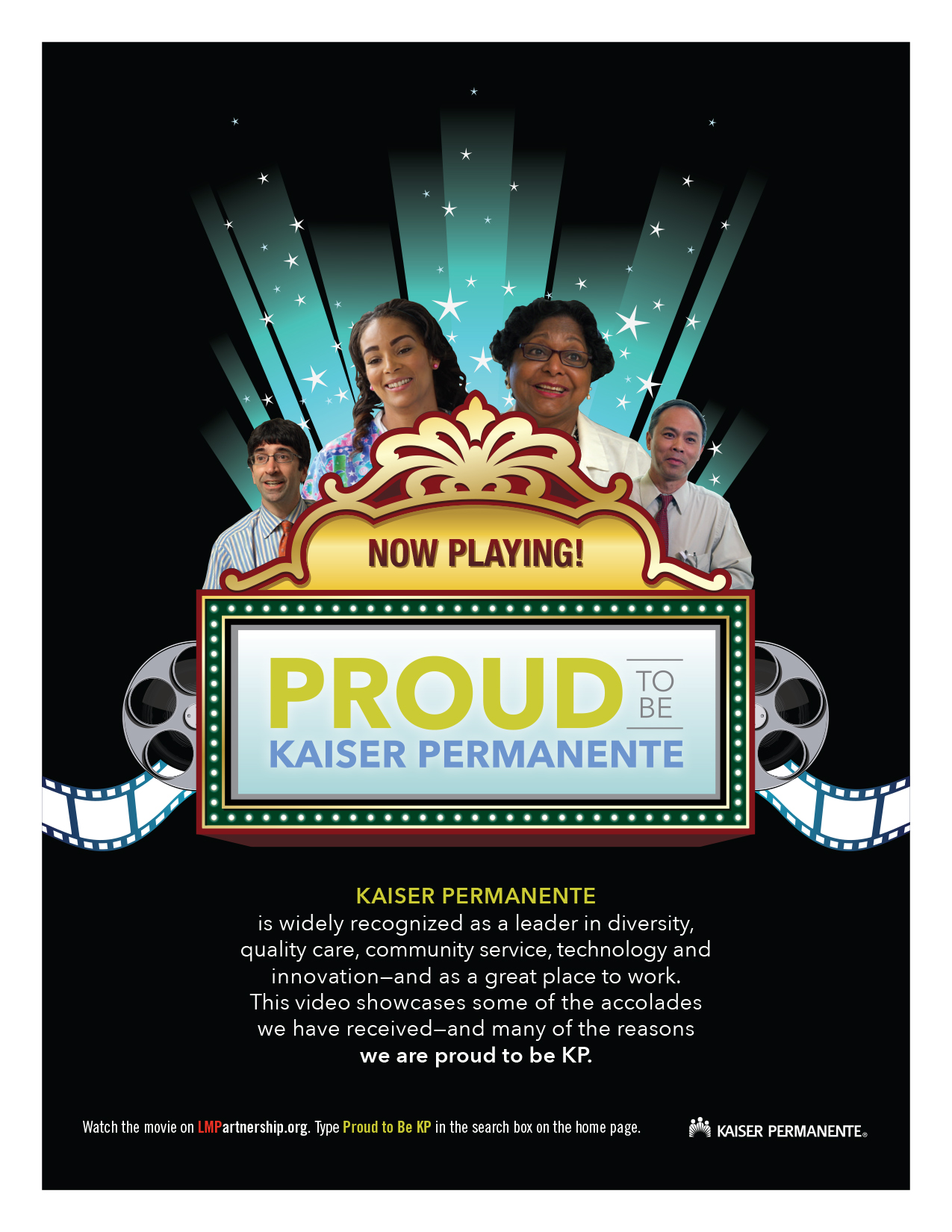
Poster: Proud to Be Kaiser Permanente

Format:
PDF (color and black and white)

Size:
8.5” x 11”

Intended audience:
Frontline employees, managers and physicians

Best used:
Post on bulletin boards, in break rooms and other staff areas to share with colleagues this short description of a video that showcases some of the accolades KP has received, and many of the reasons we are proud to be KP.

Watch the video.

Related tools:

TOOLS

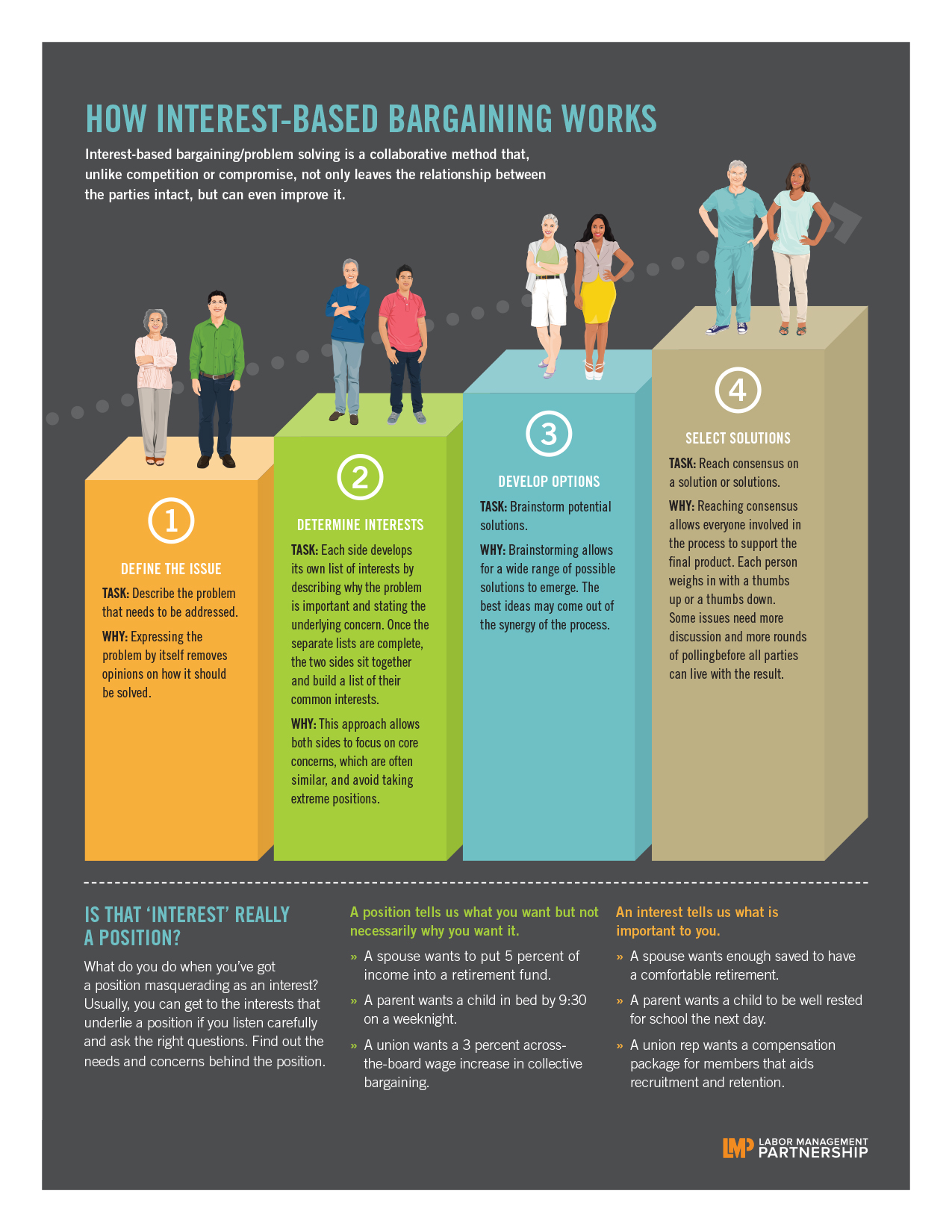
Poster: How Interest-Based Bargaining Works

Format:
PDF (color and black and white)

Size:
8.5” x 11”

Intended audience:
Frontline employees, managers and physicians

Best used:
Help your team learn to effectively solve problems using the four steps of interest-based problem solving. 

Related tools:

Pages

Subscribe to RSS - Frontline Physicians