Frontline Physicians

Help Video

How to Find UBT Basics on the LMP Website

Learn how to use the LMP website:

LMP Website Overview

Learn how to use the LMP website:

How to Find How-To Guides

This short animated video explains how to find and use our powerful how-to guides

Learn how to use the LMP website:

How to Find and Use Team-Tested Practices

Does your team want to improve service? Or clinical quality? If you don't know where to start, check out the team-tested practices on the LMP website. This short video shows you how. 

Learn how to use the LMP website:

How to Use the Search Function on the LMP Website

Having trouble using the search function? Check out this short video to help you search like a pro!

Learn how to use the LMP website:

How to Find the Tools on the LMP Website

Need to find a checklist, template or puzzle? Don't know where to start? Check out this short video to find the tools you need on the LMP website with just a few clicks. 

Learn how to use the LMP website:

TOOLS

Poster: Team's Success Brings in $10 Million

Format:
PDF

Size:
8.5" x 11"

Intended audience:
Frontline employees, managers and physicians

Best used:
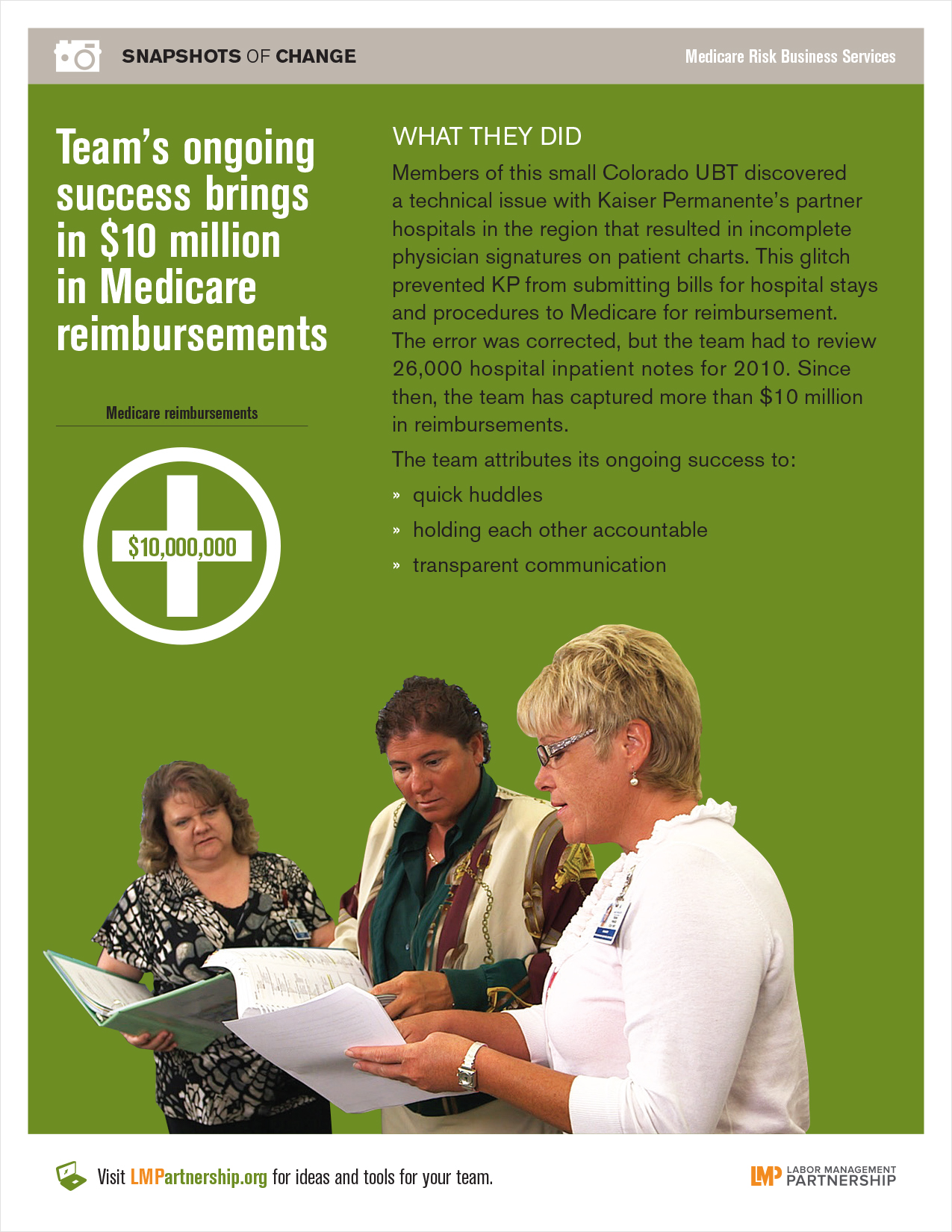
This poster highlights a business services team that discovered a glitch, corrected it, and brought in $10 million in Medicare reimbursements. Post on bulletin boards, in break rooms and other staff areas.

Related tools:

Wasted Linens Are an Unnecessary Expense

Deck: 
Team cuts annual costs by almost 7 percent

For a nurse on a hospital ward, it might seem quick and easy to grab the nearest sheet to mop up a spill or grab a huge stack of blankets to put in a patient’s room.

But for the Materials Management department at Panorama City Medical Center, that can be really wasteful.

And they should know. They’re the team responsible for purchasing and cleaning linens, and keeping patients comfortable.

With savings in mind, the materials UBT looked to educate other hospital staff about the true costs of buying and washing linens.

Managers and union members worked together to create a storyboard featuring photos of bed sheets used as a tablecloth at a barbeque, and price lists of supplies and laundering charges. And because the team piloted its effort in Maternal Child Health departments, it also included pictures of babies.

As the materials staff worked with the other teams, the storyboard was a big confidence booster to those who were not public speakers.

“At first I was really nervous,” says Sandra Hernandez, the team’s labor co-lead. “But then I saw people I knew in the room and that put me at ease.”

The team also reviewed linen usage and stocking levels with departments.

And their efforts paid off as they reduced the overall annual cost of linen in the Maternal Child Health department by 6.8 percent, more than three times the original goal.

They also were able to increase customer satisfaction scores in a year from 48 to 65 percent from internal clients such as inpatient units at the hospital,.

“It is important to be prepared with the data,” says management co-lead Steve Spickler. “But, you need to tell a story in addition to the charts. That’s how the UBTs make the connection between their contribution and the financial success of the organization.”

For more about this team's work to share with your team and spark performance improvement ideas, download a poster or powerpoint.

TOOLS

PPT: Bolder Communication Helps Diagnose Malnutrition

Format:
PPT

Size:
1 Slide

Intended audience:
Frontline employees, managers and physicians; LMP staff, UBT consultants, and improvement advisers

Best used:
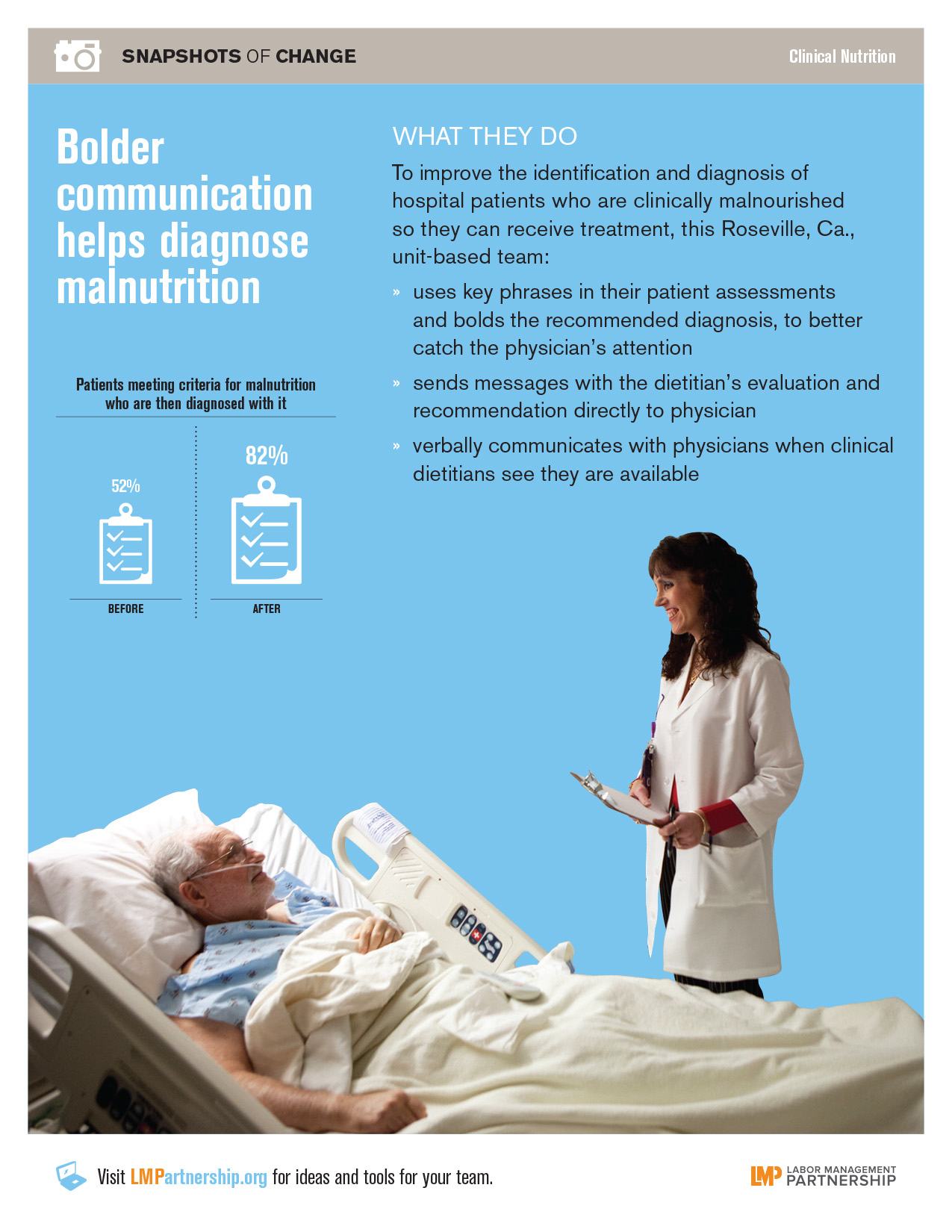
This poster features a Northern California team that improved communication and its ability to diagnose malnutrition. Use in presentations to show some of the methods used and the measurable results being achieved by unit-based teams across Kaiser Permanente. 

Related tools:

TOOLS

Poster: Bolder Communication Helps Diagnose Malnutrition

Format:
PDF

Size:
8.5" x 11"

Intended audience:
Frontline employees, managers and physicians

Best used:
Gain inspiration from this Northern California team that improved communication and its ability to diagnose malnutrition.

Related tools:

TOOLS

Poster: Service Is Our Passion

Format:
PDF (color and black and white)

Size:
8.5" x 11"

Intended audience:
Frontline employees, managers and physicians

Best used:
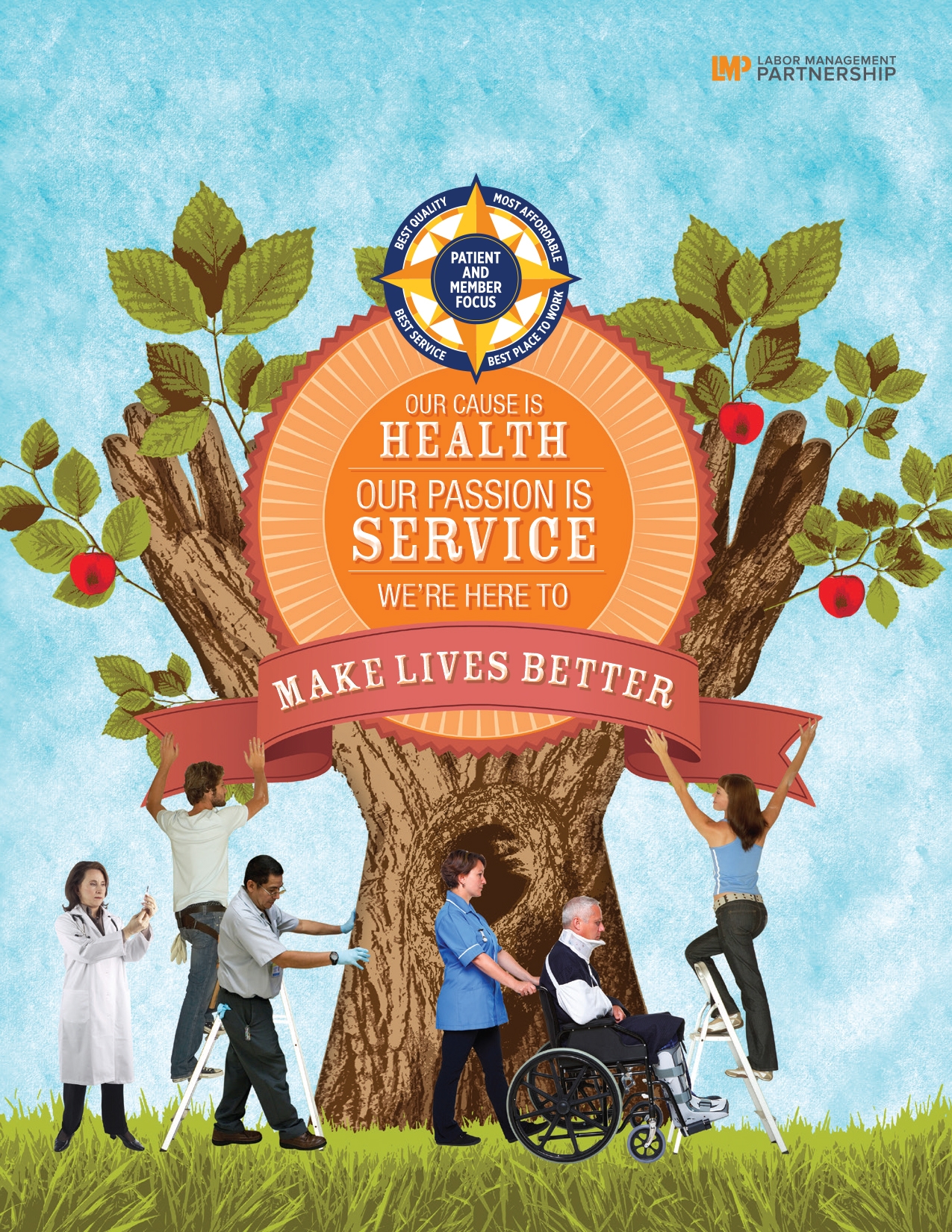
This poster with the KP Service Credo, showing the patient/member at the center being cared for by a team of KP workers, reminds us that when we provide superior service, we make lives better. Post on bulletin boards, in break rooms and other staff areas.

Related tools:

TOOLS

Poster: Fighting the Flu Face to Face

Format:
PDF (color and black and white)

Size:
8.5" x 11"

Intended audience:
Frontline employees, managers and physicians

Best used:
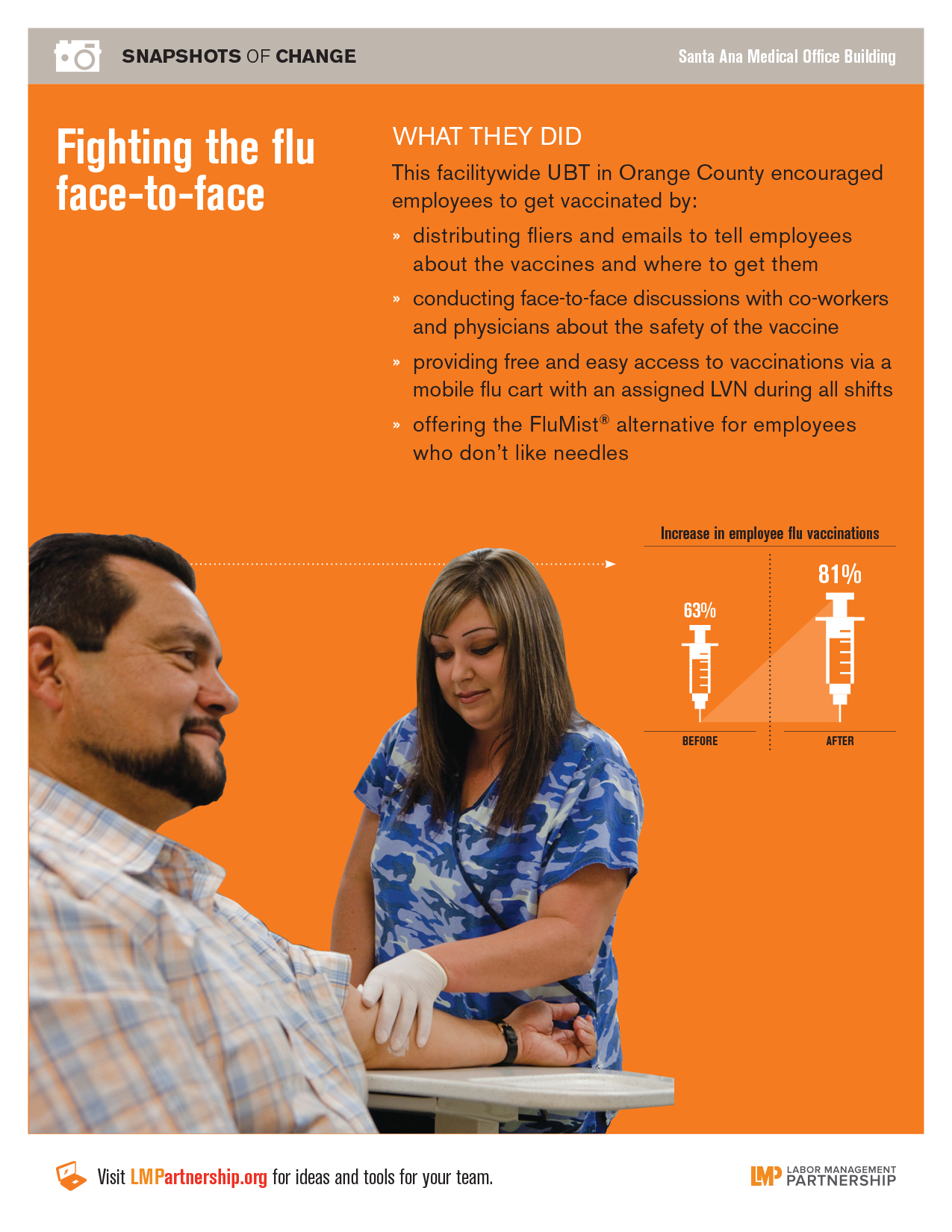
This poster, for bulletin boards, in break rooms and other staff areas, features an all-facility UBT that successfully encouraged more employees to get the flu shot.

Related tools:

TOOLS

Poster: Modern Venue for Old-Fashioned Storytelling

Format:
PDF (color and black and white)

Size:
8.5" x 11"

Intended audience:
Frontline employees, managers and physicians

Best used:
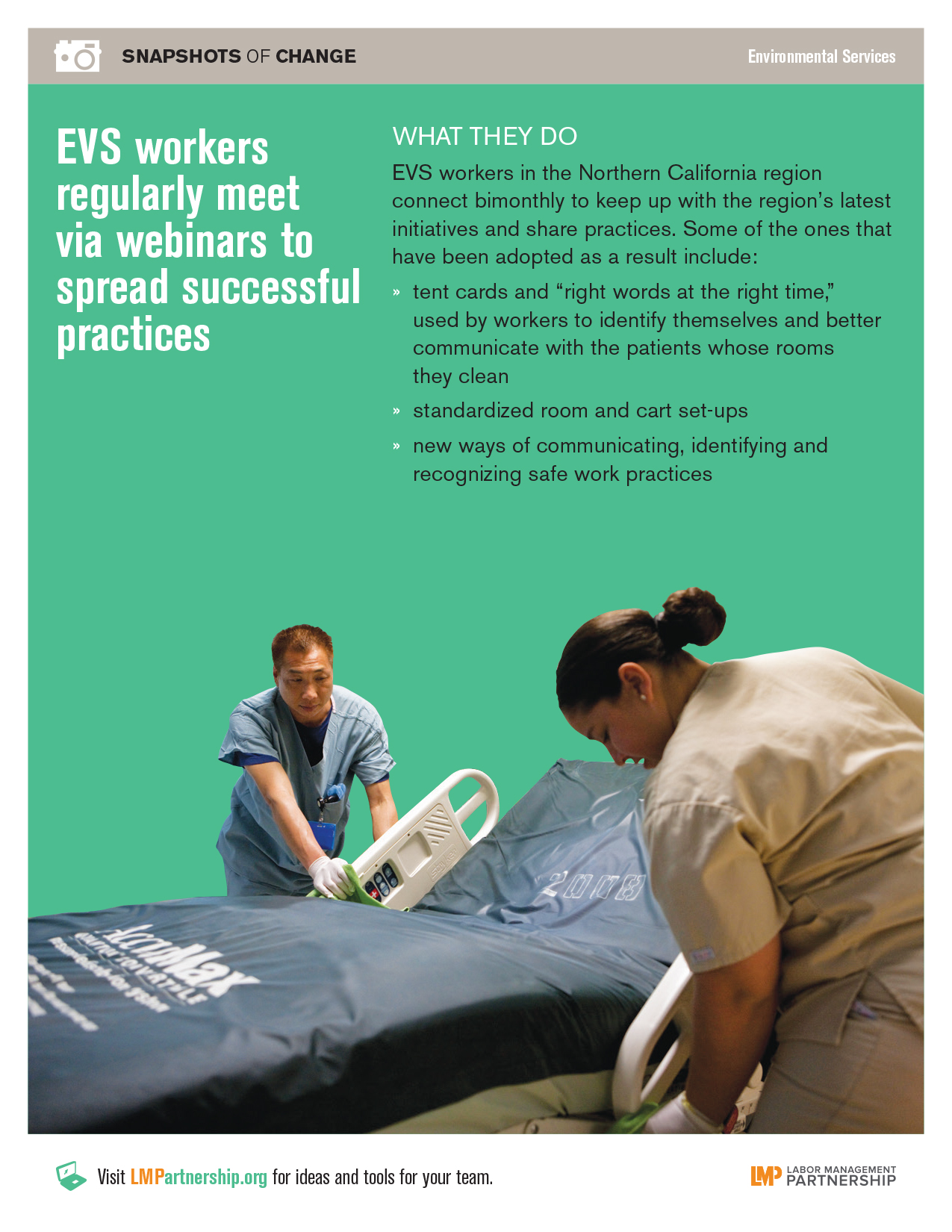
This poster, for use on bulletin boards in break rooms and other staff areas, highlights an EVS team that uses webinars to spread successful practices.

Related tools:

Contradictions That Foster Innovation

Story body part 1: 

Amy Edmondson says innovation depends on a culture of focused chaos.

Those words sound like opposites. They are. Don’t worry. It’s not a mistake.

In fact, innovation depends on four pairs of seeming opposites. As unit-based teams ramp up, involving frontline managers, physicians and employees in finding new ways to improve performance and transform health care, they can benefit from creating a culture of innovation. This is how Edmonson, a professor at Harvard Business School, defines the four cultural contradictions of innovation:

  • Chaotic/focused
  • Playful/disciplined
  • Deep expertise/broad thinking
  • Promotes high standards/tolerates failure

Let's take a more detailed look.

Chaotic/focused

“An innovation culture is focused,” says Edmondson. “It is really intent on improving a process or inventing a new business model or coming up with a new product.” At the same time, it is chaotic. “Any idea is welcome and possible—at least until we sort it out. No idea is a bad idea—at least early in the process.”Chaos, says Edmondson, “is about welcoming all ideas, even ‘wacky’ ideas.” Only in a psychologically safe learning environment will employees feel open enough to offer these “wacky” ideas, she adds.

Playful/disciplined

The Labor Management Partnership offers a disciplined process for innovation in the form of the Rapid Improvement Model (RIM) and the plan, do, study, act cycle. But, Edmondson emphasizes, teams use these tools “without knowing in advance what the answer is.” There is a careful and well-managed process, but the content of the conversations about improving performance must be open and inclusive. As teams begin a performance improvement project, UBT leaders need to be very clear about what aspect of performance they are trying to address—not on how the team is going to do it.

Deep expertise/broad thinking

An innovative team is one that values those who bring deep expertise (in a specific topic, subject area or clinical specialty, for instance) and people who are broad, general thinkers who span boundaries. “Both of those skill sets are absolutely essential at the same time,” says Edmondson.

Promotes high standards/tolerates failure

In an innovative work culture, “We hold very high standards but we are also very tolerant of failure,” says Edmondson. “That sounds ‘wrong,’ at first,” she admits, “but it is essential because, in innovation, you will never get it right the first time. You try something, test it out, it’s not going to work quite right and then you either tweak it or throw it out altogether and try something else.”

Spreading new ideas that get results throughout a large organization such as Kaiser Permanente, says Edmondson, requires finding ways to “shine a very quiet spotlight”—another seeming contradiction!—on innovators so others become aware of what they are doing and are drawn to try it too. 

“In today’s world, there are two ways to get the word out,” she says. The first is face-to-face communication, “positive buzz that starts locally and spreads.” The other is internal online social networks as “a way to listen, motivate and share practices that are potentially better.”

“It can catch on,” says Edmondson. “When there are pockets of effectiveness, other people see them, and they want to play too.”

You Gotta Learn

Deck: 
A psychologically safe environment is essential to teamwork and innovation

Story body part 1: 

The theme of the 2012 Union Delegates Conference was “You Gotta Move”—and Amy Edmondson’s advice for the delegates was “you gotta learn.”

The Harvard Business School professor studies what she calls “learning environments.” To support innovation and teamwork, it’s essential the Labor Management Partnership and unit-based teams foster learning environments throughout Kaiser Permanente.

Imagine the ideal learning environment: People feel free to take risks. They feel psychologically safe. They believe they won’t be punished or humiliated for speaking up with ideas, questions, concerns or mistakes. “Without that kind of psychological safety, it’s very hard for an organization to learn,” says Edmondson.

Now imagine the opposite of a learning environment, one where no one speaks up. “Nobody ever got fired for being silent,” says Edmondson. “And yet many bad things happen as a result of silence. Silence is a strategy for individuals to stay safe, but not necessarily for patients to stay safe or for organizations to stay vibrant.”

Creating a learning environment is up to leaders—to those people with influence, whether or not they have a formal leadership role.

“Leaders have to go first,” Edmondson says. They “have to be willing to ask questions themselves, invite participation, acknowledge their own fallibility, and to explicitly state we don’t know everything yet.” These behaviors help an environment where others can take the risks of learning.

But, she cautions, “The learning environment doesn’t live at the ‘organization’ level. For the most part, there are pockets of learning environments.…In a large, complex system, answers don’t come from central headquarters or the CEO. The answers come from the people at the front line doing the work.”

A labor management partnership like the one at Kaiser Permanente “is an important foundation” for building a learning environment, says Edmondson. “A true partnership is completely consistent with the context for mutual learning.”

Both management and union UBT co-leads can help create a learning environment by articulating the unit’s or department’s purpose and goals “in a meaningful way that touches hearts and minds, that motivates and encourages,” she says.

They can—and must—also reduce the fear people experience that makes them reluctant to speak up. The LMP helps develop and support people, helping them be their best and most courageous, Edmondson says.

Pages

Subscribe to RSS - Frontline Physicians