Frontline Physicians

Help Video

How to Find UBT Basics on the LMP Website

Learn how to use the LMP website:

LMP Website Overview

Learn how to use the LMP website:

How to Find How-To Guides

This short animated video explains how to find and use our powerful how-to guides

Learn how to use the LMP website:

How to Find and Use Team-Tested Practices

Does your team want to improve service? Or clinical quality? If you don't know where to start, check out the team-tested practices on the LMP website. This short video shows you how. 

Learn how to use the LMP website:

How to Use the Search Function on the LMP Website

Having trouble using the search function? Check out this short video to help you search like a pro!

Learn how to use the LMP website:

How to Find the Tools on the LMP Website

Need to find a checklist, template or puzzle? Don't know where to start? Check out this short video to find the tools you need on the LMP website with just a few clicks. 

Learn how to use the LMP website:

Bolder Communication Helps Diagnose Malnutrition

Deck: 
Dietitians play a key advocacy role for at-risk patients

After Northern California began a regional push in 2009 to improve the identification and diagnosis of malnourished patients, the Roseville Medical Center sought to put the plan to action.

The clinical nutrition team was partifcularly concerned because diet plays a key role in the body’s recovery.

This can be especially true for the elderly and patients with diabetes —two groups at the highest risk for malnutrition. Mary Hart, director of clinical nutrition for Roseville and Sacramento medical centers, says a lack of proper proteins and vitamins affects their ability to recover and heal.

And short hospital stays can be particularly challenging because most patients don’t stay in the hospital very long.

After sifting through the electronic charts of all admitted patients, the dietitians must spot patients “at risk” for malnourishment and reach them in time for a full evaluation and treatment—all before the patient is discharged.

While physicians are the only ones who can make an official diagnosis, they rely on clinical dietitians to assess the patient and alert the physician.

“We keep track of the number of patients who have met the criteria for clinical malnutrition, communicate that to the physician and follow up to see if (the patient) has actually been diagnosed,” Hart says.

The dietitians at Rockville put their assessments and recommendations into a patient’s electronic chart, but everyone did so a little differently.

So they standardized their process and language, which included bolding notes to doctors and speaking directly to them about potentially malnourished patients. Those simple steps made it easier for physicians to know what to look for, and diagnose accordingly.

“It helps because we can see them sooner and start nutritional management sooner and figure out how to refer them to outpatient care after they are discharged,” says labor co-lead and registered dietitian, SEIU UHW, Jennifer Amirali.

The team also piloted a KP HealthConnect tool that made it easier and quicker for clinical dietitians to identify at-risk patients. It pulls data from electronic medical records, and color-codes assessments, recommendations and final diagnoses between dietitians and physicians.

“There was more recognition (among physicians) of what a dietitian does other than just ‘serve food,’” Amirali says.

Hart agreed.

“(Physicians and administration) now see the important role of dietitians in the care team and what we can contribute to the organization and the health of the patient.”

For more about this team's work to share with your team and spark performance improvement ideas, download a poster or powerpoint.

TOOLS

Poster: Sleep Clinic Uncovers Cause of Repeat Studies

Format:
PDF (color and black and white)

Size:
8.5" x 11"

Intended audience:
Frontline employees, managers and physicians

Best used:
This poster, for use on bulletin boards, in break rooms and other staff areas, spotlights a team that cut wait times in half by nipping the need for repeat studies.

Related tools:

Better Monitoring Fast-Tracks Medi-Cal Payments

Deck: 
Attention to detail improves the billing process

The Business Office at the Redwood City Medical Center in Northern California was letting some of their bills slip by.

Specifically those billed to Medi-Cal and the Northern California region asked facility business offices to improve the turnaround time for filing those treatment authorization requests.

They wanted to improve the reimbursement rate for care provided to Medi-Cal patients because that initiated payment to Kaiser Permanente. So, the region asked facilities to file the authorizations within five days from the day a Medi-Cal patient was discharged.

But apart from the one-year time limit on billing, a lot of business departments didn’t monitor the number of days it took to file those requests. Sometimes it might take 30 days, other times perhaps just two days. They needed a consistent turnaround time. 

“A dollar devalues the longer it’s out there,” says Pattie Murphy-Kracht, director of the admitting and business office. “So an outstanding bill loses its value the longer it’s unpaid.”

The Redwood City team decided to monitor the electronic work queue that tracks patient billing to look for Medi-Cal patients. They also monitored the electronic list of Medi-Cal hospital patients, so the team could anticipate their discharge.

In two months, the number of days to file a treatment authorization request dropped from 21 to two days. 

The team said being open to change was a big reason for their success.

“We’re good at trying different ways of doing things,” union co-lead Jessica Garcia says. “Change isn’t always easy, but we’re not stuck on one way.” 

TOOLS

PowerPoint: Cross-Training Ends Scanning Backlogs

Format:
PPT

Size:
1 Slide

Intended audience:
Frontline employees, managers and physicians

Best used:
This slide spotlights a team that found a way to speed up the entry of medical records into HealthConnect. Use in presentations to show some of the methods used and measurable results being achieved by unit-based teams across Kaiser Permanente.

Related tools:

TOOLS

Poster: Errors Drop With Pre-Op Double up

Format:
PDF (color and black and white)

Size:
8.5" x 11"

Intended audience:
Frontline employees, managers and physicians

Best used:
This poster, highlighting a team that reduced errors by having two nurses check antibiotic orders, can be placed on bulletin boards, in break rooms and in other staff areas.

Related tools:

TOOLS

Poster: Tell Me Your Story [template]

Format:
PDF (color and black and white)

Size:
8.5" x 11"

Intended audience:
Frontline employees, managers and physicians

Best used:
Use this template to help you share stories of your team's successes and failures—and help tranform KP into the best place to receive and give care. Post on bulletin boards in break rooms and other staff areas.

Related tools:

TOOLS

Poster: Tell Me Your Story

Format:
PDF (color and black and white)

Size:
8.5" x 11"

Intended audience:
Frontline employees, managers and physicians

Best used: A reminder that by sharing stories of your team’s successes and challenges, you are showing everyone the way to better health care for all, inspiring others to follow your lead. On bulletin boards in break rooms and other staff areas.

Related tools:

TOOLS

Poster: Value Compass

Format:
PDF (color and black and white)

Size:
8.5" x 11"

Intended audience:
Frontline employees, managers and physicians

Best used:
This poster features our Value Compass, which puts the member and patient at the center of everything we do, and is used as a guide for decision making and problem solving. Post on bulletin boards in break rooms and other staff areas. Users may also be interested in downloadable Value Compass art in several formats.

Related tools:

TOOLS

Poster: When KP Does Well, We All Do Well

Format:
PDF (color and black and white)

Size:
8.5" x 11"

Intended audience:
F
rontline employees, managers, and physicians

Best used:
This poster reminds us that October is Open Enrollment time, and offers ways in which teams can help KP retain members and grow. Place on bulletin boards in break rooms and other staff area.

Related tools:

TOOLS

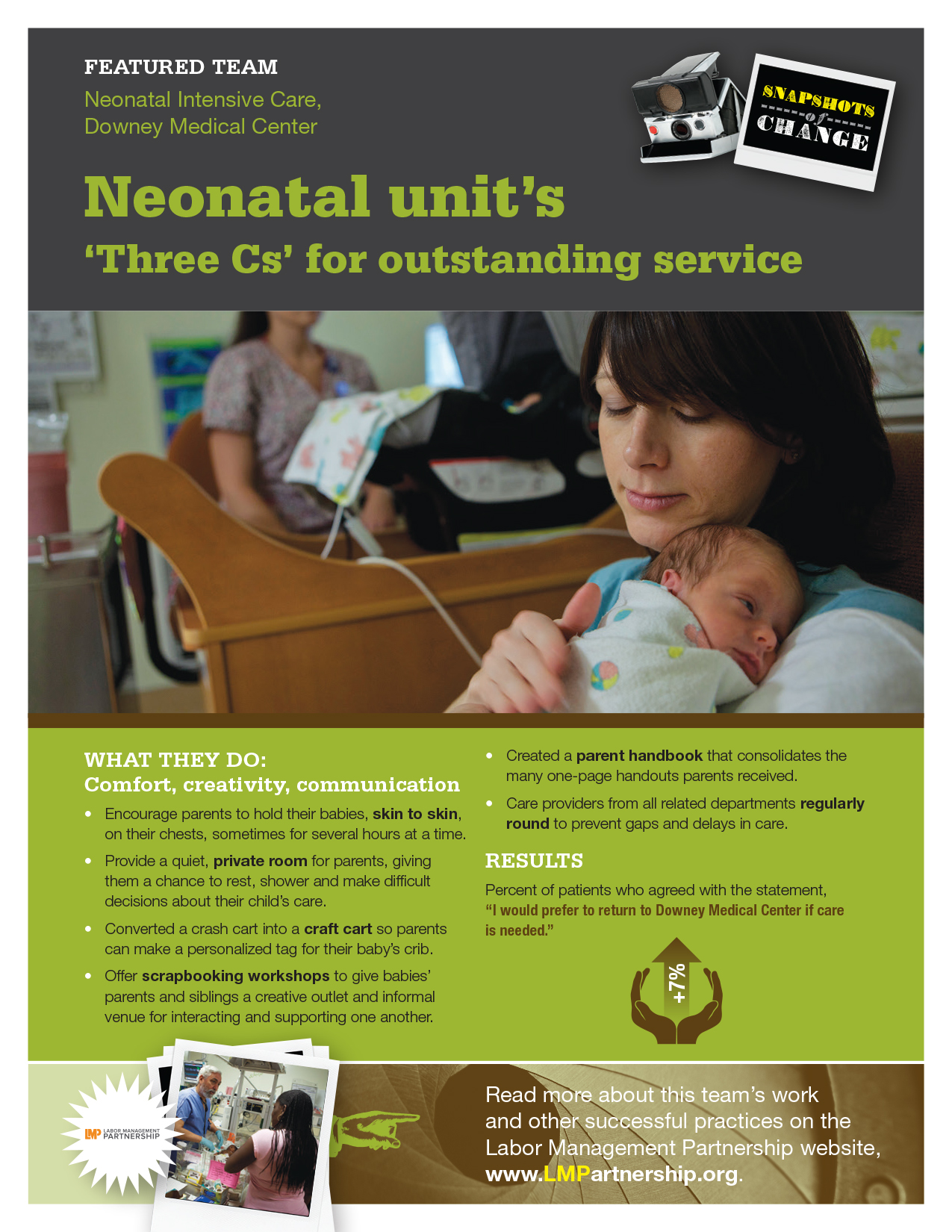
Poster: Neonatal Unit's Three C's for Outstanding Service

Format:
PDF

Size:
8.5" x 11"

Intended audience:
Frontline employees, managers and physicians

Best used:
This poster highlights a team that increased the percentage of patients who want to return to that facility to deliver their child. Use on bulletin boards, in break rooms and other staff areas.

Related tools:

Pages

Subscribe to RSS - Frontline Physicians