Frontline Workers

Help Video

How to Find UBT Basics on the LMP Website

Learn how to use the LMP website:

LMP Website Overview

Learn how to use the LMP website:

How to Find How-To Guides

This short animated video explains how to find and use our powerful how-to guides

Learn how to use the LMP website:

How to Find and Use Team-Tested Practices

Does your team want to improve service? Or clinical quality? If you don't know where to start, check out the team-tested practices on the LMP website. This short video shows you how. 

Learn how to use the LMP website:

How to Use the Search Function on the LMP Website

Having trouble using the search function? Check out this short video to help you search like a pro!

Learn how to use the LMP website:

How to Find the Tools on the LMP Website

Need to find a checklist, template or puzzle? Don't know where to start? Check out this short video to find the tools you need on the LMP website with just a few clicks. 

Learn how to use the LMP website:

Labor Sponsor Profile: Andrea Badellebess

Story body part 1: 

Andrea Badellebess has been a labor co-sponsor in the Greater Southern Alameda Area (GSAA) in the Northern California region for seven years. She sponsors 37 teamsincluding EVS, Health Management and the pharmacy UBTs, all of which include OPEIU Local 29 membersby “spreading myself around as much as I possibly can.” In talking with LMP communications consultants Shawn Masten and Cassandra Braun about the challenges and rewards of being a labor sponsor, she introduced the idea of a “family team”—a team that is above even Level 5, when “teams just interact and do what’s needed…It’s a real partnership. And it’s unspoken; it just gets done. It’s not about whose job it is.”

Q. First: How do you sponsor 37 teams?

A. Mostly, I do it electronically. I look at team meeting minutes on the shared drive and look at UBT Tracker to see where they are on projects. For those teams that are unique and need additional pushes, I work with our UBT consultant and visit them more often. If they’re a Level 5 team, I try to get to meetings at least two to three times a year. Then I have teams that need a little more motivation. I have to visit those teams more often to let them know they’re not by themselves. So it’s kind of hard. But you have to let them know you’re there.

Q. What’s the state of sponsorship today?

A. The work of sponsors has evolved slower than the work of unit-based teams. At one point, teams thought their consultants were their sponsors. But that’s the beauty of this whole performance improvement thing—it is its own ongoing small test of change. Everyone is learning as they go. There’s been a whole new culture change.

Q. What about sponsorship needs improving?

A. Here in the GSAA, we have been taking steps to improve union sponsorship especially. There are not enough people who can wear that sponsor hat. So now we are looking for stewards who want to—and have the capacity to—be sponsors. They have to be capable of seeing the common barriers teams face. And they have to either know who can remove those barriers or to point their teams in a different direction. What we’re doing is providing the training and development needed for stewards to succeed as sponsors. This is a significant shift, and one that we hope will make a difference.

Q. What do you like most about being a sponsor?

A. One of my greatest thrills—and sometimes one of my hardest jobs—is helping UBT members recognize that if they speak up they will be listened to. This is still hard for some, especially those skeptical that this whole unit-based team thing isn’t just another experiment that will pass. But this is what I tell them: “You are the experts. Who knows how to do your job better than you?” Once they realize they are the experts and have a say, and they are heard, they become a partner. UBTs make the frontline staff become partners. You’re not just a worker, you’re a partner, and you have a say in what’s going on.

Q. Can you give an example where the workers solved the problem?

A. Our call center operators were having a problem with elderly members getting hung up on or calls being dropped after they were transferred. They came together as a unit-based team and found a solution: Instead of simply putting such calls through, they stayed on the line and would talk with the person at the other end, explain who the member was and why they were calling. They had a problem, they solved it and there was no finger-pointing, no blame.

Words from the front line

“She’s very involved. It’s not like you just see her once a month or every other month. And you can tell that she’s interested in what we’re trying to say and do. If we go out of bounds, she’ll ask, ‘Is this what you meant?’”—Leilani Mejia, Health Information Management specialist, OPEIU Local 29 member and union co-lead, Fremont Medical Center
TOOLS

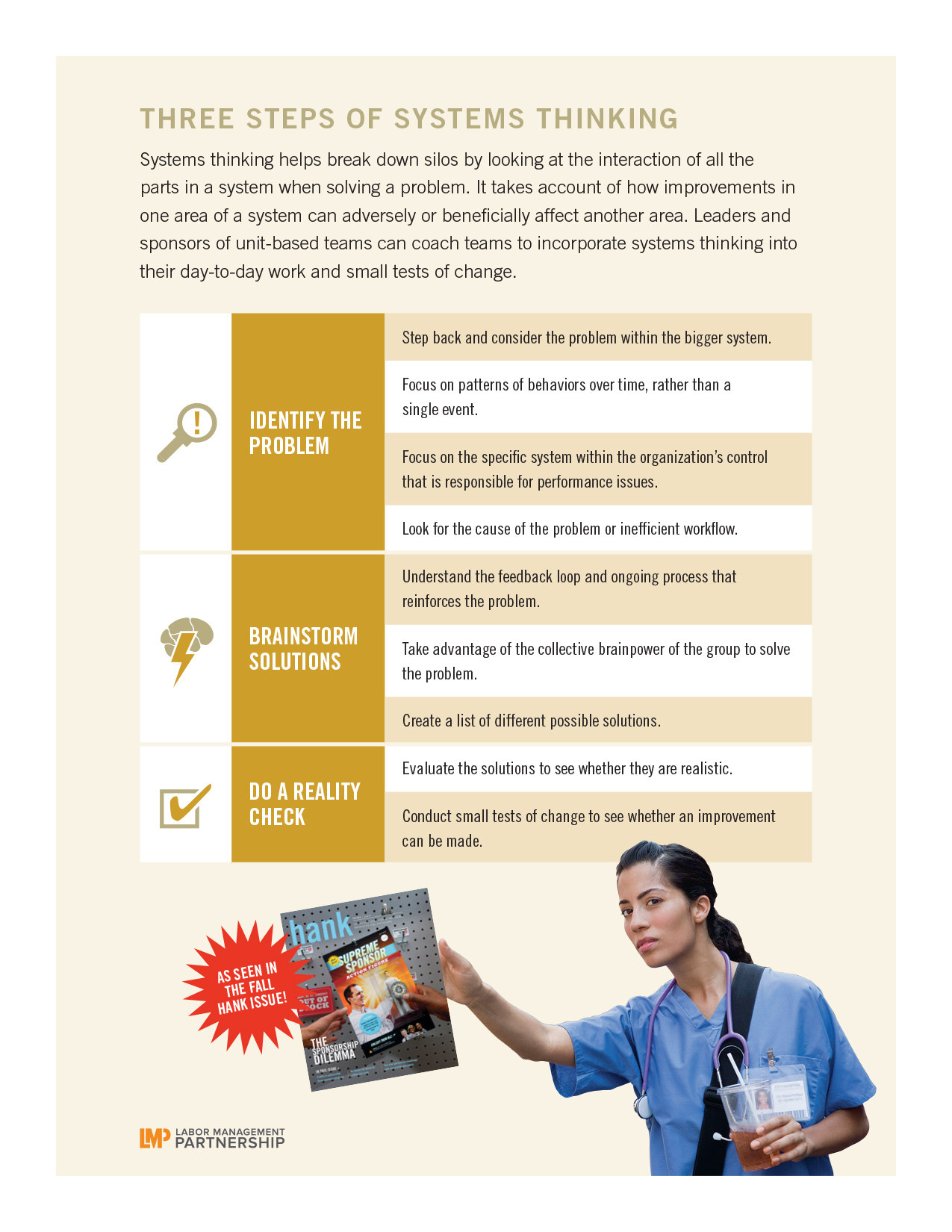
Poster: Three Steps of Systems Thinking

Format:
PDF

Size:
8.5" x 11"

Intended audience:
Frontline employees, managers and physicians

Best used:
This poster, for use on bulletin boards in break rooms and other staff areas, explains how the three steps of systems thinking can be used when solving a problem.

Related tools:

Polish Your Skills, Save the Planet

Deck: 
Southern California EVS teams go green with new certificate program

Story body part 1: 

Cutting waste and saving money for Kaiser Permanente members and patients is good. But 350 Environmental Service workers in Southern California are taking that mission a step further by tending to Mother Earth as well.

Kaiser Permanente and two Labor Management Partnership-funded workforce development trusts are among the health care partners nationwide that are training frontline workers and managers in improved recycling, waste disposal, energy conservation and other green practices. The U.S. Department of Labor and the Healthcare Career Advancement Program, a national partnership of unions and hospitals, are leading the effort.

“‘Carbon footprint’ is a phrase that’s thrown around a lot,” says Milford “Leroy” Alaman, EVS operations manager at the Los Angeles Medical Center. “Now our staff is able to understand that when you are talking about conserving energy, water and electricity, you are talking about looking at the resources we have in our facility and holding on to just what we need instead of creating more waste for us and the planet.”

Leading change at work

Along the way, these “green teams” also are reducing operating costs, enhancing employee skills and morale, and improving patient and workplace safety. 

For example, the EVS department is now using environmentally friendly microfiber mops to clean a single patient room. This has the benefit of not spreading infections between rooms and preventing lifting and straining injuries caused by wringing traditional mops and hauling buckets of water.

The department also has started a project that is reducing the cost and trouble of replacing the 500 D-cell batteries used in the hospital restrooms’ automatic towel dispensers. The traditional batteries wore out in a matter of weeks—costing about $3,000 a year to replace and adding some 6,000 batteries a year to local waste or reprocessing streams. Starting in February 2012, workers installed new rechargeable batteries. Overall, EVS' green projects, including the use of rechargeable batteries, are saving an estimated $12,000 a year.

Enhancing skills, raising sights

“I feel better having conversations with anyone…doctors, nurses, I can tell them how to be green,” says EVS attendant Jose Velasco, an SEIU UHW member and a recent graduate of a green certification course offered at West Los Angeles Community College.

The program also was piloted at KP Riverside Medical Center, where the EVS unit-based team is reaching out to others with its newfound expertise. Now an EVS member is embedded with the Operating Room UBT—with others to follow—to help tackle waste and hygiene problems there.

The SEIU UHW-West & Joint Employer Education Fund and the Ben Hudnall Memorial Trust have helped underwrite the cost of the training for Kaiser Permanente’s LMP-represented workers. Eventually, frontline workers may be able to use their certifications for higher pay and promotions as medical center “green leads,” a program that would be negotiated between KP and the unions.

But the training already is making a difference to workers as well as to KP and the community. “They have more tools, more knowledge, so they are able to catch things,” says Angel Pacheco, management co-lead of the EVS UBT at Riverside. “We talked about saving the environment for future generations.”

TOOLS

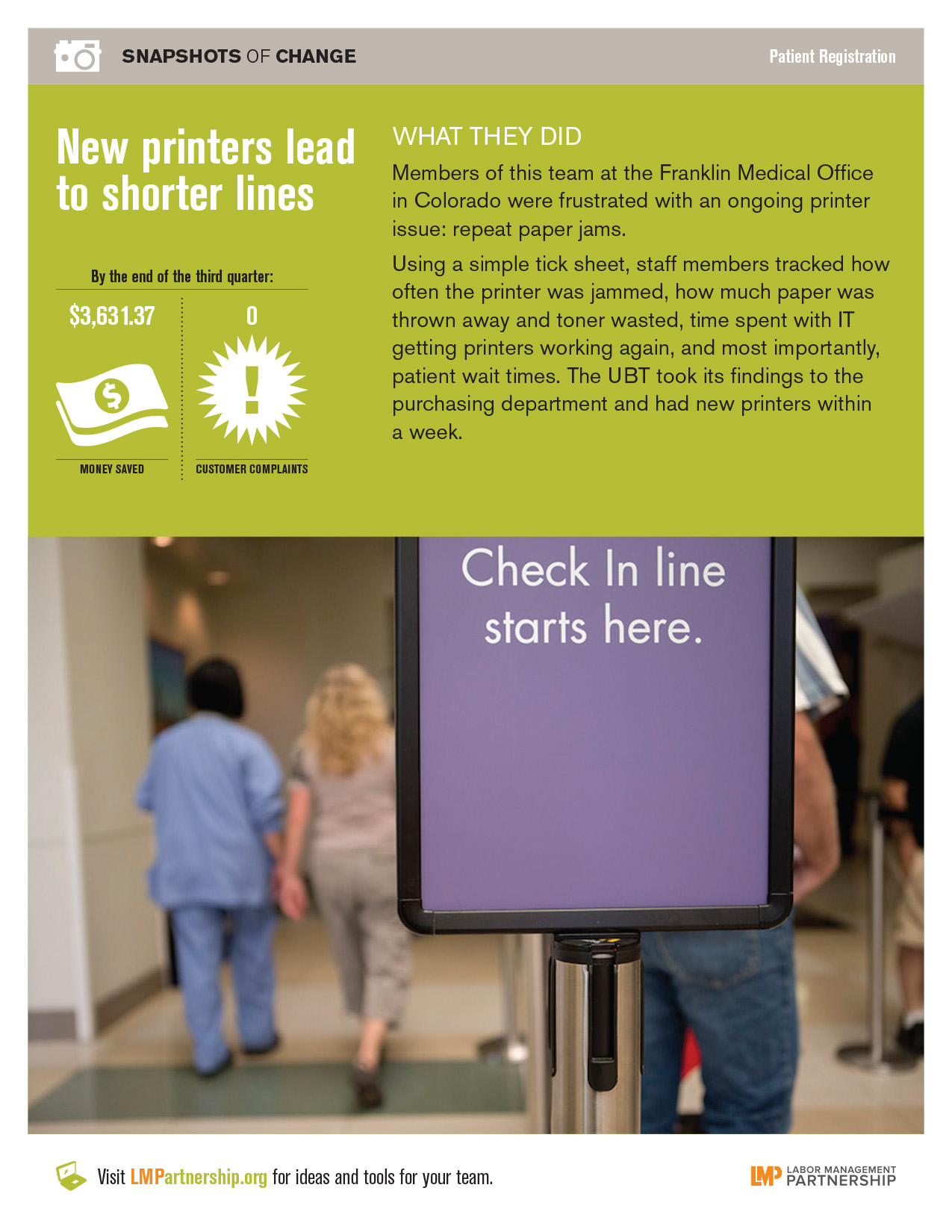
PPT: New Printers Lead to Shorter Lines

Format:
PPT

Size:
1 Slide

Intended audience:
LMP employees, UBT consultants, improvement advisers

Best used:
This PowerPoint slide features a Colorado UBT that saved money and reduced customer complaints by tackling a printer problem. Use in presentations to show some of the methods used and the measurable results being achieved by unit-based teams across Kaiser Permanente.

Related tools:

TOOLS

Poster: New Printers Lead to Shorter Lines

Format:
PDF

Size:
8.5" x 11"

Intended audience:
Frontline employees, managers and physicians

Best used:
This poster, for use on bulletin boards, in break rooms and other staff areas, features a Colorado team that saved money and reduced customer complaints by tackling a printer problem.

Related tools:

TOOLS

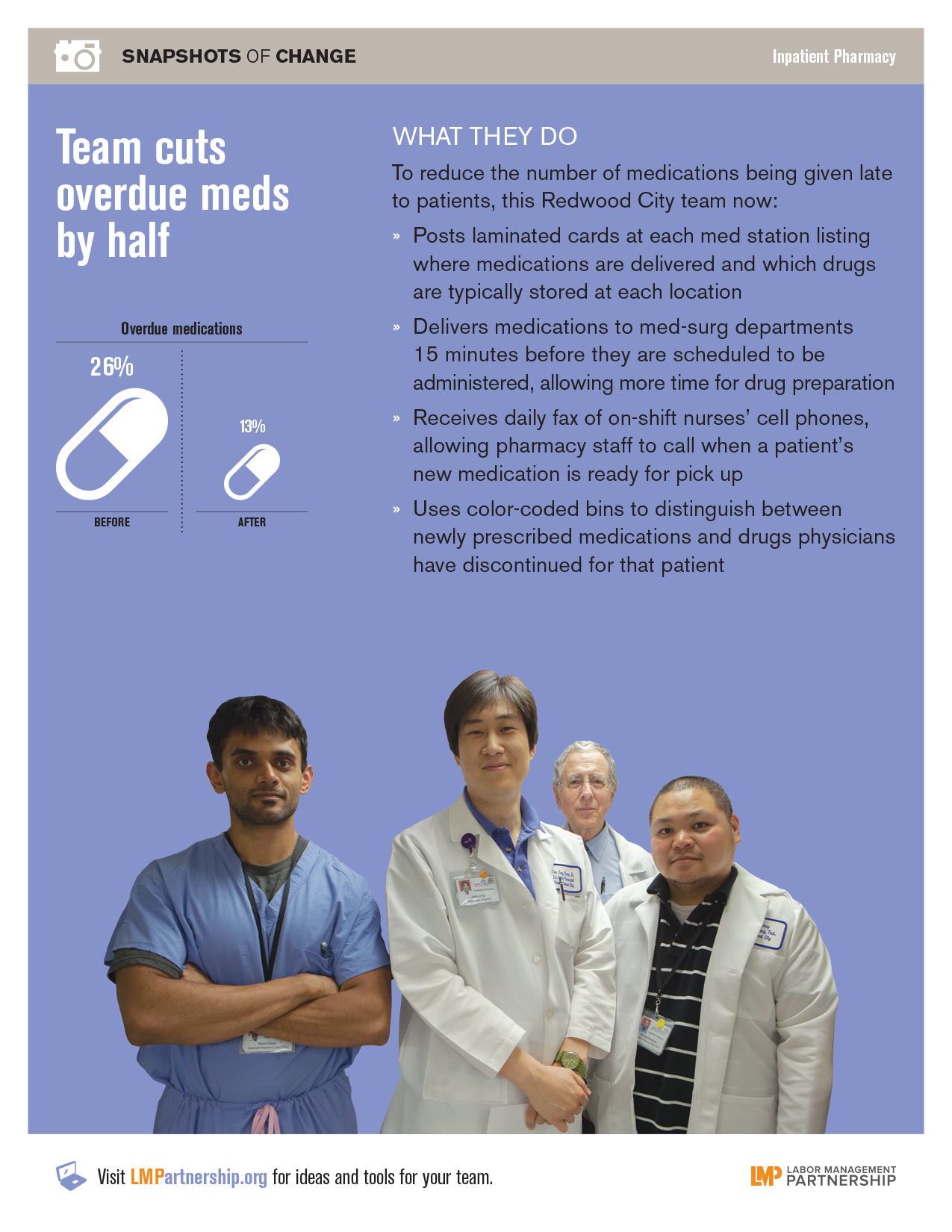
Poster: Team Cuts Overdue Meds by Half

Format:
PDF

Size:
8.5" x 11"

Intended audience:
Frontline employees, managers and physicians

Best used:
This poster features a Northern California team that found a way to get medications to patients in the hospital more quickly. Post on bulletin boards, in break rooms and other staff areas.

Related tools:

TOOLS

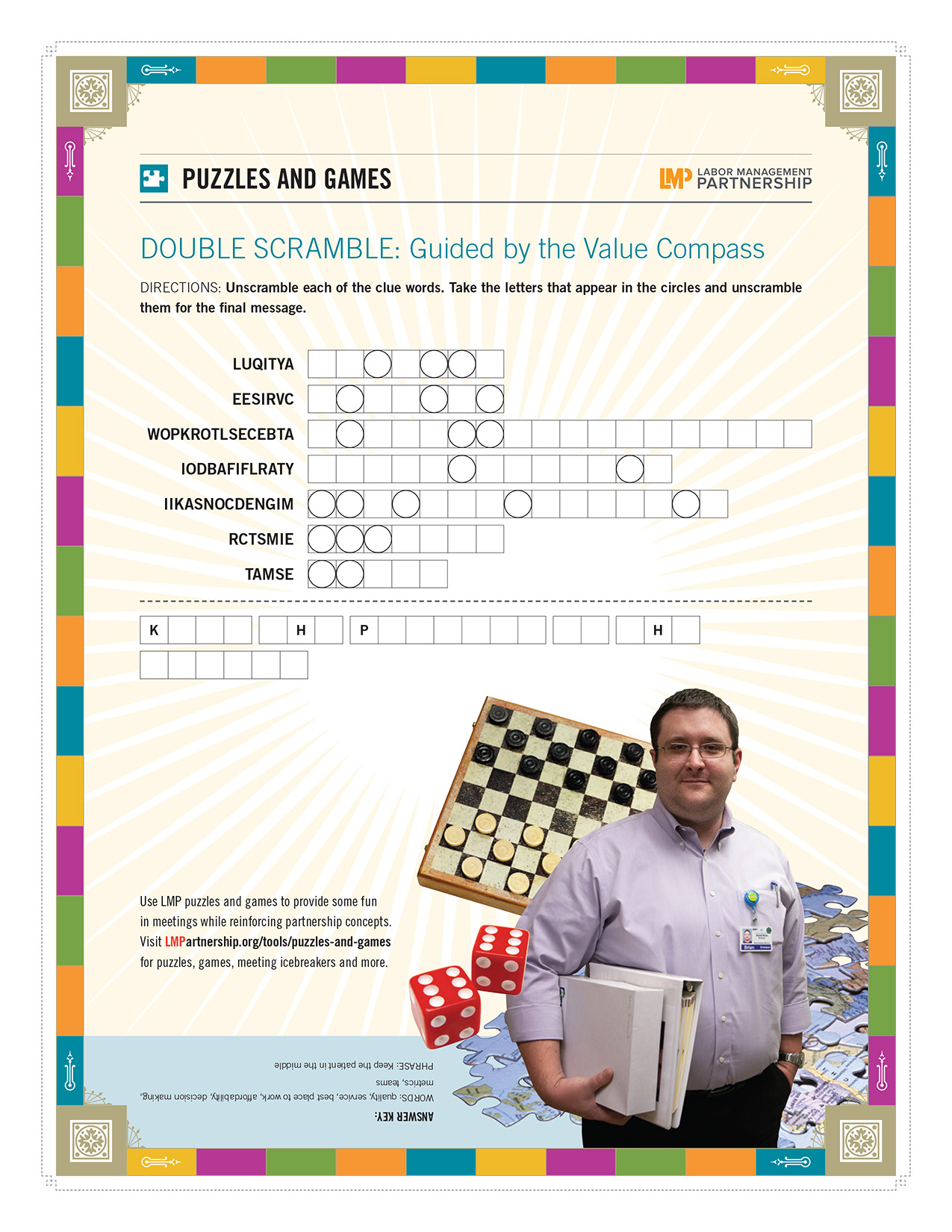
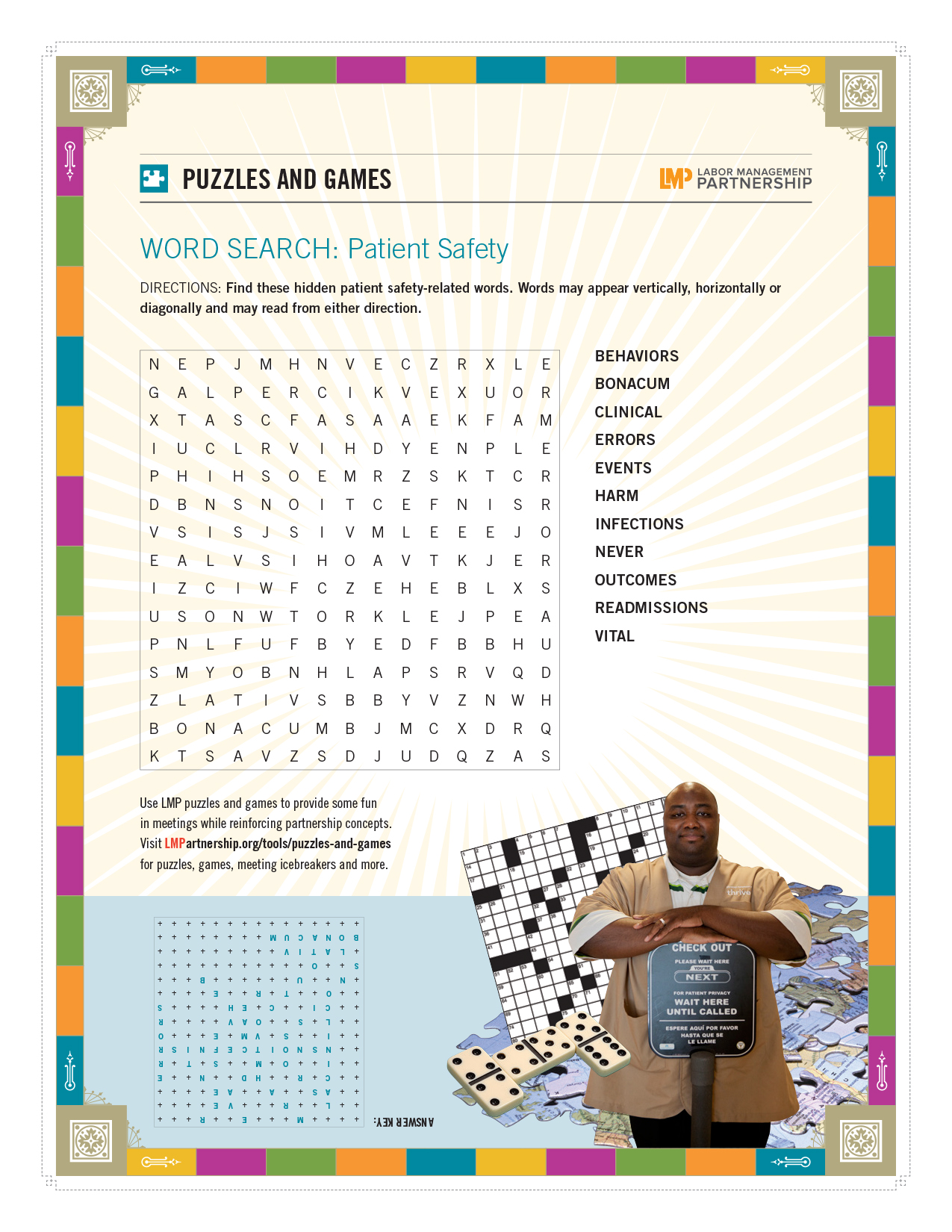
Word Search: Patient Safety

Format:
PDF

Size:
8.5" x 11"

Intended audience:
Frontline workers, managers and physicians

Best used: 
For the times when you want to take a light approach to a serious topic at a team meeting. This word search includes patient safety terms.

Related tools:

Pages

Subscribe to RSS - Frontline Workers