
Georgia
Help Video
How to Find UBT Basics on the LMP Website
LMP Website Overview
How to Find How-To Guides
This short animated video explains how to find and use our powerful how-to guides
How to Find and Use Team-Tested Practices
Does your team want to improve service? Or clinical quality? If you don't know where to start, check out the team-tested practices on the LMP website. This short video shows you how.
How to Use the Search Function on the LMP Website
Having trouble using the search function? Check out this short video to help you search like a pro!
How to Find the Tools on the LMP Website
Need to find a checklist, template or puzzle? Don't know where to start? Check out this short video to find the tools you need on the LMP website with just a few clicks.
Building Bridges
Deck: Teams look inward to achieve inclusive and equitable care
Deck:
Teams look inward to achieve inclusive and equitable care
Story body part 1:
Spurred by nationwide protests against racism and social injustice, unit-based team members are launching cultural competency projects aimed at delivering more equitable outcomes for their patients by looking closely at their own beliefs.
Mid-Atlantic psychotherapist Erin Seifert knows that big change often involves many small steps. Delivering equitable care is no different, she says.
“To give our patients the support and resources they need, we have to start with ourselves and our own biases and cultural competence,” says Seifert, labor co-lead for the North Baltimore Behavioral Health team and a member of UFCW Local 27.
Team members, who are represented by unions belonging to the Alliance of Health Care Unions and the Coalition of Kaiser Permanente Unions, began a monthly lunch-and-learn series about bias awareness in November. Activities include a pre- and post-evaluation and guided learning exercises that stimulate conversation about differences.
“It’s very informative,” says Regina Foreman, a mental health assistant and member of OPEIU Local 2. “I’ve learned a lot, especially about implicit bias. The training is helping me be more aware of my own biases.”
Such responses are encouraging, says Kristin Whiting-Davis, operations manager and the team’s management co-lead.
“We need to be able to talk about our own privileges and our own biases,” Whiting-Davis says. “I hope it will help people practice having those discussions that, ultimately, will translate into the work we do with our members.
Welcoming all
Eager to protect their young patients from the effects of racism, members of the Southwood Pediatrics team in Jonesboro, Georgia, began by educating themselves. They held listening sessions for staff and read about the impact of intolerance on children.
Their efforts informed discussions on ways to create a more welcoming environment for patients, families and each other. Ideas include a coloring contest featuring uplifting images, adding diverse artwork to the department and creating resources for families coping with racial biases.
Next steps call for staff members to vote on the most promising proposals for further action.
“We want all cultures and races to feel welcome when they come to our pediatrics unit,” says Stephanie Henry, MD, physician co-lead of the Southwood Pediatrics team. “We all have biases. We need to be open and honest about how to confront them. Then we can build bridges to start having conversations about the patient’s health.”
With reporting by Brenda Rodriguez and Tracy Silveria.
Humans of Partnership:
Humans of Partnership:
Deck: Explore career options with new career paths tool
Deck:
Explore career options with new career paths tool
Story body part 1:
Kerene Hoilett always knew she wanted to work in health care — inspired by her grandmother, a nurse.
When she learned that nursing didn’t fit her, she forged her own path.
Hoilett joined Kaiser Permanente in 2007 as an ultrasound technologist in Georgia. Since then, she has completed a project management certificate, landed an internship and earned 2 college degrees on her way to becoming a diagnostic imaging quality consultant.
“I always have that drive to challenge myself,” Hoilett says. “How can I tap into my strengths more?”
To help employees and managers tap into their strengths, Kaiser Permanente has a new career paths tool.
The new tool at kpcareerplanning.org/paths is interactive and personalized to help you explore career options. Follow the prompts to fill out a profile and find opportunities that link your skills, interests and education to careers at Kaiser Permanente.
“Kaiser Permanente encourages career mobility,” says Monica Morris, director of National Workforce Planning and Development. “With career paths, we’re trying to show you all the different career opportunities and directions you could go in the organization.”
Partnership unions negotiated to include career paths in the 2005 National Agreement with Kaiser Permanente.
“The new career paths tool reinforces our commitment to supporting lifelong learning and career development,” says Jessica Butz, workforce development director with the Alliance of Health Care Unions. “Career paths are a fundamental piece to help give employees a road map for success.”
Pursuing opportunities
After Hoilett became lead ultrasonographer in 2013, her journey took a turn to pursue leadership opportunities.
As a United Food and Commercial Workers (UFCW) member, Hoilett talked with a Partnership union-supported career counselor from the Ben Hudnall Memorial Trust, leading her to a project management pilot program. A project management certificate and 6-month internship at the regional office followed. The trust paid her to work at the internship one day a week, while she worked her regular job 4 days a week.
Hoilett applied for open positions but was unsuccessful, so she reviewed her experience gap with her career counselor.
“She encouraged me. I knew one day I would get that opportunity, and she helped me to be confident,” Hoilett says. “I wasn’t left in the dark. The career counselor was able to light my path.”
Hoilett’s persistence paid off. In 2018, she earned her master’s degree in project management and became a diagnostic imaging quality consultant. She’s using her people, project and technical skills to improve productivity and performance for imaging techs.
She isn’t stopping there. She continues to increase her impact in her current role while exploring learning opportunities in organizational leadership. And she encourages colleagues to learn, take courses and grow their careers — just like her.
“Don’t be afraid,” Hoilett says. “If you keep going, you will be successful.”
Staff Directory
Full Directory
Yael Foa
Title:
Alliance Director for both Mid-Atlantic and Georgia
Region:
Business Entity:
Alliance of Health Care Unions
TOOLS
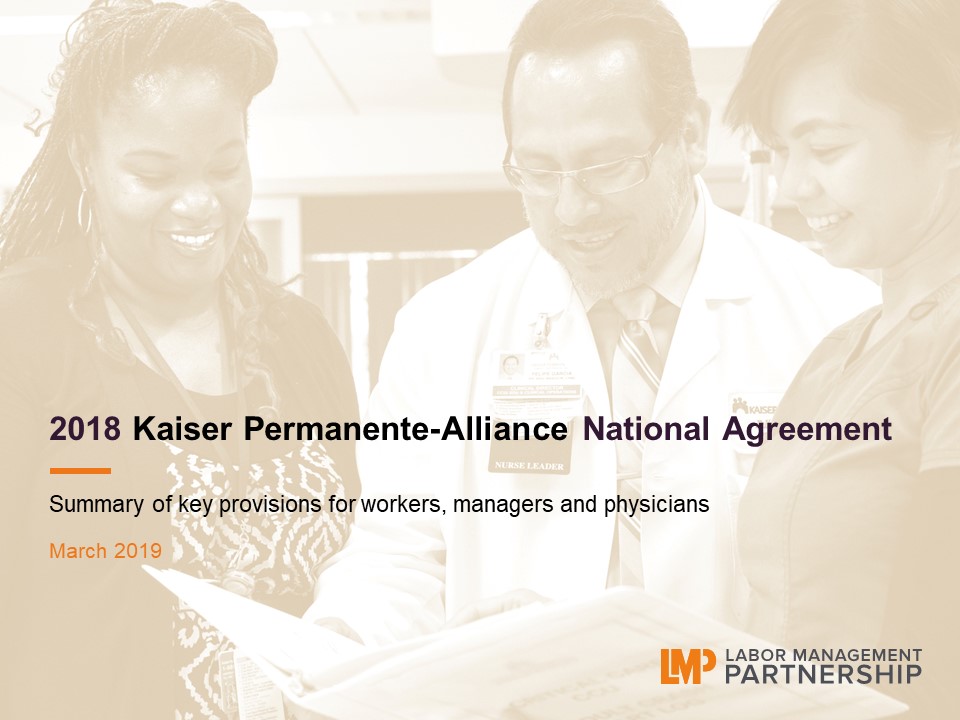
2018 KP-Alliance National Agreement Summary
Format:
PowerPoint
Size:
8.5 x 11"; 13 pages
Intended audience:
Workers represented by the Alliance of Health Care Unions, their managers, and physicians who work with them
Best used:
Get an overview of key provisions of the agreement.
Dialysis UBT Decreases Costs by Increasing Education
- Providing more information on the dialysis process
- Scheduling surgery for fistulas sooner
- Minimizing the time patients use catheters for dialysis
What can your team do to reduce infections? And are there ways educating patients can improve the care experience?
Staff Directory
Full Directory
Melissa Cofino
Phone:
(404) 364-4801
Email:
Melissa.Cofino [at] kp.org
Partnership: Just What the Doctor Ordered
Deck: Georgia physician becomes an LMP advocate
Deck:
Georgia physician becomes an LMP advocate
Story body part 1:
Emile Pinera, MD, a second-generation Kaiser Permanente employee, came to the company five years ago and immediately became co-lead of an adult medicine unit-based team in the Georgia region.
“I had the clinical part down,” says Pinera, who is now lead physician for diversity and inclusion in Georgia and an adviser on the region’s transgender task force. But being a co-lead and working in a UBT were unfamiliar. “I had to implement my medical knowledge in a team, as opposed to a top-down approach where the doctor tells everyone what to do.”
He wasn’t convinced at first—but the partnership approach and physician participation helped elevate the team’s performance, and it posted some of the region’s highest quality scores for managing diabetes and blood pressure.
“We achieved it through hard work and collaboration,” Pinera says. “I loved working with my management and labor co-leads. We were respectfully honest about what was achievable. Working in the UBT gave us the tools to effectively communicate, track, adjust and improve.”
Pinera currently guides and supports co-leads as a UBT sponsor for three teams and is lead physician for three adult medicine offices. His enthusiasm helps his teams, the members and the Georgia region.
“I was skeptical at first about UBTs’ relevance, but we couldn’t achieve our success with hypertension and diabetes management without each other’s help. I’m a believer,” he says. “My tip for fellow providers is to be engaged as much as possible, because it will help us achieve better outcomes and help our patients thrive.”
Pages
