
Videos
Strength in Numbers
Loading the player...
(1:42)
A Physical Therapy unit-based team discovers the power that comes from engaging every team member.
This short animated video explains how to find and use our powerful how-to guides
Does your team want to improve service? Or clinical quality? If you don't know where to start, check out the team-tested practices on the LMP website. This short video shows you how.
Having trouble using the search function? Check out this short video to help you search like a pro!
Need to find a checklist, template or puzzle? Don't know where to start? Check out this short video to find the tools you need on the LMP website with just a few clicks.
(1:42)
A Physical Therapy unit-based team discovers the power that comes from engaging every team member.
What can your team do to welcome new members? And what could your team do to leverage its members' unique strengths and knowledge?
What can your team do create smoother workflows? And how could your team work better with other UBTs to improve performance?
Creating a better workplace turns cynics into champions of unit-based teams. UBTs give workers represented by a union in the Coalition of Kaiser Permanente Unions a way to lead change. They help workers, managers and physicians better serve Kaiser Permanente members and patients. Yet too many people don’t know they are part of a UBT. Truth is, everyone in the unit is a UBT member. And, as you’ll see in this issue, engaging with your team can change lives—including your own. Read on and see how.
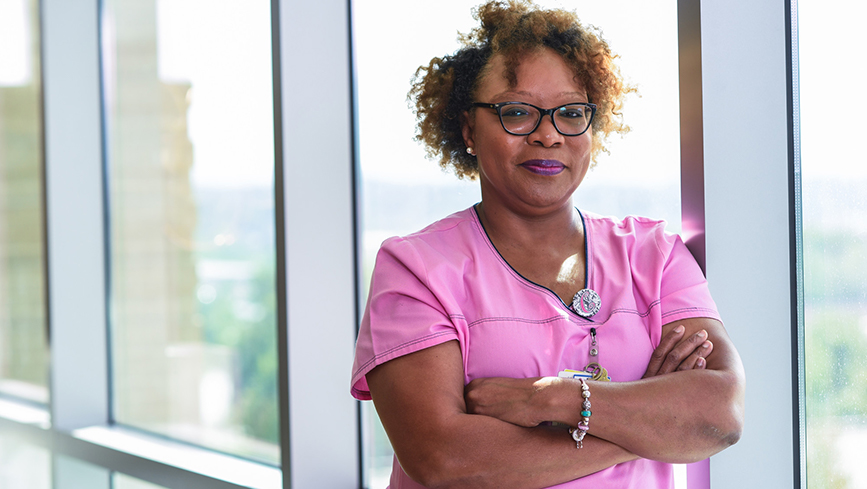
Kimberly Carolina, clinical assistant, OPEIU Local 2, Neurology (South Baltimore Medical Center, Mid-Atlantic States)
"When we first learned about working in partnership, I thought it would be difficult. I was a little skeptical and reluctant. It was hard to work with management because they’re actually your boss. I was part of a hiring team and felt uncomfortable speaking up to say why I thought certain candidates wouldn’t work.
Working as a team was very new to everyone. I wondered if there would be backlash or repercussions. Some employees didn’t feel secure about their jobs and didn’t feel like they even had a voice. One day, I realized they were the same as I was. I had a fear of speaking up and so did the managers. After I realized that, we were able to move forward. Employees, providers and everyone needed to have a voice. We needed to not only talk, but to make things happen. It’s been a lot of learning, a lot of great experience and growth.
When I first started out I didn’t see how you needed each person and each piece to make the company grow. The puzzle came together for me.
Now the communications piece is there. We work to be effective, efficient and see the broad picture. It’s amazing to see everyone come together with one common goal to fix things, such as patient wait times.
I enjoy it better now. I’m learning more. I like the results I have seen. Partnership is like you had a child two decades ago and they’ve grown up to be a successful person."
The Labor Management Partnership operates in eight states and the District of Columbia, where Kaiser Permanente has a presence. These markets serve the needs of their respective KP members and patients, guided by a common set of partnership principles and practices. Learn more about each.
Serves nearly 506,000 members in 32 medical offices. Of its 264 unit-based teams, 184 (70 percent) were rated high performing as of December 2024.
Serves more than 327,000 members in 27 medical offices. Of its 100 unit-based teams, 79 (79 percent) were rated high performing as of December 2024.
Serves over 785,000 members in Maryland, Virginia and the District of Columbia in 42 medical offices. Of its 252 unit-based teams, 179 (71 percent) were rated high performing as of December 2024.
Serves 4.6 million members in 206 medical offices and 21 hospitals. Of its 1,359 unit-based teams, 542 (40 percent) were rated high performing as of December 2024.
Serves over 612,000 members in Oregon and Southwest Washington, in 50 medical and dental offices and 2 hospitals. Of its 373 unit-based teams, 261 (70 percent) were rated high performing as of December 2024.
Southern California serves 4.8 million members in 198 medical offices and 16 hospitals. Hawaii serves nearly 266,000 members throughout the islands, in 23 medical offices and 1 hospital. Of 1,276 unit-based teams, 979 (77 percent) were rated high performing as of December 2024.
Serves nearly 587,000 members in the Puget Sound area and east to Spokane with 36 medical facilities. The Washington region became part of Kaiser Permanente in 2017. It has 83 unit-based teams as of December 2024.
These departments (Finance, Health Plan Administration and IT) serve KP members, patients and staff across the program. Of 80 unit-based teams, 49 (61 percent) were rated high performing as of December 2024.
At 8 a.m. every workday, an alarm sounds at the Member Services Call Center in Denver. Instantly, Olivia Johnson and her entire unit-based team of customer service representatives to leap out of their seats.
And dance.
The dance break tradition started when one of Johnson’s co-workers set a regular medication alarm that plays music.
“He started dancing when his alarm went off, then another person started dancing with him. Now it’s all of us dancing every morning,” says Johnson, a member of SEIU Local 105. “Afterwards we clap and tell each other it’s going to be a good day.”
Shaking their groove thing, having regular potlucks and sharing information that might make work easier for others are ways Johnson’s team combats potential stress at work. Constant stress can result in faster breathing and an increased heart rate, which the American Heart Association says can lead to physical pain, depression and unhealthy behaviors to compensate.
The members of Johnson’s UBT also alternate work assignments, so that representatives aren’t doing the same thing every week. One week, half of the team fields the calls from Kaiser Permanente members, while the other half answers questions from all of Colorado’s customer service representatives via SameTime chat. The next week, they switch. The variety helps keep the demands of the job manageable.
Terrence J. Cooper, who manages the Maple Lawn Call Center in Fulton, Maryland, says one reason working in a call center can be stressful is, simply, the nature of the work.
“We take complaints here,” says Cooper, who has been at Kaiser Permanente since 2006. “Complaints alone can be stressful.”
Cooper, who manages 20 people, tries to keep his team upbeat by injecting humor into his UBT’s daily huddles and team meetings. The team also host potlucks and does team-building activities outside of work, such as bowling.
“This allows us to catch up as a team,” Cooper says. “We talk about the weekend or the kids. It gives everyone an opportunity to take their minds off that last call.”
Cooper also serves as the local co-lead for the Kaiser Permanente wellness program “Live Well, Be Well” and tries to promote a healthy work environment to reduce stress. Frequently, fitness video games, board games or music are available in the break room to help folks “de-stress,” he says. “We try to lighten the mood.”
There’s a serious side to adding fun and festivities to the job: A study in the 2006 Ivey Business Journal Online found that workers who feel empowered and engaged—one of the outcomes of the light-hearted endeavors—are more productive and have fewer safety incidents.
Another key element to reducing stress is giving people the ability to make more decisions at work, says Deashimikia Williams, a customer service representative in Maryland and member of OPEIU Local 2. Williams also serves as her UBT’s union co-lead and is a member of the national call center “Super UBT,” whose membership crosses regional boundaries.
Williams says empowering workers and improving their work processes can have a positive impact on stress at work. Making customer service representatives, CSRs, aware of what they can do to resolve a member’s issue also reduces frustration, says Williams, whose role on the Super UBT includes exploring different improvements.
“We look at the issues CSRs and managers experience on the floor. If we streamline a process, it may not be as stressful,” Williams says. “If we can let them know what can be done by each department and who can help resolve a member’s problem, it reduces frustration.”
What can your team do streamline processes to meet patient care goals?
The new Lone Tree Specialty Care Medical Office, a 25-acre campus, boasts outdoor patios, picturesque mountain views and a walkway around the perimeter of the building. The facility, which opened in December 2013, was awarded a LEED (Leadership in Energy and Environmental Design) Silver certification by the United States Green Building Council. Lone Tree, which is near a light rail line, used recycled materials, water-wise fixtures and shading devices for balancing solar heat to win the LEED designation. The facility has nearly 350 employees and 45 physicians to take care of the 3,000 ambulatory surgeries and 3,000 minor procedures expected per year.
What happens when two nurses from two different high-performing UBTs transfer to the same brand-new Level 1 team? That team zooms to a Level 4 in only 10 months. Jane Baxter and Ingrid Baillie, both RNs, had been UBT co-leads at the Crescent and Cumberland medical centers, respectively, and then joined the Ob/Gyn staff at Alpharetta. Drawing on their experience—at different times, they each have been UFCW Local 1996 members and members of management—they helped their new UBT move up through the Path to Performance. “We knew the steps in the process and what to expect,” says Baxter. Their advice to fledging teams: Start with small performance improvement projects in areas that clearly are Kaiser Permanente priorities and that already have lots of data collected.
Nurses on the 1-West Medical-Surgical unit-based team at Moanalua Medical Center vastly improved how well they educate patients about medications, moving from about 40 percent of surveyed patients saying they understood side effects and other aspects of their prescriptions to 96 percent reporting this awareness. Between April and December 2013, the RNs, who are members of the Hawaii Nurses’ Association (HNA), made notations on patient room whiteboards, rounded hourly and did daily teach-backs on every shift. The team members designed a three-day survey for a sampling of patients to report what they understood about side effects of their medicine. The survey provided speedier feedback than waiting more than three months for HCAHPS (Hospital Consumer Assessment of Healthcare Providers and Systems) scores.
A Nephrology team at Tysons Corner Medical Center in Virginia helped patients prevent or manage chronic kidney disease by getting them into the classroom. Just 70 percent of the unit’s patients at risk of renal failure were enrolling in KP disease management classes in February 2013. But several successful tests of change boosted at-risk patient enrollment in March to 100 percent, where it has remained since. The team noted on individual patient charts if the member suffered chronic kidney disease, developed scripting for in-person coaching, mailed class invitations to patients’ homes and handed out class agendas with after-visit summaries.
The Modesto Pediatrics UBT improved wait times for immunizations—and not only increased service scores but also reduced overtime costs, an example of how a change can affect an entire system. The team reduced patient waits for immunizations from 45 minutes to 15 minutes between June and August 2013 and maintained the improvement through the rest of the year. A workflow change was key to the dramatic reduction. When a patient is ready for an injection, physicians now copy the orders to a nursing in-box instead of searching for a licensed vocational nurse to give the shot. The half-hour reduction in wait times—which is credited with improving service scores from 86 percent to 95 percent—also reduced the need for LVN overtime by an hour a day, resulting in savings of more than $16,600 over six months.
The regional Employee Health and Safety department won KP’s “Engaging the Frontline” National Workplace Safety Award. Through the Northwest’s Safety Committee Challenge, facilities had to complete a rigorous set of tasks, including regularly scheduled safety meetings, joint planning with NW Permanente and Permanente Dental Associates, safety conversation training, awareness plans and a safety promotion event during the year. Of the 16 facilities that rose to the challenge, nine met all of the qualifications. The region ended the year with a 4 percent reduction in accepted claims compared with 2013. Leonard Hayes, regional EVS manager, won the individual award for his work, which contributed to the East service area’s EVS team going injury-free for the last four years.
The regional LMP council has set a 2014 Performance Sharing Program (PSP) goal to power up unit-based teams’ achievements on improving affordability. When at least 50 percent of a medical center’s UBTs complete a project that saves money or improves revenue capture—and if the region meets its financial goals—eligible employees and managers there will get a boost in their bonus. “Imagine how powerful it will be to have a majority of unit-based teams achieving measurable cost-savings and revenue-capture improvements,” says Josh Rutkoff, a national coordinator for the Coalition of Kaiser Permanente Unions. “The idea is to take all the strong work on affordability at the front line to a whole new level.”
What can your team do to effectively respond to workflow and target changes? What else could your team do to meet targeted goals?
