Program-wide

Help Video

How to Find UBT Basics on the LMP Website

Learn how to use the LMP website:

LMP Website Overview

Learn how to use the LMP website:

How to Find How-To Guides

This short animated video explains how to find and use our powerful how-to guides

Learn how to use the LMP website:

How to Find and Use Team-Tested Practices

Does your team want to improve service? Or clinical quality? If you don't know where to start, check out the team-tested practices on the LMP website. This short video shows you how. 

Learn how to use the LMP website:

How to Use the Search Function on the LMP Website

Having trouble using the search function? Check out this short video to help you search like a pro!

Learn how to use the LMP website:

How to Find the Tools on the LMP Website

Need to find a checklist, template or puzzle? Don't know where to start? Check out this short video to find the tools you need on the LMP website with just a few clicks. 

Learn how to use the LMP website:

LMP Communications

Our team of communicators produces videos and tools, writes stories, and offers consulting. We’re here to inspire you, help you find and share successful practices, and support your team’s progress on the Path to Performance. This website, LMPartnership.org, provides tips, tools, award-winning videos and stories that will support your day-to-day work. 

Contact Us

Have a story idea or a question about the eStore? Need to update your contact information on the website? Got a general question?

Email us at: lmp-feedback [at] kp.org


When Every Day Is Partnership Day

Deck: 
Organizations, unions from across the nation explore a more collaborative future

Story body part 1: 

What if every organization and every union had a labor management partnership like ours?

It’s not as far-fetched as it sounds. On Aug. 16, more than 250 union, business and government leaders from all over the United States gathered in Chicago for Partnership Day, a meeting hosted by the Federal Mediation and Conciliation Service at its biennial conference—and offered a realistic look at the ups and downs that occur in partnerships and what it takes to launch and sustain them.

“We know partnership can make a difference,” Allison Beck, FMCS director, told the gathering. “This is not some fantasy that happens in a make-believe world.” She should know. As leader of the FMCS, the federal agency that mediates labor disputes across the United States, she’s seen firsthand how acrimonious relationships can ruin companies and unions—and how more open and respectful ones can help them both succeed.

The partnership between Kaiser Permanente and the Coalition of Kaiser Permanente Unions is the longest-lasting and strongest one in the nation, so conference participants asked many questions about how it operates.

A race to the top

Dennis Dabney, KP's senior vice president of National Labor Relations and Office of Labor Management Partnership, told the packed room he spends a lot of time on the phone with leaders from other companies interested in starting and strengthening partnerships.

“I've seen so many companies engaged in a race to the bottom,” Dabney said. “I'd like to see more engaged in a race to the top.” If he has any regrets about Kaiser Permanente’s partnership, he said, it's that we didn’t create unit-based teams sooner.

Around the Regions (Fall 2012)

Deck: 
In support of sponsors

Story body part 1: 

Colorado

The Regional Imaging teams in Colorado are lucky to have two effective sponsors: Joseph Gonzales, clinical operations for Regional Imaging, and Rebecca “Becky” Torres, a pharmacy technician and SEIU Local 105 member. Part of their success, the pair says, is the emphasis they have placed on sharing information—with each other and with their teams. The pair also figured out a way to spread effective practices. Using a PowerPoint template, the sponsors asked co-leads to explain what they’re working on, how it supports regional goals, whether it worked and the outcome. Then, the teams came together for a UBT Fair and shared their PowerPoints.

Georgia 

David Jones, MD, has a title unique at Kaiser Permanente: assistant to the medical director for unit-based teams. He mobilizes his fellow physicians in the Georgia region to get involved with UBTs and unleash the power of partnership to improve performance and grow membership. “The first thing I tell physicians about the UBTs is that it is about improving the work that we’re already doing,” he says. “It’s not about adding more work, it’s about looking at the work you're doing and figuring out how to do it better.” Read more from Jones—including how his experience with UBTs has transformed the way he delivers care to his patients.

Hawaii

A small region, Hawaii needed a novel approach to sponsorship: Branch out rather than always branch up. Initially, a five-member unit-based team committee tried to troubleshoot issues for the region’s fledgling teams. Often, those committee members, who also had roles as team co-leads or contract specialists, were trying to wear too many hats and got jammed. So the region, which now has more than 40 teams, has tapped 19 people to receive sponsorship training. The group includes middle managers, directors and other executives, frontline nurses who serve on the Kaiser Permanente board of the Hawaii Nurses Association, OPEIU Local 50, and former labor team members and co-leads.

Mid-Atlantic States

While the Mid-Atlantic States region’s clinical unit-based teams have management and labor co-sponsors, large teams such as lab and radiology are sponsored in a different way: A UBT leadership group made up of labor and management from these area performs sponsorship functions as a united body. “We generated a vision of our UBT sponsorship. We got very specific on how we would work together,” says Jane Lewis, executive director of health plan regional services and a member of the group that sponsors eight pharmacy UBTs. The UBTs report their projects and team dynamics at monthly meetings. The leadership group reviews People Pulse, service scores, quality results and other metrics, identifies struggling teams, and recognizes teams that excel.

Northern California

The region has been on a roll with its “A Leader’s Role as UBT Sponsor” training. Launched in the spring, the tutorial gives management and labor leaders an easy-to-understand yet in-depth look at providing effective support to unit-based teams and their performance improvement work. The short, online training covers everything from outlining a sponsor’s role and how a sponsor can model partnership to tips on developing strong UBT co-leads and high-performing teams. Several facilities have combined the training with in-person, interactive exercises, and early feedback suggests the blended approach is striking a chord with sponsors. The online training can be found at KP Learn.

Northwest

“My role as a senior sponsor is to bring the message of UBTs to physician leadership,” says Rasjad Lints, MD, the region’s executive sponsor of UBTs. Lints is especially interested in helping teams focus on outcome metrics—a measure of the final result of something, such as how many patients with hypertension have their blood pressure under control—and to help everyone on the team understand that improving on process metrics often drives improvement on outcomes. It can be difficult to see the value in participating in process metrics if team members don’t see how it relates to the outcome measures. “At the end of the day, physicians have to drive the care,” Lints says. While working in UBTs presents physicians with some unique challenges, he believes that “if the physicians aren’t engaged, it’s a lost opportunity.”

Ohio

In an effort to improve the quality of team project information in UBT Tracker, the regional LMP support team solicited the help of the people who support the work of teams—sponsors. In June, an improvement adviser met with Ohio’s 20-plus sponsors and asked them to work with their teams to boost the input of that data. To illustrate the value and role of quality data in UBT Tracker, they used the data in Tracker to brief the sponsors on their UBTs’ projects and status. Their approach made an impact: The region has reported an increase in sponsor engagement, and several teams have reported performance and relationship improvements. 

Southern California

The regional Labor Management Partnership department is launching a new sponsor training curriculum that covers the nuts and bolts of what sponsors do and how they do it. Topics include: the responsibilities of sponsoring bodies (such as helping define how the teams should be structured and guiding selection of co-leads); coaching skills to help develop UBT leaders; the similarities and differences between labor and management sponsorship; how managing in partnership differs from traditional management; and how the sponsor role differs from that of facilitators, project managers, trainers and consultants. Also included in the course are basics of the Labor Management Partnership and unit-based teams, such as the key elements for UBT success, the roles and responsibilities of UBT co-leads and members, and consensus decision making.

Around the Regions (Winter 2013)

Deck: 
Saving pennies, saving lives

Story body part 1: 

Colorado

When the Minor Procedures department at the Franklin Medical Office added three surgeons to its staff, the impact was positive: Access improved—patients got in faster. But staff members noticed the new surgeons were using $20 to $30 more in dressings and drapes than surgeons who had been in the department longer. The physicians responded positively when shown the information and, while allowing for medically justified exceptions, have standardized their usage of soft goods so it is more cost effective.

Georgia

The Oncology/Infectious Disease staff at the Cumberland Medical Office Building embarked on a medication reconciliation project to keep patients safe and avoid unnecessary hospital admissions. A manual cleanup of patient records came first. To check the accuracy of the records, medical assistants and licensed practical nurses, all members of UFCW Local 1996, called patients and asked them to bring their medications (or a list) to their next appointment. Providers deleted duplicates and worked across clinical disciplines and with pharmacy colleagues to sustain and improve the process. In just three months in 2011, the percent of duplicate medications fell to 15 percent, which translates to $90,000 saved by reducing hospital admissions.

Hawaii

The nurses in the 23-bed Mother/Baby unit at Moanalua Medical Center learned a lesson in human nature when they placed life-saving emergency airway kits—essential for keeping a weak infant's airways unobstructed—at each bedside. Individual parts of the kits come in handy in other procedures and regularly turned up missing. Keeping everything in zippered plastic bags with a “do not remove” sign didn’t do the trick. But after the team started re-purposing breast pump kit bags--which are sturdier and have labels with room to list the kit’s contents, whether an item has been used and if it’s been replaced—the team went from 75 percent of beds with fully stocked kits to 100 percent in four months.

Mid-Atlantic States

The Adult Primary Care UBT in Falls Church, Va., is using the New Member Identifier tool in KP HealthConnect as the basis for targeted welcome letters and phone calls to set up appointments with primary care physicians and help refill prescriptions. And, when a new member comes in, he or she is provided with a new member kit and offered a one-on-one facility tour. Patient satisfaction percentile scores have risen from 84.6 in the first quarter to 87.4 in the third quarter. Cassandra Hodziewich, MD, a family practice physician, says more new members “are getting needed labs (and) screenings."I think it’s made a difference in the quality of their care."

Northern California

Santa Clara Medical Center showcased its performance improvement work in October to eight UBTs from five regions as part of a two-day LMP learning lab. Visiting the Cardiovascular ICU, the delegation learned how the team uses visual boards to share improvement ideas and track projects. The Pharmacy department explained how it used Six Sigma to reduce workplace hazards, and the Women’s Clinic department outlined its use of process mapping to reduce lab errors. On returning home, the visitors were tasked with finding ways to implement some of what they learned.

Northwest

The Primary Care Team B staff at the North Lancaster Medical Office feels especially strongly about the importance of detecting colorectal cancer early, when it’s highly treatable, since some of their own providers have suffered from the disease. The team, which presented a poster at the Institute for Healthcare Improvement conference in December, tracks who’s eligible for a Fecal Immunochemical Test (FIT) kit, makes sure those members get one, and follows up if the kit isn’t returned. And staff members tell patients how early detection made the difference for their co-workers. The return rate is now 85 percent, up from 50 percent. “We add a personal touch by telling our story,” says labor co-lead Bill Waters, a medical assistant and SEIU Local 49 member, “and people respond.”

Ohio

The Parma Internal Medicine UBT has had a host of successes in its journey to becoming a high-performing team. In addition to improving meetings by defining roles and responsibilities, it has ensured sponsor support and increased staff engagement by creating sub-committees to work on projects. One of its innovative tests of change? Team members decided that while continuing to reduce actual wait times, they would work on the perception of time that patients experience while waiting—and created a slide presentation. The slideshow plays on computers in exam rooms and features health information on chronic diseases.

Southern California

The Bonita Primary Care unit-based team in San Diego, which was included in a poster presentation at the annual Institute for Healthcare Improvement conference, set out on a four-month blitz to reduce its supply expenses by 10 percent, or about $4,750. The team agreed to decreased minimum levels of stock and made diagrams of shelves with new quantities. Staff labeled bins and removed, combined and organized the excess stock, and then used the excess as the primary source for exam room restock over the next four months. As a result, fewer supplies were stocked in exam rooms, fewer supplies were ordered and less stock expired (which would have needed to be replaced). In five months, the team saved nearly $24,700.

TOOLS

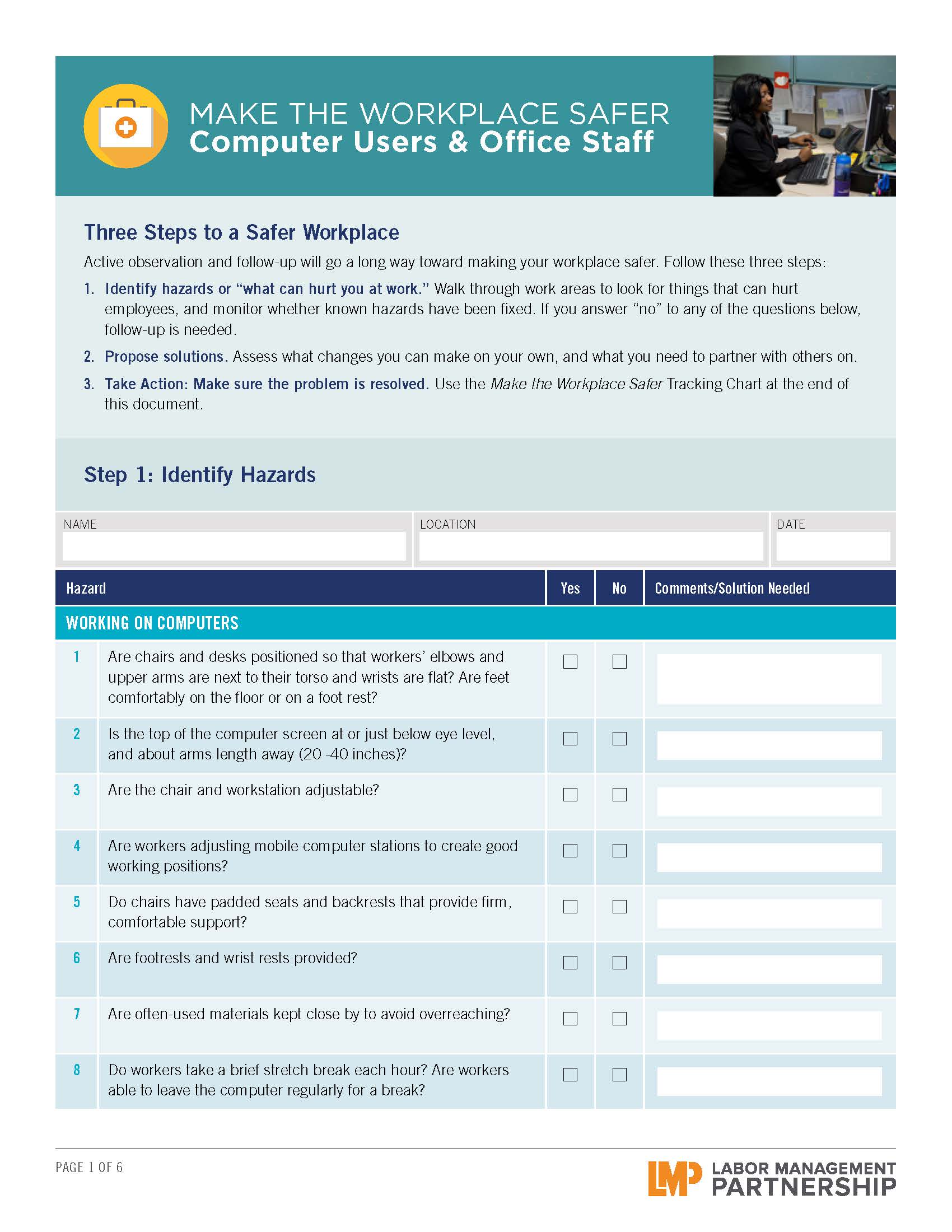
Make the Workplace Safer: Computer Users

Format:
PDF

Size:
Five pages, 8.5" x 11"

Intended audience:
Workplace safety co-leads, safety committee members and safety champions

Best used:
This checklist of 32 potential hazards can help workplace safety leaders and workers conduct onsite walk-throughs and identify safety risks for computer users and office staff.

Related tools:

Hair on Fire? There's Hope

Deck: 
Stress and health care work seem to go hand in hand. Here are ways to fix the problem.

Story body part 1: 

Struggling with stress? Got the burnout blues? We’ve all been there. A long line of patients snaking out the pharmacy door; appointments running a half-hour late.

Yet not all things that trigger stress are bad—getting excited before running a race is stressful; so is falling in love.

“A little bit of stress is good,” says Dawn Clark, MD, an ob-gyn specialist and chief facilitator of physician wellness for the Southern California Permanente Medical Group. “It helps you avoid boredom and keeps you engaged and energetic. But too much stress burns you out.”

Unfortunately, the chronic stress that leads to burnout is commonplace in health care. A 2013 survey found nearly 60 percent of health care providers are burned out. A 2015 nationwide poll showed burnout affects nearly half of all physicians.

The result? A burned-out workforce is one with low morale and high rates of absenteeism, turnover and workplace injuries. Inevitably, service and quality of care slip.

This issue of Hank takes a look at the causes of health care stress and burnout—and at the solutions. Read on to find out more about how:

  • Individuals can take steps to handle stress better.
  • Leaders can be role models and make solving workplace stress a priority.
  • Unit-based teams can address the root causes of burnout, finding remedies for lasting change.

Burnout: A widespread problem

Stress is the brain’s response to the demands put on us. Your pulse quickens, your muscles tense and you breathe faster. Everyday stresses are like small flames keeping you on alert. Burnout—which sets in when stress and frustration pile up without getting fixed—is your own personal forest fire.

Your body wears down as the constant flow of stress hormones suppresses your immune system and other functions. You don’t sleep well, and you become edgy, irritable and cynical. You don’t make good decisions. In short, you shut down. Making matters worse, your black cloud is contagious and can quickly spread to your co-workers.

Experts say burnout is usually caused by:

  • inefficient work procedures—and no power to change them
  • no sense of meaning and purpose to your workday
  • lack of work-life balance

In health care, the problem is even more complex. Frontline employees are expected to be selfless and put others’ needs first. But patients may be unhappy or demand answers when there are no easy answers to give. That’s stressful, and even more so when busy schedules are factored in.

UBTs to the rescue

Poorly designed jobs and systems are a leading cause of burnout, which means UBTs have amazing power to improve matters.

Say, for example, overlapping processes make a member-patient feel like she’s getting tossed from department to department. Her justifiable frustration may get unleashed on employees. A UBT provides a forum where an employee can speak up and say: “This process needs to change. What can we do to make the system smoother for the patient?”

That’s what Michael Leiter, an expert on workplace stress, says has to happen to reduce burnout. To fix it, you need to “change something that really matters about how you participate in your job.”

Sometimes the solutions are relatively simple. For members of the Esoteric UBT in the Sherman Way Central Lab in Southern California, working in cold, noisy room that made it hard to concentrate was causing stress—but they worked together and were able to move a key piece of equipment to a more comfortable room.

“Now at the end of the day, it doesn’t feel like I’ve just finished climbing a mountain,” says Gene Usher, one of the team’s research scientists. “It was a UBT success.”

Working together on performance improvement can cure what ails a team, as the Revenue Cycle team at Roseville Medical Center near Sacramento discovered. It also learned—as many teams do—that before it could fix its processes, it had to clear up underlying tensions first.

The team had low People Pulse scores; old conflicts between co-workers had never been resolved. So the team chose to improve its response to the survey question about “having a say in influencing decisions.”

“We decided to do tests of change that involved the staff more,” says management co-lead and former UBT consultant Kimberly Jones.

Team members started working together on improving the annual vacation process—a big morale boost. The 37-member team also took customer service trainings and a Kaiser Permanente Courageous Conversations class, which teaches different ways of approaching conflict and taking responsibility for your actions.

The class “made it easier to approach someone if there was a work problem,” says Stacey Kearny, an admitting representative and SEIU-UHW shop steward. “Now we act more like a team. When we come onto our shift, we ask the person leaving, ‘Is there something I can help you get finished?’”

Meet Your National Agreement: Champions for Health and Safety

Deck: 
By helping create a better workplace, new advocates also help improve patient care

Story body part 1: 

Rotonya Parker decided her journey to a healthier lifestyle could use some traveling companions.

She was already eating better and being more active when she learned that her unit-based team needed a Health and Safety Champion.

“I thought I should volunteer because doing it as a team would be an extra incentive,” says Parker, an external referral coordinator in Atlanta and a member of UFCW Local 1996. Since stepping up, she’s shared healthy recipes with her team and is planning a contest to see who walks the most.

Her activities help her UBT fulfill part of the 2015 National Agreement: The latest Path to Performance requires that Level 1 UBTs identify a Health and Safety Champion, who will help build the “culture of health and safety” required of Level 5 teams.

UBTs began identifying champions last fall. In January, they all received “Walk & Roll” buttons to help encourage their colleagues. They got going with an emphasis on walking and moving. In February, the theme was speaking up at work about safety concerns. Each month has a new focus.

With 32 years at Kaiser Permanente in Los Angeles under his belt, Darren “Tree” Wallace, a lead attendant in environmental services (EVS), offered to be his UBT’s champion. EVS departments frequently have a higher rate of workplace injuries, Wallace notes, so safety is key. Members of his UBT share daily tips about everything from how to avoid needle sticks to the proper way to push and pull.

“You don’t want to be old, retired and injured,” says Wallace, a member of SEIU-UHW. “You have to make sure your body is safe at work and at home.”

Take a break to thrive

For Johnyia King Turner, RN, a UFCW Local 400 member in the Mid-Atlantic States, volunteering to help her UBT as a champion was an obvious choice. Turner, who recently began working in Gastroenterology at Largo Medical Center in Maryland, frequently held two-minute thrive breaks when she worked at Capitol Hill Medical Center in Washington, D.C.

“We did squats, wall push-ups or ran in place,” Turner says. As lead nurse, she also presented safety messages in UBT meetings and paused during the workday to have quick safety conversations.

She says the messages were well received: “If you are not healthy and you are not safe, it decreases productivity and we can’t assist the members.” 

She’s excited to have a formal title to go with her passion. “I have my Walk & Roll button, and I encourage everyone to walk the stairs,” she says—and adds, laughing, “Now that I’m official, I can really go run my mouth and tell people what they need.”

From the Desk of Henrietta: Relieve Stress With ‘Yes, and’

Story body part 1: 

The chances are good you are a person who deals—directly or indirectly—with life and death every day. You might be an EVS worker who keeps patient rooms germ-free to reduce the odds of infection, or an ER nurse helping a baby with a high fever. If you are not on the clinical front lines, you likely support this honorable work from behind the scenes.

We put others first. We give everything to give the best care to our patients. But far too frequently, we don’t leave anything in reserve. We neglect to take care of ourselves. This imbalance undermines the admirable ethic of our modern health care system.

One survey showed 60 percent of health care providers are burned out. In this issue of Hank, we provide practical tips and tools that individuals, leaders and teams can use to reduce workplace stress.

But more than that, we challenge the notion that the responsibility for preventing burnout lies solely with one of these groups. Let’s call it the “yes, and” approach. Yes, individuals need to eat better, exercise more and cultivate a positive outlook to reduce their own stress. And, leaders need to ensure safe staffing levels and create a solution-oriented workplace culture.

Our Labor Management Partnership gives us a third “yes, and”: Yes, individuals and leaders matter. And, our unit-based teams can fix inefficient processes that cause unnecessary stress and interpersonal conflict.

Every day, Kaiser Permanente’s 3,500 UBTs use performance improvement tools that make our work go more smoothly. Moreover, those tools and the foundation of trust and openness fostered by partnership give everyone a voice in making improvements.

And that also reduces our stress.

Good Partnering Methods Aren’t Just for the Bargaining Table

Deck: 
How the interest-based process keeps potential problems from becoming real problems

Story body part 1: 

A former KP administrator, Michael Belmont now works for Restructuring Associates Inc., the consulting firm that helped during the creation and initial implementation of the Labor Management Partnership and that now helps facilitate national bargaining. He sees interest-based bargaining as a way to solve the problems of the future, before they arise, instead of getting stuck dealing with the baggage of past grievances.

My time at Kaiser Permanente dates back to the late 1980s. I was assistant hospital administrator in Panorama City, dealing with several unions. We were facing so much discord. It was all-encompassing, and it took the focus off improvement issues. The move toward interest-based bargaining and [the] Labor Management Partnership allowed us to put the focus on improving the member experience instead of continually trying to resolve labor problems.

Partnership, especially interest-based bargaining, gives employees and their unions a chance to have an impact on things they might not otherwise. They have a say beyond wages, hours and working conditions. In 2012, there was a bargaining subgroup on growth, focusing both on growing Kaiser Permanente and the unions. In a traditional setting, that doesn’t happen. For employees and their unions, the other side of the interest-based process is responsibility and accountability to take on and help solve the problems of the organization.

When we do trainings on interest-based problem solving, people will say, “This is how I deal with relationships.” If you are going to be a good partner—and have a successful relationship with a partner, kids, friends—you have to have your partner’s interests in mind as well as your own. Making this connection helps people connect the strategy to their work lives.

After 2000 bargaining, the Southern California region was looking for a change in labor relations, away from traditional, toward partnership. We were trying to move labor relations away from being a wall between the unions and management and toward facilitating a productive relationship between unions and management. I saw a gradual transition toward more of a partnering role. I left KP in 2006. I could come back [with Restructuring Associates] as a neutral [party] in 2010 and 2012 because of the [nature of the previous] relationships with union and management officials.

Interest-based bargaining is focused on solving problems up front rather than on grievances. People have to unlearn a lot of habits and build a lot of trust. There was 50 years of baggage [when the partnership started]. A traditional approach leaves lots of scars. Traditional is the comfort zone for most organizations. Traditional approaches are backwards looking: They are about solving problems from the past that pile up and wait for bargaining. Interest-based bargaining is about solving problems and issues that may come up in the future. Using the interest-based approach in bargaining and in day-to-day work is a much more forward-looking way to solve problems—and so much more effective.

Frontline Employees Get Intensive Ebola Preparation

Deck: 
KP, union coalition collaborate on training event

Story body part 1: 

Standing on a stage in front of hundreds of his fellow health care workers at the largest Ebola educational session on the West Coast to date, registered nurse Peter Sidhu demonstrated how to use personal protective gear in the way that keeps both patients and workers safe.

Sidhu inspected his equipment first—two pairs of gloves, a gown, mask and face shield. Then Arjun Srinivasan, MD, the associate director for health care-associated infection prevention programs at the federal Centers for Disease Control and Prevention, gave him detailed, step-by-step instructions in putting them on.  

Resources

The Nov. 7 educational session in Los Angeles was hosted by Kaiser Permanente, the Coalition of Kaiser Permanente Unions and other organizations that are coming together to help frontline caregivers learn about the newest CDC protocols and guidelines for handling Ebola patients. Hundreds attended in person, while thousands more nationwide watched a live telecast of the event.

Pages

Subscribe to RSS - Program-wide