Northwest

Help Video

How to Find UBT Basics on the LMP Website

Learn how to use the LMP website:

LMP Website Overview

Learn how to use the LMP website:

How to Find How-To Guides

This short animated video explains how to find and use our powerful how-to guides

Learn how to use the LMP website:

How to Find and Use Team-Tested Practices

Does your team want to improve service? Or clinical quality? If you don't know where to start, check out the team-tested practices on the LMP website. This short video shows you how. 

Learn how to use the LMP website:

How to Use the Search Function on the LMP Website

Having trouble using the search function? Check out this short video to help you search like a pro!

Learn how to use the LMP website:

How to Find the Tools on the LMP Website

Need to find a checklist, template or puzzle? Don't know where to start? Check out this short video to find the tools you need on the LMP website with just a few clicks. 

Learn how to use the LMP website:

Communication Drives Success

Deck: 
Courier drivers in the Northwest improve routes after fixing communication and morale issues

Story body part 1: 

The Transportation department in the Northwest is coming out of a tumultuous time. A lack of trust between managers and employees created a barrier that affected morale—and made it difficult to focus on improving routes and processes.

The department uses a robust but complex process for optimizing its routes. For maximum efficiency, it has to integrate a variety of work streams and figure out where there are redundancies that can be eliminated. Because of the complexity of the process, however, it had been more than 15 years since the criteria and requirements for the transportation system from the customer’s point of view had been reviewed.

Eventually, the UBT worked out a thorough route-modernization plan based on data-driven service requirements and metrics that established parameters on how to revise and design its routes.

But before it got there, it had to fix its communication, which broke down so badly the team entered into an issue resolution. In the Northwest, the LMP Education and Training department is responsible for facilitating issue resolutions.

Blame-free solutions

“There was a lot of tension in the department, and people were nervous about losing their jobs as a result of our work around revamping routes. Poor communication was a problem,” says Greg Hardy, sponsor and manager of the department.

The issue resolution process uses interest-based problem solving, and that helped the team focus on a common goal: Serving its customers was the top priority and improving communication was a necessity. From there, other agreements came more easily, and the department was able to maintain staffing levels and improve processes as a result of its efforts.

Improved communication improves service

As a result of the improved communication, the team was able to improve service levels and achieve the efficiency and cost savings it had strived for.

“We have a group of dedicated workers who want things done the right way,” says logistics supervisor Chris Dirksen, the team’s management co-lead.

When it came to improving communication, the team members’ first step was to get a baseline measurement of what they were trying to improve. They created a survey that would measure not only communication but also morale and UBT effectiveness. Once they had that information, they created a SMART goal: to improve employee perception of communication, morale and UBT effectiveness by 15 percent within three months, raising the overall survey score from 2.55 to 2.93 by February 2014.

As the team began to investigate the issues, it discovered email was not a good form of communication. Fewer than 20 percent of the team members knew how to log on and use Lotus Notes. The team brainstormed ways get employees to use Lotus Notes email and frontline staffers began to instruct and coach one another.

Three months later, the team sent the survey out again and found it had met its goal. Perception of communication improved 48 percent, morale improved by 56 percent and UBT effectiveness improved by 21 percent. The team scored 3.4 on its survey, exceeding its stretch goal of 2.93, and anecdotal reports are that the communication success is continuing now that the team has successfully completely the issue resolution.

New ways to communicate

Team members use several means now for communicating with one another, including email. A communication board has been set up in the department’s headquarters, near dispatch, that includes information about the projects the team is working on, notes from UBT meetings and a copy of the department’s weekly e-newsletter, “Heads Up.”

In addition, the team has gone from a representative UBT to a general membership UBT and now has regularly scheduled meetings throughout the region, so that all employees are able to participate. “This has been our biggest success to share information,” says UBT union co-lead Nickolas Platt, a courier driver and member of SEIU Local 49.

“It’s cool to watch from meeting to meeting how more people show up each time,” Hardy says. “The engagement of the team has increased as we began to see improvement, and people could see change.”
TOOLS

Total Health Presentation—Rockwood Lab (NW)

Format:
PDF

Size:
"Eight-slide deck"

Intended audience:
Total Health champions; UBT sponsors, consultants and co-leads

Best used:
This is the presentation the UBT from the Rockwood Lab gave at the Total Health virtual fair. Review information about this team's success in meeting Total Health goals and adapt to your team.

Related tools:

Videos

Getting Healthy Together

Loading the player...

(2:54)

Members of the Phlebotomy unit-based team at the Rockwood Medical Offices in Oregon share how they are motivating each other to get healthy—and the impact it has had on their customer service scores.

Videos

Stepping Up to Total Health

Loading the player...

(4:44)

Maureen Fox, an RN and improvement adviser in the Northwest, shares the inspirational story of how she transformed her health—and her life.

Northwest Team Spreads Success, Boosts Safety

Deck: 
A unified approach, and a competitive challenge, pay off

Story body part 1: 

It’s one thing to identify effective practices in an issue as important as workplace safety. It’s another to educate and engage teams in adopting a consistent set of practices across a region.

The Northwest’s Employee Health and Safety Department has done just that—and earned program-wide recognition for its approach.

In November 2012, the department’s Labor Management Partnership Workplace Safety team issued a challenge to the region’s 16 facility safety committees. The committees, established to help identify and resolve safety issues at the facility level, often differed in their approach and results. The safety challenge provided a fun way for the local committees to get to know more employees in their facilities, follow a consistent protocol and improve safety.

Challenging teams to step up

“The Safety Awareness Challenge provides safety committees an opportunity to work together with their labor, management and Permanente partners to effect real change around workplace safety,” says Chris Mozingo, RN, workplace safety labor consultant for the NW Region.

The yearlong campaign challenged each facility to:

  • submit monthly or quarterly safety meeting minutes, to help keep their work on track
  • have physicians and dentists attend at least 80 percent of their facility’s safety meetings, to ensure widespread participation and leadership (nonclinical departments were asked to send representatives to each meeting)
  • promote safety conversations (a blame-free approach for observing work practices) and ensure at least 25 percent of employees are trained to lead such conversations
  • adopt and promote safety awareness plans to help teams identify and correct at least three different workplace hazards (for instance, trips and falls or sprains and strains)
  • host a safety fair, safety barbeque or other facility event within the year

“The Safety Committee Challenge goes beyond recognizing achievement. It fosters and reinforces the relations between Regional Safety, management and frontline staff,” says Employee Health and Services Safety Specialist II Brian Cekoric.

Getting results, recognition

Nine facilities completed the safety challenge by meeting each of the five established criteria. These efforts helped the Northwest region—already a leader in some key measures of workplace safety—record a 4 percent decrease in injury rates compared with the previous year. Teams that met the challenge will receive additional funding to support safety awareness promotions in their facilities.

For its part, the Northwest Employee Health and Safety team won the 2013 National Workplace Safety Award for its work in engaging frontline teams.

“The simple focus on injury prevention and raising awareness goes a long way to changing the culture of safety,” says Rob Weiking, Employee Heath and Services program manager.

Creating an Injury-Free Workplace

Deck: 
A manager's tips for leading on safety

Story body part 1: 

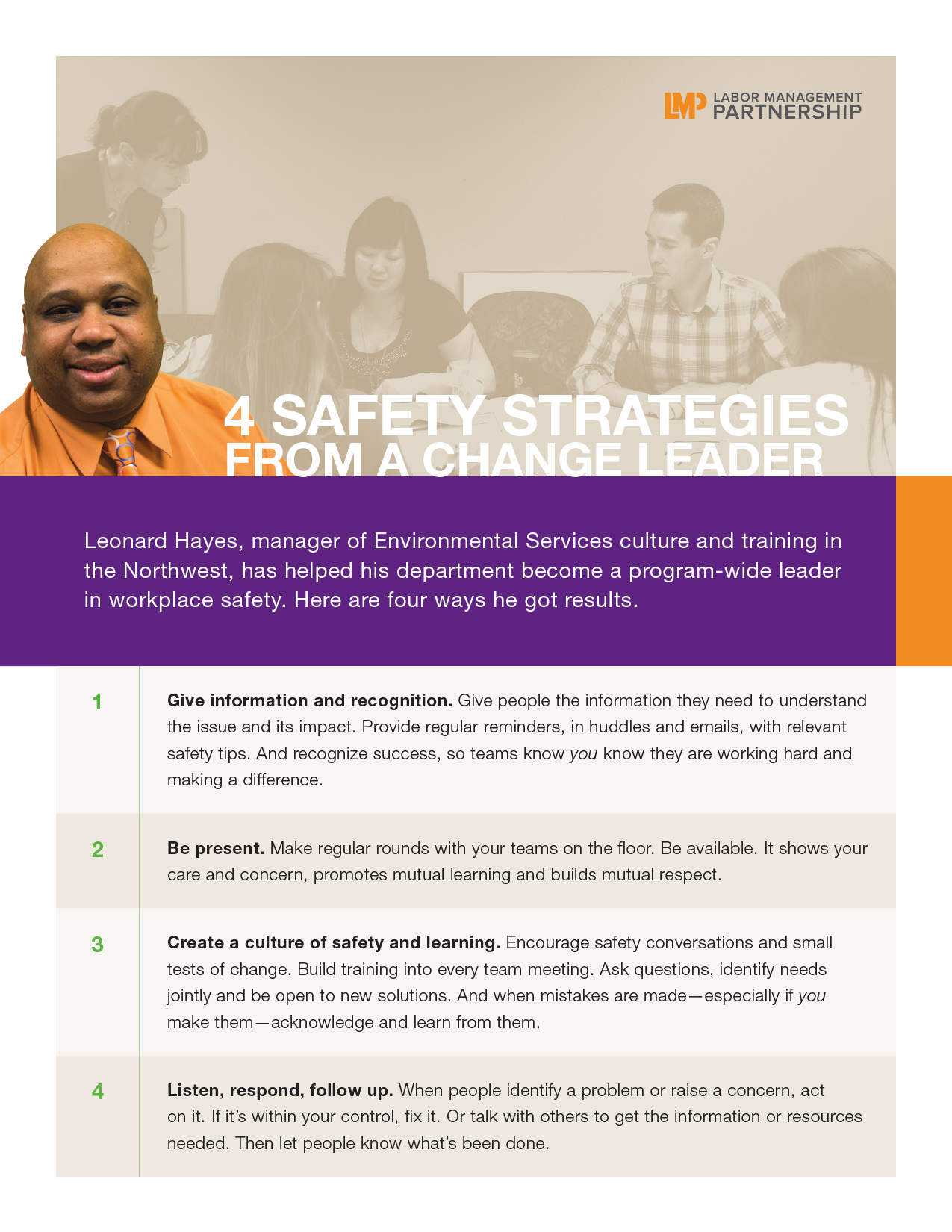
Leonard Hayes, manager of Environmental Services culture and training in the Northwest, oversees workplace safety for 125 outpatient EVS workers in five service areas. This includes the East Side service area, whose EVS unit he directly supervises and which has recorded no injuries for nearly five years. In February 2014, Hayes won the National Workplace Safety Individual Award. He spoke recently with Jennifer Gladwell, LMP communications consultant, about how he engages teams to work more safely.

Q. You and your department have achieved a great turnaround in workplace safety. How did you do it?

A. You have to give people information and recognition. Workplace safety is a standing item on our UBT agendas. We talk about working safely, acknowledge how well our teams do and tell them “thank you.” I’ve been put in this job to take away the myths that injuries are inevitable, so people can go home at the end of their shift and enjoy their time outside of KP.

Q. What do you do personally to engage your staff on safety?

A. I’m in there with them physically.  I’ve been a worker and I take interest in what the teams are doing. I try to make sure people know I care for them by being available to them and making sure they have the tools to do their job. I am committed to responding to issues as quickly as possible and resolving them. I have a great labor partner and co-lead, Sherri Pang. She’s been my anchor with the campus and the (East Side) team. She helps me a lot by sending emails, creating fliers, understanding and encouraging the team.

Change in Tubing Saves $25,000

Deck: 
Oncology UBT cuts costs with different IV set-up

Story body part 1: 

It started with a question from Oncology RN Tom Fought, a member of the Oregon Federation of Nurses and Health Professionals (OFNHP), at the Interstate Medical Office in the Northwest.

Why, he wondered, was primary tubing used for low-reaction drugs instead of the less-expensive short or secondary tubing?

That prompted the department’s unit-based team to start an improvement project that wound up saving $25,000 a year.

When patients come in for chemotherapy or other infusion medications, the drugs are administered via an IV: The bag holding the medication is hung on a pole, with a line that goes into the patient’s vein. When primary tubing is used, the valve to stop the flow of medication is very close to the patient’s body.

If the drugs being used have a high potential for an adverse reaction, it’s essential to use primary tubing, so that if there is an emergency and the line has to be shut, only a very little additional medication reaches the patient.

Appropriate times for less expensive options

When the short tubing or secondary tubing is used, the valve to stop the flow of medication is farther from the patient. In this situation, if the valve is closed, more medication is in the line and will flow into the patient until the tube is empty. These types of tubing are appropriate when the medication has a low potential for a negative reaction.

Primary tubing is $4.10 per unit, short tubing is $3.65 and secondary tubing is 65 cents. The costs add up if primary tubing is used when it’s not necessary.

“I had no idea that we would be saving the unit that much money by conforming the tubing,” Fought says.

This team alone was able to save $25,000 a year. If every Kaiser Permanente oncology infusion department adopted this practice, the savings would be dramatic.

“This was such an easy tweak—we just needed to think outside of the box,” says Lacey Anderson, RN, the Infusion Team Lead and a member of OFNHP, who was involved in the project. “The team realized this was such a great idea and wondered, ‘Why haven’t we been doing this all along?’”

Greater camaraderie

Heidi Rolf, the department manager and the UBT’s management co-lead, is proud of the work the team has accomplished. She attributes the success to the leadership of the team and notes that since the team has advanced to a Level 4 on the Path to Performance, team members have more camaraderie and are more engaged.

“At first it was a little difficult to change the habits of the nursing staff,” Fought says. “Within a few weeks, we had everyone on board and our tubing project took off.”

TOOLS

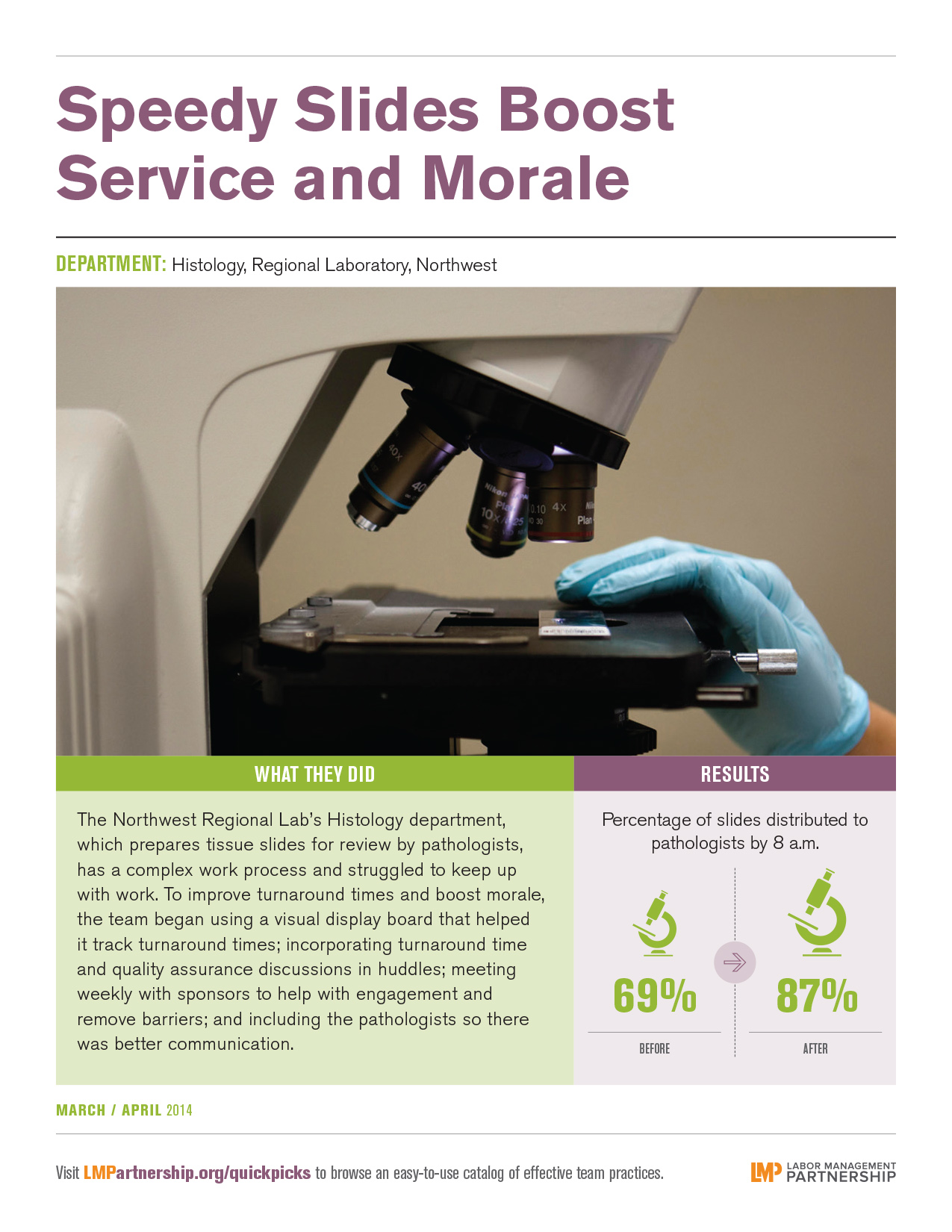
Poster: Speedy Slides Boost Service and Morale

Format:
PDF

Size:
8.5” x 11”

Intended audience:
Frontline employees, managers and physicians

Best used:
Hang this poster detailing how one UBT improved service and boosted morale on bulletin boards, in break rooms and other staff areas. Use it to discuss possible changes with colleagues.

Related tools:

Videos

Adopting an 'Ever Better' Attitude

Loading the player...

(2:59)

The 2-South Med-Surg unit-based team at Sunnyside Medical Center in the Northwest has created a culture of high performance—but it wasn’t always that way. Before they could get to a place where team members are comfortable running simultaneous tests of change on multiple service projects, they had to overcome poor morale and staff churn. This is the story of how by changing team culture, the 2-South UBT sustains high performance.


Pages

Subscribe to RSS - Northwest