Frontline Managers

Help Video

How to Find UBT Basics on the LMP Website

Learn how to use the LMP website:

LMP Website Overview

Learn how to use the LMP website:

How to Find How-To Guides

This short animated video explains how to find and use our powerful how-to guides

Learn how to use the LMP website:

How to Find and Use Team-Tested Practices

Does your team want to improve service? Or clinical quality? If you don't know where to start, check out the team-tested practices on the LMP website. This short video shows you how. 

Learn how to use the LMP website:

How to Use the Search Function on the LMP Website

Having trouble using the search function? Check out this short video to help you search like a pro!

Learn how to use the LMP website:

How to Find the Tools on the LMP Website

Need to find a checklist, template or puzzle? Don't know where to start? Check out this short video to find the tools you need on the LMP website with just a few clicks. 

Learn how to use the LMP website:

Tips for Improving Copay Collection

Deck: 
Putting employees, patients at ease while keeping affordability in mind

Story body part 1: 

Keeping the affordability point on the Value Compass in mind, unit-based teams are taking a hard look at the obstacles to collecting copayments and conducting small tests of change around proposed improvements. New practices like these are generating hundreds of thousands of dollars in new revenue.

  1. Educate employees about the importance of copay collection.
  2. Train employees in how to ask for payment. Use role playing to help them become more comfortable with asking for payments, and create and distribute talking points or scripts.
  3. Provide visual reminders for members to check in at the front desk, so a receptionist can determine if a copayment is due.
  4. Post a sign with a telephone number directing patients with questions about co-payments and financial concerns to a financial counselor.
  5. Call patients a week in advance of a scheduled procedure to advise them a copay will be due and, if possible, to collect it before they are admitted.
  6. Add the copayment amount to patient’s outstanding balance and ask for the total amount. If balance is $100 or more, ask for payment on the account.
  7. Refer patients who can’t afford to pay to facility-based financial counselors.
  8. Station a full-time financial counselor in the Emergency Department.
  9. Make sure financial aid applications are processed promptly by having co-workers share the load. Report workload status at weekly huddles.
  10. Create a uniform note-taking system for financial forms and assign a counselor to every patient referred to financial services.
 

Tips for Improving Attendance

Deck: 
Being here for our patients and members

Story body part 1: 

Unit-based teams encourage employees to make wise use of the National Agreement's sick-leave provisions, which help ensure that individuals have income in the event of a long-term illness or disability. Absences can also create hardship on other employees and affect member service and care. Here are some tips for improving attendance in your department: 

  1. Survey your unit or department to determine if there’s confusion about the use of sick time. If needed, find ways to educate staff on sick leave, tardiness and clocking in and out.
  2. Create an “attendance star” board to recognize staff members with great attendance.
  3. Encourage colleagues to schedule routine appointments during off-hours or in conjunction with lunch or breaks when possible.
  4. Track call-outs and use anonymous surveys to test for reasons why they are occurring.
  5. Use cause-and-effect tools such as fishbone diagrams to address unforeseen circumstances, morale, physical environment, workload or personal reasons.
  6. Engage staff with frequent conversations and be alert for — and respond to — indications of unhappiness or tension.
  7. Recruit an attendance champion to be on the lookout for opportunities to coach others on the importance of banking sick leave.
  8. Help employees track sick-leave usage by printing out and distributing the attendance calendar.
  9. Use the attendance scorecard to learn about the six essentials of good attendance and to see how your team rates. Then  develop small tests of change to address the weak spots identified by the scorecard.

Humans of Partnership:

I’ve always had a passion for education and staff development. I’m a second-career registered nurse and I work as an adjunct faculty member teaching nursing at Southwestern College. As the director of education for the San Diego service area, I have an opportunity to impact employees’ professional development and career goals. In September 2017, I started an ambulatory care residency program for registered nurses. I helped with the overall design of the program, including interviewing candidates. Of the 14 residents, three were nurses for KP On Call. This program allowed them to come back to work in the clinical arena and was a super awesome way to get staff energized. It’s a good feeling to be able to do that.

, ()

TOOLS

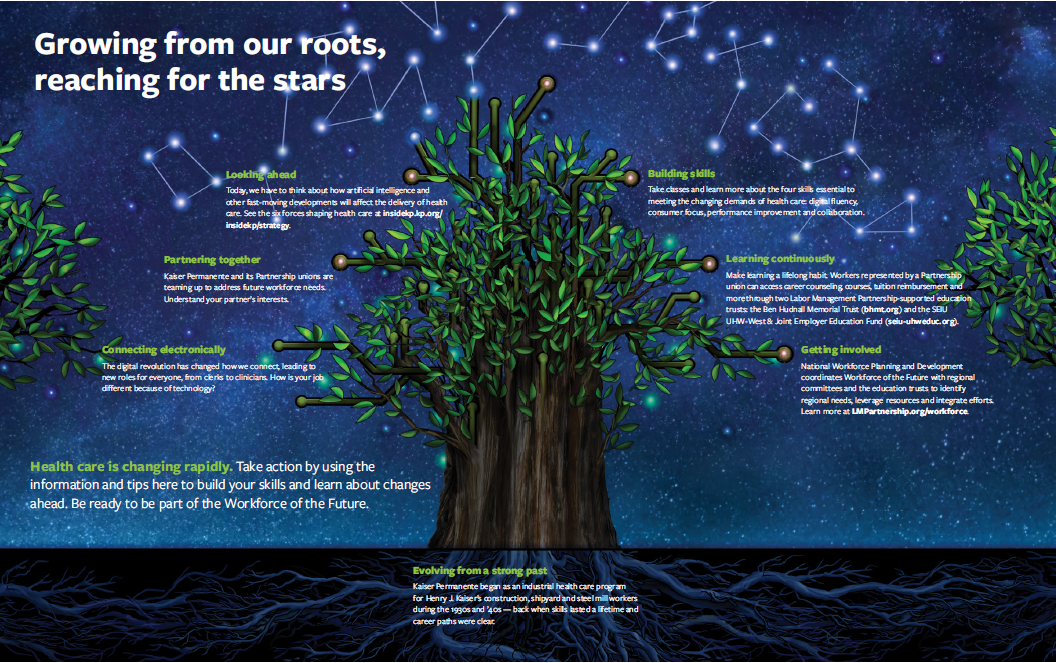
Workforce of the Future Infographic

Format:
PDF

Size:
11" x 17" (tabloid) 

Intended audience:
Managers, union stewards and others who want to promote the workforce development programs offered by Kaiser Permanente and our unions. 

Best used:
Print out this tabloid-sized poster to hang in work areas and break rooms. 

Related tools:

TOOLS

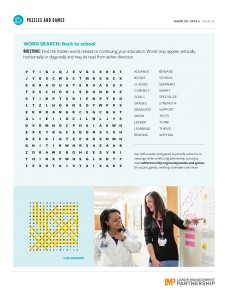
Word Search: Back to School

Format:
PDF

Size:
8.5" x 11"

Intended audience:
Frontline workers, managers and physicians

Best used:
Print out and share copies of this word search at the start of your next meeting. Team members will look for the words related to continuing their education.

Related tools:

12 Tips for Building Your Team

Deck: 
Take one action for every month of the year

Story body part 1: 

Want to take your team to the next level? Make good things happen for yourself, your co-workers and your members and patients? Collaboration is one of the four critical skills needed to meet future challenges with ease. Use these 12 team-building tips to make every month count.

1. Par-tay

Celebrate your team’s successes and acknowledge — even celebrate — failures. Failures are great opportunities for learning if you focus on where the process (not the person) needs improvement. After each test of change, recognize and reward contributing team members at huddles and meetings. Use small wins to keep the momentum going.

2. In and out

Help employees track their sick days and time off by printing out and distributing our colorful, always popular attendance calendar.

3. Follow the money

Learn your department’s budget as a team and get everyone’s ideas on how to reduce costs. Sign up for a business literacy training. 

4. Track it in tracker

Document your team’s work regularly, accurately and concisely in UBT Tracker. It will let others see and learn from your team’s accomplishments.

5. Stop the line

Ask for help or call a stop to the work when you see an imminent danger or need help to safely complete a task. Then look for system improvements and root causes of problems — ask not just what happened, but why.

6. Grow leaders

Rotate responsibilities for leading meetings and managing improvement projects among all team members. This will build your team’s skills and strengths.

7. Two words

Huddle daily. It works. Watch the video “Huddle Power” and use the tools there to get you started huddling with your team.

8. Clean up your act

Become supply savvy. Make a full assessment of supplies — track inventory, tidy up storage areas and streamline ordering. Simple changes can save thousands of dollars. Download our 6S tool to make this work a snap. 

9. Take a (waste) walk on the wild side

Perform a waste walk. Impartially observe a work area or work process to identify waste or inefficiency. Get walking with our online Waste Walk toolkit

10. Save a tree

Go paperless. Don’t print out agendas and documents. Send them out via email or use a projector instead.

11. Get online

Help patients sign up on kp.org. Remind them they can securely view their medical records and most lab results, email their doctors, schedule appointments and refill prescriptions online. Bonus tip: Encourage tech-savvy members to download the kp.org app so they can access these features on their phones. Check out how one team got 90 percent of its patients signed up.

12. Spread and borrow

Did something work for your team? Spread the word to others. Need inspiration for your next improvement project? Look for other teams that have succeeded. Work with your UBT consultant or union partnership representative to spread your successes. Visit our Team-Tested Practices section to get ideas you can try with your team!

Meet Your National Agreement: Change Is Here, Be Prepared

Deck: 
As health care evolves, so do our skills

Story body part 1: 

In the early 2000s, Blockbuster ruled the video rental roost.

Now it’s all but gone.

Blockbuster didn’t adapt to customer needs and technology trends. Netflix did.

Kaiser Permanente and the Coalition of Kaiser Permanente Unions recognize that if you don’t change with the times, you can get left behind.

The National Agreement addresses the importance of preparing for the future in partnership; section 1D of the agreement covers workforce planning and development.

Under the 2015 agreement, two educational trusts — Ben Hudnall Memorial Trust and SEIU UHW-West & Joint Employer Education Fund — received additional funding to provide workers represented by a coalition union with a variety of services, and training and education programs. Joint work on addressing experience barriers, which have sometimes prevented newly trained workers from being hired into KP jobs, is also under way.

The agreement details the structure for coordinating workforce planning and development. A national team aligns, integrates and coordinates workforce development and training efforts in partnership with the regions. Each region has a workforce planning and development committee chaired by labor and management co-leads.

The five key components of this work are:

  • workforce planning and development
  • career development
  • education and training
  • redeployment
  • retention and recruitment

“The goal is to prepare union workers for changes to jobs,” says LeAnda Russell, the coalition’s national coordinator for job innovation. “We support the lifelong learning and career development of our workers.”

It’s paying off. Use of the educational trusts has increased to record levels.

Russell encourages employees to keep learning to build the job skills needed as health care evolves. In other words — don’t hit the rewind button. It’s time to press play.

“Technology is here,” Russell says. “Don’t be afraid.”


Navigating the Future

Story body part 1: 

For Carolina Aceves, technology and health care go hand in hand.

Shortly after completing a new online digital fluency course for Kaiser Permanente employees, she saw firsthand how technology can transform a life. Her mother needed a kidney transplant, but neither she nor her siblings were a match. In October 2017, however, in a series of matches orchestrated through a national computer system, she donated a kidney as part of a chain of donations that resulted in her mother receiving a kidney.

In December, she returned to work at the California Service Center in San Diego, where she is an account administrative representative, fielding calls from KP members and answering their questions. She also chairs a young leader council for OPEIU Local 30 — and is leveraging that role to mobilize all represented members of her unit-based team, urging colleagues of all ages to take the digital fluency course.

“Health care is changing,” Aceves says. “Be current. Do your homework. Advance your career.”

At ease with technology

Digital fluency is one of four critical skills that will be essential in the health care of the future. The new online program, which helps participants understand the role of technology in health care, is free to workers represented by a union in the Coalition of Kaiser Permanente Unions through the Ben Hudnall Memorial Trust, the SEIU UHW-West & Joint Employer Education Fund, and National Workforce Planning and Development.

The national workforce office also is developing programs for the other three critical skills — consumer focus, collaboration and process improvement — as part of a larger strategy to encourage employees to upgrade their skills, advance their careers and meet the changing demands of health care.

“Whether you work in a medical center, clinic or office, we encourage employees to take the digital fluency program,” says Monica Morris, the director of National Workforce Planning
and Development.

Digital fluency skills are good for workers, KP members and the organization, says Jessica Butz, the coalition’s national coordinator for Workforce Planning and Development. While some may fear technology will eliminate jobs, the push at KP is to use it not to replace workers but to enhance the care and service they deliver.

“Learning these critical skills will prepare our workers for jobs in the future and give them the tools to shape and improve care for our members and patients,” Butz says.

Pages

Subscribe to RSS - Frontline Managers