Best Place to Work

Help Video

How to Find UBT Basics on the LMP Website

Learn how to use the LMP website:

LMP Website Overview

Learn how to use the LMP website:

How to Find How-To Guides

This short animated video explains how to find and use our powerful how-to guides

Learn how to use the LMP website:

How to Find and Use Team-Tested Practices

Does your team want to improve service? Or clinical quality? If you don't know where to start, check out the team-tested practices on the LMP website. This short video shows you how. 

Learn how to use the LMP website:

How to Use the Search Function on the LMP Website

Having trouble using the search function? Check out this short video to help you search like a pro!

Learn how to use the LMP website:

How to Find the Tools on the LMP Website

Need to find a checklist, template or puzzle? Don't know where to start? Check out this short video to find the tools you need on the LMP website with just a few clicks. 

Learn how to use the LMP website:

Around the Regions (Winter 2016)

Deck: 
Newsy bits from the landscape of Kaiser Permanente

Story body part 1: 

Colorado

The Colorado region is improving patient care and saving millions by providing high-risk patients extra attention after discharge, leading to a reduction in readmission rates. In the Post Acute Care Transitions (PACT) program, nurse practitioners visit patients in their homes after discharge from a hospital or skilled nursing facility, giving them a chance to alter the patient’s care plan if needed. The PACT team has visited approximately 4,200 high-risk patients since the program began in January 2013. At that time, 22 percent of high-risk patients were readmitted within 30 days, at a cost of $11.7 million. The PACT team has reduced readmission rates by 50 percent, saving Kaiser Permanente approximately $6 million since the program began.

Georgia

To make sure no good deed goes uncopied, the Georgia region launched a Spread and Sustain system to move best practices throughout the region—and showed off the results to KP’s board of directors at a UBT fair early last summer. Georgia took a spread blueprint from the Southern California region and fine-tuned it to meet its needs. Now its unit-based teams, sponsors and regional leaders identify projects with good spread potential, determine other locations where the new process could work, share the practice and check back to see how they’re being sustained. Several projects have been successfully spread region-wide—addressing such issues as hypertension, HPV vaccinations and lab specimen collection.

Hawaii

Hawaii is a beautiful place to live, but Kaiser Permanente members who live on the less-populated islands sometimes find it challenging to get the care they need. To address that, KP offers a special benefit called Travel Concierge Service. If health plan members need medical care that isn’t available on their island, KP assists them in traveling to the Moanalua Medical Center in Oahu or to a specialty care medical office. KP makes the travel arrangements and picks up the tab for travel, including airfare, shuttle service and discounted hotel rates. For minors who need specialty care, KP also pays for companion travel. “Our members love this service,” says Lori Nanone, a sales and account manager in the region.

Mid-Atlantic States

For several years, co-leads in the Mid-Atlantic States have compiled monthly reports of their UBT activities, goals and progress using Microsoft Word and Excel. Now, the region is rolling out a dashboard that automatically compiles the same information from UBT Tracker into an easy-to-reference SharePoint site, Kaiser Permanente’s new online social collaboration tool. The new dashboard will encourage more frequent updates to UBT Tracker and eliminate the need for co-leads to create separate documents, says Jennifer Walker, lead UBT consultant and improvement advisor. “Now the information we get is more timely and easier to assess,” Walker says. “Before, the information was up to a month old.”

Northern California

The Santa Rosa Medical Center Diversity Design committee is equipping employees with tools to help them provide better service to Spanish-speaking patients. The group, composed of labor and management, has been piloting a handout featuring a list of common Spanish phrases, such as ¿Necesita un intérprete? (“Do you need an interpreter?”), as well as instructions on using the phone interpreter system. The idea came from a Spanish-speaking patient on the facility’s Latino patient advisory committee, who recalled the time she was lost in the facility and no one could direct her in Spanish. The Spanish language flier is the latest in the committee’s work to help ensure all patients receive the same optimal service and care.

Northwest

Unit-based teams in the Continuing Care Services department are focusing on improving the experience for some of Kaiser Permanente’s most vulnerable members: those in skilled nursing facilities or receiving home health, hospice or palliative care. Teams are focusing on ensuring better transitions for patients as they go from inpatient to ambulatory care. By identifying issues before they become problems, labor and management hope to coordinate care more effectively, reduce emergency department visits and cut down on outside medical costs.

Southern California

Harmony comes easily when you use the tools of partnership. Just ask the Biohazards, a band of union members and a manager that uses partnership principles to guide performances. “We call ourselves an LMP project,” says Mary Anne Umekubo, a clinical laboratory scientist and Regional Laboratory assistant director who sings and plays percussion and guitar. She is among six band members who represent a variety of departments, shifts and unions, including SEIU-UHW and UFCW Local 770. Performing for friends and colleagues, band members use consensus decision making to choose songs, interest-based problem solving to fix mistakes and the Rapid Improvement Model to tweak performances. “We’re from different departments,” says drummer Eric Cuarez, a regional courier driver and SEIU-UHW member. “We come together to play music.”
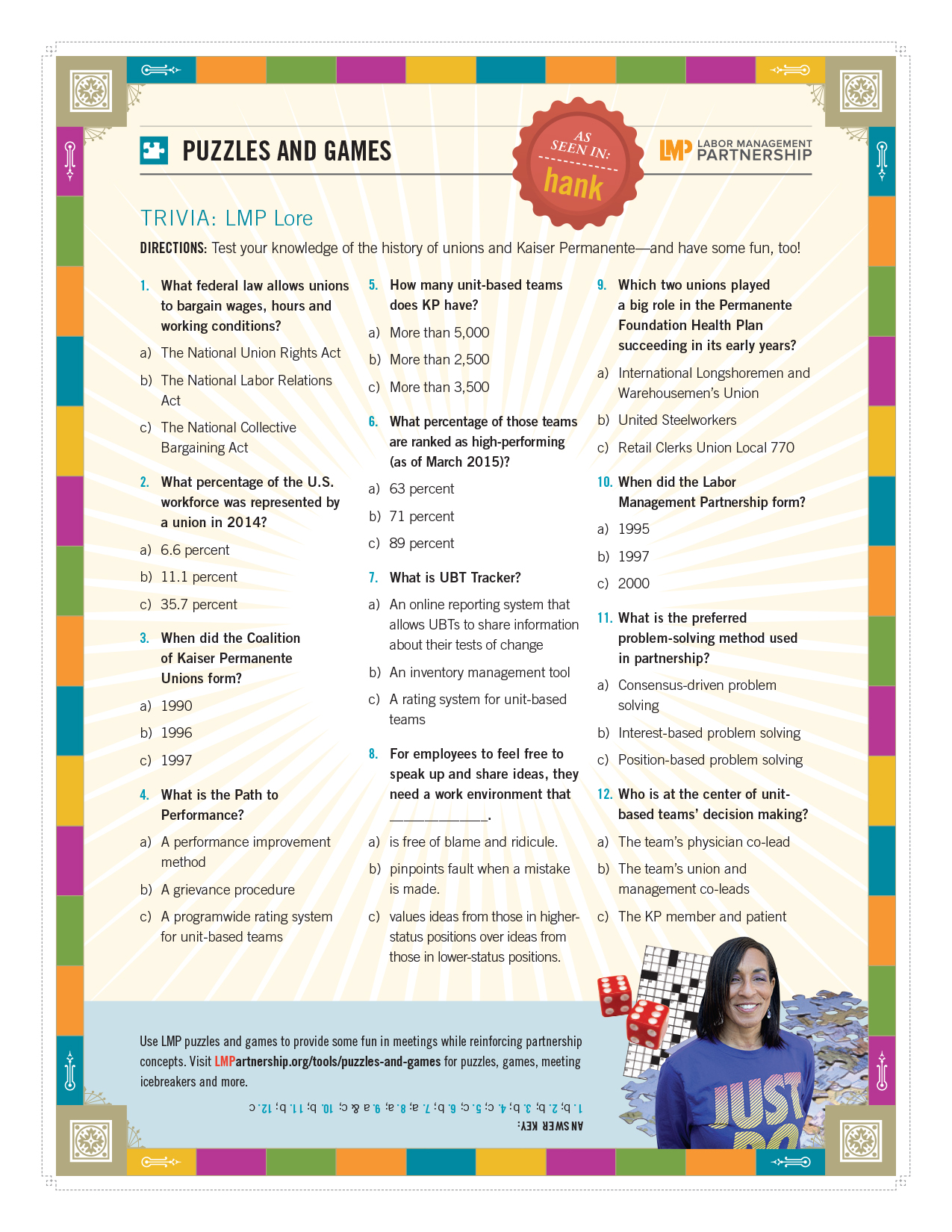
Hank Fall 2015

Format: PDF

Size: 16 pages; print on 8.5" x 11" paper (for full-size, print on 11" x 14" and trim to 9.5" x 11.5")

Intended audience: Frontline workers, managers and physicians

Best used: Download the PDF or use the links below to read the articles online.

I'm in a UBT?

Deck: 
Mid-Atlantic States UBT consultants aim to boost awareness and create a team culture

Story body part 1: 

The Mid-Atlantic States region has approximately 220 unit-based teams with more than 5,200 members. 

One problem, though: Some of those who belong to UBTs don’t know it.

The region’s seven UBT consultants, who made a commitment to work together as a UBT themselves, are trying to change that.

“Employees can’t contribute to the success of the team if they don’t know they are part of the team,” says Tracy Schrader, one of KP’s UBT consultants in the region, who is also an improvement advisor and OPEIU Local 2 member. “They don’t realize they can speak up.” 

From their travels around the Capital Beltway to team meetings and huddles, the consultants—each of whom supports about 35 teams—knew there was a disconnect for some UBT members. So when they established their own team’s 2015 goals, they planned two main tactics: to host several UBT Fairs to raise the profile of UBTs, and to improve communications so all UBT members know they are on a team.

The fairs, which the consultants originally were planning to hold at the region’s largest centers over the summer, would showcase the work of the teams at that facility and highlight such LMP initiatives and priorities as Total Health, Workplace Safety and the Ben Hudnall Memorial Trust, which provides a variety of resources for career-advancing education.

“We wanted to hold fairs that would have a strong impact,” says Jennifer Walker, RN, a lead UBT consultant and improvement advisor.

Surprising news

Then—just as happens with frontline teams—they received some data that surprised them. The 2014 People Pulse results showed that some locations the consultants thought would score poorly on UBT-related questions scored well and vice versa. Armed with that data, the consultants decided to hold the first five fairs at the centers that had the most teams with more than 10 percent of members answering “no” when asked “are you in a UBT?”

“It was a real eye-opener,” says Preena Gujral, another MAS UBT consultant and improvement advisor who’s a member of OPEIU Local 2. “Data is very important. It’s perception versus reality.”

The data also led the consultants to combine their two tactics:  The fairs would be the method for communicating the message that all work group members are indeed part of a UBT.

Walker, one of the region’s lead consultants, says it can be difficult to get the message across, especially with large departments. Unlike small departments where everyone participates in UBT meetings, larger departments typically have a core group of employees who attend UBT meetings as representatives of everyone on staff. Employees who aren’t representatives don’t always realize that they are part of the team, too.  

The energy and attendance of the first UBT Fair that the consultants sponsored, held at the end of June at the Fair Oaks Medical Center in Fairfax, Virginia, was higher than they expected, with more than 150 employees stopping by.

“The participation was fantastic,” says Wendy Williams, RN, a UBT consultant and member of UFCW Local 27.

Irene Taliaferro, a gastroenterology nurse practitioner, attended the fair at Fair Oaks in late August. She hadn’t realized she was a UBT member.

“I came to find out more about UBTs. Before I came to the fair, I knew nothing about them,” says Taliaferro. “We have a representative who goes to meetings. I don’t know much about it.”

Providing incentive—and a model

Steve Pereira, UBT consultant and improvement advisor, hopes the blitz of UBT Fairs gives workers like Taliaferro a better understanding of the partnership and an incentive to be more involved.

“People want to know more than their 9-to-5 jobs,” Pereira says. “This is the opportunity for that.”

Because of their commitment to use the same tools as frontline UBTs, the consultants have been using the Plan, Do, Study, Act cycle of the Rapid Improvement Model in planning and holding the fairs.

So, Walker says, “We structured it so the fairs happen before the annual People Pulse is taken again, in September”—that way, the fairs serve as a test of change. Will the communication provided by the fairs improve the score on the “I’m in a UBT” question?

“We’ll look for the next People Pulse results to validate whether this was the best way to go,” she says.

Watch for an update on the consultants’ efforts next year on LMPartnership.org, after the 2015 People Pulse results are in.

Take action to get the help you need

No need to struggle on your own. There are lots of resources out there to guide teams along the Path to Performance:

  • Find out who your UBT consultants and union partnership representatives are. Go to the “regions” tab on LMPartership.org to find regional or facility LMP co-leads, who will have the most up-to-date information.
  • Get the training you need to build and strengthen your UBT. Visit our training page for links and contact information.
  • Find out if there is a UBT Fair coming up at your facility or one nearby and go to it. Soak up great ideas and inspiration from other UBT members!

Partnership Attitude Brings State-of-Art Test to Members

Deck: 
Neurology department in the Northwest improves ability to diagnose epilepsy

Story body part 1: 

“This whole project was a mere idea written on a piece of paper only a few months ago,” says Juan Piantino, MD, “and now it’s a reality.”

Shortly after Dr. Piantino, a neurologist, came to Kaiser Permanente in July 2014, he was approached by another member of the department—Debbie Newcomb, an electro-neurodiagnostic technologist and UFCW Local 555 member. Newcomb’s work includes performing electroencephalograms (EEGs), a test that monitors a patient’s brain waves and helps diagnose patients with epilepsy.

She was interested in implementing ambulatory EEGs (AEEGs), an advanced technology that is relatively new. Because the test is conducted over a longer time period than a routine EEG, it is more likely to capture events that provide the medical team with information needed for a good diagnosis. AEEGs also are less expensive than an inpatient telemetry EEG. But Newcomb needed a physician partner to move forward.

“I wasn’t intimidated about approaching him,” says Newcomb, who’s the labor co-lead of the neurology UBT. “The partnership has given me the confidence to speak up—and in fact, I consider it part of my role as a union steward.”

Swift implementation

Dr. Piantino had experience with the test with other health care systems—as did Newcomb—and was enthusiastic. The pair began figuring out how the test could be implemented in the Northwest region. Newcomb collaborated with the staff at the Stanford Comprehensive Epilepsy Center to understand the specific details of its program. She worked with KP Purchasing to identify the type and cost of the machines that would be needed.

Armed with information, Dr. Piantino met with leadership of the Northwest Permanente Medical Group—and within a few short months, in December 2014, the region was equipped to do continuous ambulatory EEGs.

So far this year, 16 patients have had their treatment guided by the ambulatory EEG as outpatients. Because the test is administered with a camera, the physician reading the results can see the patient in real time and correlate the brain activity to the physical movements of the patient. In addition, being able to conduct the test in the patient’s own environment avoids a potentially stressful and expensive hospital stay.

One adult patient had been in and out of the Emergency department five times in two weeks. Newcomb performed the ambulatory EEG on him; he had five events, all pseudo-seizures. “He is now seeing the proper doctor for his problems—no more trips to the ED,” Newcomb says.

By the end of July, the program already had paid for the cost of equipment. The benefits of an accurate diagnosis for the patient are immeasurable.

“It was the positive attitude and the willingness to improve patient care that made this happen in record time,” says Dr. Piantino.

Pediatric patients helped

Not all epilepsy is easily identifiable. One young, active child who was recently diagnosed was brought into the Neurology clinic because he was not meeting developmental milestones, and his parents and physician were concerned. The team turned to the ambulatory EEG.

“We got a really good study,” says Dr. Piantino. “This will guide his therapy.”

In another instance, neonatologists at Sunnyside Medical Center were able to control a newborn baby’s seizures within 48 hours when they turned to the ambulatory/continuous monitoring EEG test—after the routine EEG didn’t reveal any unusual brain activity.

“I have been a pediatric neuro-intensivist at two big centers, in Seattle and Chicago,” Dr. Piantino says, “and I can say with confidence that this child received state-of-the-art treatment.”


Videos

Portraits in Partnership: A manager's point of view

Loading the player...

(2:15)

Environmental Services Manager Leonard Hayes has built a workplace where each of his 150 employees has a voice. Watch this short video to hear his perspective on how the Labor Management Partnership at Kaiser Permanente helps him solve problems and improve safety with his team.


Videos

Portraits in Partnership: A union worker's point of view

Loading the player...

(2:30)

When Lab Assistant Cher Gonzalez talks, her manager and facility leaders listen. That's just one of the many benefits, she says, of working in the Labor Management Partnership at Kaiser Permanente. Watch this short piece to see a union worker's perspective of the LMP.


This Plan Was Made for You and Me

Deck: 
A whirlwind tour of KP and union history

Story body part 1: 

1933-1945: ‘There is no such thing as labor relations’

The health care program now known as Kaiser Permanente began in the Mojave Desert when Dr. Sidney Garfield, fresh out of medical school, opened a clinic for 5,000 Colorado River Aqueduct workers in 1933. Dr. Garfield soon found his practice foundering because insurance companies were sending the most serious—and most profitable—cases to Los Angeles hospitals. He developed a prepaid plan with a focus on safety and illness prevention, and it worked. The hallmarks of what would become the Kaiser Permanente Health Plan—prepayment, prevention and group practice—were forged here, but it would be 12 years before members of the public could join.

In 1938, Henry J. Kaiser and his son Edgar persuaded Dr. Garfield to create a similar medical program for workers building the Grand Coulee Dam in Washington.

The resulting industrial health plan was so popular, the unions insisted dam workers’ families be included. That feature carried over when Dr. Garfield built the largest civilian medical care program on the World War II home front, covering almost 200,000 Kaiser workers in California, Oregon and Washington.

With the traditional labor pool—young, healthy white males—serving in the military, thousands of African Americans and other people of color migrated to the shipyards, securing good union jobs after the long hurt of the Great Depression. Women came out in force, too. The Permanente Foundation Health Plan, both the on-the-job care and the broad coverage of the 50-cent-a-week supplemental plan, was extremely successful.

For the first time in their lives, ordinary people could count on affordable medical care.
 

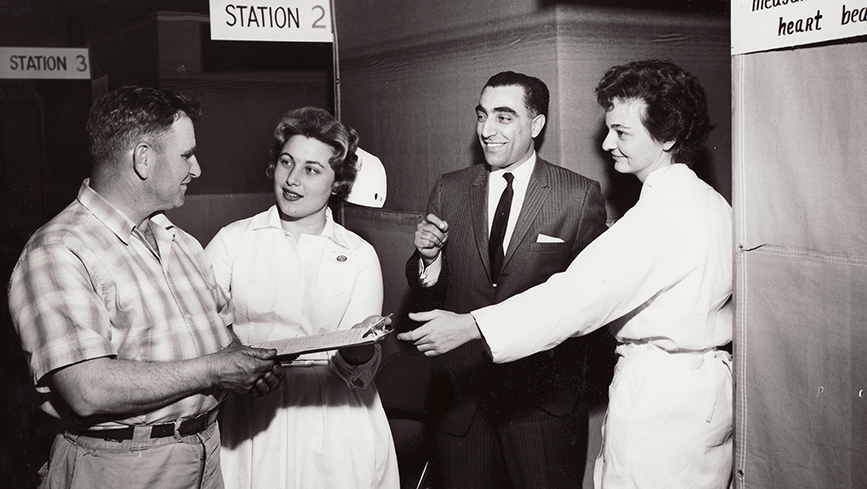
A longshore worker signing up for a "multiphasic" exam, which provided a comprehensive health assessment, in 1963.

1946-1989: ‘If not for organized labor’

On July 21, 1945, with the war in Europe over and the shipyards beginning to close, the Permanente Foundation Health Plan opened to the general public. A year later, on Aug. 1, 1946, Dr. Garfield signed the Permanente Foundation’s first union contract, with the CIO-affiliated Nurses’ Guild. The contract, in a first for Alameda County hospitals, established a 40-hour workweek, down from 48 hours.

Key support for the Permanente health plan came from unions. Harry Bridges, president of the International Longshoremen and Warehousemen’s Union, was an early advocate. He defended the plan against attacks by professional medical associations, whose members called prepaid group practice unethical, and brought all 6,000 ILWU members on the West Coast into the plan. Almost 15,000 members of the Retail Clerks Union in Los Angeles, a large and prominent union led by Joe DeSilva, joined in 1951.

But by the mid-1960s, financial pressures began creating divisions. In 1966, registered nurses in Northern California, represented by the California Nurses Association, became the first nurses in the state to conduct a work action. Major strikes erupted in 1968 in both Northern and Southern California. The strife simmered, and in 1986, a seven-week strike by SEIU Local 250 had some 9,000 clerks, certified nursing assistants and technicians walking the picket line at 14 Kaiser Permanente facilities in California. The action didn’t prevent a two-tier wage restructuring plan, but there was one positive outcome: The first Joint Conference on Service Issues, a precursor to the Labor Management Partnership agreement.
 

It Took Courage

Deck: 
The birth of the Labor Management Partnership

Story body part 1: 

When I think about the Labor Management Partnership and Kaiser Permanente’s history, I can’t help but believe the creation of the LMP was inevitable—and that it’s been the linchpin to KP’s success after the financial challenges of the 1970s, ’80s and ’90s.

From the very beginning, Kaiser Permanente’s management and its unions shared a philosophy of engagement. This culture never went away entirely, but when the competition from for-profit HMOs mounted in the 1980s, it got pushed to the background. Kaiser Permanente did what many businesses do—it reduced its workforce and made other cost-cutting changes. Union members became frustrated, believing the changes undermined KP’s mission and eroded working conditions.

The unions responded with traditional work actions and strikes.

But I’d say four milestones changed the landscape.

First, in the early 1990s, the Industrial Union Department of the AFL-CIO created the KP Coordinated Bargaining Committee to improve the unions’ bargaining position. That committee, which included most of the major unions at Kaiser Permanente, became the Coalition of Kaiser Permanente Unions. We were charged with coordinating a full-scale “corporate campaign” against KP.

But we realized we might do permanent damage to the company and to our 57,000 coalition union members. So we opted to pursue an alternative strategy. In the mid-’90s, we approached KP with a bold new idea—partnership. Unlike other union-employer “cooperation” arrangements, where management would come to labor for help after decisions had been made, the proposed partnership called for labor’s integration into KP’s management and operations structure.

After almost a year of discussions, Kaiser Permanente agreed, and in 1997, the Labor Management Partnership was formed. The decision demonstrated courage on both sides. It placed a value on the knowledge possessed at every level of the organization, from the boardroom to the front line. Building on that, we broke away from traditional, reactionary problem solving and turned to interest-based problem solving and consensus decision making.

This led to the fourth milestone—the decision to conduct national bargaining using those same problem-solving methods and to include operational leaders and rank-and-file union representatives at the bargaining table.

Other factors have contributed to KP’s financial turnaround, but there can be no denying the impact the partnership made—and continues to make—in ensuring that Kaiser Permanente is the national leader in health care, with a great place to work and industry-leading salaries, wages and benefits. Its position did not come about by accident, but by the courage of leadership and the power of partnership.

Visit Kaiser Permanente's 70th anniversary mini-site.

TOOLS

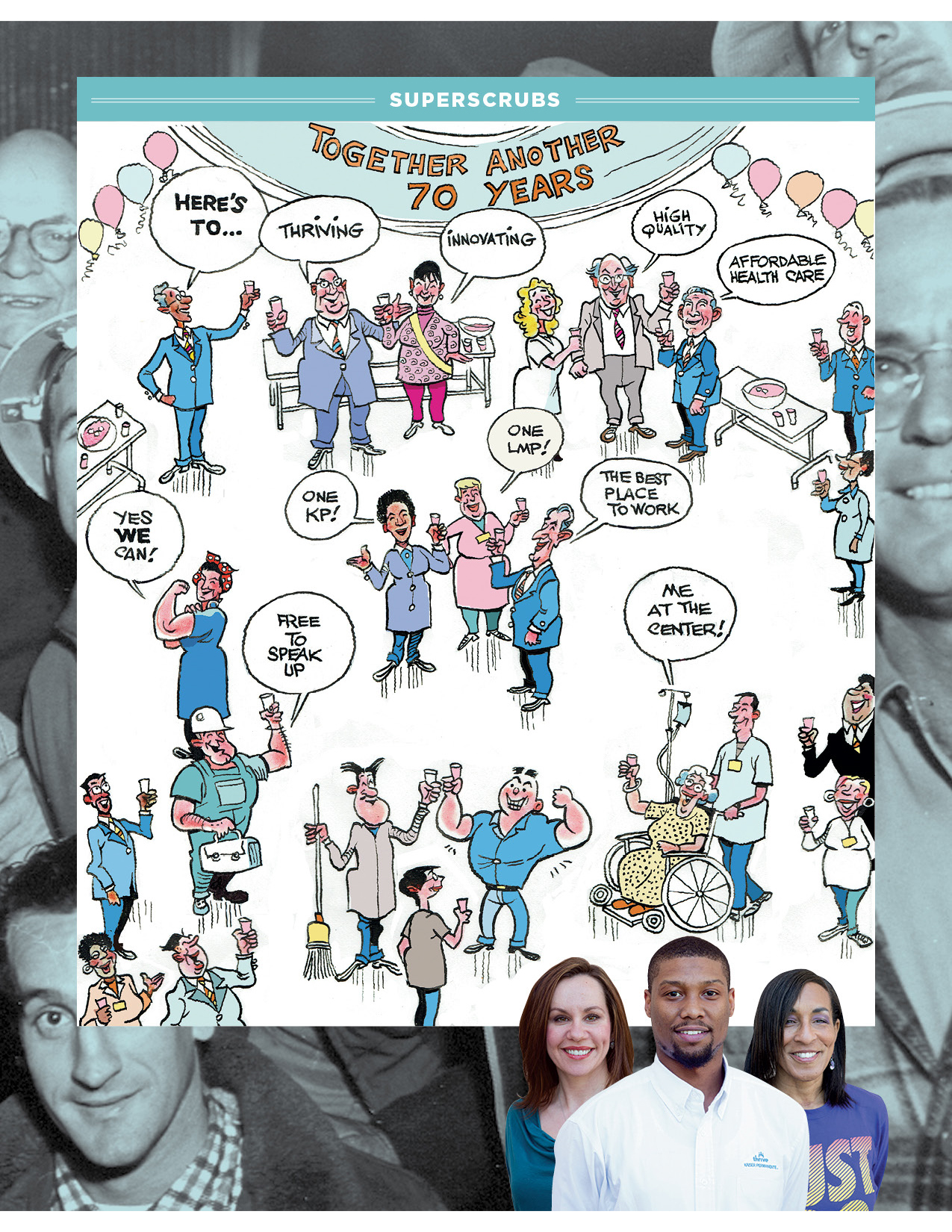
SuperScrubs: Together Another 70 Years

Format:
PDF (color or black and white)

Size:
8.5" x 11"

Intended audience:
Anyone with a sense of humor.

Best used: 
This full-page comic celebrates 70 years of Kaiser Permanente.  Post on bulletin boards, in break rooms and other staff areas.

Related tools:

Pages

Subscribe to RSS - Best Place to Work