Culture

Help Video

How to Find UBT Basics on the LMP Website

Learn how to use the LMP website:

LMP Website Overview

Learn how to use the LMP website:

How to Find How-To Guides

This short animated video explains how to find and use our powerful how-to guides

Learn how to use the LMP website:

How to Find and Use Team-Tested Practices

Does your team want to improve service? Or clinical quality? If you don't know where to start, check out the team-tested practices on the LMP website. This short video shows you how. 

Learn how to use the LMP website:

How to Use the Search Function on the LMP Website

Having trouble using the search function? Check out this short video to help you search like a pro!

Learn how to use the LMP website:

How to Find the Tools on the LMP Website

Need to find a checklist, template or puzzle? Don't know where to start? Check out this short video to find the tools you need on the LMP website with just a few clicks. 

Learn how to use the LMP website:

TOOLS

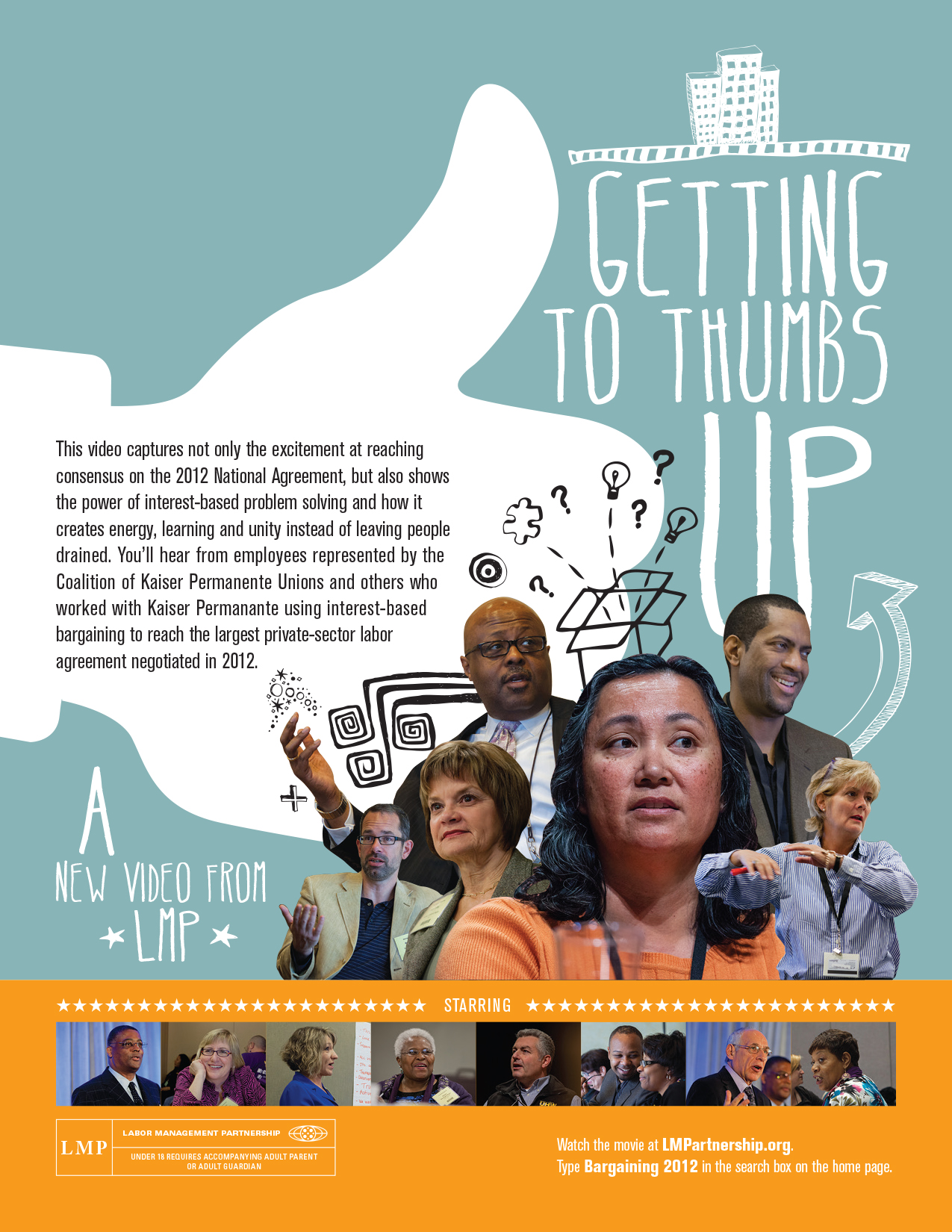
Poster: Getting to Thumbs Up

Format:
PDF (color and black and white)

Size:
8.5" x 11"

Intended audience:
Frontline employees, managers and physicians, and UBT consultants

Best used:
This poster promotes a powerful video that shows how interest-based problem solving creates energy, unity and consensus.

See the video:

Getting to Thumbs Up (video)

Related tools:

TOOLS

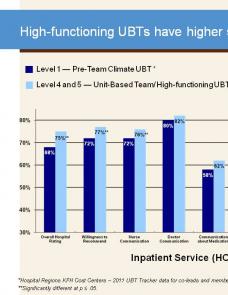
Research on How UBTs Deliver on Service

Format:
PowerPoint slide

Size:
8.5" x 11"

Intended audience:
Unit-based team sponsors and co-leads, and KP managers

Best used:
This summary of KP research shows that high-performing teams are improving HCAHPS scores while reducing workplace injuries and sick days. Use in meetings or discussions to benchmark team results against high-performing UBTs across Kaiser Permanente.

Related tools:

TOOLS

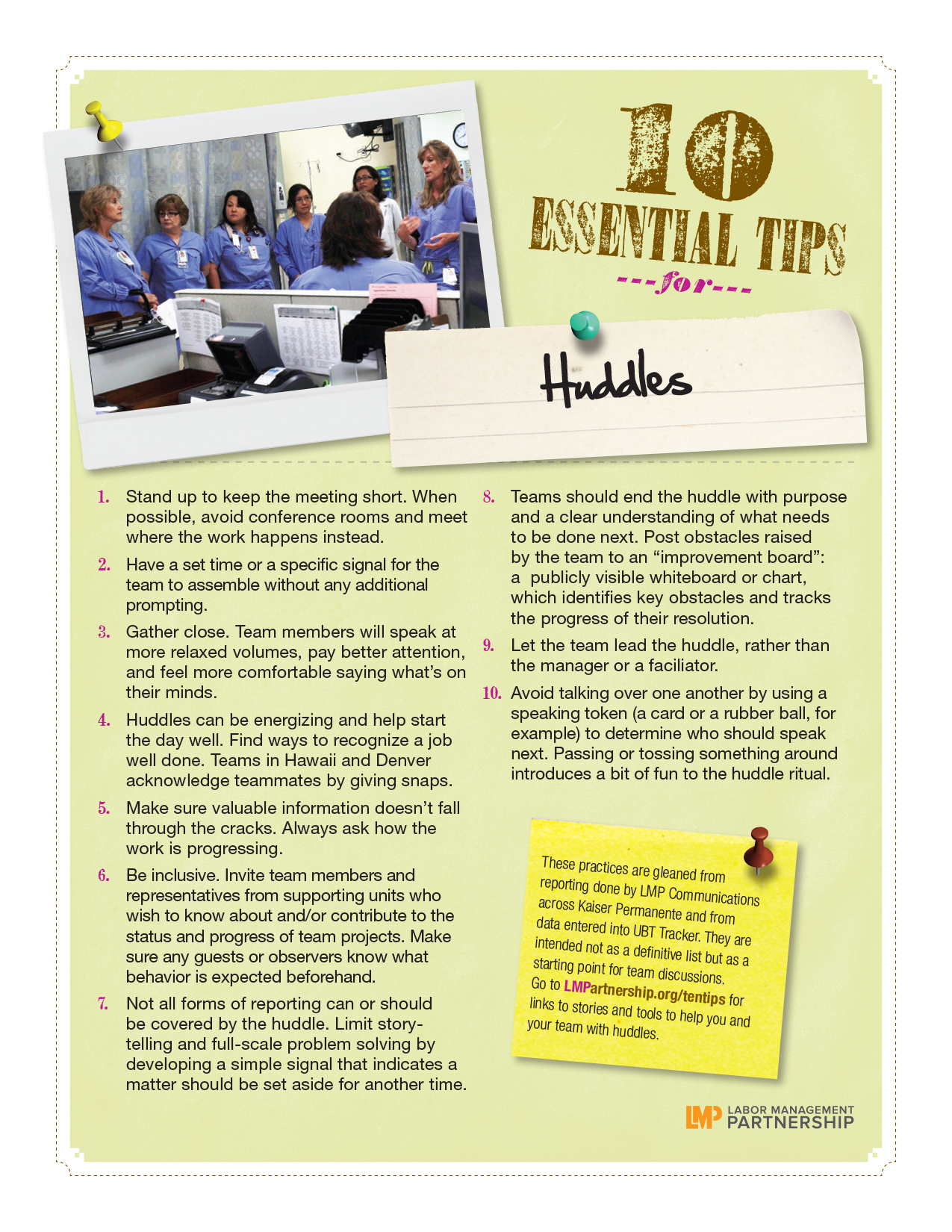
10 Essential Tips for Huddles

Format: 
PDF

Size: 
8.5" x 11"

Intended audience: 
Frontline employees, managers and physicians, and UBT consultants

Best used:
Post these 10 tips on successful huddles on bulletin boards and discuss in team meetings; use this tipsheet as a starting point for team discussions and brainstorming. 

Related stories/videos:
See how teams have put these tips to use.


Related tools:

TOOLS

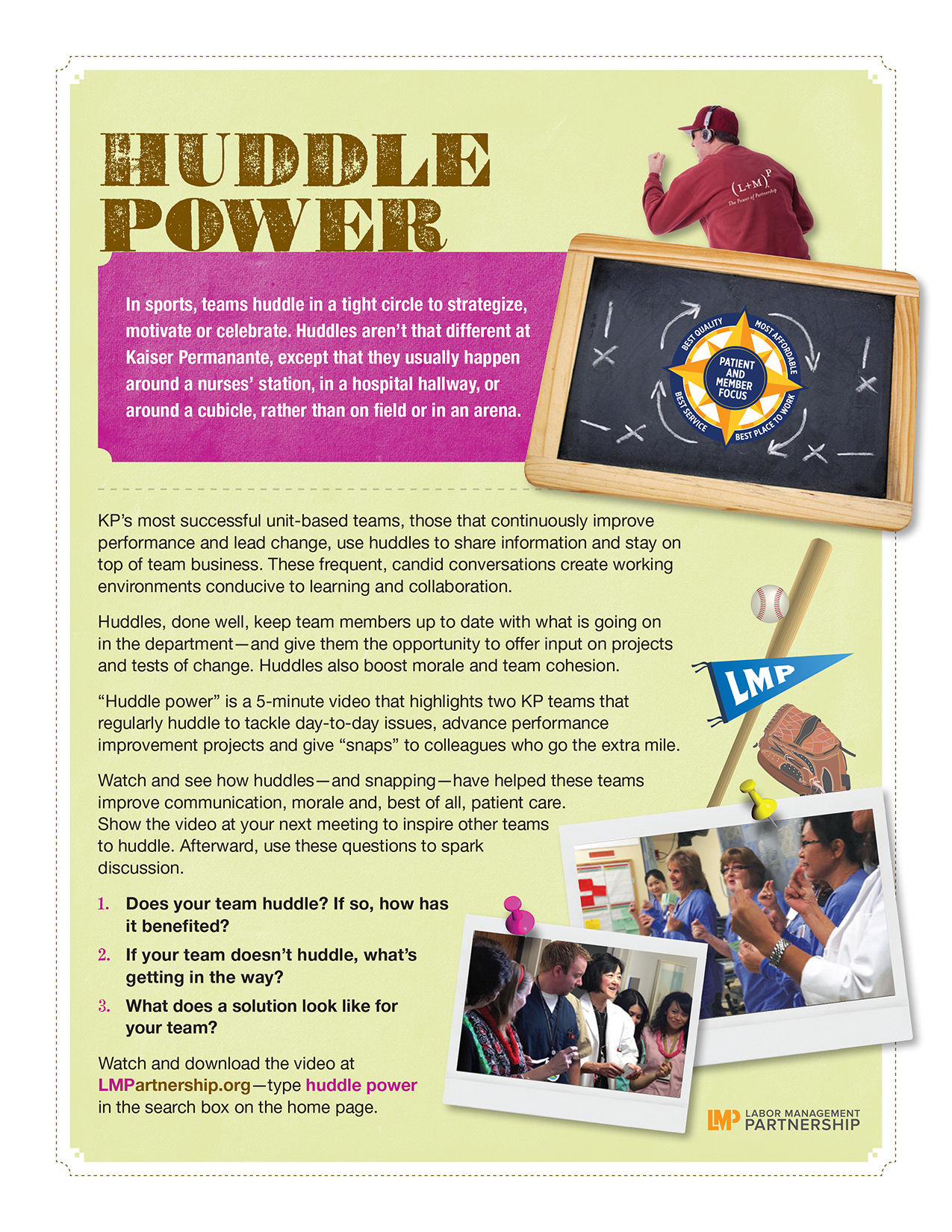
'Huddle Power': Video User's Guide

Format: 
PDF

Size: 
8.5" x 11"

Intended audience: 
Frontline employees, managers and physicians, and UBT consultants

Best used: 
Show the "Huddle Power" video and pass out this guide at UBT meetings and trainings to inspire your team to use daily huddles as one way to improve performance. 

Click here to watch the "Huddle Power" video.

Related tools:

TOOLS

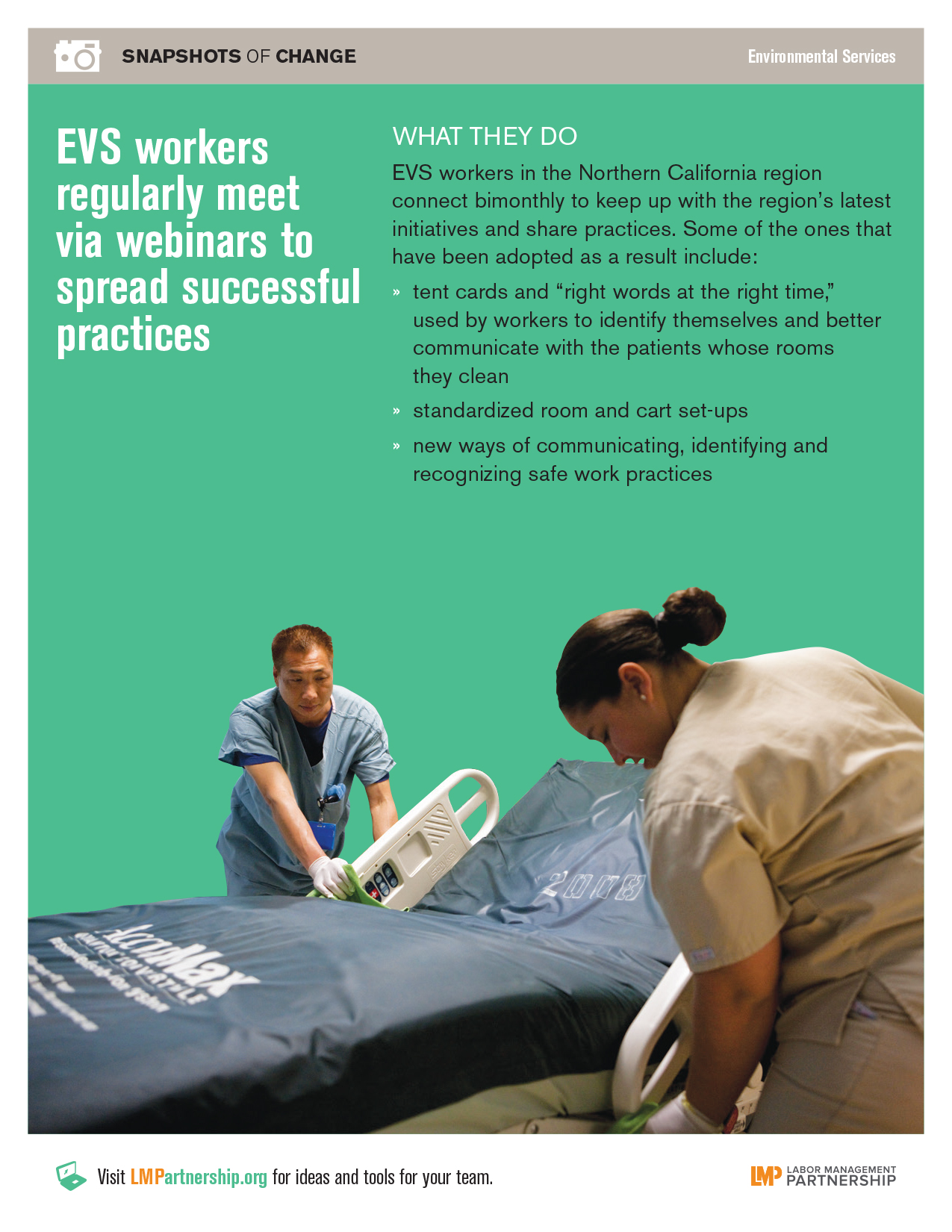
Poster: Modern Venue for Old-Fashioned Storytelling

Format:
PDF (color and black and white)

Size:
8.5" x 11"

Intended audience:
Frontline employees, managers and physicians

Best used:
This poster, for use on bulletin boards in break rooms and other staff areas, highlights an EVS team that uses webinars to spread successful practices.

Related tools:

Beyond 'Teamwork'

Deck: 
Teaming as the essential skill for innovation, learning

Story body part 1: 

“Team” is a noun. “Teaming” is a verb, defined by the woman who coined it as teamwork on the fly, coordinating and collaborating across boundaries, without the luxury of stable team structures.

That woman, Harvard Business School Professor Amy Edmondson, talked to the 2012 Union Delegates Conference about why teaming is such a crucial skill, especially for those in health care settings where work is complex and unpredictable.

“In health care, many times people are interacting with each other in an emergency room, for instance, now, for five minutes, but they don’t know each other,” says Edmondson. “The catch is we have to act as if we trust each other…because we often don’t have the luxury of having a lot of time to get to know each other.”

A “team” is a static, stable entity. But, says Edmondson, “In health care, if we wait until we have the perfectly designed ‘team,’ the moment has passed. We have to get together quickly, do what needs to be done, and then disband and do other things.”

In the absence of long-term work relationships, Edmondson says allegiance to an organization with a compelling vision can be the glue that holds these teams-on-the-fly together. “There is the pride in working for KP,” for instance, she says. “That is a real bond.”

Looking at the performance improvement work of unit-based teams at Kaiser Permanente, the principles of teaming still apply. While not as fluid as an emergency room, UBTs still see plenty of flux. Just think about the manager that gets promoted or retires, or the labor co-lead who rotates out of that role. The team has to be able to keep focused on improving performance even as the cast of characters changes.

UBTs can be stable teams that do great work. They are a very powerful tool,” Edmondson says. “And yet, I also want people to be able to quickly get up to speed, do what needs to be done with other people in the absence of those stable structures.”

A UBT needs to be a scaffold that is strong enough to withstand the flux, says Edmondson.

“If there is clarity about what the structure looks like—independent of the people who are in that structure—you are better off,” says Edmondson, a point explored in research she’s conducted with Harvard colleague Melissa Valentine. “We won’t always have the same human beings in those roles, but the roles are reasonably static.”

Behaviors that support teaming

  • Speak up: ask questions, acknowledge errors, offer ideas.
  • Listen intensely.
  • Integrate different facts and points of view.
  • Experiment: take a step-by-step approach, learning as you go.
  • Reflect on your ideas and actions.


Contradictions That Foster Innovation

Story body part 1: 

Amy Edmondson says innovation depends on a culture of focused chaos.

Those words sound like opposites. They are. Don’t worry. It’s not a mistake.

In fact, innovation depends on four pairs of seeming opposites. As unit-based teams ramp up, involving frontline managers, physicians and employees in finding new ways to improve performance and transform health care, they can benefit from creating a culture of innovation. This is how Edmonson, a professor at Harvard Business School, defines the four cultural contradictions of innovation:

  • Chaotic/focused
  • Playful/disciplined
  • Deep expertise/broad thinking
  • Promotes high standards/tolerates failure

Let's take a more detailed look.

Chaotic/focused

“An innovation culture is focused,” says Edmondson. “It is really intent on improving a process or inventing a new business model or coming up with a new product.” At the same time, it is chaotic. “Any idea is welcome and possible—at least until we sort it out. No idea is a bad idea—at least early in the process.”Chaos, says Edmondson, “is about welcoming all ideas, even ‘wacky’ ideas.” Only in a psychologically safe learning environment will employees feel open enough to offer these “wacky” ideas, she adds.

Playful/disciplined

The Labor Management Partnership offers a disciplined process for innovation in the form of the Rapid Improvement Model (RIM) and the plan, do, study, act cycle. But, Edmondson emphasizes, teams use these tools “without knowing in advance what the answer is.” There is a careful and well-managed process, but the content of the conversations about improving performance must be open and inclusive. As teams begin a performance improvement project, UBT leaders need to be very clear about what aspect of performance they are trying to address—not on how the team is going to do it.

Deep expertise/broad thinking

An innovative team is one that values those who bring deep expertise (in a specific topic, subject area or clinical specialty, for instance) and people who are broad, general thinkers who span boundaries. “Both of those skill sets are absolutely essential at the same time,” says Edmondson.

Promotes high standards/tolerates failure

In an innovative work culture, “We hold very high standards but we are also very tolerant of failure,” says Edmondson. “That sounds ‘wrong,’ at first,” she admits, “but it is essential because, in innovation, you will never get it right the first time. You try something, test it out, it’s not going to work quite right and then you either tweak it or throw it out altogether and try something else.”

Spreading new ideas that get results throughout a large organization such as Kaiser Permanente, says Edmondson, requires finding ways to “shine a very quiet spotlight”—another seeming contradiction!—on innovators so others become aware of what they are doing and are drawn to try it too. 

“In today’s world, there are two ways to get the word out,” she says. The first is face-to-face communication, “positive buzz that starts locally and spreads.” The other is internal online social networks as “a way to listen, motivate and share practices that are potentially better.”

“It can catch on,” says Edmondson. “When there are pockets of effectiveness, other people see them, and they want to play too.”

You Gotta Learn

Deck: 
A psychologically safe environment is essential to teamwork and innovation

Story body part 1: 

The theme of the 2012 Union Delegates Conference was “You Gotta Move”—and Amy Edmondson’s advice for the delegates was “you gotta learn.”

The Harvard Business School professor studies what she calls “learning environments.” To support innovation and teamwork, it’s essential the Labor Management Partnership and unit-based teams foster learning environments throughout Kaiser Permanente.

Imagine the ideal learning environment: People feel free to take risks. They feel psychologically safe. They believe they won’t be punished or humiliated for speaking up with ideas, questions, concerns or mistakes. “Without that kind of psychological safety, it’s very hard for an organization to learn,” says Edmondson.

Now imagine the opposite of a learning environment, one where no one speaks up. “Nobody ever got fired for being silent,” says Edmondson. “And yet many bad things happen as a result of silence. Silence is a strategy for individuals to stay safe, but not necessarily for patients to stay safe or for organizations to stay vibrant.”

Creating a learning environment is up to leaders—to those people with influence, whether or not they have a formal leadership role.

“Leaders have to go first,” Edmondson says. They “have to be willing to ask questions themselves, invite participation, acknowledge their own fallibility, and to explicitly state we don’t know everything yet.” These behaviors help an environment where others can take the risks of learning.

But, she cautions, “The learning environment doesn’t live at the ‘organization’ level. For the most part, there are pockets of learning environments.…In a large, complex system, answers don’t come from central headquarters or the CEO. The answers come from the people at the front line doing the work.”

A labor management partnership like the one at Kaiser Permanente “is an important foundation” for building a learning environment, says Edmondson. “A true partnership is completely consistent with the context for mutual learning.”

Both management and union UBT co-leads can help create a learning environment by articulating the unit’s or department’s purpose and goals “in a meaningful way that touches hearts and minds, that motivates and encourages,” she says.

They can—and must—also reduce the fear people experience that makes them reluctant to speak up. The LMP helps develop and support people, helping them be their best and most courageous, Edmondson says.

TOOLS

PowerPoint: The Power of Teaming

Format:
PPT

Size:
11-slide deck

Intended audience:
Sponsors, UBT co-leads, trainers, facilitators, stewards

Best used:
Harvard Business School Professor Amy Edmondson delivered this presentation, "The Power of Teaming," at the March 2012 Union Delegates Conference to explain her research on how nimble, successful organizations and projects increasingly rely on teaming rather than stable, unchanging teams. She demonstrates how leaders can create a culture of teaming by fostering psychologically safe learning environments where innovation can flourish. Use to help build a culture of teaming, or "teamwork on the fly," and foster productive collaboration among UBTs and across departments.

Related tools:

TOOLS

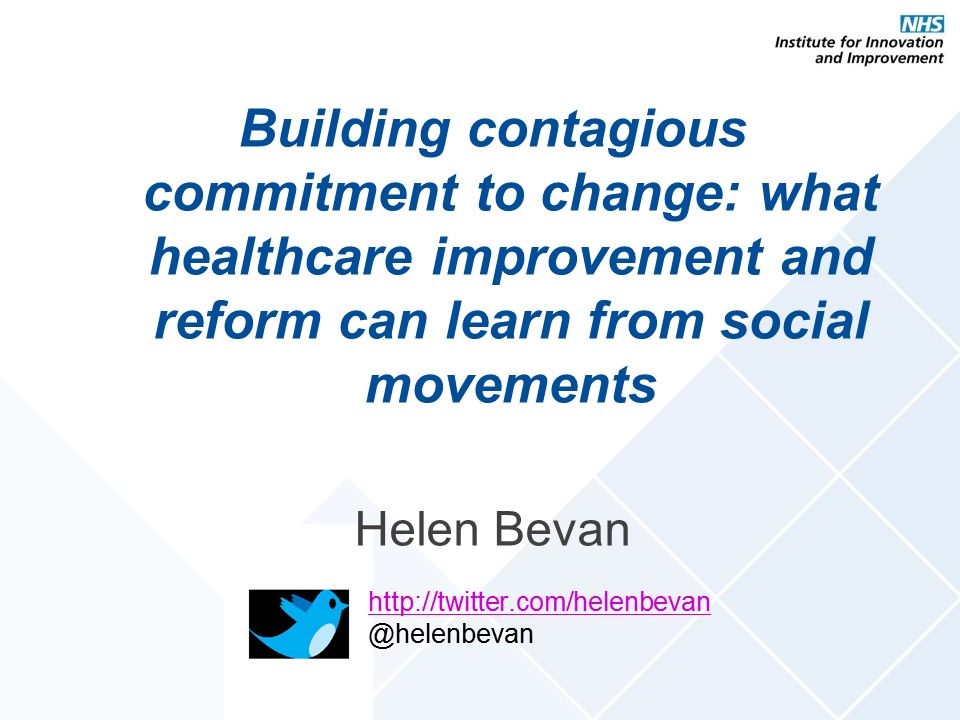
PowerPoint: Contagious Commitment to Change

Format:
PowerPoint

Size:
42-slide deck

Intended audience:
Those interested in learning what a top health care innovator has learned from her work in Great Britain's National Health Services (NHS) system.

Best used:
The slide deck was presented by Helen Bevan, chief of service transformation at the NHS Institute for Innovation and Improvement, the largest government-sponsored health care system in the world. Use to educate staff members, managers and physicians on how to motivate change.

Related tools:

Pages

Subscribe to RSS - Culture