Culture

Help Video

How to Find UBT Basics on the LMP Website

Learn how to use the LMP website:

LMP Website Overview

Learn how to use the LMP website:

How to Find How-To Guides

This short animated video explains how to find and use our powerful how-to guides

Learn how to use the LMP website:

How to Find and Use Team-Tested Practices

Does your team want to improve service? Or clinical quality? If you don't know where to start, check out the team-tested practices on the LMP website. This short video shows you how. 

Learn how to use the LMP website:

How to Use the Search Function on the LMP Website

Having trouble using the search function? Check out this short video to help you search like a pro!

Learn how to use the LMP website:

How to Find the Tools on the LMP Website

Need to find a checklist, template or puzzle? Don't know where to start? Check out this short video to find the tools you need on the LMP website with just a few clicks. 

Learn how to use the LMP website:

Nowhere to Go but Up

Deck: 
Interest-based problem solving and sponsorship involvement help team turn itself around

Story body part 1: 

Some departments glide effortlessly into becoming high-performing teams. Not so for the San Rafael Health Information Management team.

Now at a Level 5 on the Path to Performance, the team had to overcome numerous hurdles to get to where it is today.

“They went through a lot of hell to get there,” says Richard Orlanes, a regional LMP consultant who worked with the team during some of its darkest days. “To see the transformation they made in about a year—it was almost like they fired the old people in the department and brought new people in.”

As recently as 2011, the team members, whose work is to maintain KP’s medical records, were negative and distrustful, their morale was low, and they didn’t participate during UBT meetings.

“You could hear a pin drop at the meetings—nobody said anything,” says Richard Incaviglia, an outpatient ambulatory coder, SEIU UHW member and the team’s labor co-lead. “At one time people even said they wanted to dissolve the UBT.”

Sponsor involvement is key

But instead, the co-leads—with assistance from Joan Mah, the local UBT consultant—reached out to the LMP regional office for help. They brought in Orlanes to observe the department and lead a series of interest-based problem-solving exercises. He also suggested including sponsors in the exercises; when the management sponsor accepted and also brought her boss to the meetings, it sent a message to the team that leadership really wanted to turn things around. To provide a sponsor perspective on the union side, the co-leads involved Kisha Fant, a union partnership representative, and Zachary Adams, a contract specialist.

“Bringing in the sponsor means everything. Her being there told us that this was a serious effort,” Incavigilia says.

The management sponsor, Freida Smith, the Marin/Sonoma HIM director, is now the team’s management co-lead. As she remembers it, she wasn’t so much invited to participate in the problem-solving sessions—she invited herself.

“I stuck my nose in,” Smith says. “I had to step in and assume some responsibility because the sponsor needs to be involved and is ultimately responsible.”

Discussing positions and interests

Smith believes that the turning point for the team came when they discussed their positions and interests with Orlanes as the facilitator.

“We had to decide as a team that there was nothing we could do about what happened in the past,” Smith says, “but we could step out on faith and move forward.”

After working with the LMP regional consultant for several months, the team members were finally ready to start working together on their common interests. They prioritized the issues of communication, trust and honesty, and transparency, and worked to transform the negativity in the department. One of their early tests of change was to introduce a daily 8 a.m. huddle. The team huddles over the phone because half the team members work remotely. After the huddle, Smith sends an email to the whole department summarizing what was discussed.

“Once we started communicating and voicing opinions, and we realized we didn’t need to worry about retaliation, everybody started participating,” Incaviglia says.

On to high performance

Now the team has a long list of successful performance improvement projects under its belt, including a project to reduce the number of medical records that have missing documentation and another to make sure charts are coded within four days or less.

Smith believes that being transparent was the key to success.

“No matter how small or large the issue, be transparent,” she says. “I share every single thing that impacts the team’s day-to-day existence, including the budget.”

These days Smith is not only the management co-lead of the San Rafael HIM team but also the sponsor of a team in Santa Rosa. Her advice for other sponsors of dysfunctional teams? “I think the key is to communicate with the UBT co-leads first and then, if things don’t improve, take it to the whole team.”
TOOLS

Issue Resolution and Corrective Action User Guide

Format:
PDF

Size:
110 pages

Intended audience:
Managers, union members and stewards

Best used:
This guide provides an overview of two critical LMP issue resolution processes that are used to address workplace issues at the front line.  It includes examples of completed issue resolution tracking forms, which are used at the end of the process. Also, it explains the philosophy behind the process to create a lasting foundation for change. Read it cover to cover, or use it as a reference document.

Related tools:

TOOLS

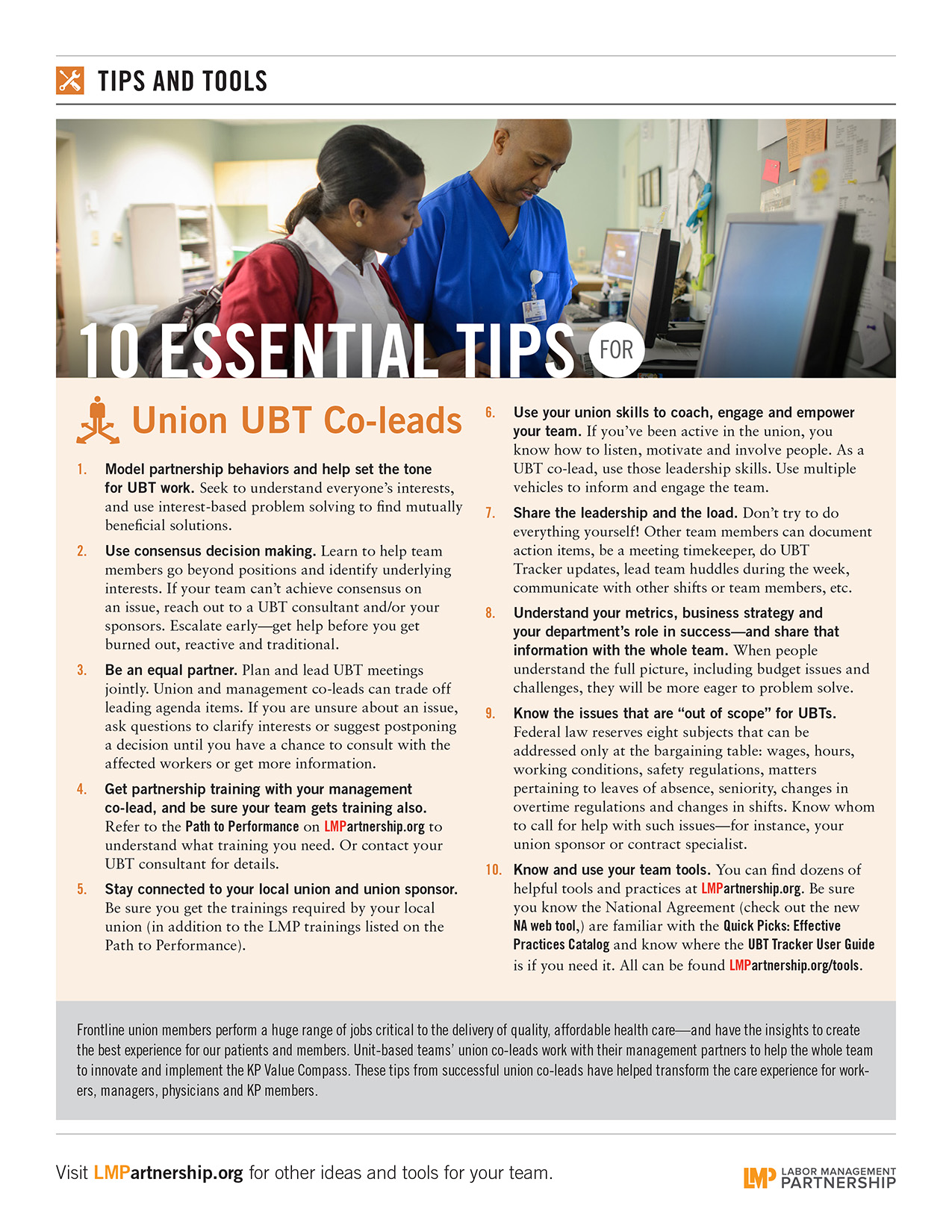
10 Essential Tips for Union Co-leads

Format:
PDF

Size: 
8.5" x 11" 

Intended audience:
Union co-leads, sponsors and stewards; unit-based team consultants

Best used:
Effective union co-leads share tips for working effectively and engaging team members.

Related stories/tools:
Get team examples and tools to put these tips to use.

Related tools:

TOOLS

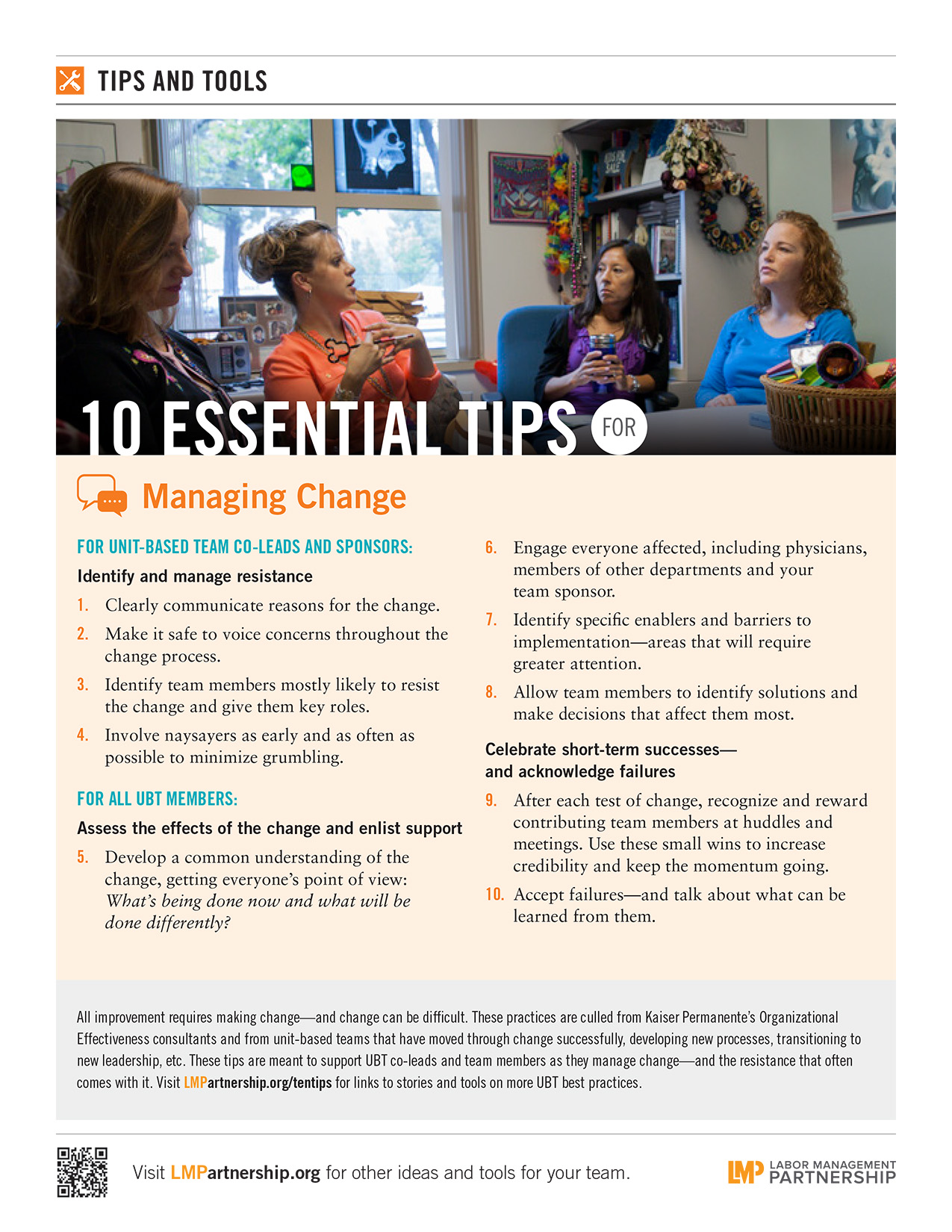
10 Essential Tips for Managing Change

Format:
PDF

Size:
8.5" x 11"

Intended audience:
UBT co-leads and team members

Best used:
As a starting point to acknowledge resistance to change and to brainstorm ideas on how to make the changes we choose more effective.


Related tools:

TOOLS

Poster: Safe to Speak Up?

Format:
PDF (color and black and white)

Size:
8.5” x 11”

Intended audience:
Frontline employees, managers and physicians

Best used:
Post on bulletin boards in break rooms and other staff areas to help your team create a workplace culture where employees feel free to raise concerns.

Related stories:

Related tools:

Patients Win After Team Ignores Traditional Hierarchy

Deck: 
Calls get answered promptly and access improves

Story body part 1: 

It’s not every day you hear of physicians offering to step in and help out staff in their assigned duties, but at the Primary Care department at Englewood Medical Office in Colorado, that’s exactly what happened.

The nursing staff, short-staffed due to medical leaves, “was overwhelmed,” says Kate Frueh, DO. Messages from patients were piling up in the electronic inbox in KP HealthConnect. Patients who might have been helped by phone or via email were coming in for appointments—making it hard for those who truly needed the in-person appointments to be seen.

“We think we’ve got some of the best nurses in the region,” says Larry Roth, MD. “We just thought, how can we help the nurses and, at the same time, help both ourselves and the patients?”

Physicians dive in

So the team brainstormed ideas, and the physicians offered to help clear the backlog.

“The nursing staff was flabbergasted,” says Linda Sawyer, RN, a member of UFCW Local 7 and the department’s labor co-lead. 

After testing a couple of time blocks and working together, the physicians began setting aside 30 minutes every morning to help triage messages and call patients back directly without getting the nurses involved—and they do it again in the afternoon.

As a result, the team consistently closes encounters within an hour more than 40 percent of the time. With more problems being resolved by phone, appointment slots have opened up and access for patients needing in-person appointments has improved. Morale in the department has improved, too—and the team recently won the Colorado region’s quarterly “Value Compass” award.

Meantime, team members have been working with Linda Focht, their UBT consultant, to boost their Path to Performance ranking—which was only at Level 2 late in 2012, despite functioning at a high level in most dimensions of the Path to Performance.

Common challenges

Focht says some of the challenges that held the team back are common across the program—a department reorganization (including a reduction in staff), new work procedures and gaps in team training. And there were new co-leads who were unfamiliar with the process for assessing team performance.

With some of those issues addressed in the first months of 2013, the team moved up to a Level 3 in the most recent ranking.

“The team members kept their focus on the goal of more streamlined work processes,” says manager Mary Watkins, RN, “and all of the staff of the Primary Care Department are helping each other to become more successful.”

 Watch a video about this team on the KP intranet.

I’ve Got Your Back

Deck: 
A business rep talks about union activism in the South—at Kaiser Permanente

Story body part 1: 

Louise Dempsey is the business representative for UFCW Local 1996 in Atlanta. She spoke with LMP communications consultant Laureen Lazarovici about her experiences as a union activist in the South.

In the late ’60s and early ’70s, my mom worked for the Social Security Administration. She transferred often for her job, so we moved a lot. She was in the union, and she organized two of the offices she got transferred to in order to get better benefits. One was in the hills of Tennessee, where there were a lot of coal mines and a lot of poverty. She once worked for a group of attorneys and mobilized her co-workers to get better wages. There was a lot of disparity in pay in terms of gender and race. Sometimes, they didn’t exactly like her. She earned the reputation as the go-to person. People would say, “If anybody can get it done, it’s Mildred.”

Unions at Kaiser Permanente

And today, here we are in the South. It is not strong union territory. Because of Georgia’s so-called “right to work” law, employees can work for KP here whether they join the union or not [in contrast to KP regions in other states with stronger worker protection laws]. But people join because they know that the stronger we are, the more we can stand up for ourselves. We have to talk to folks about the benefits of working for a unionized company. I worked for KP as an LVN before there was a union. Our wages were all over the place and assignments were based on favoritism. We’ve had people come to work for KP because it’s unionized.

When they hear about the Labor Management Partnership, they say, “I’ll sign up.” They understand they have a voice, they can be part of a UBT, they can affect the direction their team is going, and say what they need and want and be heard. Sure, we have to educate managers, but we have to educate employees about unions, too. When I talk at new employee orientation, I tell them we are there as a mediator, facilitator, advisor. You are not by yourself anymore. I’ve got your back and your front and your side, too. With the Labor Management Partnership, KP is always offering opportunities for employees to learn, like the Ben Hudnall Memorial Trust. I have been in the medical field for 30 years, and folks are always thirsting for more knowledge.

Getting used to a new way of doing things

Folks in management come into Kaiser and they are not used to unions or the partnership. We have to educate them: We have a union, we have a contract, we have a partnership. We educate them about a union environment and also that we are not the traditional head-butting adversarial union.

Normally, when I go into a meeting at KP, there is not a whole bunch of posturing. People want to get to a solution. There is no name-calling, finger-pointing or yelling. It makes a difference. Partnership benefits the local because I have open access to the employees. I went to five facilities recently. I was not stopped once. It is always, “Hi, how are you, who do you need to see?” My co-workers at the local who represent employees at other companies don’t all have that. KP has not relegated me to a break room or to certain hours. I can have a bulletin board in the break room. I have the time to speak with new hires during orientation. They don’t censor the questions the employees ask or the ones I answer. That’s partnership.

TOOLS

All in a Day's Work: To Speak or Not to Speak

Format:
PDF (color or black and white)

Size:
7.25" x 7.25" (prints out on 8.5" x 11") 

Intended audience:
Anyone with a sense of humor

Best used:
Illustrate the importance of speaking up by posting this humorous take on culture on bulletin boards and in your cubicle, and attaching it to emails. 


Related tools:

Pages

Subscribe to RSS - Culture