Culture

Help Video

How to Find UBT Basics on the LMP Website

Learn how to use the LMP website:

LMP Website Overview

Learn how to use the LMP website:

How to Find How-To Guides

This short animated video explains how to find and use our powerful how-to guides

Learn how to use the LMP website:

How to Find and Use Team-Tested Practices

Does your team want to improve service? Or clinical quality? If you don't know where to start, check out the team-tested practices on the LMP website. This short video shows you how. 

Learn how to use the LMP website:

How to Use the Search Function on the LMP Website

Having trouble using the search function? Check out this short video to help you search like a pro!

Learn how to use the LMP website:

How to Find the Tools on the LMP Website

Need to find a checklist, template or puzzle? Don't know where to start? Check out this short video to find the tools you need on the LMP website with just a few clicks. 

Learn how to use the LMP website:

Groundbreaking From the Get-Go

Deck: 
What is it that makes our National Agreements so extraordinary?

Story body part 1: 

The first round of national bargaining was unlike anything ever undertaken before—and each round of bargaining since then has broken new ground.

The 2000 National Agreement was a brand-new concept. The partnership had been formed just three years earlier, and it was the first time that Kaiser Permanente and the Coalition of KP Unions—which at that time had 33 union locals as members—bargained on a national scale.

Much of what was discussed was aspirational rather than literal. But over time, what once seemed like pie in the sky has become reality.

It was the first time that Kaiser Permanente and the Coalition of KP Unions—which at that time had 33 union locals as members—bargained on a national scale. The partnership had been formed just three years earlier.

“We’ve accomplished a lot that you wouldn’t normally see in labor negotiations,” says Adam Nemer, the Northwest region’s executive director of benefits and membership administration, regulatory services and issues management. He has worked at KP for a dozen years. “We don’t just focus on wages, benefits and working conditions. We get into how we will work together to improve the health of our members.”  

One of the most extraordinary developments came with the 2005 agreement, which called for the creation of unit-based teams.

“The vision and the genesis of the partnership was involvement with the front line—so creating UBTs was important,” says LaMont Stone, a labor liaison for OPEIU Local 29 in Northern California who’s been involved in the last two rounds of bargaining. “This actually gets the frontline employee involved in decision making. With UBTs, you now have ideas going from the top to the bottom and back.”
With Collective Wisdom, You Can Achieve Anything

Deck: 
The only doctor on the 2012 Common Issues Committee had an unusual vantage point

Story body part 1: 

When I was asked to represent The Permanente Medical Group at 2012 bargaining, I leapt at the opportunity. My own experience with partnership at Fresno Medical Center showed me what great things could be accomplished with collective problem solving.

I sat on the subgroup that looked at how to improve partnership to enhance performance and Kaiser Permanente’s operational agility. I was amazed at seeing so many people with different backgrounds sharing their thoughts and shaping the outcomes. From the highest levels of Kaiser Permanente and union leadership to the front line, everybody was around the table, and they were all equal in this venue. Everyone was heard and engaged.

I personally learned a lot from the different perspectives voiced by all of the individuals representing their fields. I strongly believe that collective wisdom is better than individual wisdom, and that with collective wisdom you can achieve anything in life. Interest-based bargaining, which assembles voices from all levels and reaches of Kaiser Permanente, is a great example of collective wisdom.

Another thing that struck me—how much folks craved the physician perspective. When I spoke, all 25 to 30 people in that subgroup really listened. And there were issues where a physician perspective was critical. That was a strong message I brought back to physicians. In most unit-based teams at Fresno, there is physician involvement. The intention is to bring those perspectives together to enhance the care for our members and patients. But does that mean if I walk into a UBT meeting I’ll see a doctor? Maybe yes, maybe no.

I’ve worked at Kaiser Permanente for 34 years, and I saw the pre-partnership years. They were contentious ones. We’ve had relative peace with coalition unions since partnership. That’s not to say that working in partnership is perfect in every way. It can’t be done without trusting each other. And how do you develop trust? Through transparency. The whole bargaining process was about transparency; essentially, everybody could share everything. That doesn’t mean people didn’t disagree.

The interest-based, collective approach takes into account everyone’s perspectives to reach a better outcome, which is ultimately a common goal—superior care for our members and patients.

Sightseeing? Making a Major Purchase? Try IBPS.

Deck: 
After helping negotiate four National Agreements, the interest-based process has become a way of life for a nurse practitioner

Story body part 1: 

I just used interest-based problem solving (IBPS) while I was at a union convention in Philadelphia. We got five people to rent a car together and go sightseeing on our one day off. So we had to decide what to do in Philadelphia for 24 hours. We brainstormed, then identified the ideas we all supported. We went to Valley Forge, Amish country and the boardwalk in Atlantic City. It worked great.

My husband and I used interest-based problem solving to make a decision about a major purchase recently. I used IBPS to get to “yes.” IBPS is the easiest way to organize your mind. My mind automatically goes to it and that whole process. If a conversation gets confusing, you can go back to the structure provided by it.

Being at a round table with interest-based problem solving is the best way to move health care forward. What we do at the bargaining table with IBPS is great, but we need to do a better job bringing that back to the workplace. We can make it better by having more frontline managers at the bargaining table.

Frontline managers, especially the newer ones, need a sense of the history and commitment of our National Agreement. And frontline managers need more support. There are still problems with backfill, with allowing employees to be involved in LMP activities.

The way we do business at Kaiser Permanente is the Labor Management Partnership, so we need to have those interest-based discussions. I’ve been involved in 2000, 2005, 2010 and 2012 bargaining. I am in awe of the great work labor and management representatives do—and how we can come up with common goals in a nonadversarial manner. I hope we all see it as a value.

Good Partnering Methods Aren’t Just for the Bargaining Table

Deck: 
How the interest-based process keeps potential problems from becoming real problems

Story body part 1: 

A former KP administrator, Michael Belmont now works for Restructuring Associates Inc., the consulting firm that helped during the creation and initial implementation of the Labor Management Partnership and that now helps facilitate national bargaining. He sees interest-based bargaining as a way to solve the problems of the future, before they arise, instead of getting stuck dealing with the baggage of past grievances.

My time at Kaiser Permanente dates back to the late 1980s. I was assistant hospital administrator in Panorama City, dealing with several unions. We were facing so much discord. It was all-encompassing, and it took the focus off improvement issues. The move toward interest-based bargaining and [the] Labor Management Partnership allowed us to put the focus on improving the member experience instead of continually trying to resolve labor problems.

Partnership, especially interest-based bargaining, gives employees and their unions a chance to have an impact on things they might not otherwise. They have a say beyond wages, hours and working conditions. In 2012, there was a bargaining subgroup on growth, focusing both on growing Kaiser Permanente and the unions. In a traditional setting, that doesn’t happen. For employees and their unions, the other side of the interest-based process is responsibility and accountability to take on and help solve the problems of the organization.

When we do trainings on interest-based problem solving, people will say, “This is how I deal with relationships.” If you are going to be a good partner—and have a successful relationship with a partner, kids, friends—you have to have your partner’s interests in mind as well as your own. Making this connection helps people connect the strategy to their work lives.

After 2000 bargaining, the Southern California region was looking for a change in labor relations, away from traditional, toward partnership. We were trying to move labor relations away from being a wall between the unions and management and toward facilitating a productive relationship between unions and management. I saw a gradual transition toward more of a partnering role. I left KP in 2006. I could come back [with Restructuring Associates] as a neutral [party] in 2010 and 2012 because of the [nature of the previous] relationships with union and management officials.

Interest-based bargaining is focused on solving problems up front rather than on grievances. People have to unlearn a lot of habits and build a lot of trust. There was 50 years of baggage [when the partnership started]. A traditional approach leaves lots of scars. Traditional is the comfort zone for most organizations. Traditional approaches are backwards looking: They are about solving problems from the past that pile up and wait for bargaining. Interest-based bargaining is about solving problems and issues that may come up in the future. Using the interest-based approach in bargaining and in day-to-day work is a much more forward-looking way to solve problems—and so much more effective.

TOOLS

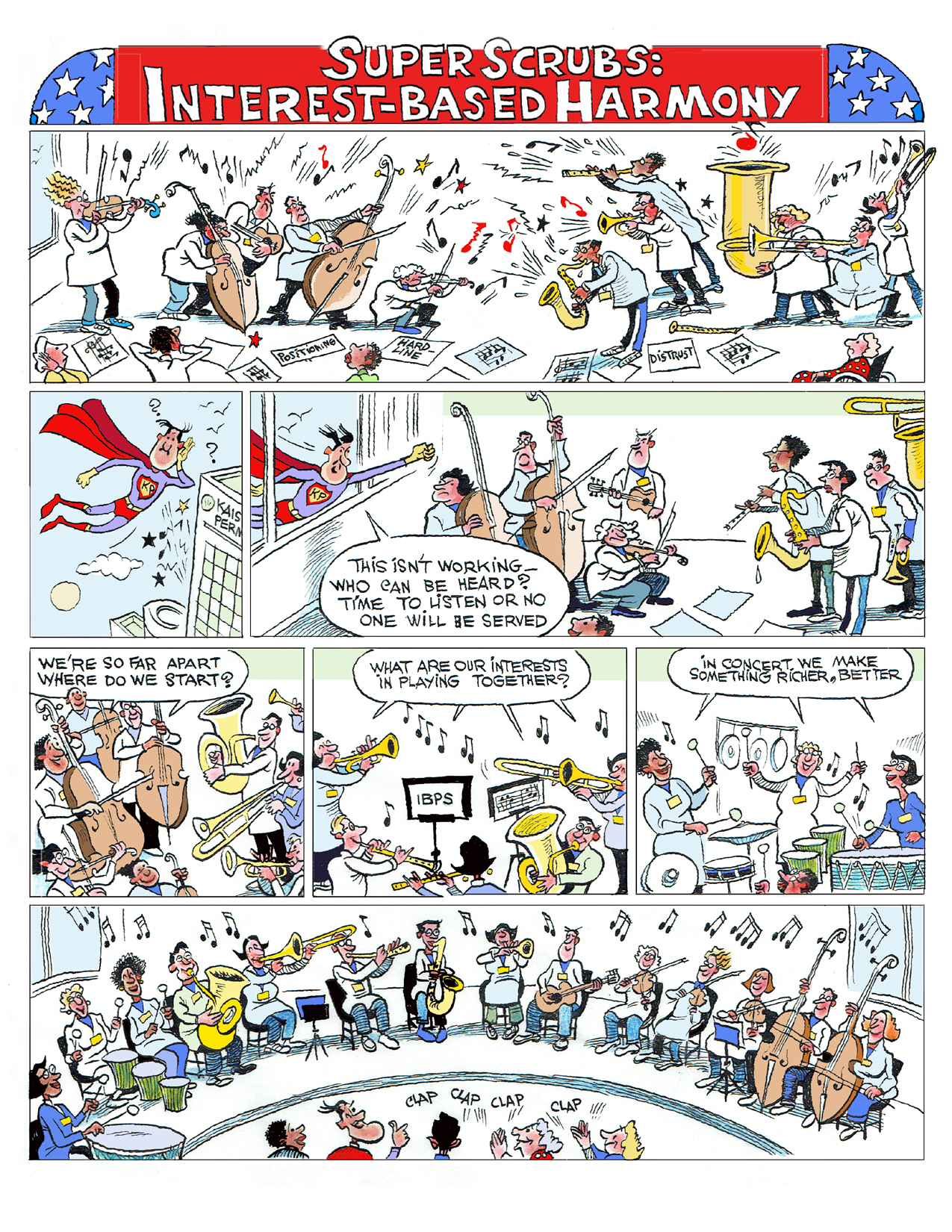
SuperScrubs: Interest-Based Harmony

Format:
PDF (color or black and white)

Size:
8.5" x 11"

Intended audience:
Anyone with a sense of humor.

Best used:
This full-page comic features Manny helping orchestrate harmony by encouraging everyone to discover their common interests. Enjoy, and appreciate the value of interest-based problem solving.

Related tools:

Pages

Subscribe to RSS - Culture