Videos
Speak Up, Change a Life
Loading the player...
(3:00)
Here is a real example of the impact that an empowered worker had on our patients—starting with 8-year-old Lucy Scott.
This short animated video explains how to find and use our powerful how-to guides
Does your team want to improve service? Or clinical quality? If you don't know where to start, check out the team-tested practices on the LMP website. This short video shows you how.
Having trouble using the search function? Check out this short video to help you search like a pro!
Need to find a checklist, template or puzzle? Don't know where to start? Check out this short video to find the tools you need on the LMP website with just a few clicks.
(3:00)
Here is a real example of the impact that an empowered worker had on our patients—starting with 8-year-old Lucy Scott.
The Colorado region is improving patient care and saving millions by providing high-risk patients extra attention after discharge, leading to a reduction in readmission rates. In the Post Acute Care Transitions (PACT) program, nurse practitioners visit patients in their homes after discharge from a hospital or skilled nursing facility, giving them a chance to alter the patient’s care plan if needed. The PACT team has visited approximately 4,200 high-risk patients since the program began in January 2013. At that time, 22 percent of high-risk patients were readmitted within 30 days, at a cost of $11.7 million. The PACT team has reduced readmission rates by 50 percent, saving Kaiser Permanente approximately $6 million since the program began.
To make sure no good deed goes uncopied, the Georgia region launched a Spread and Sustain system to move best practices throughout the region—and showed off the results to KP’s board of directors at a UBT fair early last summer. Georgia took a spread blueprint from the Southern California region and fine-tuned it to meet its needs. Now its unit-based teams, sponsors and regional leaders identify projects with good spread potential, determine other locations where the new process could work, share the practice and check back to see how they’re being sustained. Several projects have been successfully spread region-wide—addressing such issues as hypertension, HPV vaccinations and lab specimen collection.
Hawaii is a beautiful place to live, but Kaiser Permanente members who live on the less-populated islands sometimes find it challenging to get the care they need. To address that, KP offers a special benefit called Travel Concierge Service. If health plan members need medical care that isn’t available on their island, KP assists them in traveling to the Moanalua Medical Center in Oahu or to a specialty care medical office. KP makes the travel arrangements and picks up the tab for travel, including airfare, shuttle service and discounted hotel rates. For minors who need specialty care, KP also pays for companion travel. “Our members love this service,” says Lori Nanone, a sales and account manager in the region.
For several years, co-leads in the Mid-Atlantic States have compiled monthly reports of their UBT activities, goals and progress using Microsoft Word and Excel. Now, the region is rolling out a dashboard that automatically compiles the same information from UBT Tracker into an easy-to-reference SharePoint site, Kaiser Permanente’s new online social collaboration tool. The new dashboard will encourage more frequent updates to UBT Tracker and eliminate the need for co-leads to create separate documents, says Jennifer Walker, lead UBT consultant and improvement advisor. “Now the information we get is more timely and easier to assess,” Walker says. “Before, the information was up to a month old.”
The Santa Rosa Medical Center Diversity Design committee is equipping employees with tools to help them provide better service to Spanish-speaking patients. The group, composed of labor and management, has been piloting a handout featuring a list of common Spanish phrases, such as ¿Necesita un intérprete? (“Do you need an interpreter?”), as well as instructions on using the phone interpreter system. The idea came from a Spanish-speaking patient on the facility’s Latino patient advisory committee, who recalled the time she was lost in the facility and no one could direct her in Spanish. The Spanish language flier is the latest in the committee’s work to help ensure all patients receive the same optimal service and care.
Unit-based teams in the Continuing Care Services department are focusing on improving the experience for some of Kaiser Permanente’s most vulnerable members: those in skilled nursing facilities or receiving home health, hospice or palliative care. Teams are focusing on ensuring better transitions for patients as they go from inpatient to ambulatory care. By identifying issues before they become problems, labor and management hope to coordinate care more effectively, reduce emergency department visits and cut down on outside medical costs.
Harmony comes easily when you use the tools of partnership. Just ask the Biohazards, a band of union members and a manager that uses partnership principles to guide performances. “We call ourselves an LMP project,” says Mary Anne Umekubo, a clinical laboratory scientist and Regional Laboratory assistant director who sings and plays percussion and guitar. She is among six band members who represent a variety of departments, shifts and unions, including SEIU-UHW and UFCW Local 770. Performing for friends and colleagues, band members use consensus decision making to choose songs, interest-based problem solving to fix mistakes and the Rapid Improvement Model to tweak performances. “We’re from different departments,” says drummer Eric Cuarez, a regional courier driver and SEIU-UHW member. “We come together to play music.”
Diversity and inclusion. Without both, we each tend to identify with our own clan—be it defined by race, gender, age, economic status, what have you—and all the other clans remain other.
Diversity without inclusion permits an accumulation of biases that leads to a world where, as one recent study showed, minority patients are up to 30 percent less likely to receive pain treatment in emergency rooms than whites, even though they report pain just as frequently. This matters: Pain slows healing and can create new health problems. Sadly, this huge gap in treating pain is just one example in a long list of health disparities linked to cultural biases.
Inclusion—finding what we have in common, appreciating diversity instead of ignoring differences—is key to eliminating disparities and delivering high-quality health care.
As Ron Copeland, MD, Kaiser Permanente’s senior vice president of National Diversity and Inclusion Strategy and Policy, says, “I don’t believe you can have passion for true quality or service excellence without also being genuinely passionate about diversity and inclusion practices. They’re one and the same.”
How do you get good at inclusion? Practice seeing what you have in common with others. The Labor Management Partnership’s unit-based teams—whose membership cuts across all demographics—do this daily as they use interest-based problem solving. As this issue of Hank shows, a natural next step is to address how to deliver the best possible care to all our members.
It takes only one person or one small group to spark meaningful change. Be that person. Be an active member of your team.
(1:43)
Sponsoring five unit-based teams could be a full-time job on its own—but it’s just one of several hats Lynette Harper wears. This slideshow captures a day in her life at work.
Format:
PDF
Size:
8.5” x 11”
Intended audience:
Frontline employees, managers and physicians
Best used:
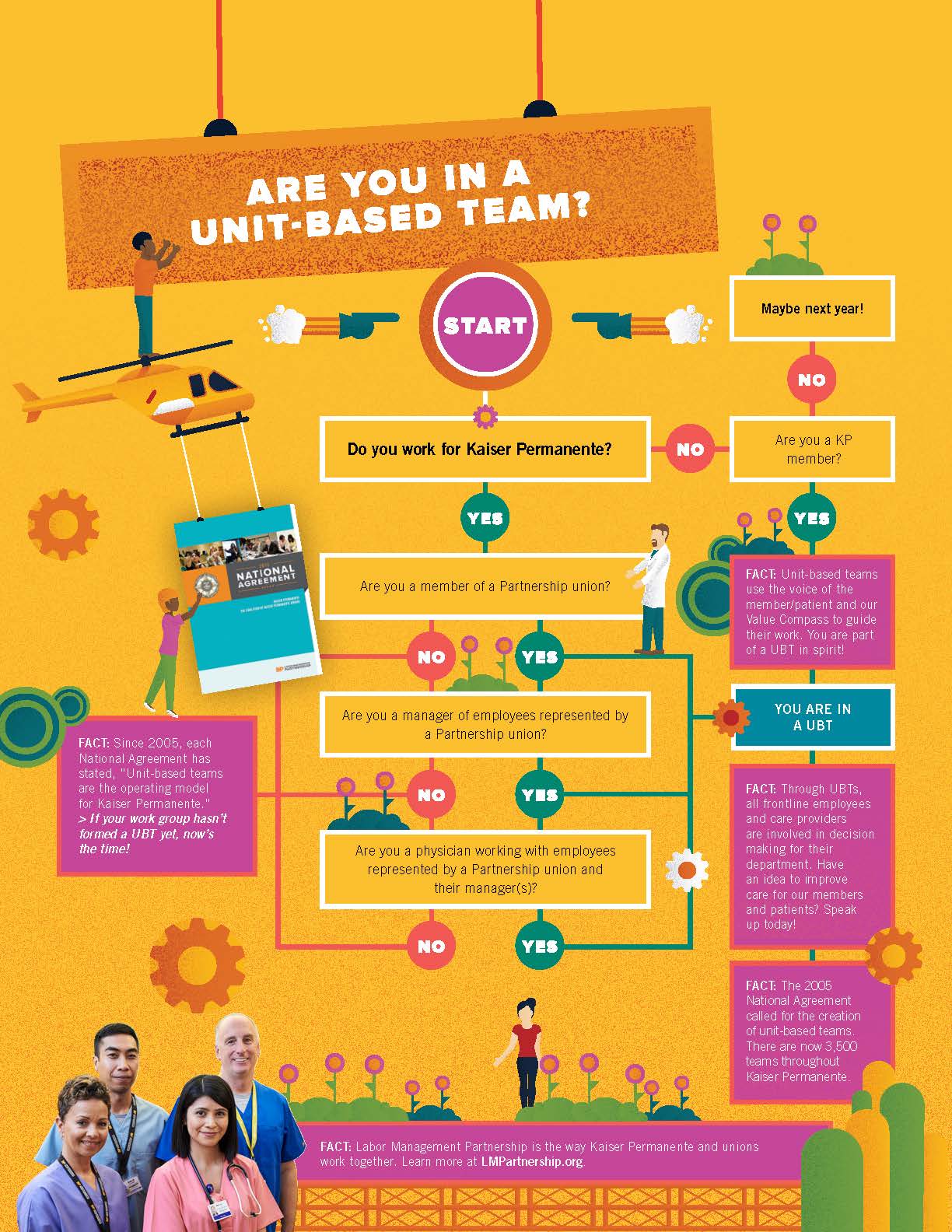
This colorful "decision tree" will help department members understand that everyone in the "natural work group" is part of the UBT. Share on a bulletin board or in your break room.
(3:07)
This short video features Kaiser Permanente employees at a business office in Walnut Creek, Calif., who take an Instant Recess® dance break every morning—almost without fail—in the parking lot.
Each day, every day, Kaiser Permanente’s 3,500 unit-based teams are providing ever-better patient care and advancing our mission. Now, under the 2015 National Agreement, UBTs will have an even greater role to play—and higher expectations to meet.
The new contract, which took effect Oct. 1, 2015, calls for UBTs to bring the voice of KP members and patients into their work. Teams also will be making total health and safety a greater part of their activities. And they will undergo more rigorous, face-to-face performance assessments.
To help them meet the new expectations, there’s a cadre of expert peer advisors and coaches they can call on—unit-based team consultants and union partnership representatives (UPRs) trained in performance improvement methods. Both UBT consultants and UPRs support unit-based teams, but UPRs, who are coalition union-represented employees, also specifically mentor and support labor in UBT and performance improvement work. Both help teams sharpen their communication, data collection and analysis, and other skills needed to advance on the Path to Performance.
It’s a unique system to support workplace learning and innovation.
“I’ve learned a lot about how to build teams and how to use performance improvement tools,” says Gage Martin, an SEIU-UHW member and union partnership representative at the Santa Rosa Medical Center in Northern California. “I take that learning and help teams do projects in all areas of our Value Compass. It’s a great job.”
The UBT consultant and UPR roles were created, as a test of change, in 2008. Since then, they have helped KP set the standard for quality, service and the workplace experience, and delivered tens of millions of dollars in cost savings.
As we strive to deliver the promise of One KP—providing each member and patient with the best care experience, every time—we also need to have One LMP, with each person working in partnership, having the same resources available to them and the same accountability to upholding the National Agreement. UBT consultants and UPRs help make that happen.
When one of her teams is able to leap over the roadblocks in its path with the grace of an Olympic hurdler, Charisse Lewis finds herself out of a job.
As a UBT consultant for the Baldwin Park Medical Center in Southern California, it’s an occupational hazard that she looks forward to—again and again. Like coaches everywhere, she enjoys seeing her teams take what they’ve learned and make it their own.
“I do a lot of mentoring,” says Lewis, who acts as coach, counselor and head cheerleader for her facility’s 68 unit-based teams, nudging them past milestones on the Path to Performance, the five-stage “growth chart” UBTs use to measure success. “I’m teaching teams how to function without me.”
For example, she recently helped a team of critical care nurses advance from Level 1 to Level 4 by using an array of strategies from team-building activities to involving union representatives. Another team advanced to Level 4 in part because she coached the management co-lead, who was new to Kaiser Permanente, in how to manage effectively in a partnership culture.
Lewis doesn’t work alone. She’s part of Baldwin Park’s UBT Strategy Group, a SWAT team of union members and managers who target at-risk teams. That team’s goal is to help UBTs excel so they can drive performance to provide the best service, quality, affordability and job satisfaction. Low-performing teams, says Lewis, tend to suffer from poor communication, paltry trust and a lack of transparency.
“It’s hard to get past that stuff,” she says. “They flounder there. They don’t trust each other and it’s hard to be a team.”
Part of Lewis’s talent in helping turn teams around is her skill in assessing stumbling blocks and getting teams engaged with the right resources. She draws on her experience as an LMP coordinator, trainer and improvement advisor to nuture her teams.
“I don’t like to stare at that elephant in the room,” says Lewis. “If it’s a contract issue, then we need a contract specialist. If it’s an HR issue, let’s make sure that HR is involved. I like to address the problem and get the team’s leaders involved, from both labor and management.”
Her approach speaks for itself. Baldwin Park has the highest percentage of high-performing teams in Southern California: Of 68 teams at Baldwin Park, 88 percent are at Levels 4 and 5 on the Path to Performance.
Her passion, integrity and ability to help others overcome their differences and work together to improve member and patient care has earned her praise from LMP leaders throughout Southern California—but Lewis, in turn, credits her success to the many people who support her efforts.
“I have the support of the regional LMP office, and I have a strong support system at the medical center,” she says. “It makes my job easier.”
If you are inspired to improve your team’s communication, just like the ones in Baldwin Park did, here are the next steps for you to take:
For years, success eluded the Baldwin Park Critical Care team. Mired in distrust, staff members didn’t participate in unit-based team meetings. As recently as 2011, few in the 49-member department knew the team existed.
“I didn’t even know what UBT stood for,” says Sheryl Magpali, RN, a member of UNAC/UHCP and now the team’s union co-lead. “No one claimed to be part of it. It was pretty much nonexistent until 2013.”
With a new manager on board, interest in the UBT grew. Staff members from the Critical Care Unit and its sister department, the Step-Down Unit, elected 12 representatives, who in turn chose Magpali as the labor co-lead. Celso Silla, RN, the new department administrator, became the management co-lead.
It was rough going at first.
Attendance was spotty. When the team did meet, members focused on long-simmering grievances about labor and personnel issues. The team reached out to Charisse Lewis, Baldwin Park’s UBT consultant. While consultants often focus on helping teams with using the Rapid Improvement Model and designing tests of change, they also help teams learn to work as teams—clearing up issues that are distracting them from the work at hand.
Lewis’s first steps were to encourage the team’s union members to meet separately with a labor representative.
“That helped relieve the stressors of the union issues,” Magpali says. Now, she says, “team meetings focus on changes that affect the unit, rather than things we have no control over.”
The department—nearly all nurses, but also including ward clerks, who are SEIU-UHW members and one of whom is a team representative—began building trust in other ways, too. At Lewis’s suggestion, staff members organized a bowling night and had dinner together. This summer, they held a backpack drive.
“Charisse has been good at guiding us—attending our meetings, observing and listening and seeing how we can do better,” says Silla.
Lewis didn’t stop with team-building activities. She coached Magpali, a soft-spoken nurse, to speak up during meetings and make her voice heard, and she helped Silla overcome his reluctance to leave his union co-lead in charge of meetings.
Once trust was established, the team could turn its attention to improving patient care, with remarkable results. UBT members have reduced central line-associated bloodstream infections from five in 2014 to none as of August of this year. Buoyed by that success, they are working to reduce catheter-associated infections.
Silla attributes the improvements to the culture of partnership and putting frontline employees in charge of decisions that affect their work.
“We would have been in limbo” without Lewis’s guidance, Silla says. “Now we’re on the same page. We can be a Level 5 in the future.”
The Mid-Atlantic States region has approximately 220 unit-based teams with more than 5,200 members.
One problem, though: Some of those who belong to UBTs don’t know it.
The region’s seven UBT consultants, who made a commitment to work together as a UBT themselves, are trying to change that.
“Employees can’t contribute to the success of the team if they don’t know they are part of the team,” says Tracy Schrader, one of KP’s UBT consultants in the region, who is also an improvement advisor and OPEIU Local 2 member. “They don’t realize they can speak up.”
From their travels around the Capital Beltway to team meetings and huddles, the consultants—each of whom supports about 35 teams—knew there was a disconnect for some UBT members. So when they established their own team’s 2015 goals, they planned two main tactics: to host several UBT Fairs to raise the profile of UBTs, and to improve communications so all UBT members know they are on a team.
The fairs, which the consultants originally were planning to hold at the region’s largest centers over the summer, would showcase the work of the teams at that facility and highlight such LMP initiatives and priorities as Total Health, Workplace Safety and the Ben Hudnall Memorial Trust, which provides a variety of resources for career-advancing education.
“We wanted to hold fairs that would have a strong impact,” says Jennifer Walker, RN, a lead UBT consultant and improvement advisor.
Then—just as happens with frontline teams—they received some data that surprised them. The 2014 People Pulse results showed that some locations the consultants thought would score poorly on UBT-related questions scored well and vice versa. Armed with that data, the consultants decided to hold the first five fairs at the centers that had the most teams with more than 10 percent of members answering “no” when asked “are you in a UBT?”
“It was a real eye-opener,” says Preena Gujral, another MAS UBT consultant and improvement advisor who’s a member of OPEIU Local 2. “Data is very important. It’s perception versus reality.”
The data also led the consultants to combine their two tactics: The fairs would be the method for communicating the message that all work group members are indeed part of a UBT.
Walker, one of the region’s lead consultants, says it can be difficult to get the message across, especially with large departments. Unlike small departments where everyone participates in UBT meetings, larger departments typically have a core group of employees who attend UBT meetings as representatives of everyone on staff. Employees who aren’t representatives don’t always realize that they are part of the team, too.
The energy and attendance of the first UBT Fair that the consultants sponsored, held at the end of June at the Fair Oaks Medical Center in Fairfax, Virginia, was higher than they expected, with more than 150 employees stopping by.
“The participation was fantastic,” says Wendy Williams, RN, a UBT consultant and member of UFCW Local 27.
Irene Taliaferro, a gastroenterology nurse practitioner, attended the fair at Fair Oaks in late August. She hadn’t realized she was a UBT member.
“I came to find out more about UBTs. Before I came to the fair, I knew nothing about them,” says Taliaferro. “We have a representative who goes to meetings. I don’t know much about it.”
Steve Pereira, UBT consultant and improvement advisor, hopes the blitz of UBT Fairs gives workers like Taliaferro a better understanding of the partnership and an incentive to be more involved.
“People want to know more than their 9-to-5 jobs,” Pereira says. “This is the opportunity for that.”
Because of their commitment to use the same tools as frontline UBTs, the consultants have been using the Plan, Do, Study, Act cycle of the Rapid Improvement Model in planning and holding the fairs.
So, Walker says, “We structured it so the fairs happen before the annual People Pulse is taken again, in September”—that way, the fairs serve as a test of change. Will the communication provided by the fairs improve the score on the “I’m in a UBT” question?
“We’ll look for the next People Pulse results to validate whether this was the best way to go,” she says.
Watch for an update on the consultants’ efforts next year on LMPartnership.org, after the 2015 People Pulse results are in.
No need to struggle on your own. There are lots of resources out there to guide teams along the Path to Performance: