Frontline Physicians

Help Video

How to Find UBT Basics on the LMP Website

Learn how to use the LMP website:

LMP Website Overview

Learn how to use the LMP website:

How to Find How-To Guides

This short animated video explains how to find and use our powerful how-to guides

Learn how to use the LMP website:

How to Find and Use Team-Tested Practices

Does your team want to improve service? Or clinical quality? If you don't know where to start, check out the team-tested practices on the LMP website. This short video shows you how. 

Learn how to use the LMP website:

How to Use the Search Function on the LMP Website

Having trouble using the search function? Check out this short video to help you search like a pro!

Learn how to use the LMP website:

How to Find the Tools on the LMP Website

Need to find a checklist, template or puzzle? Don't know where to start? Check out this short video to find the tools you need on the LMP website with just a few clicks. 

Learn how to use the LMP website:

TOOLS

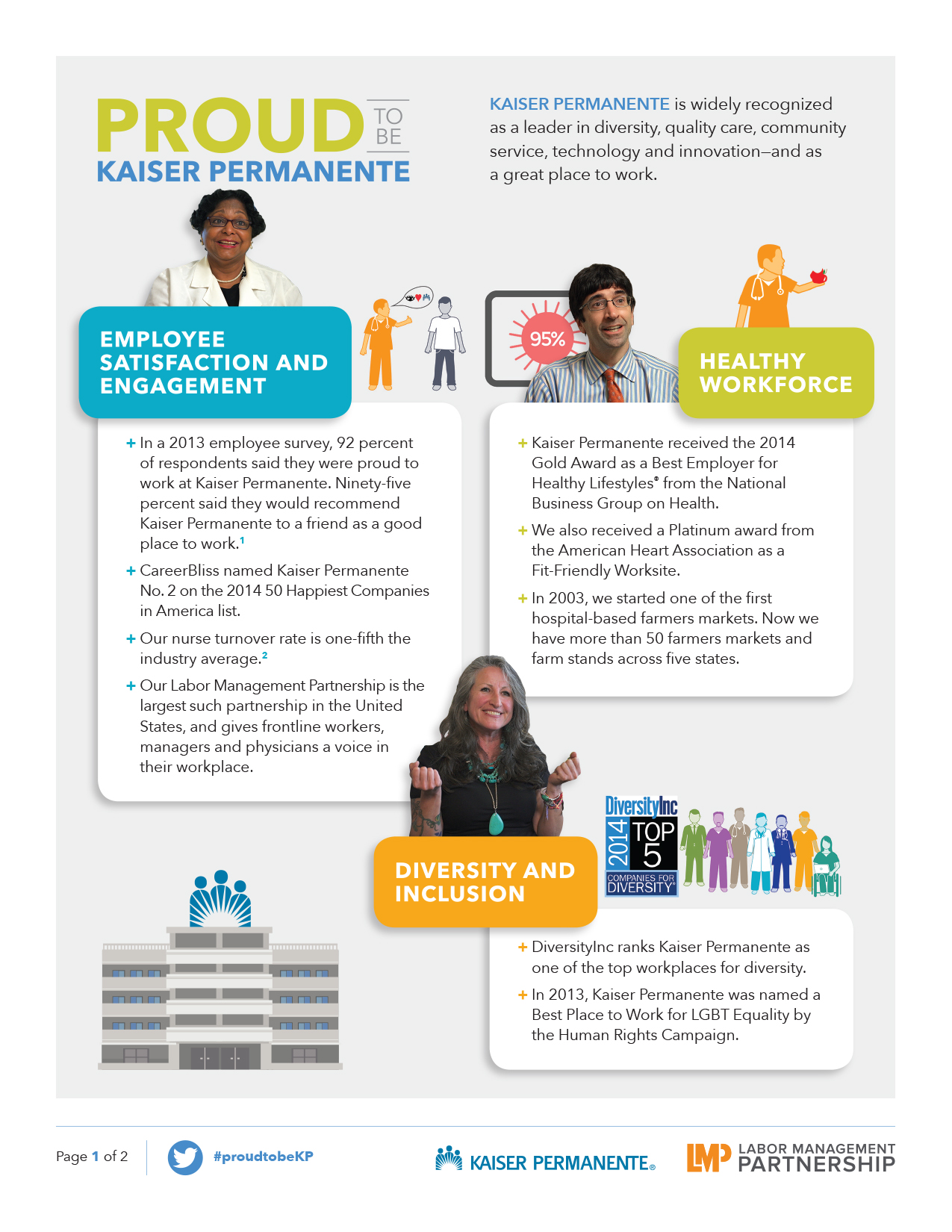
"Proud to Be Kaiser Permanente" Poster

Format:
PDF

Size:
8.5" x 11" (two-sided)

Intended audience:
Frontline employees, managers and physicians

Best used:
This poster showcases some of the accolades Kaiser Permanente has received as a leader in diversity, quality care, community service, technology and innovation—and for being a great place to work. Use at LMP and UBT trainings, UBT meetings, union conferences, and new employee trainings

Watch the video: "Proud to Be Kaiser Permanente"


Related tools:

Frontline Employees Get Intensive Ebola Preparation

Deck: 
KP, union coalition collaborate on training event

Story body part 1: 

Standing on a stage in front of hundreds of his fellow health care workers at the largest Ebola educational session on the West Coast to date, registered nurse Peter Sidhu demonstrated how to use personal protective gear in the way that keeps both patients and workers safe.

Sidhu inspected his equipment first—two pairs of gloves, a gown, mask and face shield. Then Arjun Srinivasan, MD, the associate director for health care-associated infection prevention programs at the federal Centers for Disease Control and Prevention, gave him detailed, step-by-step instructions in putting them on.  

Resources

The Nov. 7 educational session in Los Angeles was hosted by Kaiser Permanente, the Coalition of Kaiser Permanente Unions and other organizations that are coming together to help frontline caregivers learn about the newest CDC protocols and guidelines for handling Ebola patients. Hundreds attended in person, while thousands more nationwide watched a live telecast of the event.

TOOLS

Poster: Simple Conversation Improves Follow-up Care

Format:
PDF

Size:
8.5” x 11”

Intended audience:
Frontline employees, managers and physicians

Best used:
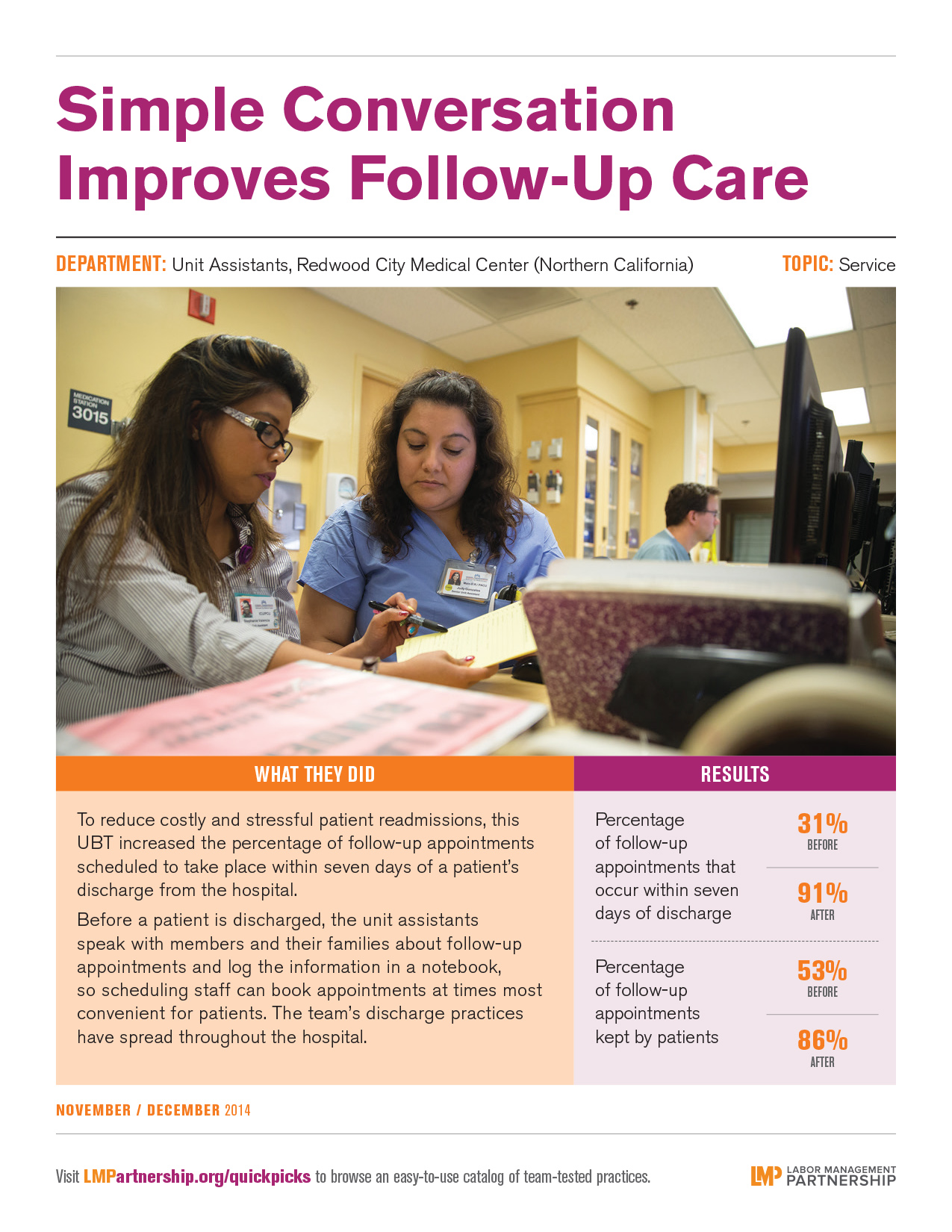
This poster highlights unit assistants who worked to reduce costly and stressful patient readmissions by increasing the percentage of follow-up appointments within seven days of discharge. Post on bulletin boards, in break rooms and other staff areas.


Related tools:

TOOLS

Icebreaker: What's Your Question?

Format:
PDF (color and black and white)

Size:
8.5” x 11”

Intended audience:
Frontline employees, managers and physicians

Best used:
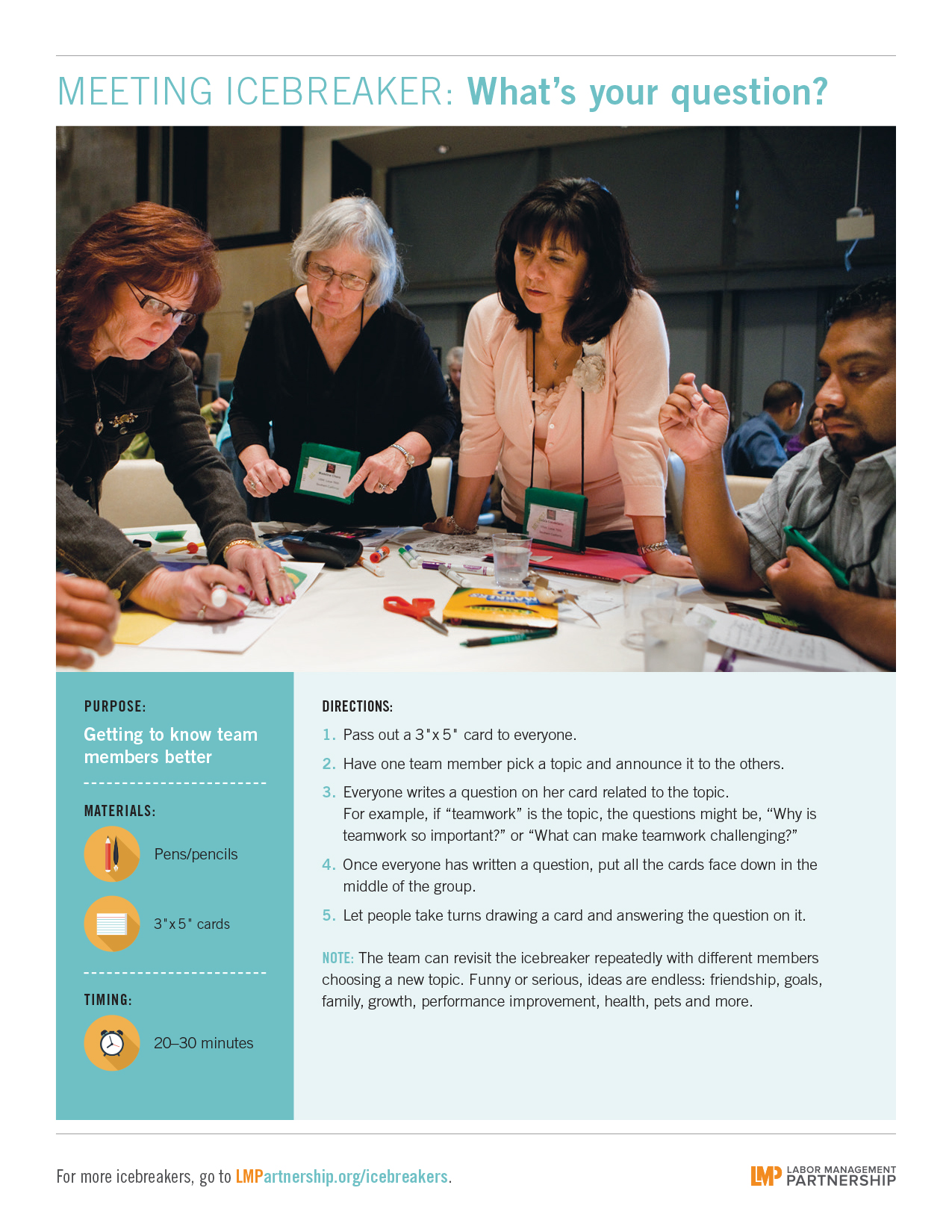
Posted on bulletin boards, in break rooms and other staff areas, this poster features information on how to use an icebreaker during a meeting to get to know your team members better.

Related tools:

Giving Patients a Voice

Deck: 
How UBTs are listening to members

Story body part 1: 

On her last day at work before going on maternity leave, something started going wrong with Juanita Ichinose’s pregnancy—and she found herself in an ambulance, on her way to the Downey Medical Center. Her husband, Trav, followed in his car. The images from an ultrasound foretold a grim story: Juanita was expecting twins, but one of the boys was not moving. “Code Pink” began blaring from the overhead speakers as she was wheeled to the operating room. What caregivers and the family feared came to pass. One twin survived, but the other did not.

“We had some moments with our other son,” says Trav Ichinose. “Then I went to see Teo. He weighed a pound and a half. The doctor told me, ‘He is very small.’”

Thus began Teo Ichinose’s four-month stay in the neonatal intensive care unit, a journey that led his father to become an active member of the department’s parent advisory council. Today, Teo is a happy 4-year-old, obsessed with his toy airplane from the latest Disney movie. And his father continues to bring the voice of the patient to Downey’s NICU unit-based team, where his input has helped shape numerous improvements.

UBTs exist to include all voices—employees, managers and physicians—in efforts to improve performance. And some UBTs are bringing in one more crucial voice: the patient’s.

To be sure, there are UBT members who resist. Objections range from “we don’t have time” to “patients can’t possibly know how our department runs.” But for others, it is a step that literally brings the patient-and-member focus of the Value Compass to life.

“UBTs have a lot of expertise. They know what is and isn’t working,” says Hannah King, director for service quality for unit-based teams. “What is missing is the perspective of the user, someone who might be afraid or in pain. We don’t know what they go through before and after they come to us. So we need to ask.”

Read on to see how UBTs have included patients and members in their work and improved performance.

Whose handoff is this, anyhow?
Downey NICU finds a way to keep parents involved during shift changes

During his son’s four-month stay in the NICU, Trav Ichinose became concerned that parents were prevented from visiting during shift changes, when the Nurse Knowledge Exchange Plus occurs.

“Parents want to maximize their time with their babies, and the policy was undermining that,” he says.

Nurses wanted to integrate parents into the process but also needed to prevent interruptions. “During the report, the parents tended to interject,” says Marnie Morales, RN, the team’s union co-lead and a UNAC/UHCP member. “That was a safety issue,” because it is important nurses not get sidetracked.

So, together with Ichinose and the parent advisory council, UBT members devised a system that met the needs of caregivers and parents. There would be “quiet time,” when parents listen and jot down notes while the outgoing nurse updates the incoming nurse. Once they’re done, it’s the parents’ turn to discuss their baby’s care with the nurses.

In testing the process, the nurses realized they needed to be able to discuss sensitive information out of the parents’ earshot—if, for example, there was a domestic violence situation or mental health problems in the family. So they came up with a discreet cue that signals the need to step away.

“The patient is getting better care because there is better communication. Information that wasn’t getting shared before is now,” Morales says. “As nurses, we get so involved with charting that we forget the patient is sitting there. Now, we are explaining as we are doing it because the parent is there watching.”

The change gave the team a boost in its satisfaction scores, which rose from 74 percent in the third quarter of 2012 to 88 percent one year later. It works to maintain the scores by holding refresher trainings with staff.

“With long stays like ours, your emotional resilience is tested to the max,” Ichinose says. “There are things that happen in the NICU setting that can undermine that resilience—or bolster it. Bolstering our ability to take in information, to be physically and emotionally present for the care of our child, affects our satisfaction with the care.”

Preserving pride, preventing falls:
A comment provides a San Diego team with fresh insight

Why do patients fall when they are in the hospital? Is it because they are elderly? Or under the influence of medications that affect their balance? The leaders, physicians and nurses at the San Diego Medical Center considered a range of possibilities and tried everything in the usual playbook, posting pictures of falling leaves on patient doors and using color-coded armbands to indicate fall risk. But nothing was working.

Then the UBT on the 5 West medical-surgical unit cared for a patient who was a member of the facility’s patient advisory council—and they asked his wife for her opinion. She said her husband—normally a self-sufficient, strong man—was too embarrassed to call a nurse to help him to the bathroom, especially given that he was wearing a flimsy, possibly revealing hospital gown.

That “aha” moment led the UBT to take a new approach: No one walks alone. Instead of trying to figure out who is at risk for falling, caregivers would treat everyone as a fall risk and provide assistance. The pilot program was so successful that it is being spread to the entire hospital. Before the campaign began in November 2012, the hospital had been averaging 16 falls a month. In June 2014, that figure was 3.4 a month.

Seeing the experience through the patient’s eyes was the key to the solution.

“I felt as if I was part of the team, and my input was just as valuable as any other member’s,” says Pat, the patient’s wife (last name withheld at her request). “If you go to patients with the attitude that they will be helping you do your job better, you will get an honest evaluation of what can be done to help, and they can make your job easier and more rewarding.”

Reluctant to change?
Some ideas for including patients as part of a UBT

Sheryl Almendrez, the management co-lead of the Definitive Observation Unit (also called a step-down unit) at the San Diego Medical Center, acknowledges that caregivers on her team were hesitant to have a patient join its improvement work: “They were interested, but were they ready to hear ‘the real truth’?” And what if a chronic complainer ate up valuable time?

As it turns out, there was little to fear. Patients’ requests were reasonable. For example, they want nurses to give them a heads-up when using an ear thermometer. “We’re used to it,” says Almendrez, but they may not know what it is. “They may think it’s an injection coming at them.”

For the Urgent Care unit in Largo, Md., listening to patients’ feedback about long wait times when coming in with a sore throat led that UBT to work with colleagues in the lab to fast-track tests for strep throat.

“Our team was very hesitant about bringing a member in because there could be more complaints than real feedback,” says Donna Fraser, RN, the team’s union co-lead and a member of UFCW Local 400. Making it clear why it was including patients helped: “We told the patient that we want to know what we are doing wrong, because how else will we improve?”

Morales of the Downey NICU says she no longer flinches from criticism, whether or not it’s phrased “constructively.”

 “Some of the people we have on our advisory council are the ones who complained the most,” she says. “You know what? They became the advocates for all the other babies. They helped us change a lot of things on our unit for the better.”

How to Climb the Path to High Performance

Deck: 
Helping workers, KP, members and patients

Story body part 1: 

Kaiser Permanente and the Coalition of Kaiser Permanente Unions set an ambitious goal in the 2012 National Agreement: to have 75 percent of all unit-based teams achieve high performance by year-end 2014—for good reason. As teams develop, they deliver better, more affordable care and a better work experience.

There’s work to be done. More than 60 percent of teams in Georgia, Hawaii and the Northwest are meeting the goal, but overall, just 52 percent of KP’s 3,500 UBTs program-wide were rated high performing as of June 30.

The good news is that nearly 1,800 teams across KP have hit their mark, built performance improvement into their everyday work, and are showing other teams how to do the same.

Modeling the way

The Perioperative UBT at Ontario Medical Center in Southern California is one of those teams.

“It’s about having everyone involved and engaged,” says Michelle Tolentino, RN, one of the Perioperative UBT’s union co-leads and a member of UNAC/UHCP. “We attended UBT training together, got results on our first project (safely reducing patient stay times) and kept rolling.”

The 11-member representative team, which covers more than 60 nurses, surgical techs, medical assistants and others, reached Level 5 on the five-point Path to Performance soon after forming in 2012. Like many other teams in the region, it saw its rating drop in 2013 after a labor dispute led union members to suspend their UBT involvement. When the issue was resolved, the team regrouped and quickly regained its Level 5 rating.

The secret sauce

The team does a few key things right that helped it achieve and now maintain its high performance. Those can be modeled by other teams aspiring to Levels 4 and 5 status:

  • Performance improvement tools: “Using our performance improvement tools—process mappings; run charts; plan, do, study, act cycles—keeps us all sharp,” says Mary Rodriguez, assistant clinical director and UBT co-lead. “That’s been key for us: understand the process and use the tools.”
  • Constant tests of change: The Perioperative team now has seven active tests of change, most focusing on improving affordability and workflow efficiency. “Our projects often build off of other projects,” says Rodriquez. For instance, a recently completed project helped reduce turnaround time in the OR from 28 minutes to 20 minutes in three months. In a parallel project, the number of patients receiving medication at least 30 minutes before surgery—the ideal time for most patients—increased from 70 percent to 85 percent. Such projects draw on the whole team’s skills and perspectives, she says.
  • Physician involvement: Shawn Winnick, MD, an anesthesiologist, assistant clinical director and UBT member, points to another key to success: “Physician presence on a (clinical) UBT is extremely important,” he says. “It brings a different perspective to projects.”

Calling UBTs “the single most powerful vehicle we have at KP to empower employees and lead change,” he notes that physician leaders at the medical center have supported UBT development and helped overcome barriers.

“Staff and physicians need to have the time to consistently make it to UBT meetings,” he says. “Even if it means bringing in someone to cover part of a shift, that is more than paid back by the cost savings and organizational benefits that come out of UBTs.”

The benefits accrue to the workforce as well as patients.

“We have a say in our work process,” says Robert Kapadia, a certified registered nurse anesthetist and member of KPNAA. “I come to the table as an equal partner and advocate for others on the team, and for our patients. Our UBT is a way to solve problems and move forward, not just complain.”

Dr. Winnick adds: “There’s not a single member of our team who hasn’t contributed an idea or helped make us better. That’s a measure of a performance. We all have different skills and perspectives, and we bring all of that to our team.”

TOOLS

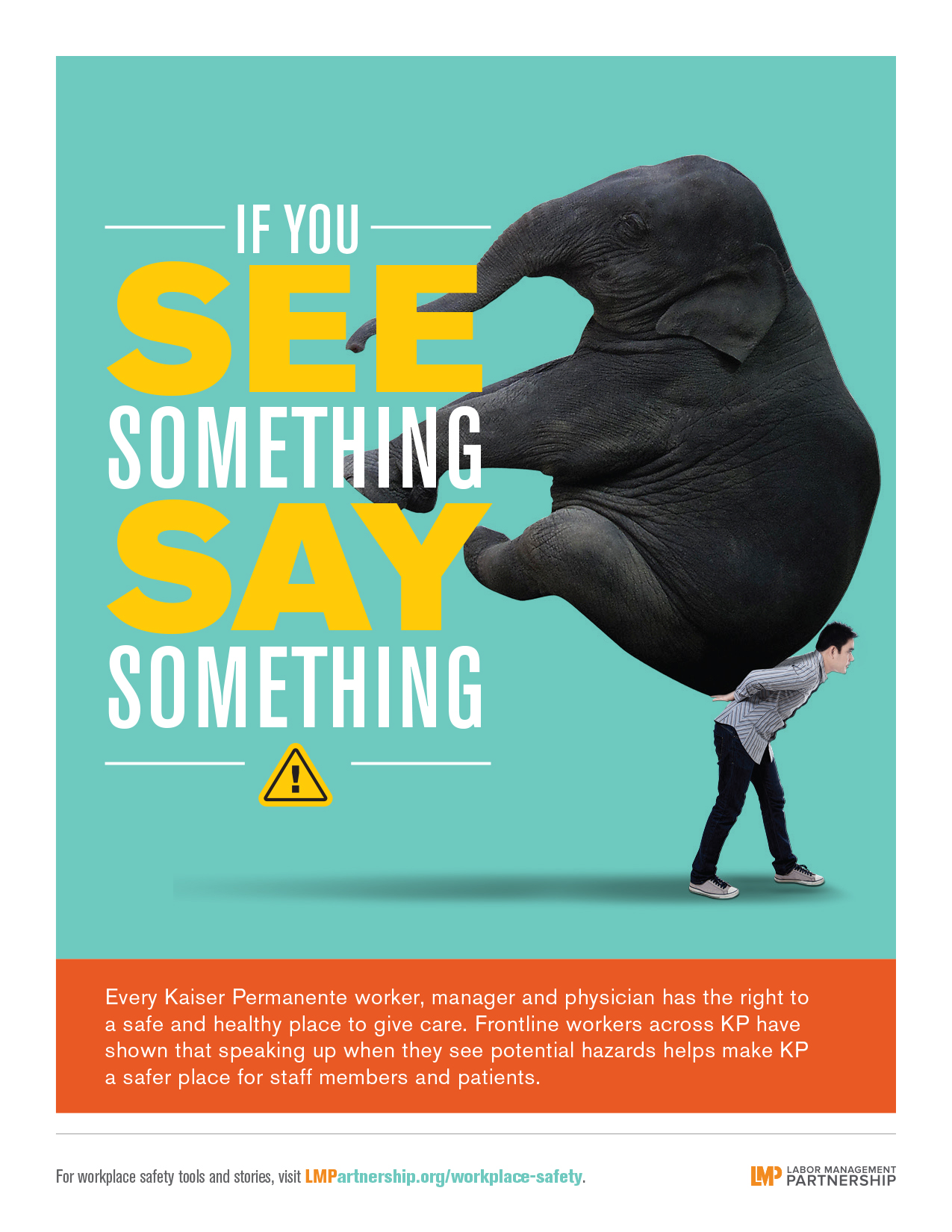
Poster: If You See Something, Say Something

Format:
PDF (color and black and white)

Size:
8.5” x 11”

Intended audience:
Frontline employees, managers and physicians

Best used:
This is a good primer during your UBT meetings to encourage team members to speak up when they see hazards.

Related tools:

Teen Interns Jump-Start UBTs

Deck: 
Using the Community Benefit program to school interns in performance improvement

Story body part 1: 

Summer interns often are put to work fetching coffee or making copies. But last year, UBT consultant Geoffrey Gamble wanted to create a more valuable experience for the teens of KP’s Summer Youth Employment Program at the Modesto Medical Center. So he trained a small army of performance improvement consultants to help support unit-based teams.

Despite initial skepticism from some team members and managers, the results were stunning. By the end of the summer, 12 of the 13 teams supported by the interns advanced at least one level on the Path to Performance. What’s more, four of the 19 projects carried out by the UBTs yielded savings or cost avoidance totaling $400,000. The program was such a success, it has returned to Modesto this summer and has spread to the Sacramento and San Jose medical centers. And in the process, the interns are gaining on-the-job training that translates to their studies and to the work world.

“I went in thinking we were going to do grunt work, but in reality it was like, ‘Wow, I’m actually doing something I can apply,’” says Nate Aguirre, who interned in Modesto’s Emergency Department last year. “It was a life-changing experience.”

The Community Benefit program has offered training and work experience to teenagers in underserved communities since 1968. In the past, that experience included clerical work or coaching on speaking in front of a large group. When Modesto’s internship coordinator retired in 2013, Gamble agreed to oversee the program as long as it supported his work developing UBTs.

Overcoming doubt with results

“When I first proposed the idea, directors were very skeptical,” Gamble recalls. “People would say, We’re struggling to do this with professionals—how do you expect to get momentum from a 16-year-old?’”

But Gamble saw the opportunity to offer teams a fresh perspective and the daily support many need to get started. He also wanted to show team members that performance improvement didn’t have to be complicated and could be incorporated in their daily work.

“I told managers that I was going to treat (interns) like adults and give them the skills I would give employees,” Gamble says. “If you hold them to that expectation, they will rise to the occasion.”

In the first few days of the eight-week program, Gamble trained the 16-year-old interns in basic performance improvement tools, including the Rapid Improvement Model, process mapping and Labor Management Partnership basics. By the second week, the youth were assigned to Level 1, 2 and 3 unit-based teams and started helping the teams launch projects and enter data into UBT Tracker.  

Rosemary Sanchez, Modesto’s Emergency Department supervisor, was one of the loudest doubters.

“At first I was like, ‘Ugh, one more thing to do.’ But then I thought, ‘OK, this could work and help us accomplish our goals and share our knowledge.’” 

Intern Nate Aguirre was crucial in helping the team on its project to streamline and standardize supplies in the treatment rooms.

“Nate was awesome,” Sanchez says. “He was so enthusiastic collecting data.”  

Getting the ball rolling

Aguirre also spent time talking to employees in the department to learn about their jobs and the challenges they face in their work.

Meghan Baker, an Emergency Department clerk and union co-lead for the UBT, says that sparked interest and support from UBT members—a shift from before, when they had struggled to get employees involved.

“People were into having their voice heard by someone,” says Baker, who's a member of SEIU-UHW. “Now people are talking and getting the ball rolling on things. And we’re making it known that people are being heard.”

At the start of the program, the Emergency Department UBT was ranked at Level 3. The team advanced to Level 4 after completing the work.

Michelle Smith, manager of Specialty Surgery Reception, appreciated the new perspective and support her team received from its intern for its project to reduce surgery no-shows and last-minute cancellations.

“It was nice to have someone get our project going,” she says, “because we were at a standstill.”

The team’s intern walked the UBT members through mapping out their process. New workflows emerged that included calling patients ahead of scheduled surgeries, which reduced no-shows and increased service scores.

When the teams were asked what they thought helped them advance, many said it was because of the interns coming to the departments every day to help push and support the work. 

“We would have eventually worked on the project, but having her come in and start us off in a positive way was great,” Smith says. “She taught us how to be a team, because we realized we all had to be part of the work.”

Pages

Subscribe to RSS - Frontline Physicians