Frontline Physicians

Help Video

How to Find UBT Basics on the LMP Website

Learn how to use the LMP website:

LMP Website Overview

Learn how to use the LMP website:

How to Find How-To Guides

This short animated video explains how to find and use our powerful how-to guides

Learn how to use the LMP website:

How to Find and Use Team-Tested Practices

Does your team want to improve service? Or clinical quality? If you don't know where to start, check out the team-tested practices on the LMP website. This short video shows you how. 

Learn how to use the LMP website:

How to Use the Search Function on the LMP Website

Having trouble using the search function? Check out this short video to help you search like a pro!

Learn how to use the LMP website:

How to Find the Tools on the LMP Website

Need to find a checklist, template or puzzle? Don't know where to start? Check out this short video to find the tools you need on the LMP website with just a few clicks. 

Learn how to use the LMP website:

TOOLS

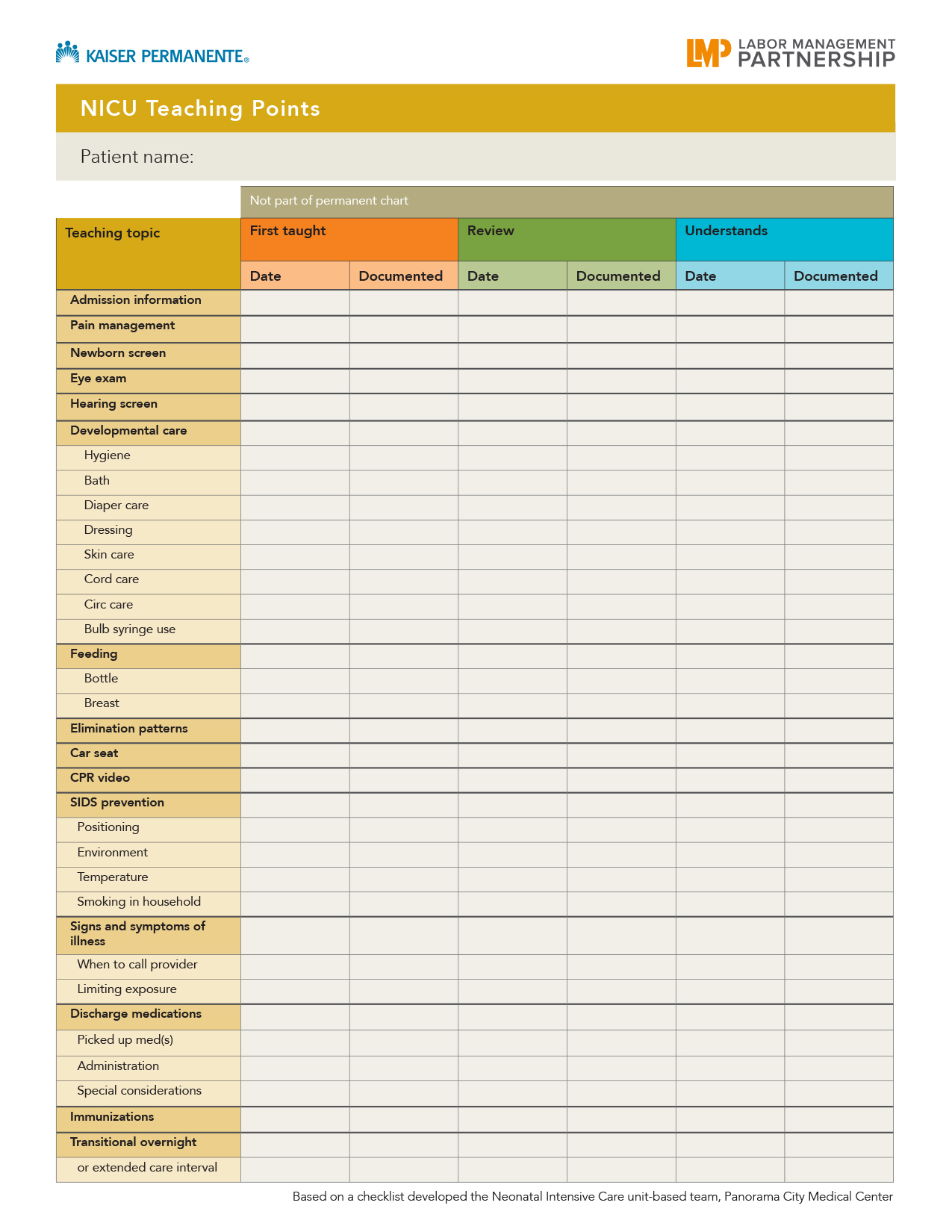
NICU Teaching Points

Format:
PDF and Word DOC

Size:
8.5" x 11"

Intended Audience:
NICUs and maternity wards

Best used:
Use this checklist to ensure that information about how to take care of a new infant is gone over consistently with parents of newborns. 

Related tools:

TOOLS

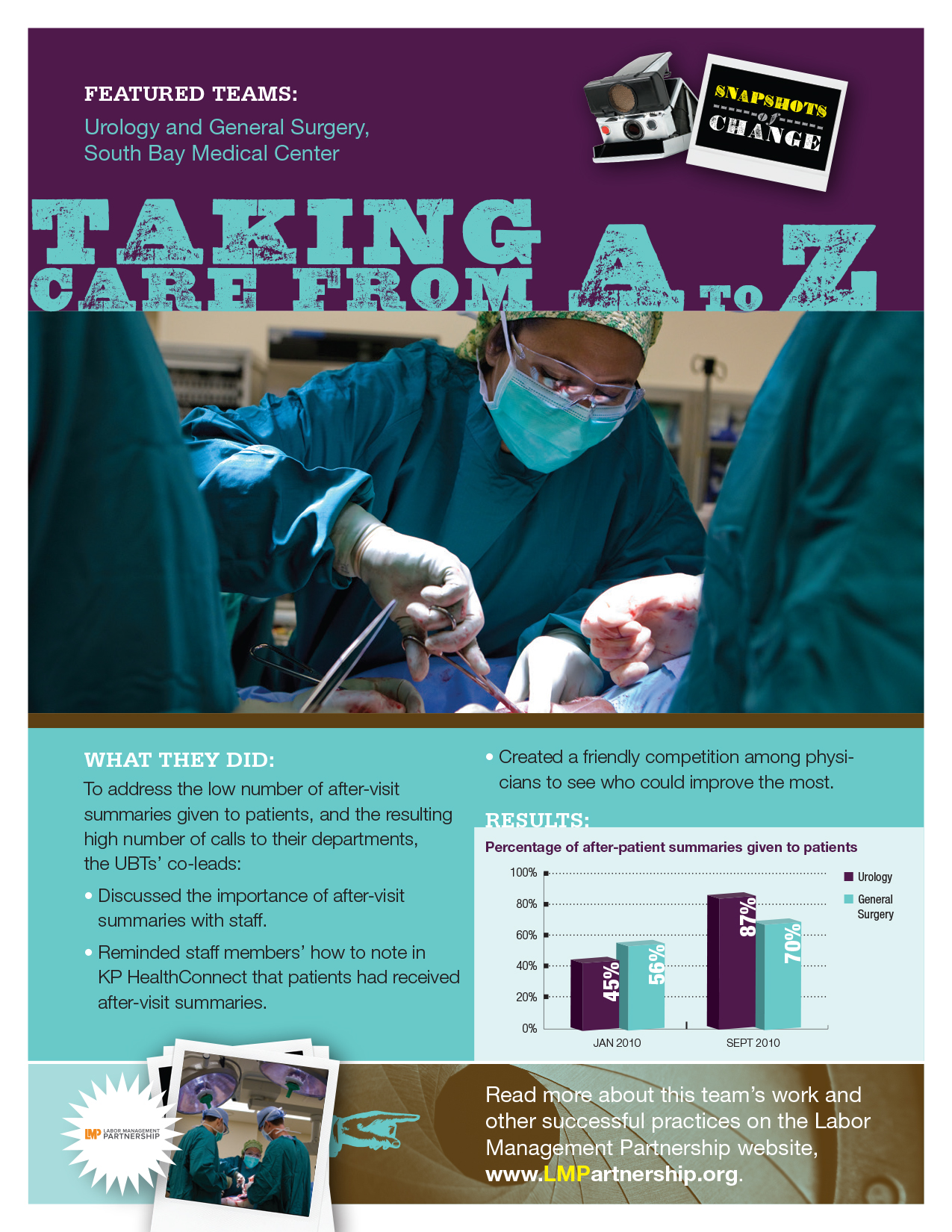
Poster: Taking Care From A to Z

Format:
PDF (color and black and white)

Size:
8.5” x 11”

Intended audience:
UBT co-leads, union members and fronline managers

Best used: 
This poster features a Southern California surgery team that improved customer service by handing out more after-visit summaries to members. Post on bulletin boards, in break rooms and other staff areas.

Related tools:

Smaller Teams Help Radiology Department Improve Performance

Story body part 1: 

After a false start, the diagnostic imaging department at Woodland Hills Medical Center has found its stride. Its results are impressive: By drawing on the wide experience of the team, it’s improving workflow and boosting attendance.

To get those results, the department created one large UBT with several subcommittees and involved a physician champion. Two radiology summits, which were held to set priorities, included the whole team: 

  • More than 160 employees and physicians who see a quarter-million patients a year.
  • Staff in eight far-flung clinics as well as throughout the medical center. They range in age from late teens to 40-year veterans of Kaiser Permanente.
  • Team members in eight areas of expertise, including ultrasound, MRI, CAT scan, nuclear medicine, mammography, general x-ray, and special procedures.  

From confusion to clarity

At first, the team’s diverse skills and experience flummoxed the department-based team (the term Woodland Hills uses instead of unit-based team).  

“We didn’t know the scope of our work,” says Selena Marchand, a lead sonographer and labor co-lead. “The old DBT got stalled talking about things like the doctors’ parking lot.”

Lessons for large teams

  • Ensure your representative group is truly representative: strive to create a structure that includes someone from each location, modality, shift, etc.
  • Include physicians
  • Reach out to trained facilitators for help
  • Focus on what your department has the power to change

A secret society?

In addition, says Marchand, the representative group—which was working without a facilitator—didn’t communicate with its co-workers about the DBT’s projects. “They thought we were some sort of secret society,” says Marchand, a member of SEIU UHW. 

The team restructured in October 2009, electing one delegate from each “modality,” as the areas of expertise are known, to the representative group.

“Pushing responsibility and accountability back to different modalities has been one of our successes,” says Mike Bruse, the department administrator and management co-lead. “We’re focused on things that we can control in our department.”

Summits get everyone involved

The co-leads convened two department-wide summits to focus on improving team performance and set priorities. Staff members brainstormed about what the challenging issues facing the department were and wrote them on flip chart pages on the wall. Then, each employee attached a sticky note to the issues that most concerned them. The team and managers set out to tackle the seven issues that received the most tags. As the work got under way, progress reports were posted in the employee break room to keep everyone on the team—not just the representatives—informed.

Better workflow

The department also improved the way it distributes film to radiologists, so that patients’ results get to primary care physicians faster. Before the change, technicians were forced to constantly interrupt doctors to read films. Now, there is a tally sheet on each radiologist’s door indicating how many films he or she is reading. This allows techs to know who is available to read a film—and allows radiologists to work undisturbed. An aide to the technologists tracks the process, acting as a traffic controller.

“It was a relatively simple thing that improved satisfaction and patient care a lot,” says Mark Schwartz, MD, who represents physicians on the UBT. “And it didn’t cost any money.”

Better attendance

The team also improved attendance, decreasing last-minute sick calls by 14 days from the end of 2009 to October 2010. They beat the Lab Department in a friendly competition two quarters in a row and were rewarded with a barbeque. To do this, team members simplified presentation of attendance data and posted up-to-the-minute metrics.  

Beyond these gains, management co-lead Bruse says the most significant change is employees’ confidence in their own ability to make improvements.

“Our meetings used to be ‘complain to Mike,’ ” he said. “These days, when people see a problem, they take steps to solve it themselves.”

Game Changer: Putting the Patient First

Deck: 
Teams in South San Francisco and San Diego work to keep patients front and center

Story body part 1: 

What happens when teams truly walk a mile in their patients’ shoes? They often discover their own actions are making that mile a rocky one for patients—and as a result make huge breakthroughs in the way they deliver care.

In the case of South San Francisco’s multidepartmental pre-admission team, observing their processes from the other side of the gurney spurred them to dramatically streamline the pre-surgery and admitting process for patients. With the member at the forefront of their thinking, the team members turned a two-inch-thick packet of confusing, redundant information into a streamlined, one-page checklist. And a funny thing happened—while redesigning the process to help patients, the team improved the way it works.

“Patients would often get confused and weren’t sure what the next step in the process was,” says Brian Tzeng, MD, the Peri-operative Medicine director. “We realized we didn’t have a clear path for the patient to follow.”

Other teams throughout Kaiser Permanente are making similar realizations, framing their performance improvement work by asking the question, “What’s best for the patient?” If a possible solution doesn’t work well for the member and patient, then there’s more brainstorming to be done. These teams are taking the Value Compass to heart—organizing their work not just around the four points but examining what they’re doing from the patient’s perspective.

What does that mean for frontline teams? At the San Diego Medical Center, the Emergency Department sees up to 300 patients every 24 hours. Physicians and staff members are always on the go, delivering on the ultimate bottom line—saved lives. What could be more important? Clinical quality is high; patients are seen in a timely manner and the rate of unscheduled return visits is good.

Yet the results of a recent patient satisfaction survey bothered the team. The department scored well overall, but their patients gave it only 63 percent approval on one question: While you were in the Emergency Department, were you kept informed about how long the treatment would take?

TOOLS

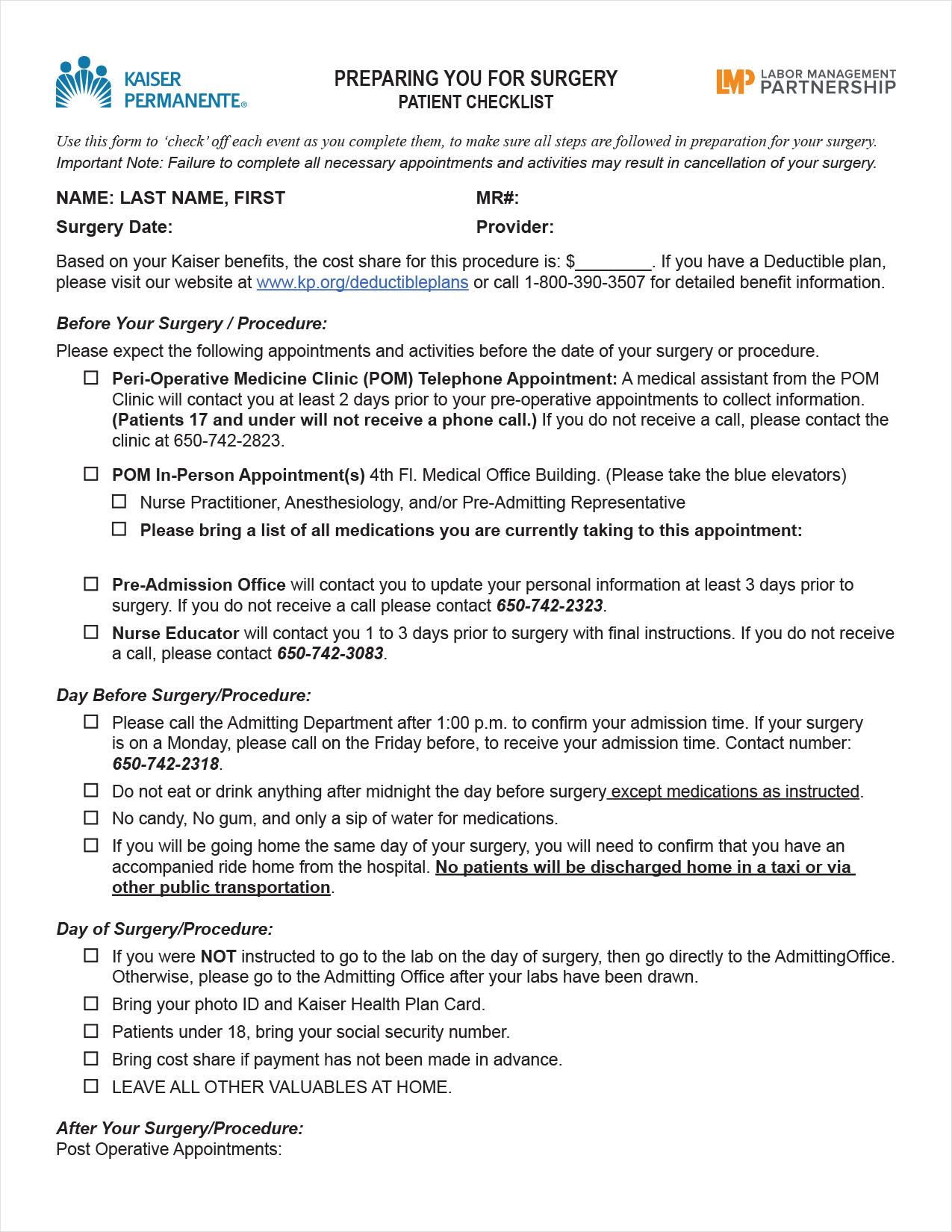
Preparing You for Surgery

Format:
PDF and Word DOC

Size:
1 page, 8½” x 11”

Intended Audience:
Teams working on improving the pre-surgery process for patients.

Best used:
Use this document as a model to consider how your facility might revamp the presurgery process and create your own one-page checklist for patients. 
This checklist was developed by a multidepartmental team in South San Francisco that wanted to streamline the presurgery process for patients. As a result of using it, 80 percent of patients are now being confirmed as pre-admitted 24 hours before surgery and the completeness and accuracy of admissions rate has hit 99.4 percent.

Read more about the process in the Fall 2010 Hank.


Related tools:

UBT Sends Message on Colon Cancer Screening

Deck: 
Union City team effort helps save lives

Various interventions have been implemented to increase the rate of colon cancer screenings, including at-home Fecal-Immunochemical Tests or FIT kits. These kits are mailed or handed to patients identified as age- or risk-appropriate and can be completed in the privacy of the member’s own home.

The FIT kit doesn’t require a doctor’s appointment and is returned directly to the lab in a prepaid envelope. Patients who have positive FIT kit results for occult blood are referred for further testing.

“A long time ago, there was no way to track these people,” Kari Russitano, medical assistant, SEIU UHW, says. “Kaiser has done a lot to improve cancer screenings.”

But getting members to take and return the test remains a problem.

In 2009, the Union City Medical Center fell short of its 71 percent return rate goal for colorectal screenings. Kaiser Permanente routinely mass mails the kits to members identified through the electronic medical records database. But many members either don’t return the tests or the ones they return aren’t legible.

“Thirty percent were thrown away because we couldn’t read their name or the medical record number,” Deborah Hennings-Cook, RN, manager, Internal Medicine, says.

Clinical coordinator, Vimi Chand, Department of Internal Medicine, adds, “Obviously mailing alone wasn’t working, so we decided to contact members by phone or secure email. And it worked.”

Of the 1,754 members contacted, more than 63 were referred for further screening. 

Having the medical assistants and receptionists make the calls was a hard sell at first, but their peers in the unit-based team stressed the preventive nature of the test.

“It didn’t seem like extra work, because we collaborated together and educated each other to think of it as if ‘this could be your family member,’” Sophia Opfermann, receptionist, OPEIU Local 29, says. “A lot of staff didn’t know what the FIT kits were for, so we educated them about that, too.” 

Then frontline staff came up with the idea for the note cards—bright fluorescent notes that read: “This test detects early signs of COLON CANCER.”

“Knowing that many people don’t understand the importance of the test, they made the verbiage strong about ‘saving lives’ and ‘help us help you,’" Hennings-Cook says. "It was something they wanted to do, and it worked.”

One challenge was adding the phone calls and emails to the medical assistants’ existing workload. Lists of patients who hadn’t responded were provided to medical assistants but some had more than others.

“We heard a little bit of flak when the lists first came out and some MAs had huge lists, but they helped each other and just did it,” Chand says. 

In the end, the bottom line was helping patients.

“By collaborating together and educating each other, we are helping to saving lives,” Opfermann says.

Secondary Blood Pressure Screenings Rise, Improve Care

Deck: 
Department explains the "why" behind the tests

The team in the Head and Neck Surgery/Audiology department at the South Bay Medical Center had been compiling monthly reports about missed second blood pressure checks.

And this can be a critical point for a patient’s care because high blood pressure is often called “the silent killer.” Those who have it often don’t exhibit symptoms until it’s extremely high, and untreated hypertension can lead to heart disease, stroke and kidney problems.

But the team reviewed the numbers without a follow-up plan.

So, they decided to have morning huddles several days a week to explain the screenings and follow with plans of action.

“We discuss why this is important and what it means to our members, that it can save lives, especially for those who haven’t been diagnosed,” says Kathy Malovich, the department administrator. 

UBT leaders provided team members with their individual performance scores on administering needed second blood pressure tests. They customized training and other follow-up plans, including coaching the team on procedures for Proactive Office Encounters (a process that takes advantage of a member’s visit to ensure the member gets any needed tests or appointments).

At huddles, they discussed the importance of controlling high blood pressure for patients. They emphasized that not only was it a strategic clinical goal but a Performance Sharing Program (PSP) goal for the medical center.  

“People think they’ve done the second test because they know they should have,” says Leroy Foster, who was the department administrator when the test of change began. “Maybe they got distracted by any number of things.” Foster said the hard data helped motivate the team. 

With a low of 35 percent for second blood tests, each team member jumped to 92 percent or better in a year. Four of the six team members hit 100 percent. In 10 months, team scores for second blood tests went up from 84.8 to 92.1 percent.

Huddling was also a key to success.

“I used to think, ‘you guys have way too many meetings,’” Jennell Jones, the union co-lead, says. “But now I see how meeting keeps people connected.”

TOOLS

Patient Care Cards

Format:
Zipped PDF

Size:
Printout, 2-sided, 4" x 6" index card

Intended Audience:
Unit-based teams

Best used:
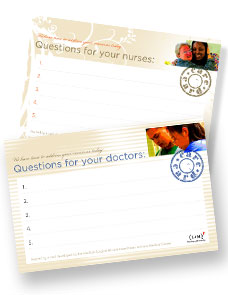
Download and print these two care cards to give to patients for their comments, allowing teams to address in-patient concerns. One care card is for patients to ask questions of their nurses and make comments on their nursing care. The other card is for patients to ask questions of their doctors and make comments on care from their doctors. This tool is inspired by a card developed by the Medical-Surgical 4B unit-based team at Irvine Medical Center.

Related tools:

The Case for Unit-Based Teams

Deck: 
A model for frontline engagement and performance improvement

Story body part 1: 

An Internal Medicine team in Ohio improved its workflow and increased from 62 percent to 74 percent the number of diabetes patients with cholesterol levels under control—surpassing the region’s goal—even while coping with a staff shortage.

A medical/surgical unit at Fontana Medical Center, in Southern California, went 23 consecutive months without an incidence of hospital-acquired pressure ulcers—after previously experiencing seven to 10 cases a year.

Colorado’s regional laboratory improved the accuracy of its transfer and tracking records from 90 percent to 98 percent, significantly reducing rework and speeding turnaround times for patients’ lab results.

These outcomes, and hundreds of others across Kaiser Permanente, were the result of performance-improvement projects undertaken by unit-based teams (UBTs)—Kaiser Permanente’s strategy for frontline engagement and collaboration.

Physician involvement in UBTs to date has varied, and generally remains limited. However, based on evidence from across Kaiser Permanente, we believe unit-based teams can help physicians achieve their clinical goals and improve their efficiency and deserve their broader involvement.

How UBTs work

Teams identify performance gaps and opportunities within their purview—issues they can address in the course of the day-to-day work, such as workflow or process improvement. By focusing on clear, agreed-upon goals, UBTs encourage greater accountability and allow team members to work up to their scope of practice or job description. Achieving agreed-upon goals, in turn, promotes continuous learning, productive interaction, and the capacity to lead further meaningful change.

As a strategy for process and quality improvement, UBTs draw on the study of “clinical microsystems” by Dartmouth-Hitchcock Medical Center and the Institute for Healthcare Improvement. “If we want to optimize a system, it's going to be around teams and teamwork, and it's going to cut across hierarchies and professional norms,” says Donald Berwick, MD, president and CEO of IHI and President’s Obama’s nominee to head the Centers for Medicare and Medicaid Services. “Unit-based teams and much better relationships between those who organize systems and those who work in the systems are going to be essential.”

Four kinds of benefits

The focused nature of UBT activities translates to four broad benefits to physicians and patients:

  • Clinical benefits: Saving lives and improving health
  • Operational benefits: Using resources wisely and improving efficiency
  • Member/Patient benefits: Giving a great patient-care experience
  • Physician/team benefits: Improving team performance and worklife

The example below, of a positive clinical outcome in one unit, shows how UBTs use practical, frontline perspective to solve problems.

Simple solutions get results

The Internal Medicine department at Hill Road Medical Offices in Ventura (SCAL) faced a practical challenge: Patients with an initial elevated blood pressure reading need to be retested after waiting at least two minutes—but they often left the office before the staff could do a second test. In fact, the staff was doing needed second checks only 26 percent of the time as of March 2008. 

The team’s simple solution: A bright yellow sign reading, “Caution: Second blood pressure reading is required on this patient,” which employees hang on the exam room door so the physician or staff would be sure to do the test.“The teams come up with good ideas about workflow because these are the folks in the trenches and they see the headaches,” says Prakash Patel, MD. “They share ideas and work out processes that help.”

In just one month, the department’s score on giving second blood pressure tests was 100 percent. Their score on the regional clinical goal of hypertension control went from 76 percent in August 2008 to 79.8 in May 2009, just below the regional goal of 80.1 percent.

"I strongly encourage all chiefs of service to champion the unit-based team in their department by either active participation or as a physician advisor, particularly regarding quality, service and access initiatives," says Virginia L Ambrosini, MD, assistant executive medical director, Permanente Human Resources.

UBTs are taking hold at the right moment for Kaiser Permanente. At a time when health care providers are under pressure to contain costs, maintain quality, and improve service, UBTs have the problem-solving tools to address those issues.

Read the full article, including principles of employee engagement and tips for selecting a performance improvement project.



Pages

Subscribe to RSS - Frontline Physicians