Frontline Workers

Help Video

How to Find UBT Basics on the LMP Website

Learn how to use the LMP website:

LMP Website Overview

Learn how to use the LMP website:

How to Find How-To Guides

This short animated video explains how to find and use our powerful how-to guides

Learn how to use the LMP website:

How to Find and Use Team-Tested Practices

Does your team want to improve service? Or clinical quality? If you don't know where to start, check out the team-tested practices on the LMP website. This short video shows you how. 

Learn how to use the LMP website:

How to Use the Search Function on the LMP Website

Having trouble using the search function? Check out this short video to help you search like a pro!

Learn how to use the LMP website:

How to Find the Tools on the LMP Website

Need to find a checklist, template or puzzle? Don't know where to start? Check out this short video to find the tools you need on the LMP website with just a few clicks. 

Learn how to use the LMP website:

TOOLS

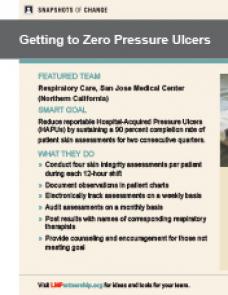
PPT: Getting to Zero Pressure Ulcers

Format:
PPT

Size:
1 Slide

Intended audience:
LMP employees, UBT consultants, improvement advisers

Best used:
This PowerPoint slide features a Northern California team that improved patient safety. Use in presentations to show some of the methods used and the measurable results being achieved by unit-based teams across Kaiser Permanente. 

Related tools:

TOOLS

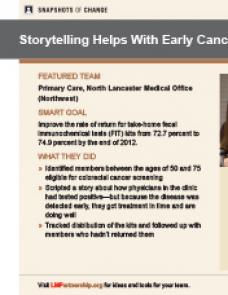
PPT: Storytelling Helps With Early Cancer Detection

Format:
PPT

Size:
1 Slide

Intended audience:
LMP employees, UBT consultants, improvement advisers

Best used:
This PowerPoint slide features a Northwest team that tried a unique approach to get more patients screened for cancer. Use in presentations to show some of the methods used and the measurable results being achieved by unit-based teams across Kaiser Permanente. 

Related tools:

Videos

Not My Father's Union

Loading the player...

(3:02)

"Not My Father's Union" is a three-minute video highlighting what's different about the unions working in partnership at Kaiser Permanente. Union members involved in the Labor Management Partnership do more than fight for wages and benefits. They are directly involved in solving problems and making the decisions that make KP the best place to receive care.


Admissions: Let Patients Know Your Role

Deck: 
Being helpful is a start, and a gift doesn't hurt

During the normal stress of being admitted to the hospital, it's not always clear to patients and their families who does what.

And if a nurse or clerk can’t answer a question on admissions, the patient can get frustrated.

So it was in the admitting department at Fremont Medical Center in Northern California, where patients gave low satisfaction scores regarding the process.

“Many different staff use the word ‘admitting,’ so we needed to make sure we stood out, and that patients knew when their admission officially began and ended,” says labor co-lead and admitting representative Joanna Nelson.

Team members thought one of their biggest challenges was making sure patients knew when they were dealing with admitting staff versus other employees.

They first tried using scripted language, the “Right Words at Right Time” (RWRT) approach to let patients know when the actual admission process had started and the representative’s role.

When that failed, the UBT added another level of patient service and rounding, which included a small gift and card.

The gifts were mostly Kaiser Permanente brand items including cups, tablets, aprons, vases or plants. Admitting representatives also gave personal cards to each patient.

“We came up with an extra-special plan for our new admissions. Once the patient was admitted, the Admitting rep went back up to the room—either later that same day or the next day—and gave our patients a welcome gift,” shop steward and OPEIU Local 29 member Nelson says, describing the gesture as a “thank you for choosing our hospital.”

And it worked.

In four quarters, polite and professional customer service scores improved 21 points, and efficient and easy customer service scores picked up three points.

The team also helped by letting patients know how all the pieces fit together.

“Personalize your admitting process,” says Fonda Faye Carlisle, manager, Admitting and Patient Financial Services. “Since the admitting department is not the only voice that says, ‘I will be admitting you,’ admitting needs to personalize so the patient can differentiate between them and others, such as nursing.”

There were team benefits, as well, beyond the scores. Department morale and attendance also increased.

“Our satisfaction is seeing our patients happy and watching our scores improve,” Nelson says.

TOOLS

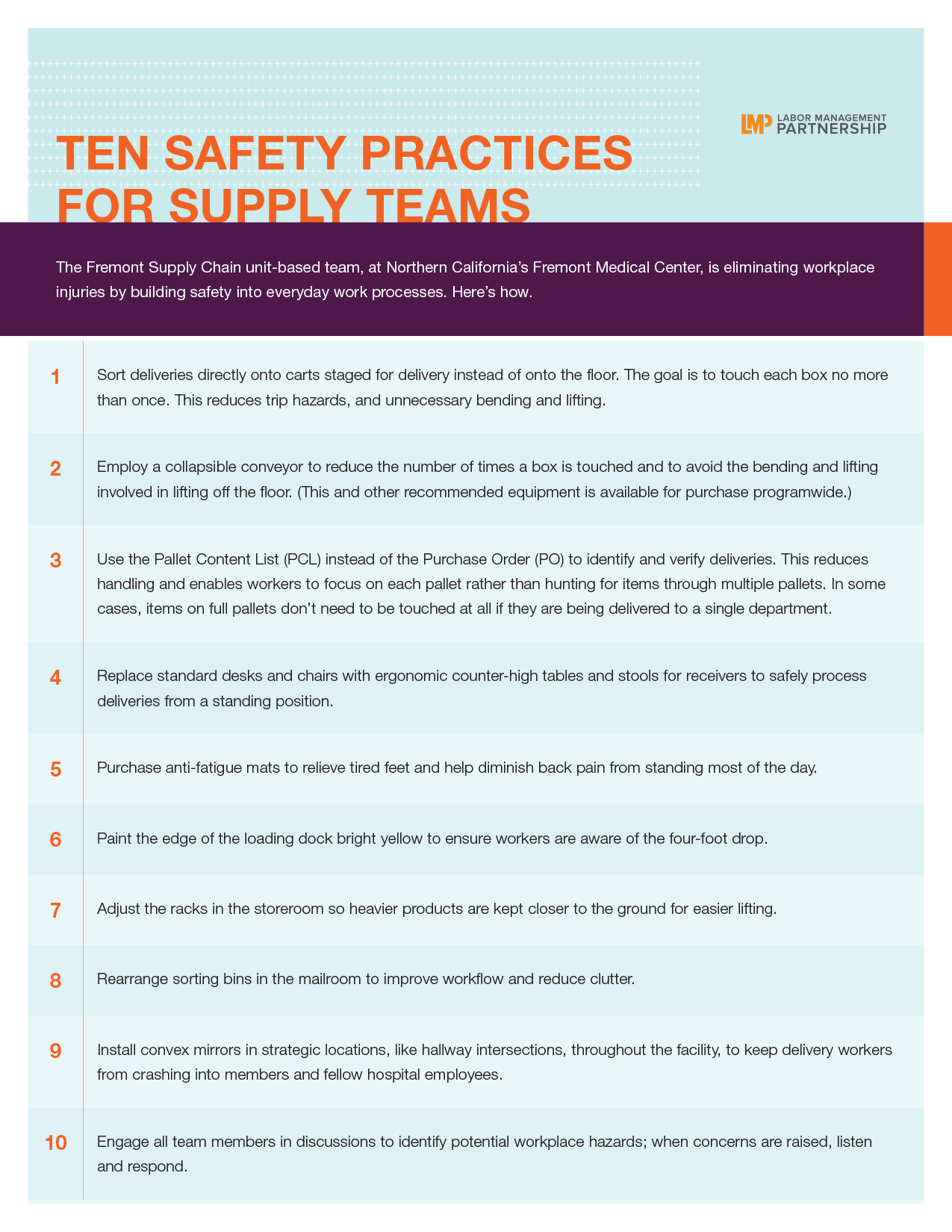
Ten Safety Practices for Supply Teams

Format:
PDF

Size:
8.5" x 11"

Intended audience:
Materials management and supply teams

Best used:
One-page tipsheet with 10 safety principles for materials management and supply teams. Use to share successful workplace safety practices with similar teams.

Related tools:

TOOLS

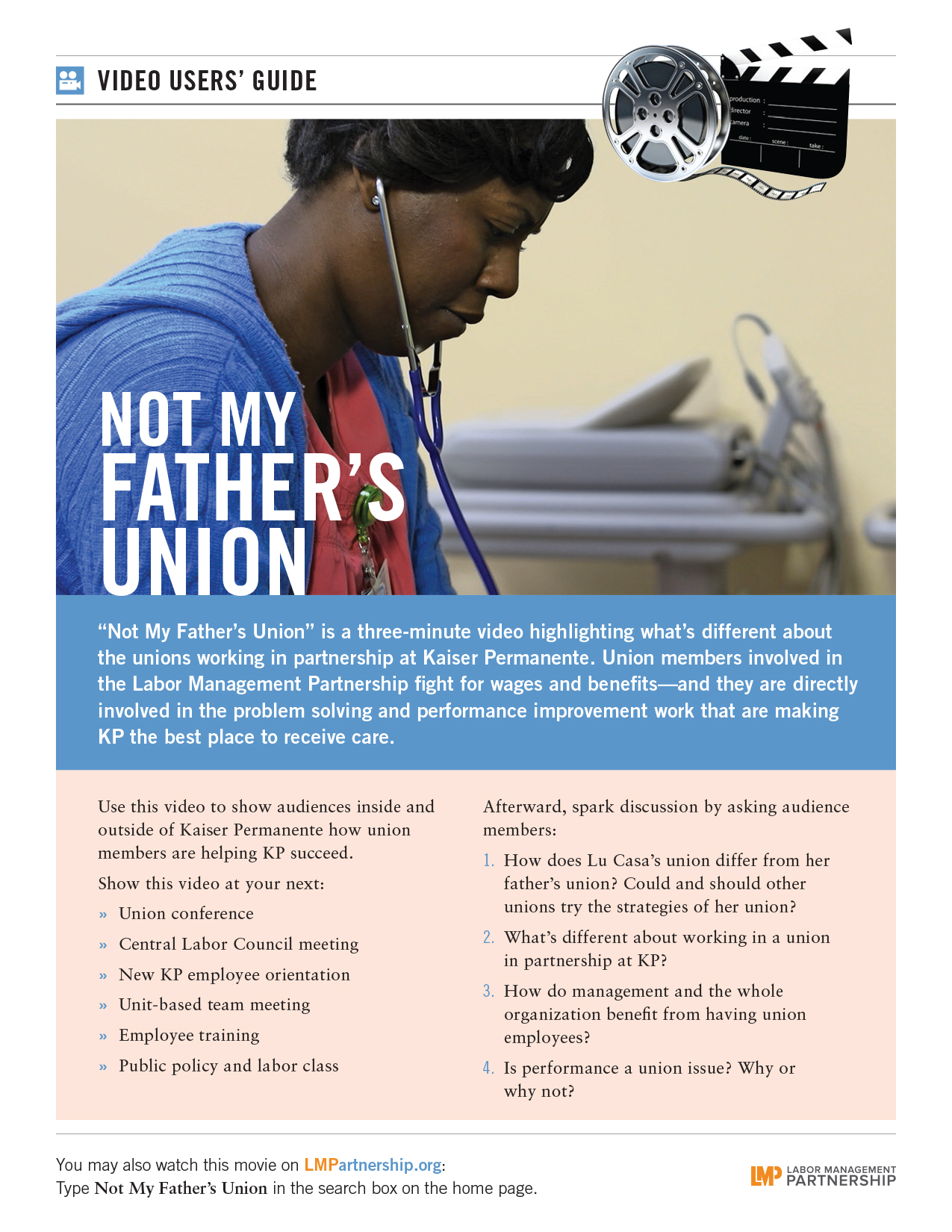
"Not My Father's Union" Video Users' Guide

Format:
PDF

Size:
8.5" x 11"

Intended audience:
Union employees, union members, external audiences

Best used:
This video users' guide suggests ways in which "Not My Father's Union" can be used to show audiences inside and outside of KP how unions members are helping KP succeed. Use at LMP and UBT trainings, UBT meetings, union conferences, and new employee trainings.

View video: "Not My Father's Union"

Related tools:

TOOLS

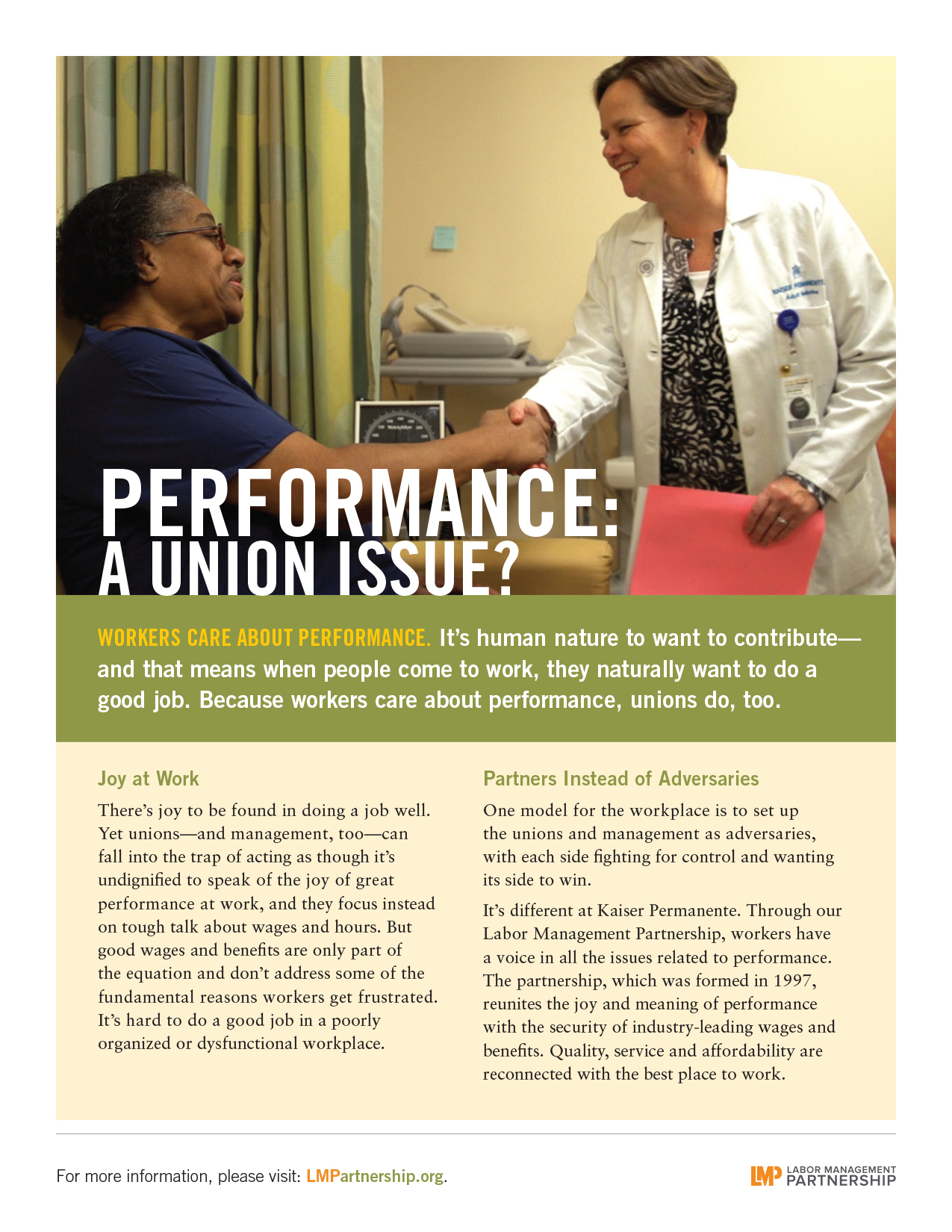
Performance: A Union Issue?

Format:
PDF

Size:
8.5" x 11"

Intended audience:
Union employees, union members, external audiences

Best used:
This poster describes why performance is a union issue. It’s human nature to want to contribute—and that means when people come to work, they naturally want to do a good job. Because workers care about performance, unions do, too. Post at LMP and UBT trainings, UBT meetings, union conferences, and new employee trainings.

Related tools:

Transforming Transport

Deck: 
Capitol Hill cuts length of wheelchair trips by more than half

Story body part 1: 

Department: Adult Medicine, Capitol Hill Medical Center (Mid-Atlantic States)

Value Compass: Service

Problem: Some individual patient transport trips were taking an hour or more, inconveniencing patients and impacting the unit's smooth operation. Staff members sometimes had to wait for a patient to receive medications or had to return to the unit to retrieve a wheelchair adequate for the height and weight of the patient.

SMART goal: Reduce staff time spent transporting a patient by wheelchair from the unit to the lab, pharmacy, hospital entrance or public transit stop from an average of 30 minutes to 15 minutes between May and September 2012.

Union co-lead: Louise Casa, nurse practitioner, UFCW Local 400

Management co-lead: Jacqueline Marshall, RN, clinical operations manager for Adult Medicine

Small tests of change:

  • A trained, dedicated transporter position
  • New, wider wheelchairs
  • Coordinating transport times with other departments
  • Lab and pharmacy patient priority cards

Results: Reduced staff time to transport patients from an average of more than 30 minutes to 10 minutes.

Biggest challenges

A brisk walk by an able-bodied person from the unit to the train station takes about 15 minutes roundtrip—but struggling with an infirm patient in an outdated or inappropriately sized wheelchair could easily double that time.

Other issues included patient dissatisfaction, staff injuries and the added risk of patient treatment delays or falls, says labor co-lead Casa, noting that “we had to look at the problem from many angles.”

Background

The Capitol Hill Medical Center opened with great fanfare in 2011. Hailed as a beacon for affordable and accessible care just as the national debate heated up on these issues, the center attracted attention—and many new members. One key factor that made the new facility so attractive—its proximity to a major public transit station in the District of Columbia—also turned into a potential Achilles heel.

That was until the Adult Medicine UBT rolled in with the right solutions.

The Adult Medicine team started by using performance improvement charting tools to log the time each staff member took to transport a patient to and from the Union Station subway stop or to ancillary departments within the medical center.

The team discovered many of the elderly or wheelchair-using members struggled to make the long trek from the exit doors of Union Station to the waiting room of the Adult Medicine unit, a medical center starting point for most patients.

The team lobbied for new wheelchairs—and for a new transporter position, an OPEIU Local 2 member who transports many of the patients and coordinates the trips that staff members make to the other departments.

In addition, the team now calls ahead to the lab or pharmacy to ensure tests and medications will be ready, or nearly so, when the patient is brought in. It also gives patients red cards to signal their priority status to lab and pharmacy staff.

TOOLS

Team Presentations on Patient Safety

Format:
Powerpoint

Size:
41 pages

Intended audience:
Frontline employees and managers

Best used:
These slides were presented by three teams that shared their outstanding work on patient safety in a virtual UBT Fair in March, 2013. Use to spread best practices on patient safety.

The teams featured are:

  • Cumberland (GA) infectious diseases/oncology team on medication reconciliation
  • Rock Creek (Colorado) gastroenterology team on equipment cleanliness
  • South San Francisco (NCAL) radiology team on a stop-the-line process to prevent wrong-site X-rays


Related tools:

TOOLS

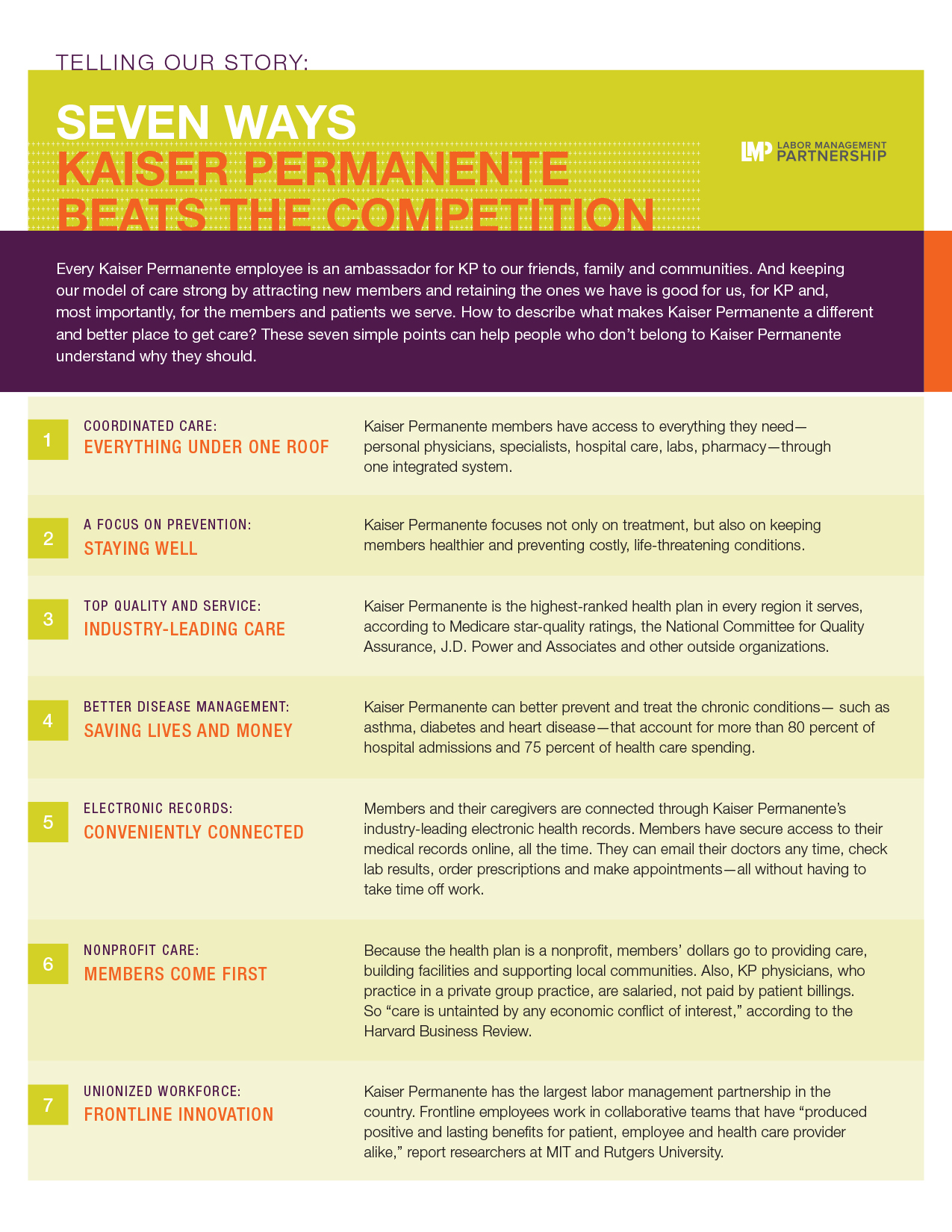
Telling Our Story

Format:
PDF

Size:
8.5" x 11"

Intended audience:
Frontline employees and teams

Best used:
This one-page tipsheet with seven short talking points describes KP's advantages as a health plan. Use to understand how Kaiser Permanente is different and better than other health plans, and to encourge non-members to consider joining KP.

Related tools:

Pages

Subscribe to RSS - Frontline Workers