Frontline Workers

Help Video

How to Find UBT Basics on the LMP Website

Learn how to use the LMP website:

LMP Website Overview

Learn how to use the LMP website:

How to Find How-To Guides

This short animated video explains how to find and use our powerful how-to guides

Learn how to use the LMP website:

How to Find and Use Team-Tested Practices

Does your team want to improve service? Or clinical quality? If you don't know where to start, check out the team-tested practices on the LMP website. This short video shows you how. 

Learn how to use the LMP website:

How to Use the Search Function on the LMP Website

Having trouble using the search function? Check out this short video to help you search like a pro!

Learn how to use the LMP website:

How to Find the Tools on the LMP Website

Need to find a checklist, template or puzzle? Don't know where to start? Check out this short video to find the tools you need on the LMP website with just a few clicks. 

Learn how to use the LMP website:

Behind-the-Scenes Service

Story body part 1: 

In 2011, the Medical Records unit-based team in the Northwest received 1,222,361 pages of outside records that required indexing into patients’ electronic medical records—a staggering 725,000 more pages than it received in 2010.

Yet team members met and mastered the challenges facing them, whittling down an enormous backlog and reducing the turnaround time for processing from 62 days in December 2010 to three days by December 2011—benefiting both their internal customers and KP’s members and patients. And they’re sustaining that success.

The steady increase had been debilitating. Overtime hours went through the roof, with more than 2,450 hours logged in 2010. The 37 team members work 24 hours a day, seven days a week and have seven different work classifications. Staff members were worn out. Piles of paperwork were stacked high, waiting for processing. Morale was at an all-time low.

The case illustrates vividly that service is not just a bedside issue at Kaiser Permanente. For a variety of reasons, many KP members see outside providers—and when those providers submit paper or electronic records with the patient’s medical information to Kaiser Permanente, the records have to get indexed into KP HealthConnect. If there’s a delay, the patient’s regular physician may be missing important information the next time the member is seen at KP.

“When the clinician needs medical information on their patients in order to treat their current medical condition, we’re able to provide updated and accurate records,” says the team’s union co-lead, Kathleen Boland, a data quality clerk and SEIU Local 49 member. And, she notes, members aren’t having to repeat critical tests and procedures, saving them time and money.

Things started to change when, through unit-based team training, team members learned such skills as process mapping and how to understand data. They created SMART goals (specific, measurable, attainable, realistic/relevant, time-bound), started huddling and developed a greater understanding of roles and responsibilities.

The team receives more than 700 different types of documents, so variation was rampant. Team members developed cheat sheets to standardize how documents should be prepped for indexing and to get everyone to use the same process for each task. They also cross-trained and helped each other out when someone was on vacation or ill.

“In the beginning,” says Bruce Corkum, RN, a UBT resource team specialist, “they didn’t share the work. Then they started understanding how they could help each other work toward the same goal.”

Not only did the backlog disappear, but the need for overtime is nonexistent now, they’ve improved attendance and “morale has improved,” says Burgandy Muzzy, a health records clerk and member of SEIU Local 49. People are happy to be at work.

“People are talking about us in a positive way now,” says manager Debbie Lang, “instead of as ‘those people who lose everything.’ ”
TOOLS

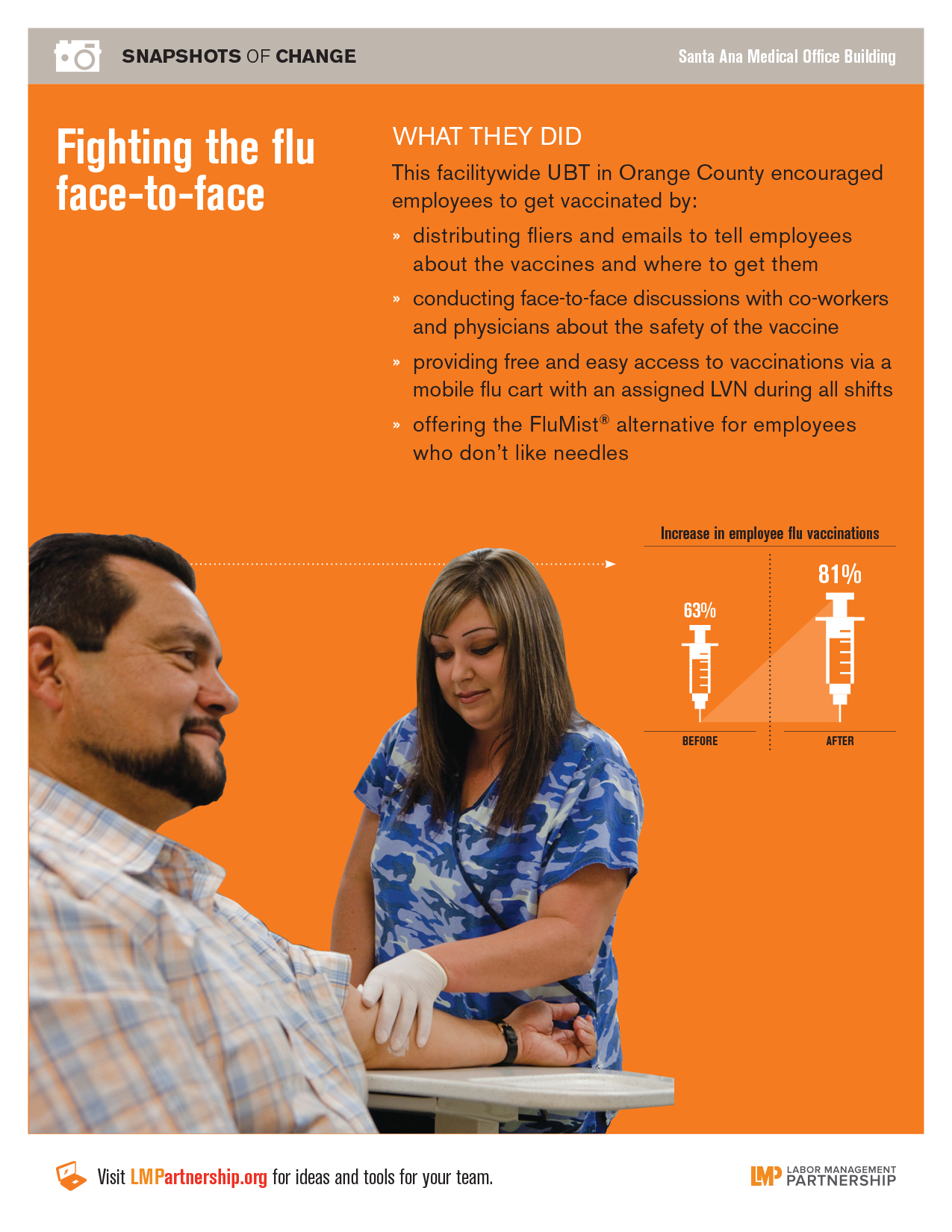
Poster: Fighting the Flu Face to Face

Format:
PDF (color and black and white)

Size:
8.5" x 11"

Intended audience:
Frontline employees, managers and physicians

Best used:
This poster, for bulletin boards, in break rooms and other staff areas, features an all-facility UBT that successfully encouraged more employees to get the flu shot.

Related tools:

TOOLS

Poster: Modern Venue for Old-Fashioned Storytelling

Format:
PDF (color and black and white)

Size:
8.5" x 11"

Intended audience:
Frontline employees, managers and physicians

Best used:
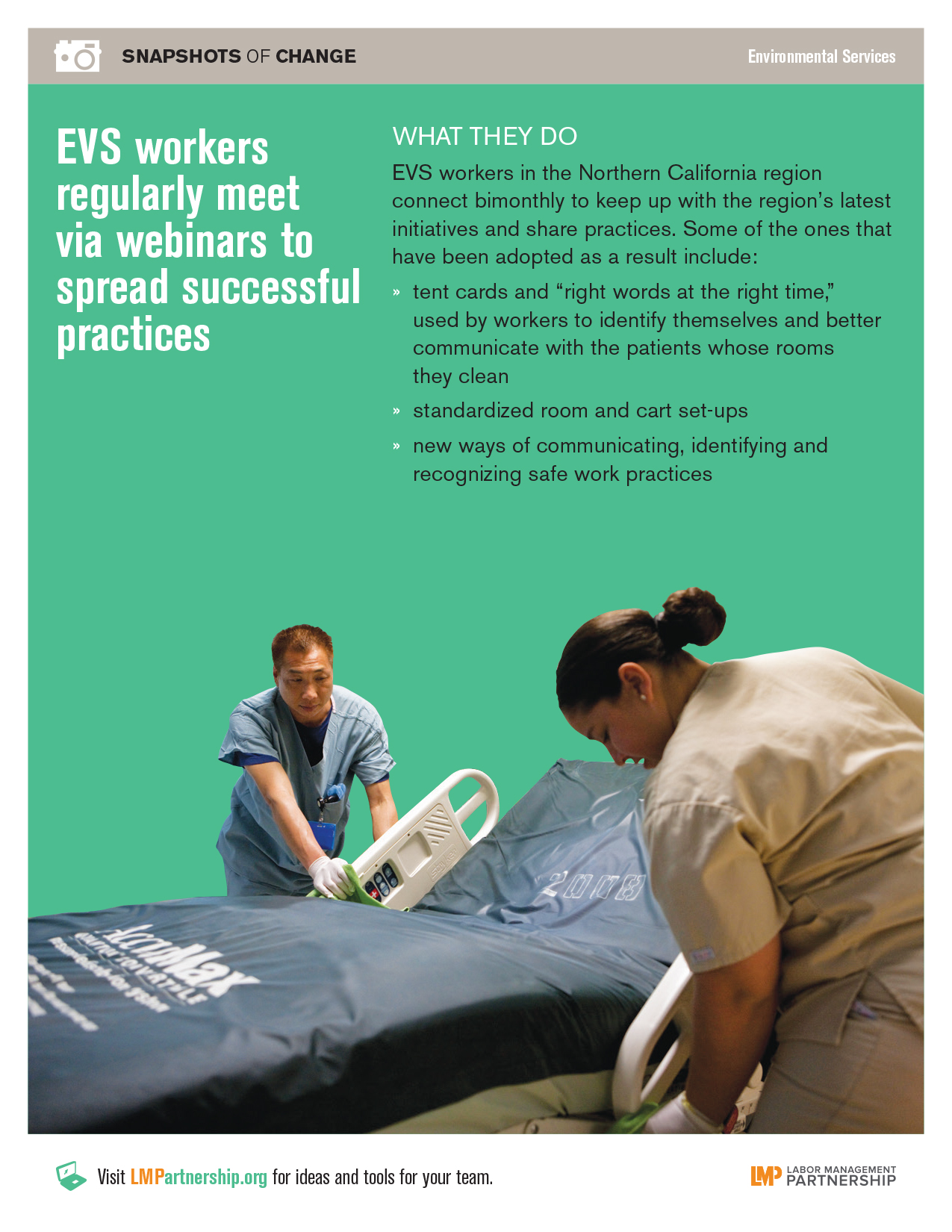
This poster, for use on bulletin boards in break rooms and other staff areas, highlights an EVS team that uses webinars to spread successful practices.

Related tools:

Contradictions That Foster Innovation

Story body part 1: 

Amy Edmondson says innovation depends on a culture of focused chaos.

Those words sound like opposites. They are. Don’t worry. It’s not a mistake.

In fact, innovation depends on four pairs of seeming opposites. As unit-based teams ramp up, involving frontline managers, physicians and employees in finding new ways to improve performance and transform health care, they can benefit from creating a culture of innovation. This is how Edmonson, a professor at Harvard Business School, defines the four cultural contradictions of innovation:

  • Chaotic/focused
  • Playful/disciplined
  • Deep expertise/broad thinking
  • Promotes high standards/tolerates failure

Let's take a more detailed look.

Chaotic/focused

“An innovation culture is focused,” says Edmondson. “It is really intent on improving a process or inventing a new business model or coming up with a new product.” At the same time, it is chaotic. “Any idea is welcome and possible—at least until we sort it out. No idea is a bad idea—at least early in the process.”Chaos, says Edmondson, “is about welcoming all ideas, even ‘wacky’ ideas.” Only in a psychologically safe learning environment will employees feel open enough to offer these “wacky” ideas, she adds.

Playful/disciplined

The Labor Management Partnership offers a disciplined process for innovation in the form of the Rapid Improvement Model (RIM) and the plan, do, study, act cycle. But, Edmondson emphasizes, teams use these tools “without knowing in advance what the answer is.” There is a careful and well-managed process, but the content of the conversations about improving performance must be open and inclusive. As teams begin a performance improvement project, UBT leaders need to be very clear about what aspect of performance they are trying to address—not on how the team is going to do it.

Deep expertise/broad thinking

An innovative team is one that values those who bring deep expertise (in a specific topic, subject area or clinical specialty, for instance) and people who are broad, general thinkers who span boundaries. “Both of those skill sets are absolutely essential at the same time,” says Edmondson.

Promotes high standards/tolerates failure

In an innovative work culture, “We hold very high standards but we are also very tolerant of failure,” says Edmondson. “That sounds ‘wrong,’ at first,” she admits, “but it is essential because, in innovation, you will never get it right the first time. You try something, test it out, it’s not going to work quite right and then you either tweak it or throw it out altogether and try something else.”

Spreading new ideas that get results throughout a large organization such as Kaiser Permanente, says Edmondson, requires finding ways to “shine a very quiet spotlight”—another seeming contradiction!—on innovators so others become aware of what they are doing and are drawn to try it too. 

“In today’s world, there are two ways to get the word out,” she says. The first is face-to-face communication, “positive buzz that starts locally and spreads.” The other is internal online social networks as “a way to listen, motivate and share practices that are potentially better.”

“It can catch on,” says Edmondson. “When there are pockets of effectiveness, other people see them, and they want to play too.”

You Gotta Learn

Deck: 
A psychologically safe environment is essential to teamwork and innovation

Story body part 1: 

The theme of the 2012 Union Delegates Conference was “You Gotta Move”—and Amy Edmondson’s advice for the delegates was “you gotta learn.”

The Harvard Business School professor studies what she calls “learning environments.” To support innovation and teamwork, it’s essential the Labor Management Partnership and unit-based teams foster learning environments throughout Kaiser Permanente.

Imagine the ideal learning environment: People feel free to take risks. They feel psychologically safe. They believe they won’t be punished or humiliated for speaking up with ideas, questions, concerns or mistakes. “Without that kind of psychological safety, it’s very hard for an organization to learn,” says Edmondson.

Now imagine the opposite of a learning environment, one where no one speaks up. “Nobody ever got fired for being silent,” says Edmondson. “And yet many bad things happen as a result of silence. Silence is a strategy for individuals to stay safe, but not necessarily for patients to stay safe or for organizations to stay vibrant.”

Creating a learning environment is up to leaders—to those people with influence, whether or not they have a formal leadership role.

“Leaders have to go first,” Edmondson says. They “have to be willing to ask questions themselves, invite participation, acknowledge their own fallibility, and to explicitly state we don’t know everything yet.” These behaviors help an environment where others can take the risks of learning.

But, she cautions, “The learning environment doesn’t live at the ‘organization’ level. For the most part, there are pockets of learning environments.…In a large, complex system, answers don’t come from central headquarters or the CEO. The answers come from the people at the front line doing the work.”

A labor management partnership like the one at Kaiser Permanente “is an important foundation” for building a learning environment, says Edmondson. “A true partnership is completely consistent with the context for mutual learning.”

Both management and union UBT co-leads can help create a learning environment by articulating the unit’s or department’s purpose and goals “in a meaningful way that touches hearts and minds, that motivates and encourages,” she says.

They can—and must—also reduce the fear people experience that makes them reluctant to speak up. The LMP helps develop and support people, helping them be their best and most courageous, Edmondson says.

Bolder Communication Helps Diagnose Malnutrition

Deck: 
Dietitians play a key advocacy role for at-risk patients

After Northern California began a regional push in 2009 to improve the identification and diagnosis of malnourished patients, the Roseville Medical Center sought to put the plan to action.

The clinical nutrition team was partifcularly concerned because diet plays a key role in the body’s recovery.

This can be especially true for the elderly and patients with diabetes —two groups at the highest risk for malnutrition. Mary Hart, director of clinical nutrition for Roseville and Sacramento medical centers, says a lack of proper proteins and vitamins affects their ability to recover and heal.

And short hospital stays can be particularly challenging because most patients don’t stay in the hospital very long.

After sifting through the electronic charts of all admitted patients, the dietitians must spot patients “at risk” for malnourishment and reach them in time for a full evaluation and treatment—all before the patient is discharged.

While physicians are the only ones who can make an official diagnosis, they rely on clinical dietitians to assess the patient and alert the physician.

“We keep track of the number of patients who have met the criteria for clinical malnutrition, communicate that to the physician and follow up to see if (the patient) has actually been diagnosed,” Hart says.

The dietitians at Rockville put their assessments and recommendations into a patient’s electronic chart, but everyone did so a little differently.

So they standardized their process and language, which included bolding notes to doctors and speaking directly to them about potentially malnourished patients. Those simple steps made it easier for physicians to know what to look for, and diagnose accordingly.

“It helps because we can see them sooner and start nutritional management sooner and figure out how to refer them to outpatient care after they are discharged,” says labor co-lead and registered dietitian, SEIU UHW, Jennifer Amirali.

The team also piloted a KP HealthConnect tool that made it easier and quicker for clinical dietitians to identify at-risk patients. It pulls data from electronic medical records, and color-codes assessments, recommendations and final diagnoses between dietitians and physicians.

“There was more recognition (among physicians) of what a dietitian does other than just ‘serve food,’” Amirali says.

Hart agreed.

“(Physicians and administration) now see the important role of dietitians in the care team and what we can contribute to the organization and the health of the patient.”

For more about this team's work to share with your team and spark performance improvement ideas, download a poster or powerpoint.

TOOLS

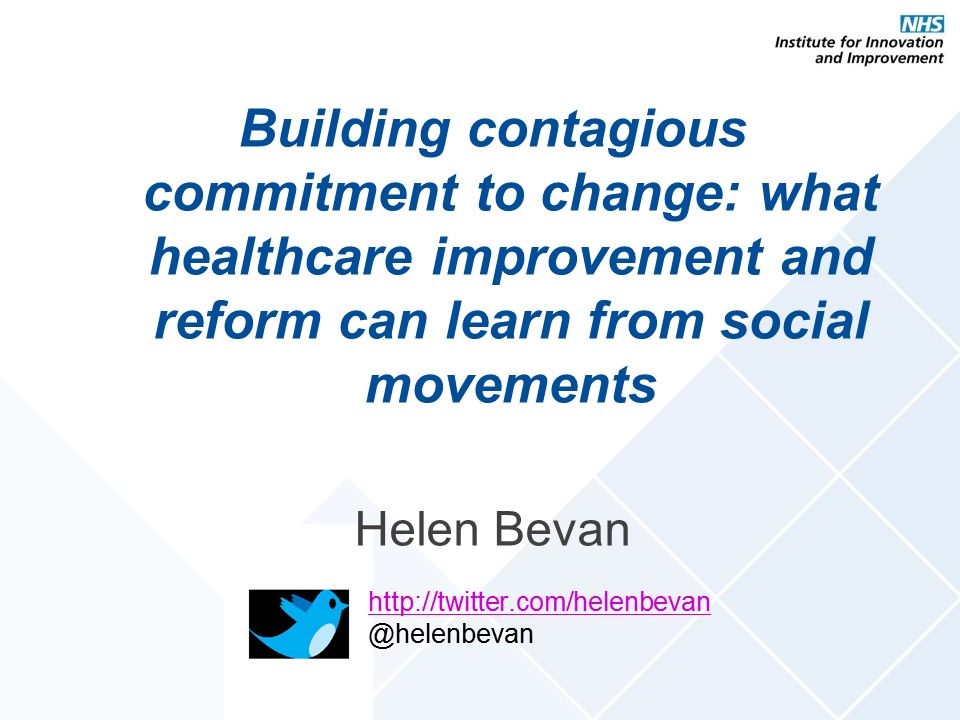
PowerPoint: Contagious Commitment to Change

Format:
PowerPoint

Size:
42-slide deck

Intended audience:
Those interested in learning what a top health care innovator has learned from her work in Great Britain's National Health Services (NHS) system.

Best used:
The slide deck was presented by Helen Bevan, chief of service transformation at the NHS Institute for Innovation and Improvement, the largest government-sponsored health care system in the world. Use to educate staff members, managers and physicians on how to motivate change.

Related tools:

Five Tips for Leading Change

Deck: 
Helen Bevan, a British health care leader, looks to civil rights leaders and others to learn how to inspire large-scale transformation

Story body part 1: 

When Helen Bevan told her National Health Services colleagues in the United Kingdom she would be speaking at a conference of Kaiser Permanente union employees, they were surprised.

“What could they possibly learn from us?” they asked.

A lot, she says.

“Kaiser is a role model for us,” explains Bevan, chief of service transformation at the NHS Institute for Innovation and Improvement, part of the largest government-sponsored health care system in the world.“We look at and learn a lot from Kaiser in terms of innovations, efficiencies, use of new technology and its approach to patient care.”

We have much to learn from them as well—especially when it comes to large-scale change.

How to move forward

“To move forward in health care, leaders must tell their story, make it personal, create a sense of ‘us’ and include a call for action,” says Bevan, one of the plenary speakers at this year’s Union Delegates Conference in Hollywood. “The way to build and sustain health care reform is to learn the lessons of social movement leaders.”

Bevan’s point is on the mark. The 700 delegates attending the conference, themed “You Gotta Move,” were called to act on improving their own health and the health of their communities. They took that message to the streets of Hollywood, distributing fliers with tips on easy steps to take to improve health. Some also gathered for a flash mob in front of Hollywood’s Grauman’s Chinese Theatre, dancing to Beyonce’s “Move Your Body”—a song made for Michelle Obama’s “Let’s Move” campaign to end childhood obesity.

“It’s such a great experience to see the extent to which union members are stepping up to be a part of the change process,” Bevan says.

Building commitment and energy

The actions at the delegates conference—and beyond—are precisely what’s needed to reform health care in America and the world, she says, adding: “We can only create large-scale change if we build a platform of commitment and energy.” 

Because unit-based teams, KP’s platform for improvement, engage frontline workers, managers and physicians, they “already have that commitment and energy,” Bevan says. UBTs “create a sense of coming together around a common cause and achieving the same outcomes.”

But UBTs alone can’t bring about the large-scale change needed to meet the unprecedented challenges to improve quality and reduce costs.

Engage and inspire

“Transformation needs to occur at all levels of the organization in order for it to be sustainable,” Bevan says. “Senior leaders need to stop being pacesetters and start engaging, inspiring and emotionally connecting with employees. The passion is there. We just have to tap into it.”

As the task of delivering health and health care becomes more complex and the scale of change increases, “We need to think widely and innovatively about how we define the role of senior leaders,” Bevan says.

That’s where social movement thinking comes in. “Successful movements often have charismatic leaders—think Martin Luther King or Nelson Mandela—but what ultimately guides and mobilizes the movement are leaders at multiple levels.” The key, she says, is to depend less on reorganizing structures and processes as the catalyst for change and more on unleashing emotional and spiritual energy for change.

“People are much more likely to embrace change if it builds on the passion, the sense of a calling that got them into health care in the first place,” Bevan says. By connecting to that shared passion through storytelling, “We can create an unstoppable force for change.”

TOOLS

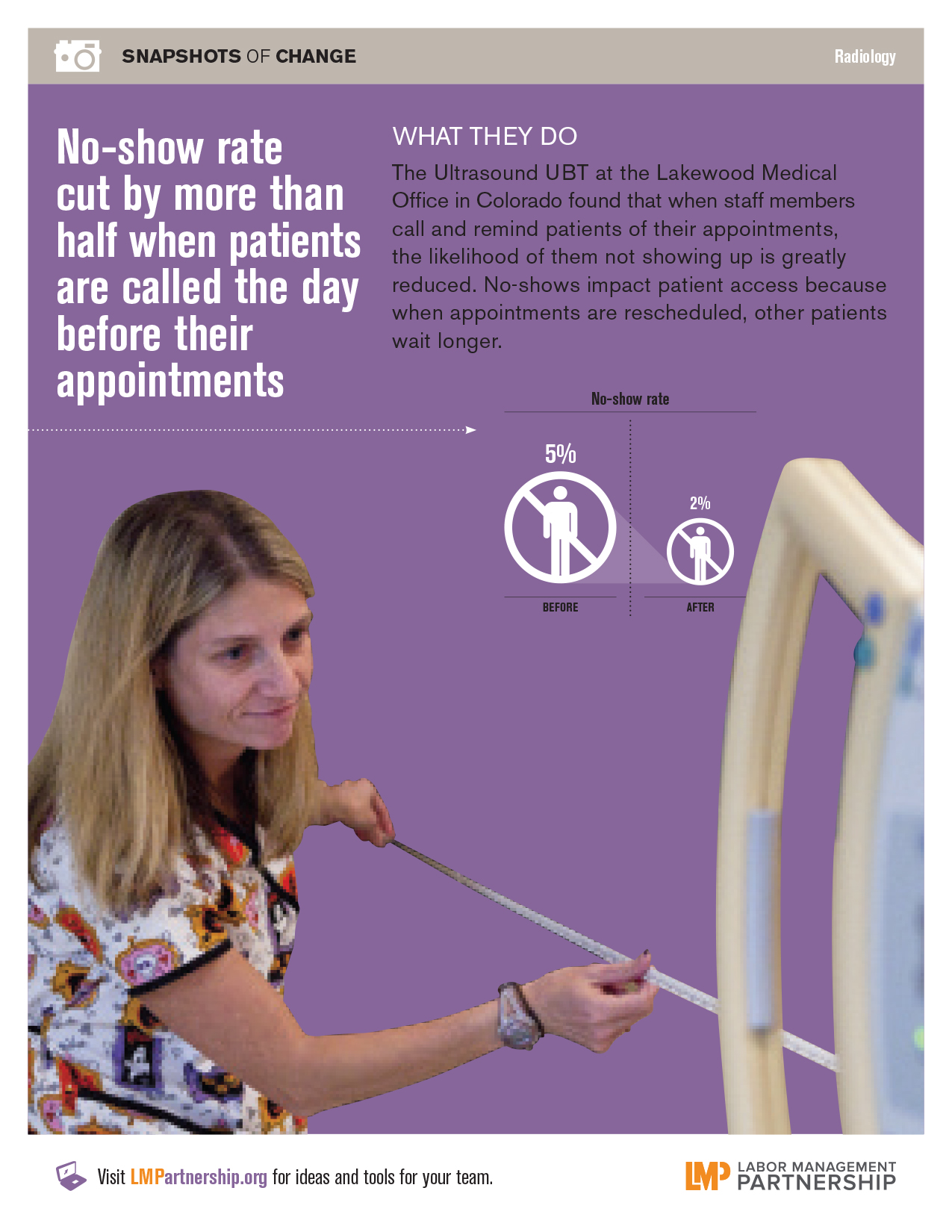
Poster: Reduce Patient No-Show Rates

Format:
PDF (color and black and white)

Size:
8.5” x 11”

Intended audience:
UBT members, co-leads and consultants

Best used:
Post on bulletin boards, in break rooms and other staff areas to demonstrate
 how reminder calls can reduce patient no-shows.


Related tools:

Pages

Subscribe to RSS - Frontline Workers