Frontline Workers

Help Video

How to Find UBT Basics on the LMP Website

Learn how to use the LMP website:

LMP Website Overview

Learn how to use the LMP website:

How to Find How-To Guides

This short animated video explains how to find and use our powerful how-to guides

Learn how to use the LMP website:

How to Find and Use Team-Tested Practices

Does your team want to improve service? Or clinical quality? If you don't know where to start, check out the team-tested practices on the LMP website. This short video shows you how. 

Learn how to use the LMP website:

How to Use the Search Function on the LMP Website

Having trouble using the search function? Check out this short video to help you search like a pro!

Learn how to use the LMP website:

How to Find the Tools on the LMP Website

Need to find a checklist, template or puzzle? Don't know where to start? Check out this short video to find the tools you need on the LMP website with just a few clicks. 

Learn how to use the LMP website:

TOOLS

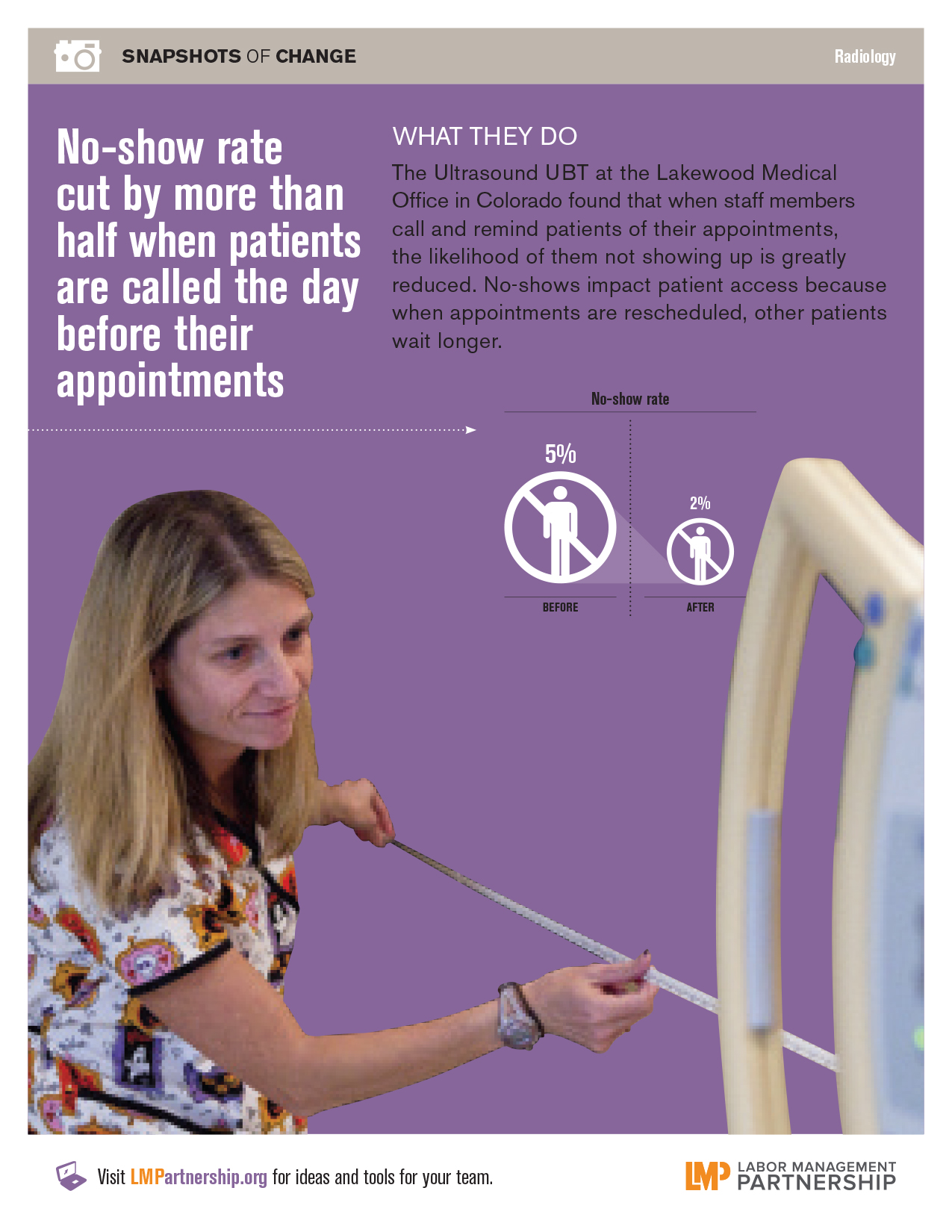
Poster: Reduce Patient No-Show Rates

Format:
PDF (color and black and white)

Size:
8.5” x 11”

Intended audience:
UBT members, co-leads and consultants

Best used:
Post on bulletin boards, in break rooms and other staff areas to demonstrate
 how reminder calls can reduce patient no-shows.


Related tools:

From Union Activist to Manager

Deck: 
Lessons for leadership in unit-based teams

Story body part 1: 

What happens when things change in your job and you have to rethink what’s always worked in the past?

For me, that moment came two years ago when I moved into a management role. I had spent 24 years as a frontline nurse, union steward and labor partner to hospital administration before my job transition.

Frankly, I wasn’t sure what to expect going in, but having been a steward and a labor partner helped me become a better manager. Kaiser Permanente has given me opportunities to grow as a leader that I don’t believe I would have had elsewhere. Along the way I learned six lessons that I think can help others lead in a collaborative team environment:

  • Speak well and connect. As a labor partner, I developed my speaking and presentation skills—skills that most don’t learn in nursing school. My confidence grew with each presentation and I now feel a connection with my colleagues that helps us all gain value from our conversations.
  • Give and get respect. As a nurse, I was respected at the bedside by physicians, managers and other nurses. I don’t think I would have been as respected as a manager if I hadn’t been respected at the bedside first. My clinical experience helped give me credibility.
  • Understand operations. As a labor partner I learned valuable lessons about hospital operations. That allowed me to build on my experience as a caregiver and begin to see the bigger picture—how things are intertwined and why certain decisions are made.
  • Listen and hear. You have to be a great listener and actually hear what people are saying. You have to be able to take things in and think about how to respond. As a steward, I always mulled things over before reacting, and I try to do that still.
  • Know your contract. Most union leaders know their contract inside out—certainly I did when I was president of the RN bargaining unit. Managers should, too. The National Agreement gives us many tools that can help both sides stay on track.
  • Stay flexible, be practical. Nurses are very solution-oriented. The solution to a problem has to make sense. I learned over the years that different people might get to the same outcome, but there are many ways to approach the problem. You need to be willing to try a different route to get to the solution so that everyone feels they have a voice in the process.

As a labor leader, I learned to believe in people and know that there’s always another side to any story. My staff understands they can come to me any time. And our unit-based team helps us draw on everyone’s knowledge and allows everyone to be heard.

In the end, it wasn’t that hard to make the transition from labor leader to manager. In both roles you have to consider diverse points of view, and sometimes you have to step back and ask, “Does it make sense?” You’re not always popular, but I’m OK with that.

We may not always agree. But there is no “we” or “them,” we are all one—because we always put our patients first.

TOOLS

PowerPoint: Errors Drop With Pre-Op Double up

Format:
PPT

Size:
1 slide

Intended audience:
LMP staff, UBT consultants, improvement advisers

Best used:
This PowerPoint slide highlights a team that reduced missed antibiotic orders by having two nurses check antibiotic orders. Use in presentations to show some of the methods used and the measurable results being achieved by unit-based teams across Kaiser Permanente.

Related tools:

TOOLS

PowerPoint: Sleep Clinic Finds Cause of Repeat Studies

Format:
PPT

Size:
1 Slide

Intended audience:
LMP staff, UBT consultants, improvement advisers

Best used:
This slide spotlights a team that cut wait times in half by nipping the need for repeat studies. Use in presentations to show some of the methods used and the measurable results being achieved by unit-based teams across Kaiser Permanente.

Related tools:

How to Implement a Facility-Wide UBT Strategy

Deck: 
Developing a proven plan

Story body part 1: 

When your team is on the same page, you all succeed—individually and collectively. By using these team-tested best practices, you can create a proven unit-based team strategy.

1. Provide sponsors and teams with ample and frequent training.

Offer frequent refreshers on Consensus Decision Making, Interest-Based Problem Solving, and the Rapid Improvement Model and its plan, do, study, act steps.

2. Make good use of your local experts.

Work with your management and union leaders and your facility’s project managers to identify their areas of knowledge and assign them to teams needing that expertise.

3. Create one consolidated list.

Include all the just-in-time, classroom and web-based (KP Learn) courses that meet Path to Performance requirements. Make the list and course-request process easily accessible.

4. Involve sponsors and subject matter experts.

They should sit in on the LMP Council and require regular updates. Identify common issues and address them.

5. Have teams do a “project prioritization matrix.”

This should be done annually after year-end assessments. Download the tool at LMPartnership.org.

6. Distribute and use LMP and performance improvement tools.

Everyone should be looking to learn on a continual basis.


TOOLS

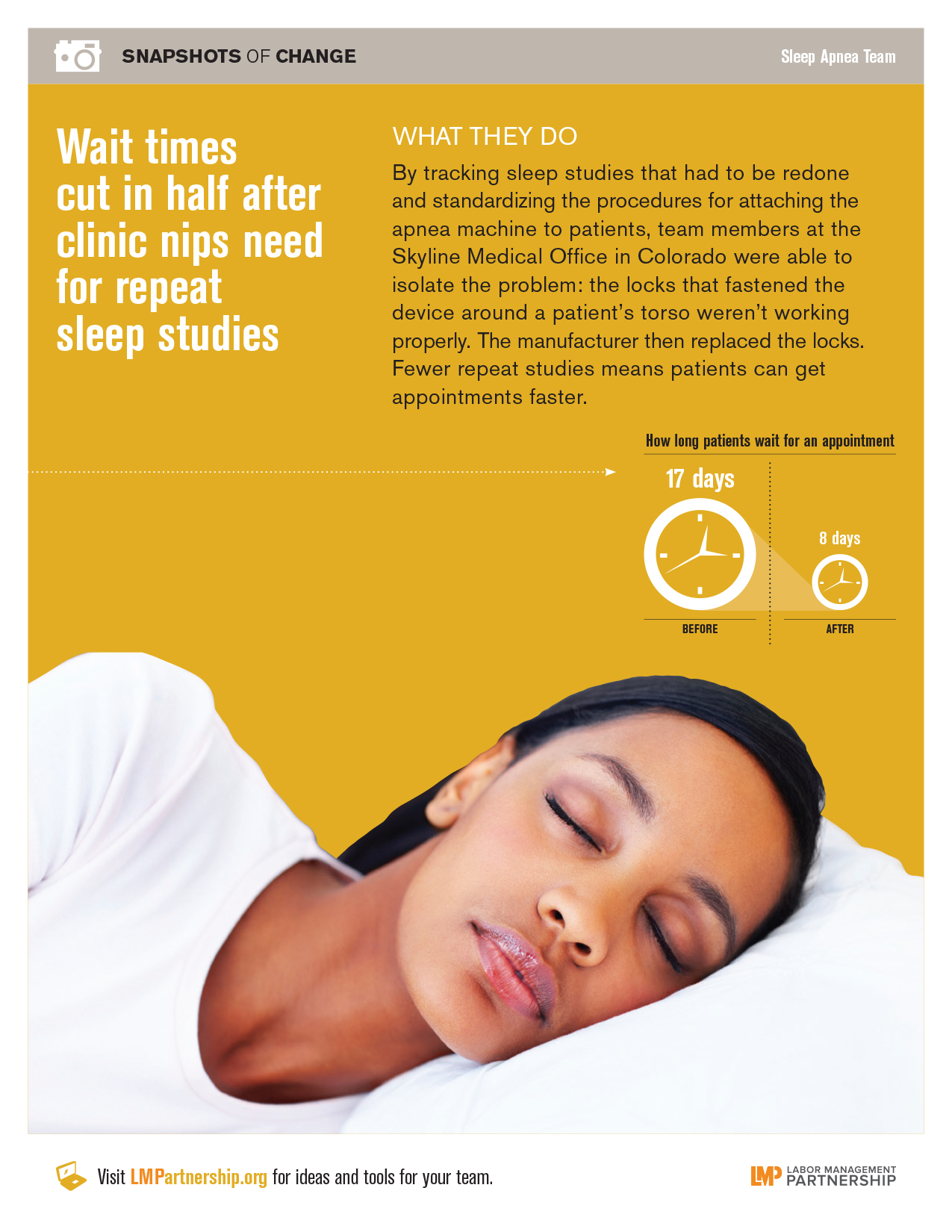
Poster: Sleep Clinic Uncovers Cause of Repeat Studies

Format:
PDF (color and black and white)

Size:
8.5" x 11"

Intended audience:
Frontline employees, managers and physicians

Best used:
This poster, for use on bulletin boards, in break rooms and other staff areas, spotlights a team that cut wait times in half by nipping the need for repeat studies.

Related tools:

Better Monitoring Fast-Tracks Medi-Cal Payments

Deck: 
Attention to detail improves the billing process

The Business Office at the Redwood City Medical Center in Northern California was letting some of their bills slip by.

Specifically those billed to Medi-Cal and the Northern California region asked facility business offices to improve the turnaround time for filing those treatment authorization requests.

They wanted to improve the reimbursement rate for care provided to Medi-Cal patients because that initiated payment to Kaiser Permanente. So, the region asked facilities to file the authorizations within five days from the day a Medi-Cal patient was discharged.

But apart from the one-year time limit on billing, a lot of business departments didn’t monitor the number of days it took to file those requests. Sometimes it might take 30 days, other times perhaps just two days. They needed a consistent turnaround time. 

“A dollar devalues the longer it’s out there,” says Pattie Murphy-Kracht, director of the admitting and business office. “So an outstanding bill loses its value the longer it’s unpaid.”

The Redwood City team decided to monitor the electronic work queue that tracks patient billing to look for Medi-Cal patients. They also monitored the electronic list of Medi-Cal hospital patients, so the team could anticipate their discharge.

In two months, the number of days to file a treatment authorization request dropped from 21 to two days. 

The team said being open to change was a big reason for their success.

“We’re good at trying different ways of doing things,” union co-lead Jessica Garcia says. “Change isn’t always easy, but we’re not stuck on one way.” 

TOOLS

PowerPoint: Cross-Training Ends Scanning Backlogs

Format:
PPT

Size:
1 Slide

Intended audience:
Frontline employees, managers and physicians

Best used:
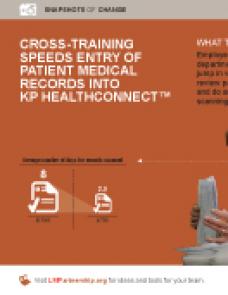
This slide spotlights a team that found a way to speed up the entry of medical records into HealthConnect. Use in presentations to show some of the methods used and measurable results being achieved by unit-based teams across Kaiser Permanente.

Related tools:

TOOLS

10-Minute Tool to Build Trust and Confidence

Format:
PDF

Size:
8.5" x 11"

Intended audience:
Frontline teams

Best used:
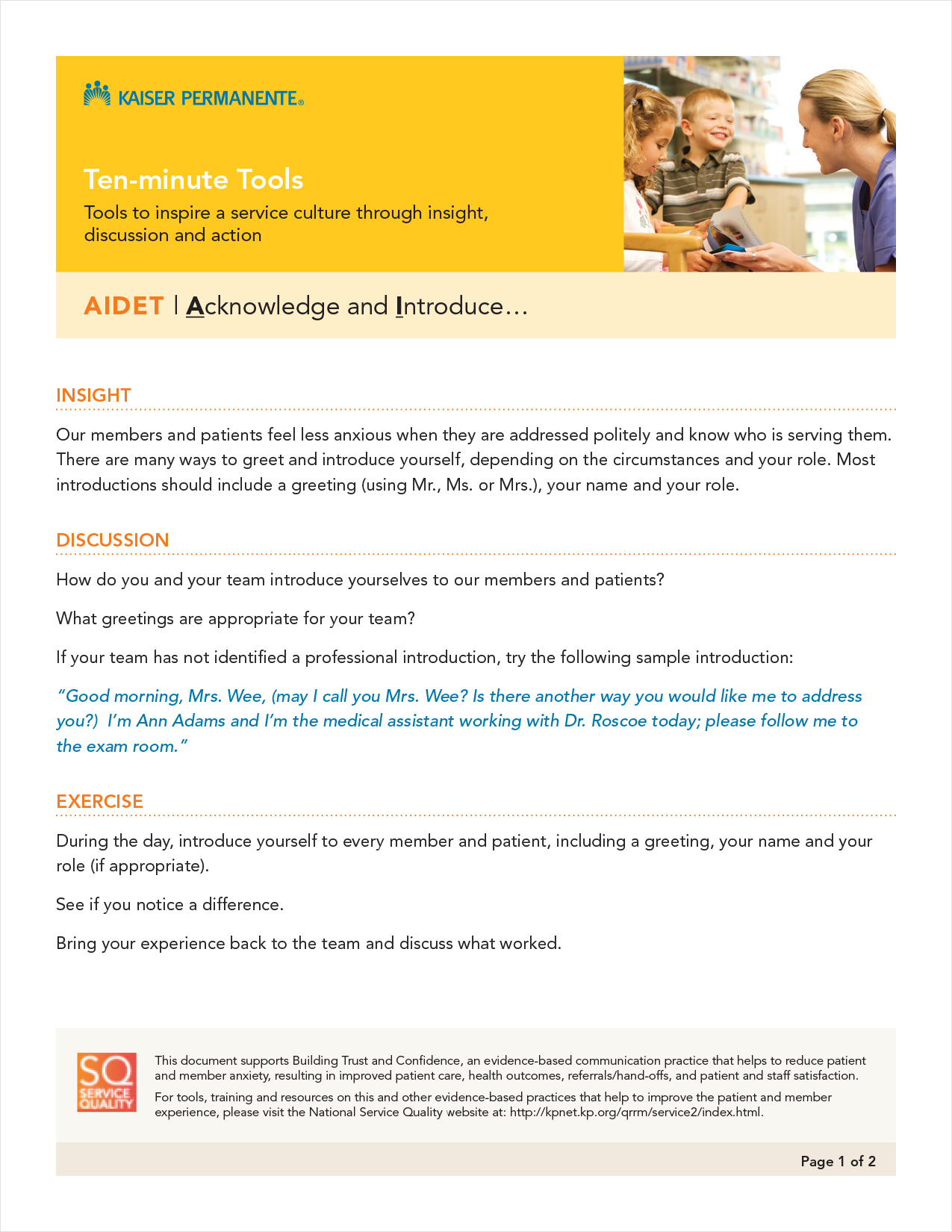
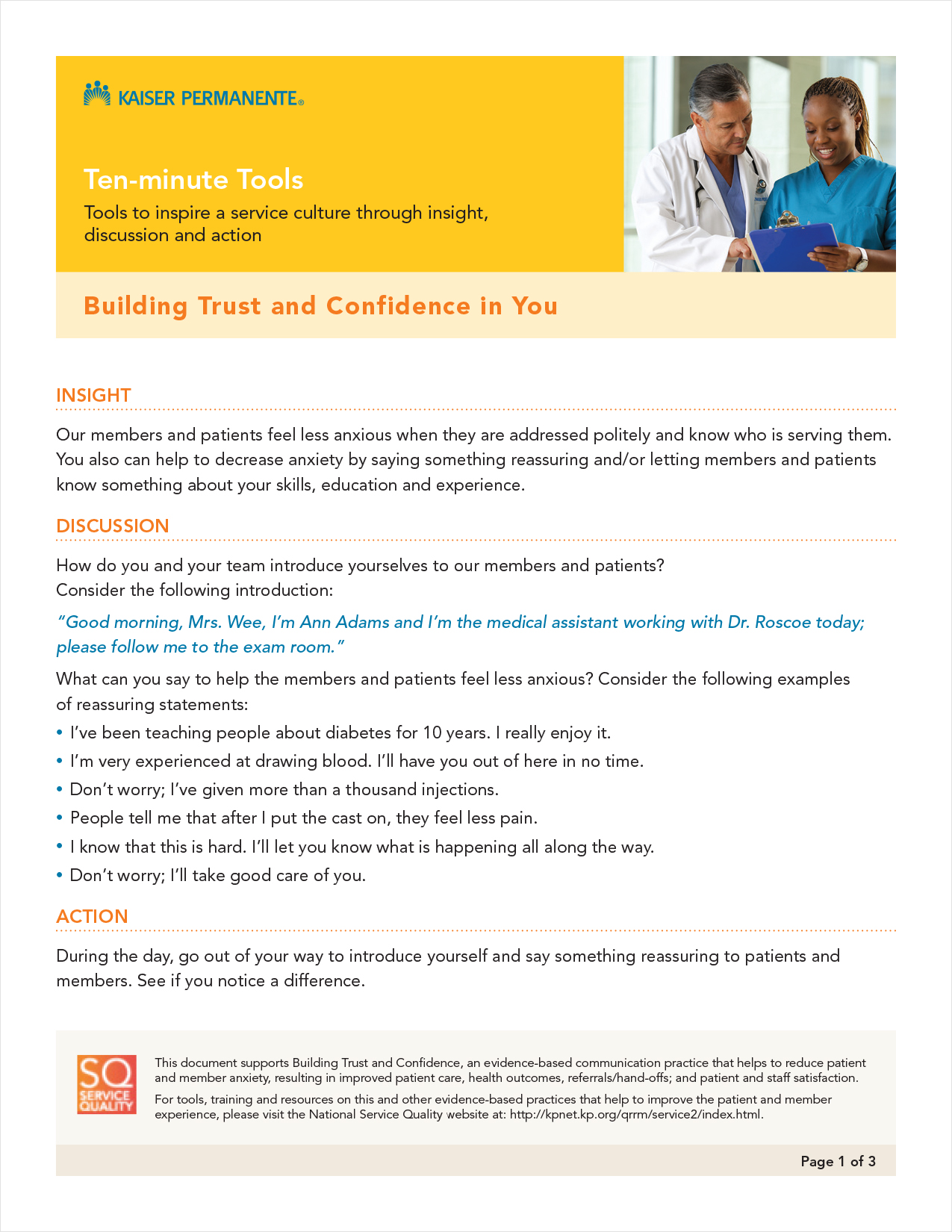
Share these tips in team meetings and training to learn ways to boost patients' and members' trust and confidence in our caregivers, teams and organization.


Related tools:

Pages

Subscribe to RSS - Frontline Workers