Videos
Voices of Joint Staffing
Loading the player...
(1:52)
Discover how managers and Coalition union members are working together on staffing plans to build sustainable solutions for the future.
This short animated video explains how to find and use our powerful how-to guides
Does your team want to improve service? Or clinical quality? If you don't know where to start, check out the team-tested practices on the LMP website. This short video shows you how.
Having trouble using the search function? Check out this short video to help you search like a pro!
Need to find a checklist, template or puzzle? Don't know where to start? Check out this short video to find the tools you need on the LMP website with just a few clicks.
(1:52)
Discover how managers and Coalition union members are working together on staffing plans to build sustainable solutions for the future.
Format:
PDF
Size:
One page, 8.5" x 11"
Intended audience:
Frontline workers, managers and physicians
Best used:
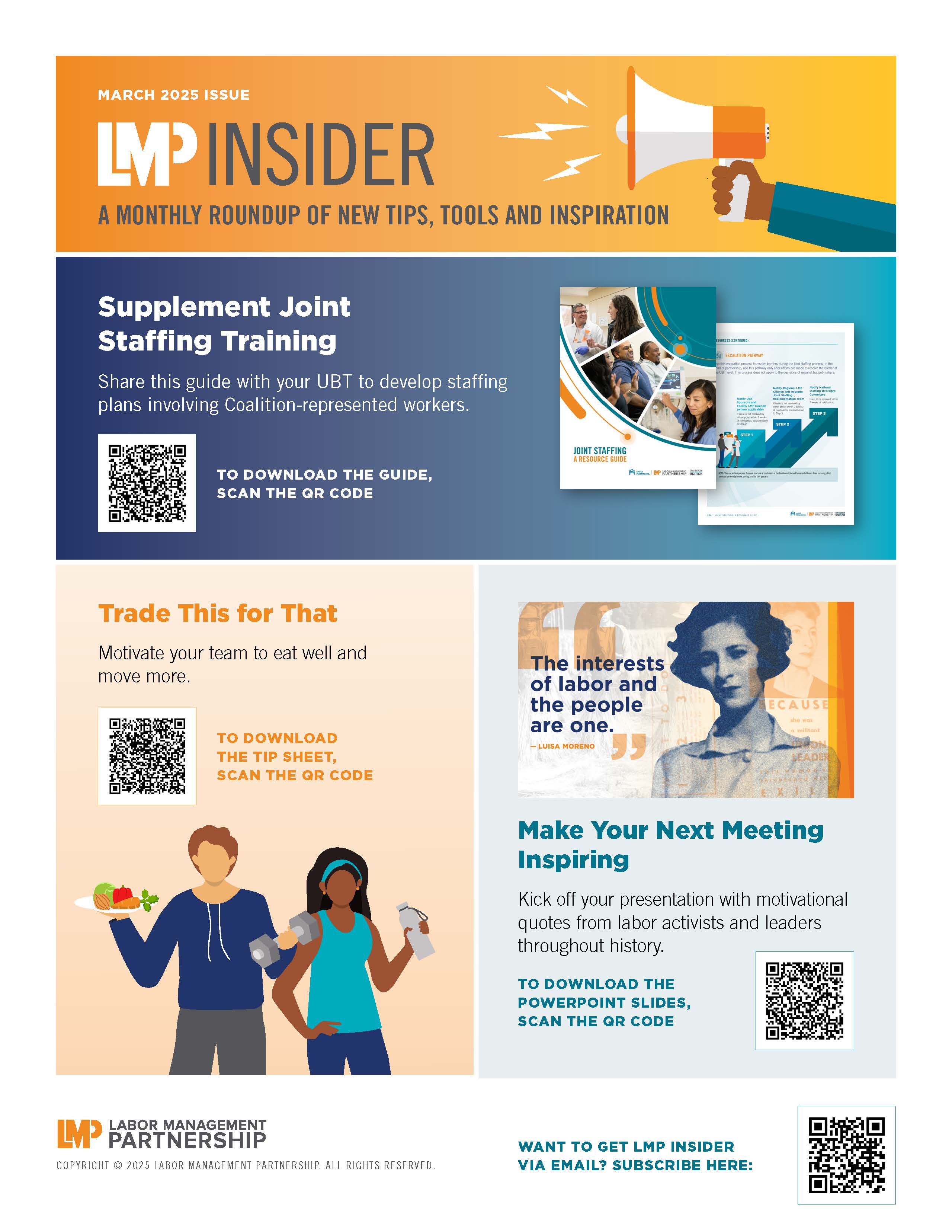
Print and place on bulletin boards in your workplace to share the handpicked highlights of resources to make your job easier.
This course covers the LMP/Coalition of Kaiser Permanente Unions' joint staffing process.
30 minutes (web-based)
LMP leaders, sponsors, regional budget makers and others involved in this vital partnership work
Staff overtime soared. Patient satisfaction scores plunged. Large numbers of contract nurses filled shifts each day to keep up with patient care.
By the end of 2022, staffing challenges at the Kaiser Permanente Downey Medical Center in Southern California called for drastic action.
Today, those struggles have eased, thanks to more staff nurses and a workplace innovation that tracks staffing data. Stakeholders from the executive suite to the front lines credit one thing for the turnaround: partnership.
“We worked closely with labor unions, made agreements, and stuck to them,” says Mitch Winnik, senior vice president and area manager for Downey. “The results have been amazing.”
“Patient care is getting better because labor and management are working together,” adds Paul Ciriacks, a registered nurse at Downey and UNAC/UHCP member.
The solution started with a simple step: setting up monthly meetings between hospital and union leaders to discuss staffing.
At these meetings, they quickly agreed on 2 main goals:
Success by the numbers:
Supporting Downey’s success is a new staffing dashboard that covers all job classifications. It allows managers to share real-time data about staff vacancies, hiring progress and overtime usage with frontline workers.
Downey and Panorama City Medical Center are piloting the dashboard. By 2026, the staffing dashboard will be available to all Kaiser Permanente hospitals in Southern California.
Managers access the dashboard — containing sensitive personnel data — using a password. Entering a unit-based team’s name and ID number initiates an automated process that pulls recruitment and payroll data from HRconnect.
The result is an up-to-the-minute glimpse of the team’s staffing situation — and a comparison to the previous month to highlight personnel trends.
Charlene Young, a nurse manager, used the dashboard to explain a recent rise in overtime. It showed that 2 open positions were in the process of being filled. "That should help with the situation," she told her team in Downey’s medical-surgical-telemetry unit.
Andre Welch, a nurse assistant and SEIU-UHW member, says seeing the data makes him feel more confident. “For me, it always helps when they show me the hard numbers.”
Format:
PDF
Size:
2 pages, 8.5" x 11"
Intended audience:
Co-leads, UBT members and staffing champions involved in the Coalition joint staffing process.
Best used:
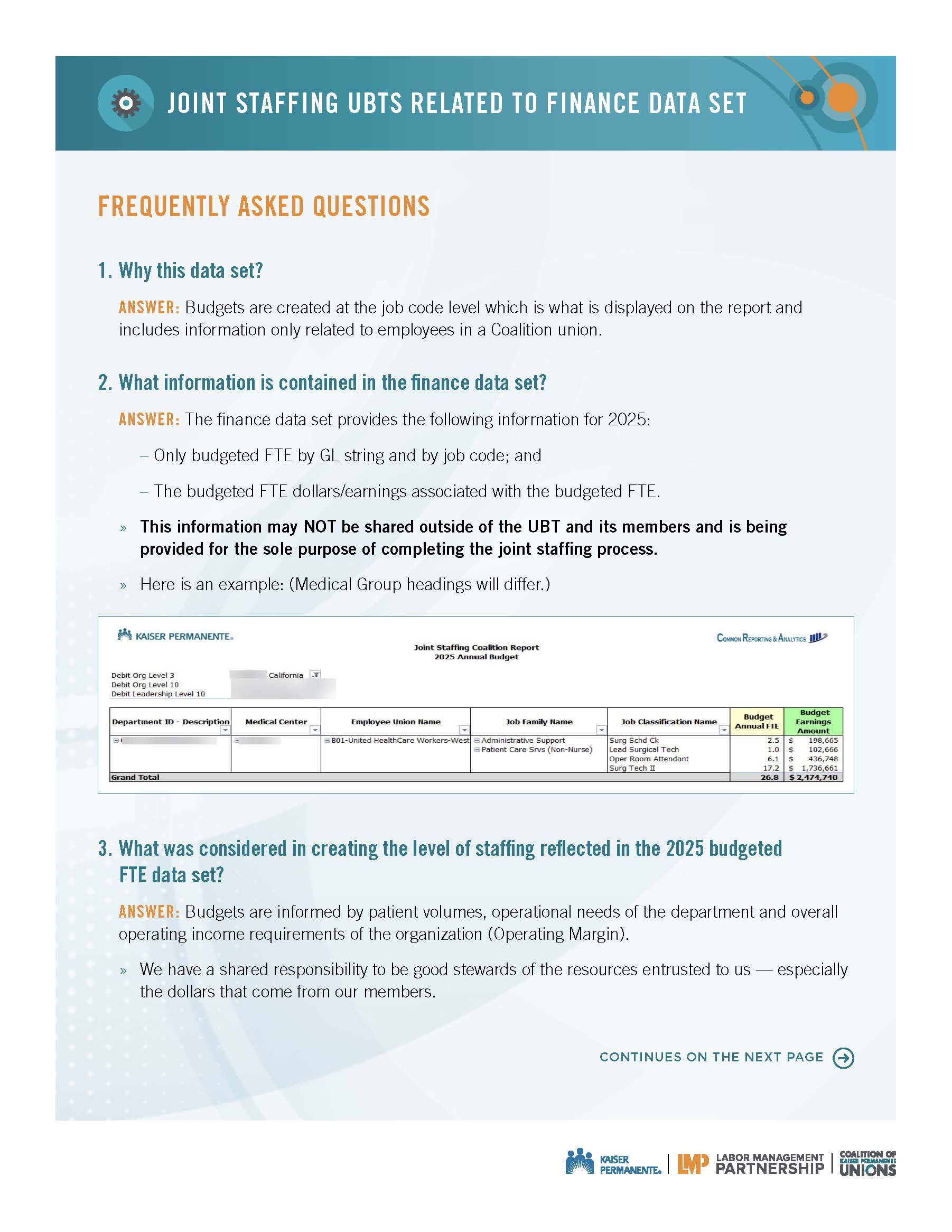
Review these frequently asked questions to understand how to use finance data in staffing plans involving Coalition-represented workers.
Format:
PPT
Size:
1 slide
Intended audience:
Frontline union members, managers and leaders who are involved in implementing joint staffing language in the Coalition national agreements
Best used:
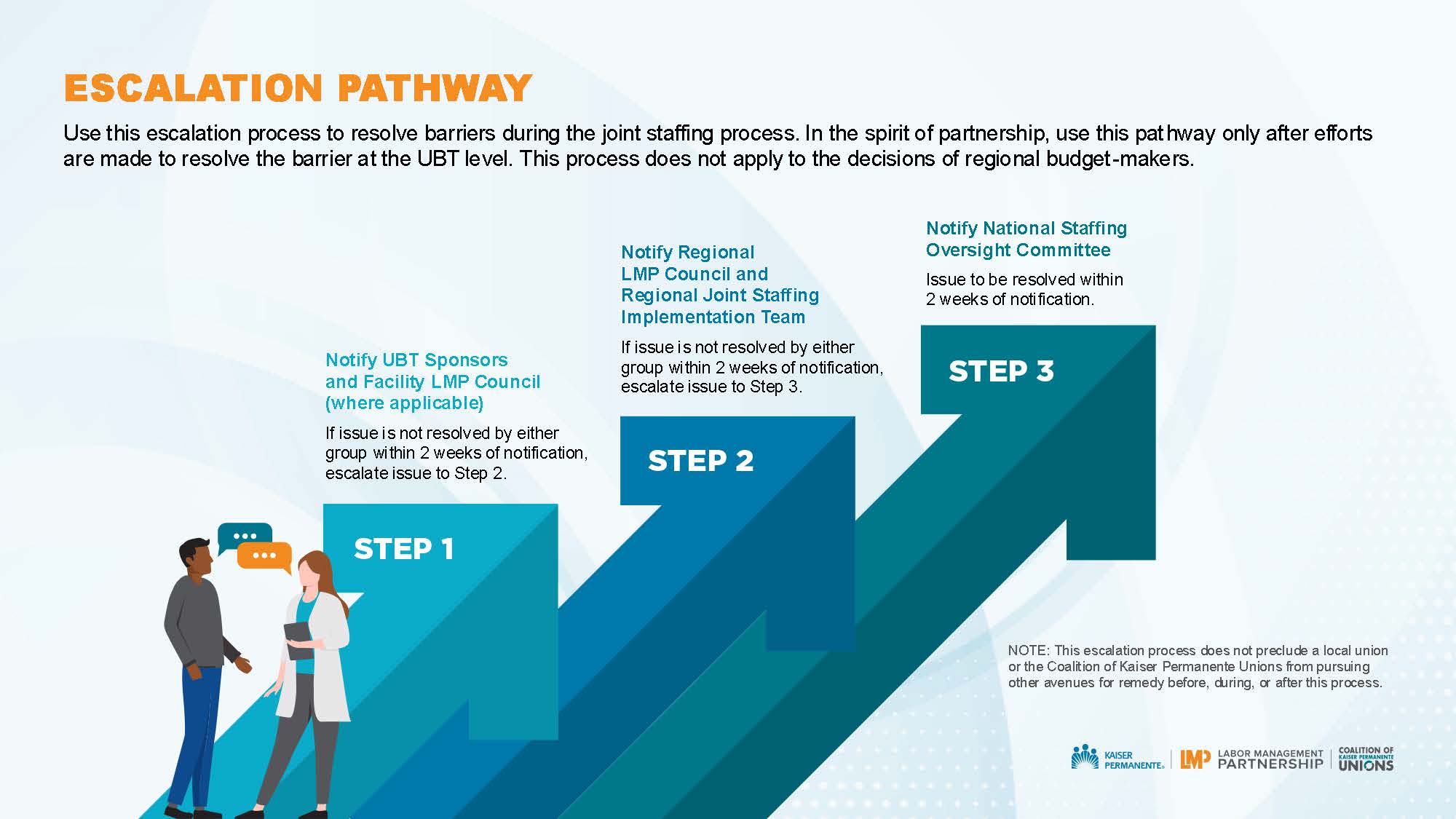
Use this escalation pathway to resolve barriers during the joint staffing process.
Format:
PDF
Size:
One page, 8.5" x 11"
Intended audience:
Frontline workers, managers and physicians
Best used:
Print and place on bulletin boards in your workplace to share the handpicked highlights of resources to make your job easier.
Format:
PDF
Size:
8.5" x 11"
Intended audience:
KP Learn administrators
Best used:
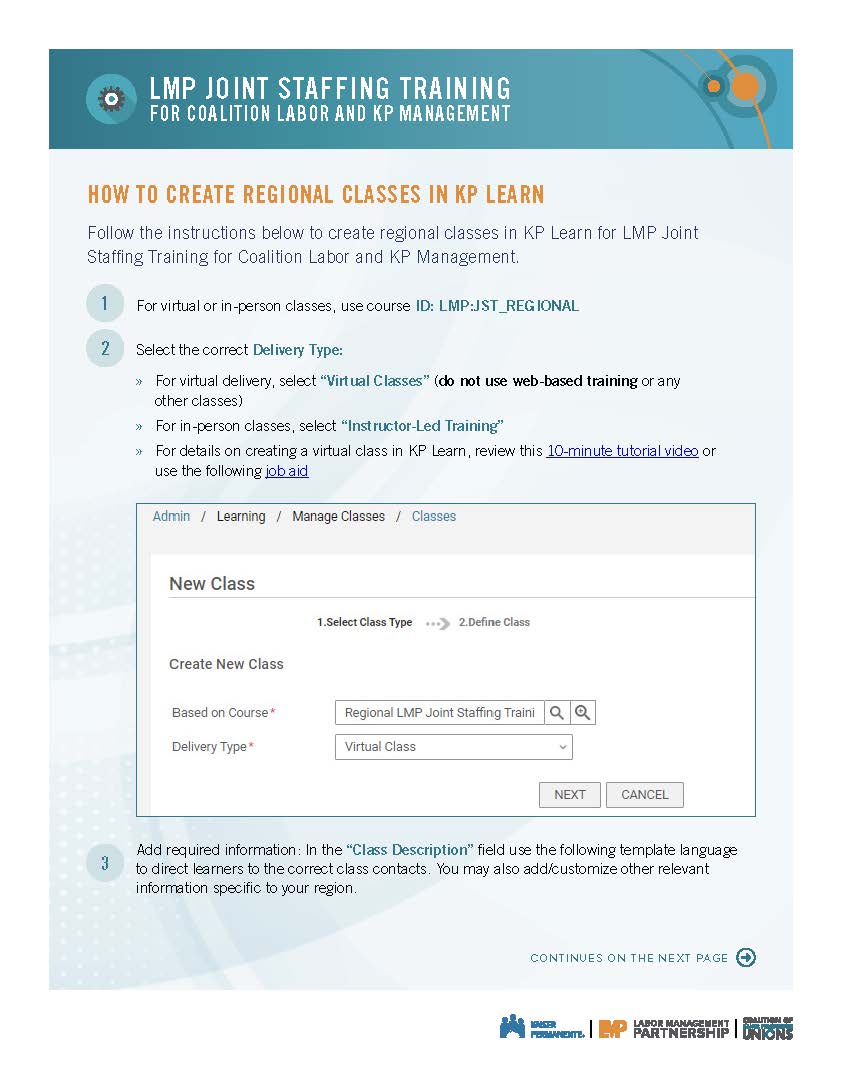
Create regional classes for LMP Joint Staffing Training for Coalition Labor and KP Management.
Format:
PDF
Size:
37 pages
Intended audience:
Unit-based teams with Coalition-represented workers
Best used:
Use this resource guide to understand joint staffing and what is expected at each stage of the process.
Staffing shortages – worsened by pandemic-related burnout and an aging workforce – are among the health care industry's most pressing challenges.
But Kaiser Permanente has an edge over the competition: the Labor Management Partnership, which provides leaders, managers, and union members with the tools, support, and long-lasting relationships to respond to challenges creatively.
The Partnership – an operational strategy shared by Kaiser Permanente and 2 union federations – is helping the organization address staffing challenges on several fronts.
Recent progress includes work with the Coalition of Kaiser Permanente Unions to implement a joint staffing process and accelerate hiring to fill thousands of vacancies through 2024; and a venture with the Alliance of Health Care Unions to design a training program to overcome a shortage of wound-care nurses.
Now, management and labor are boosting another central staffing effort: all-day hiring events that can attract hundreds of job candidates. Often, applicants come away with a job offer in hand.
"The Partnership is essential to our success," says Abbot Kohler, senior director, Pipeline and Operational Excellence for the Northwest Region, where Partnership union members participate in planning and conducting hiring events. "By bringing labor into the mix, our applicants get a more complete view of the many advantages of working for KP."
Staffing challenges remain for Kaiser Permanente and the health care industry at large. While KP has taken aggressive action to hire and fill vacancies – and things are starting to improve – staffing continues to be a top priority for management and labor. The hiring events, supported by KP and the Partnership unions, are a step in the right direction.
The events focus on addressing hard-to-fill vacancies for 2 or 3 open positions based on a facility or service area's greatest need. KP works with the Indeed job listings website to advertise events, connect with candidates and schedule interviews.
Enterprisewide, at least 30 hiring events took place in 2023, drawing more than 5,000 applicants and helping KP hire more than 1,200 new employees in 5 regions. Alliance and Coalition union members are actively involved in these hiring efforts. In the Northwest Region, they participated in 9 events that resulted in 149 new hires last year.
"The staffing issue is tailor-made for partnership," says Joshua Holt, RN, a board member with the Oregon Federation of Nurses and Health Professionals. "Involving labor in the hiring process helps to identify new members of the team who will provide the high standard of care that this organization requires."
Event organizers say a central draw for candidates are the unions and their commitment to the Partnership, which empowers frontline workers to collaborate with managers and physicians in decisions to improve care, service, and quality of work life.
"They see it as being able to have a voice and not getting in trouble for speaking your mind," says Olivia Devers, a certified nursing assistant at Kaiser Permanente Sunnyside Medical Center near Portland and a senior labor partner with SEIU Local 49. She served on panels interviewing certified nursing assistant candidates at 2 events last year.
Partnership union members have been pivotal in driving attendance. A social media campaign led by UNAC/UHCP nurses at South Bay Medical Center in Southern California proved effective in promoting an event last May focused on filling select positions, including tele-health nurses.
Nearly 300 job candidates turned out, with interview panels meeting with applicants late into the day.
"Nurses know other nurses. We've worked together in the past, or we're friends from nursing school," says Cathy Tu, RN, a contract specialist with UNAC/UHCP who promoted the event on Instagram. "When we put out the word, we hit that target audience."
As hiring events continue in 2024, the involvement of frontline union members will remain paramount to their success.
The Coalition, for instance, has committed to taking part in at least 10 hiring events in 6 regions as part of its 2023 national agreement with Kaiser Permanente.
"Anytime you've got a diverse team with different perspectives coming together with a single goal in mind, you come out with a great result," says Shannon Surber, executive director for staffing systems and strategy in the Northwest Region.