UBT Co-Leads

Help Video

How to Find UBT Basics on the LMP Website

Learn how to use the LMP website:

LMP Website Overview

Learn how to use the LMP website:

How to Find How-To Guides

This short animated video explains how to find and use our powerful how-to guides

Learn how to use the LMP website:

How to Find and Use Team-Tested Practices

Does your team want to improve service? Or clinical quality? If you don't know where to start, check out the team-tested practices on the LMP website. This short video shows you how. 

Learn how to use the LMP website:

How to Use the Search Function on the LMP Website

Having trouble using the search function? Check out this short video to help you search like a pro!

Learn how to use the LMP website:

How to Find the Tools on the LMP Website

Need to find a checklist, template or puzzle? Don't know where to start? Check out this short video to find the tools you need on the LMP website with just a few clicks. 

Learn how to use the LMP website:

Sleep Team Dreams up Solutions in Partnership

Deck: 
Small tests of change help improve efficiency and affordability

Story body part 1: 

Who knew bubble wrap envelopes could help patients sleep better at night?

That’s what the Sleep Medicine team in Falls Church, Virginia, discovered when it purchased padded envelopes and a postage machine and launched a service that allows patients to receive — and return — sleep therapy supplies by mail. Thanks to the team’s new approach, patient complaints about supplies dropped from multiple times a week to zero in 3 months between February and May 2019.

“Our patient satisfaction has really gone up. No complaints,” says Danielle Long, sleep apnea coordinator and the team’s labor co-lead who is an OPEIU Local 2 member.

This effort to fix a broken process is a powerful example of how management and labor can work together to improve service, access and affordability.

“Every single one of us contributed to making the workflow easier,” says Alireza Mallah, sleep apnea coordinator and a member of OPEIU Local 2.

Not ‘user-friendly’

Most patients seen by the team suffer from sleep apnea, a condition in which breathing is often blocked or partly blocked during sleep. To detect sleep apnea, patients wear a portable monitoring device. Treatment involves using a machine that delivers air pressure through a mask while sleeping.

As a service to patients, clinic staff arranged for members to pick up the sleep study devices and respiratory supplies at one of 10 medical office buildings in the area.

But patients sometimes were slow to retrieve the equipment and supplies, which caused storage problems. At other times, supplies were incorrect, late, or missing — frustrating patients and staff. And because the team relied on in-house couriers to make the deliveries, there was no way to track items, causing waste.

“It wasn’t a user-friendly process,” explains George Sweat, the team’s management co-lead and director of Medical Specialities. “There was no reliable system for supplies to get from point A to point B, and some members would get duplicate supplies because we had no way of tracking them.”

The breakthrough

“Why don’t we mail these supplies?” team members wondered aloud. But without guidance or goals, the talk remained just that: talk. Solutions seemed like a “myth to everybody,” Mallah recalls.

Then Sweat arrived in March 2018 with a fresh perspective and a zeal for data.

“The breakthrough was looking at the numbers,” says Sweat, who discovered that 25 sleep study devices were lost in 2018, totaling $120,000 — money the team could have saved or spent elsewhere.

He shared his findings with the team and helped set goals to mail all supplies by June 2019 and reduce the annual cost of respiratory supplies by 20 percent. Along the way, they would survey patients to see if their efforts improved member satisfaction.

Continuous improvement

Using the Plan-Do-Study-Act model, the team started out with small tests of change. Team members bought a postage machine that enables them to track shipments and experimented with different envelopes.

“For the first week or two, it was a little rocky,” explains Long. “We started out slowly.”

Now the team mails most supplies to patients, who have the option of picking up and dropping off equipment at the Falls Church location. The team also streamlined the inventory of respiratory supplies, eliminated the use of couriers, centralized distribution of equipment, and introduced paperless billing.

“We’re capturing 100 percent of the revenue,” says Sweat, who estimates the department has saved more than $111,000 in the first four months of 2019, putting it on track to meet its financial goal.  

Best place to work and receive care

The team’s process improvements also benefit patients by increasing access and member satisfaction.

Because patients can return the sleep study devices by mail quickly, staff can put the equipment back into circulation faster, enabling providers to diagnose patients within days instead of weeks.

Patients are happier, too. As of August 2019, 96 percent of patients surveyed said they prefer receiving their supplies by mail rather than traveling to pick them up.

What’s more, team members say performance improvement has made their work lives easier. “I don’t have to work as hard to satisfy my patients,” says Mallah.

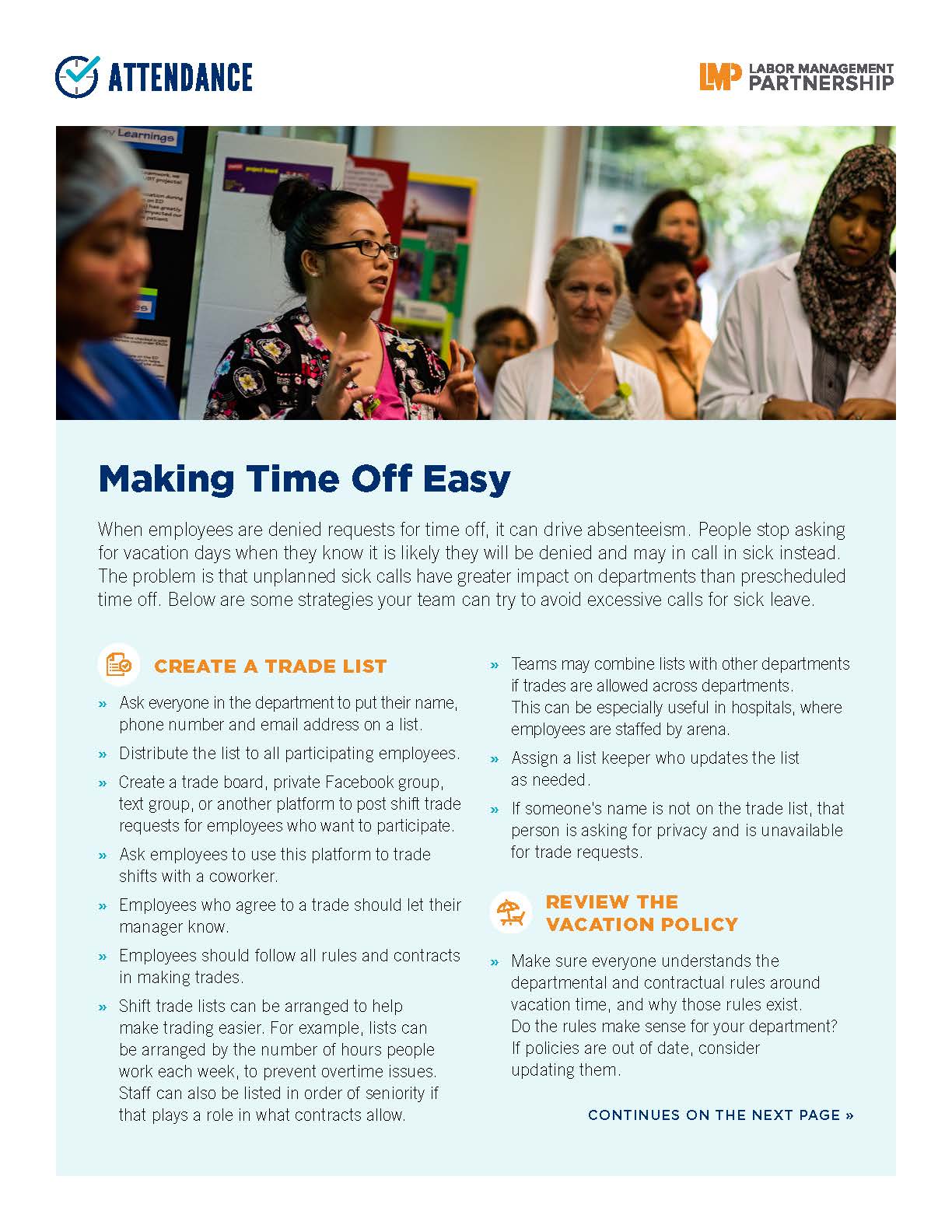
Bubble Wrap Delivers Better Night’s Sleep

  • Mailing sleep therapy equipment directly to patients instead of leaving packages for them to pick up at their nearest medical office building
  • Centralizing supply distribution and eliminating the use of in-house couriers for greater efficiency
  • Purchasing software that enables tracking of deliveries for improved cost savings

​What can your team do to put the patients' needs at the center when you try to improve performance?


How-To Guide: Run Your UBT Smoothly

UBT: It's not just another TLA (Three-Letter Acronym). Unit-based teams are the way we do business at Kaiser Permanente, the engine for improving the care and service we provide patients and members, and a way for everyone to have a voice on the job. 
But getting your team off the ground can be challenging, as can keeping it running. Whether you are just starting a new team or keeping your existing team on track, using these few key tools will help things go smoothly. 


Visit to Nursing Unit Yields Workflow Solution

  • Taking “voice of the customer” training, which advocates direct input from clients to improve a process or service
  • Shadowing nurses to better understand their perspective and identify the root causes of complaints about late or missing medication
  • Starting the morning shift 30 minutes earlier to ensure timely delivery of medications

What can your team do to listen to the voice of your customers? Especially if those customers are fellow employees in a different department? 

TOOLS

Stoplight Report: Your Voice Matters

Format:
PDF

Size:

  • One page, 8.5"x11"
  • Large-size format, 24"x36"

Intended audience:
Frontline managers and unit-based team co-leads

Best used:
Use this visual aid to show team members the status of issues raised in rounding conversations; available in standard size and as a 24"x36" poster for large-format printers.

Related tools:

Take the Easy Way Out

Deck: 
Speed your team on its way with ideas from other teams

Story body part 1: 

Do you or your teammates want to shrink wait times? Save money on supplies? Reduce time wasters or roadblocks? Once you’ve identified a problem to solve, you may wonder where to start. No need to invent an improvement project from scratch. Visit the Team-Tested Practices section and see what’s worked for others. We’ve got short summaries of successes from every region and every type of work environment to give your team a kickstart.

1. What’s here? 

When you visit LMPartnership.org/team-tested-practices, you’ll find the first several “tiles” of the dozens you can choose from as you scroll through this section. Each tile will have a photo and short preview about a specific, measurable improvement a team has made.

2. Sharpen your search 

Want to narrow down what you see? Use the filters on the left side of the page. There are several to try, including:

  • Topic. Choices include affordability, patient safety, service and more.
  • Department. See what departments like yours have done.
  • Region. Check out the projects done in your region.

Selecting more than one filter at a time works, too. And remember that you can get great ideas from departments very different from yours and regions other than your own. You’ll notice these filters throughout the website to help you focus your searches. 

3. Intrigued? 

See something your team might want to try? Click on the tile to get a more complete description of the challenge the team was facing — and the main tests of change that helped the team achieve its goal. And the measurable result: “Saved $40,000,” “decreased wait times by 11 minutes,” “69 percent drop in costs.”

4. No dead ends! 

So, maybe the practice you clicked on isn’t right for your team. Before you move on, check out the related tools and stories in the colorful columns farther down this page. Throughout the site, the color orange means, “Here are tools to get your team started on work like this.” Blue is, “Get inspired by stories and videos about teams working on similar efforts!” And, “Just for fun” — green will take you to puzzles, games and other light-hearted resources to kick off your improvement campaign on an upbeat note.

Pages

Subscribe to RSS - UBT Co-Leads