Workforce of the Future

Help Video

How to Find UBT Basics on the LMP Website

Learn how to use the LMP website:

LMP Website Overview

Learn how to use the LMP website:

How to Find How-To Guides

This short animated video explains how to find and use our powerful how-to guides

Learn how to use the LMP website:

How to Find and Use Team-Tested Practices

Does your team want to improve service? Or clinical quality? If you don't know where to start, check out the team-tested practices on the LMP website. This short video shows you how. 

Learn how to use the LMP website:

How to Use the Search Function on the LMP Website

Having trouble using the search function? Check out this short video to help you search like a pro!

Learn how to use the LMP website:

How to Find the Tools on the LMP Website

Need to find a checklist, template or puzzle? Don't know where to start? Check out this short video to find the tools you need on the LMP website with just a few clicks. 

Learn how to use the LMP website:

Build Your Career With Tuition Reimbursement

Deck: 
How you can turn a high school diploma into a career at Kaiser Permanente

Story body part 1: 


Donna McGee started her career with Kaiser Permanente in 1990 with a high school diploma and a dream.

She began her journey in supply chain as a storekeeper. She worked there for 4 years as a member of SEIU.

"When I started out, I had my high school diploma," says McGee. "Getting promoted into a management position, I needed to get my education."

So, she took some courses. Then she kept going. She earned 3 college degrees — all with the help of tuition reimbursement.

During this time, McGee moved into other roles. First, she went to supply chain management. She's now the site director at Antioch Medical Center. 

Finding support

McGee credits her success to the help she had on each step.

"It has been amazing to have the support of the organization to get that continuing education to allow my career to grow," says McGee.

Kaiser Permanente and its labor partners encourage lifelong learning for employees. In 2024, a record 35,000 Kaiser Permanente employees used the tuition reimbursement benefit. Employees can receive up to $3,000 each year for completing courses to continue their education, get a certificate or earn a degree.

Attending school and working isn't easy, but McGee found a way to make it work. Sometimes, she even took her physical education classes during her lunch break. With support from her management team, she earned an associate degree in business administration and management.

After one degree, McGee knew she could do more. She went on to get both her bachelor's and master's degrees online in business administration and management. Tuition reimbursement helped her all along the way.

'Go after your dreams'

McGee played a key role on the opening team at Antioch Medical Center. She feels privileged to lead and work closely with teams to deliver exceptional care to members. Her dreams came true. She wants others to do the same.

"Shoot for the stars," McGee says. "Use the tuition reimbursement benefit that you have available to you and go after your dreams. You can do anything at Kaiser Permanente."
 

Key Findings on How Workers Perceive Technology

Deck: 
Unit-based teams have positive impact

Story body part 1: 

Frontline workers see technology as important to their work. But they vary widely in their views on how easy it is to use tech at work.

What can help workers feel more at ease with tech? Unit-based teams.

"Of surveyed employees, 82% saw the importance of technology enabling work in their unit. At the same time, 52% saw this as difficult to do. Those involved in UBTs were more positive on the importance of technology and saw lower difficulty in implementing new technology," says Spencer Lewis, a Brandeis University doctoral student.

Lewis analyzed results of the most recent survey commissioned by Kaiser Permanente and the Alliance of Health Care Unions. The survey asked workers how they perceive technology, the Labor Management Partnership, and UBTs.

Here are 4 key findings:

1. The greater an employee's UBT involvement, the more effective they perceived workplace tech to be.

2. Frontline workers interested but not yet involved in UBTs were among the most optimistic about tech's importance, effectiveness, and ease of implementation.

3. Employees without LMP training are more pessimistic about tech.

4. Employees uninvolved and uninterested in UBTs are the most pessimistic about tech's importance, effectiveness, and ability to be implemented.

Learn more about UBTs.

Related: Teams Tackle Technology One Byte at a Time


Teams Tackle Technology One Byte at a Time

Deck: 
Survey shows how unit-based teams can boost tech’s effectiveness

Story body part 1: 

When you think of technology in health care, what comes to mind?

Virtual care? Medical devices? Electronic health care records?

In Washington, a radiology team increased its health and impact with an app to track a step challenge.

In Virginia, advice nurses bonded through Microsoft Teams and a buddy system.

Across the Labor Management Partnership, unit-based teams are embracing technology step by step. By doing so, they're strengthening teamwork, improving service, and becoming more efficient.

That reflects findings of a survey by Kaiser Permanente and the Alliance of Health Care Unions. The survey asked workers how they perceive technology, LMP, and UBTs. A Brandeis University analysis of the survey linked UBT interest and involvement with views of the importance of technology.

UBTs are natural work groups that collaborate to improve patient care. The Partnership has 3,700 UBTs. Each team is co-led by a manager and a worker and a physician — if it includes doctors.

Stepping up team activities

The Olympia Radiology UBT formed in 2022.

The step challenge was an early project. To track steps, team members downloaded an app to phones and smart watches. This led the team to walk more and raised interest in the UBT.

"People get excited," says management co-lead Lydon Fitzgerald, a radiology manager. "They want to be a part of it."

The team has 50 members, including techs for CT, MRI, and X-ray. It plans to add sonographers and mammography techs.

"They want a voice," says labor co-lead Jesse Toth, a radiologic tech and UFCW Local 3000 steward. "It's about inclusion."

Know the code

The radiology team took more tech steps. It began to use Microsoft Teams to share files and host some meetings.

Then the team focused on patient satisfaction scores. It added QR codes, so patients could give real-time feedback.

But many older patients weren't familiar with QR codes. The team then added signs and created scripts to show patients how to use QR codes with their phone.

"We're trying to keep patients happy and on time," Toth says.

Make time to train

When the unit got 2 new machines, the co-leads made sure workers got trained. The team learned how to use the equipment and found ways to work smarter.

"Tech is integral to workflows. How can we make it better?" Fitzgerald says. "We embody the principles of LMP, working together at the lowest level to find solutions."

TOOLS

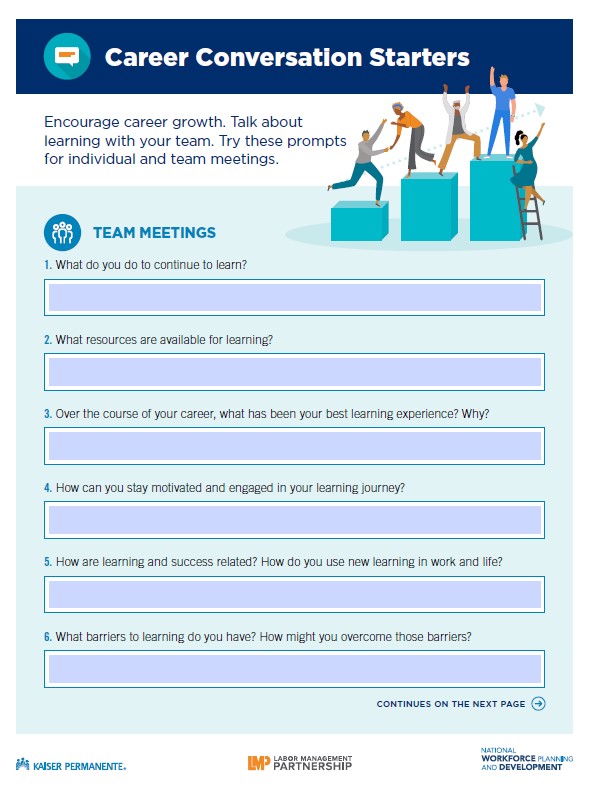
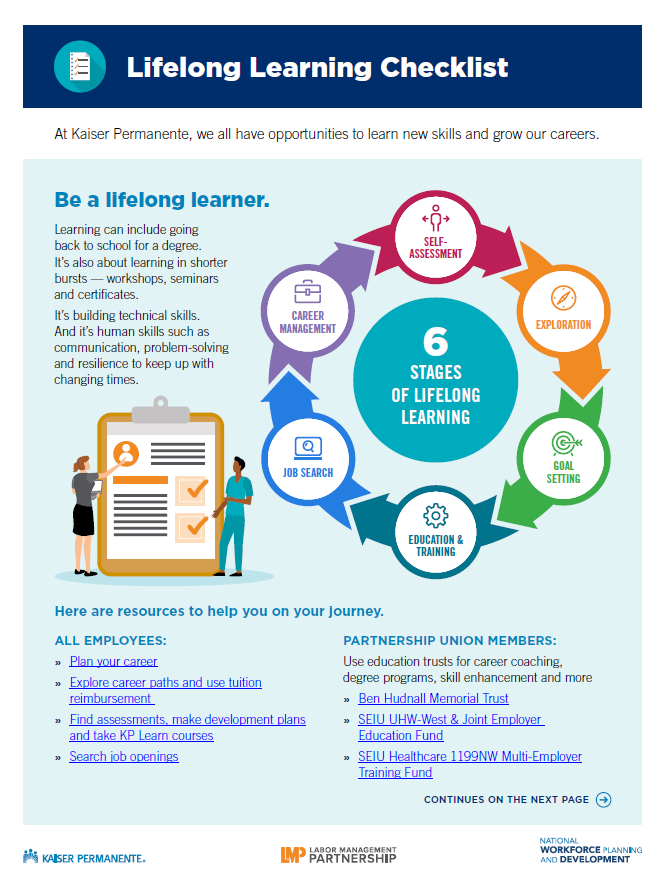
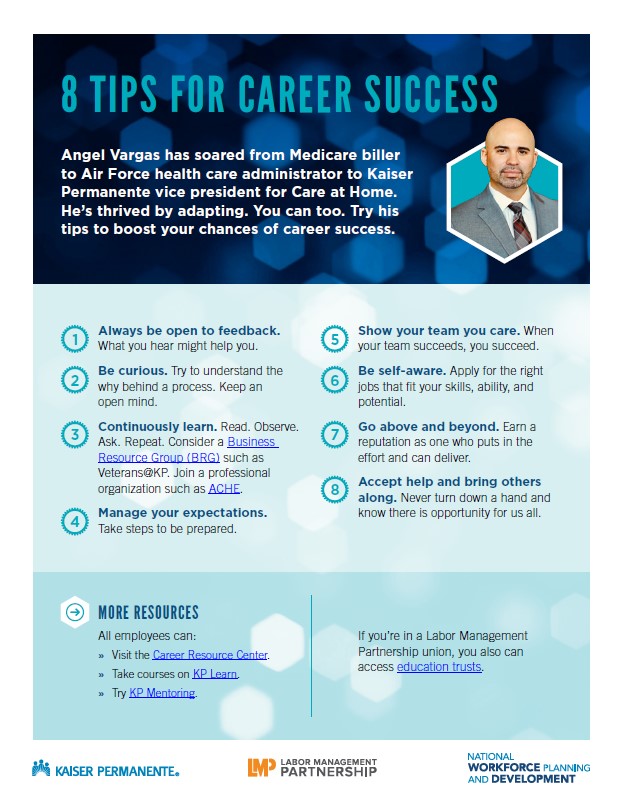
Lifelong Learning Communications Toolkit

Format:
PDF

Size:
8.5" x 11"

Intended audience:
Communicators, workforce development professionals, managers, union leaders, executives

Best used:
This toolkit has information for all Kaiser Permanente employees that markets and functions can use to promote lifelong learning.

Related tools:

TOOLS

Power of Partnership Meeting Presentation

Format:
PPTX

Size:
1280 x 720 pixels

Intended audience:
Communicators, workforce development professionals, managers, union leaders, executives

Best used:
Use this presentation with notes and accompanying video in team meetings to discuss workforce development resources. 

Related tools:

TOOLS

Workforce of the Future Virtual Backgrounds

Format:
JPG

Size:
1920 x 1080 pixels

Intended audience:
Anyone attending or hosting online meetings.

Best used:
Upload to Microsoft Teams, Zoom, or any other virtual meeting platform.

Related tools:

Pages

Subscribe to RSS - Workforce of the Future