
LMP Processes
Help Video
How to Find UBT Basics on the LMP Website
LMP Website Overview
How to Find How-To Guides
This short animated video explains how to find and use our powerful how-to guides
How to Find and Use Team-Tested Practices
Does your team want to improve service? Or clinical quality? If you don't know where to start, check out the team-tested practices on the LMP website. This short video shows you how.
How to Use the Search Function on the LMP Website
Having trouble using the search function? Check out this short video to help you search like a pro!
How to Find the Tools on the LMP Website
Need to find a checklist, template or puzzle? Don't know where to start? Check out this short video to find the tools you need on the LMP website with just a few clicks.
LMP Curriculum
LMP Learning offers a range of dynamic classroom, online and just-in-time training that builds the partnering and performance skills and knowledge needed to sustain the success of the Labor Management Partnership and to advance Kaiser Permanente’s business strategy. LMP Learning is available to all unit-based team members, co-leads, sponsors and others throughout Kaiser Permanente who need to develop these skills and knowledge.
Training
Working in partnership and creating a collaborative, high-functioning team requires specific skills, and the LMP Learning program offers a variety of training opportunities—online and in person—to ensure UBT members, co-leads and sponsors can be successful. Different trainings are recommended at different levels of the Path to Performance and cover areas such as problem solving, decision making and performance improvement.
UBT Basics
Unit-based teams (UBTs) are transforming Kaiser Permanente by changing the roles of union members and managers and creating an environment in which all employees are encouraged to think critically about problem solving and work innovations. They were launched in 2005 as part of that year’s National Agreement. The people who negotiated the agreement envisioned UBTs as a way to improve care by tapping into the knowledge and experience of frontline staff, managers and physicians. The Partnership unions have since reaffirmed UBTs as a platform for improvement in each National Agreement.
How Partnership Works
The Labor Management Partnership brings together Kaiser Permanente workers, managers and physicians at all levels of the organization. Together, Kaiser Permanente, the Coalition of Kaiser Permanente Unions and the Alliance of Health Care Unions provide team-tested tools and practices for solving problems, making decisions and delivering better care, service and improving work life.
Story body part 1:
The Labor Management Partnership is an operational strategy shared by Kaiser Permanente and the Partnership unions.
This joint commitment is designed to:
- deliver high-quality care and service to Kaiser Permanente members and patients
- continuously improve performance as measured by national standards
- involve unions and individual frontline workers in decisions about how to deliver the best care
- make KP more affordable by removing waste from care delivery systems
- preserve and improve upon industry-leading benefits and working conditions for employees
The partnership is jointly led and funded by Kaiser Permanente and two groups of Partnership unions, the Coalition of Kaiser Permanente Unions and the Alliance of Health Care Unions. There are more than 150,000 employees represented by the union locals that are part of the partnership. About 23,000 managers and 25,000 physicians also participate.
Results for KP members and patients
Our Labor Management Partnership has delivered measurable results for KP members and patients. Most of the day-to-day work of the partnership is led by self-directed work teams — what we call unit-based teams (UBTs) — made up of frontline managers, employees and physicians. All teams are measured quarterly on several dimensions of performance, leadership and engagement.
Past National Agreements
A series of national labor agreements between Kaiser Permanente and the Partnership unions have used the interest-based bargaining process to achieve industry-leading results. The first was in 2000, three years after the Labor Management Partnership was founded; subsequent agreements followed in 2005 (with a re-opener in 2008), 2010, 2012 and 2015, each building on the previous and developing fresh innovations.
2005 National Agreement
Story body part 1:
The 2005 agreement was remarkable for its creation of unit-based teams to drive frontline performance improvement, with the teams co-led by a unit's manager, a union-represented staff member and, where applicable, a physician. The agreement also beefed up workforce development. It was in force from Oct. 1, 2005, to Sept. 30, 2010.
TOOLS
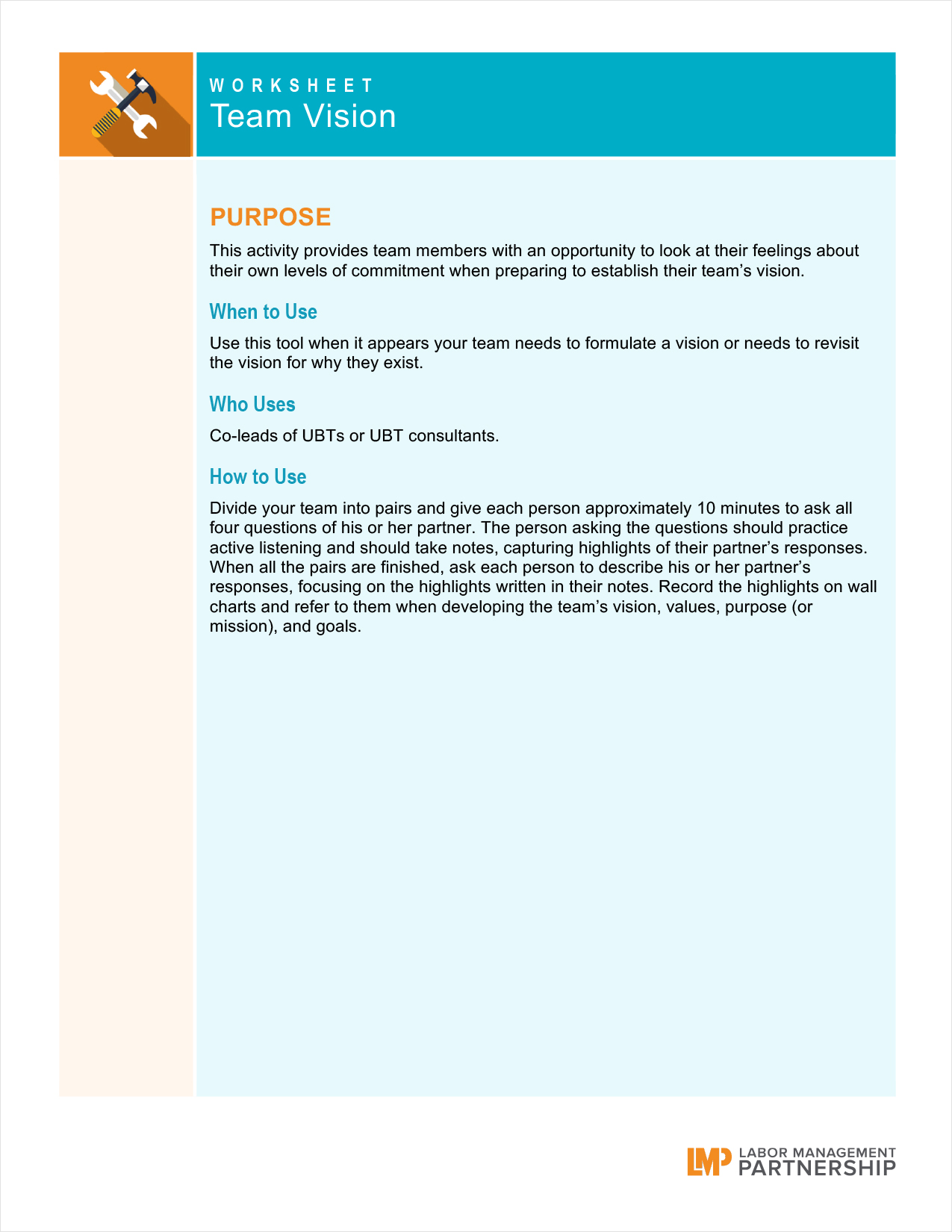
Team Vision
Format:
PDF or Word DOC
Size:
8.5" x 11"
Intended audience:
Co-leads of unit-based teams or UBT consultants
Best used:
Use this activity when your team needs to look at their feelings about commitment and formulate a vision of why it exists, or needs to revisit that vision.
TOOLS
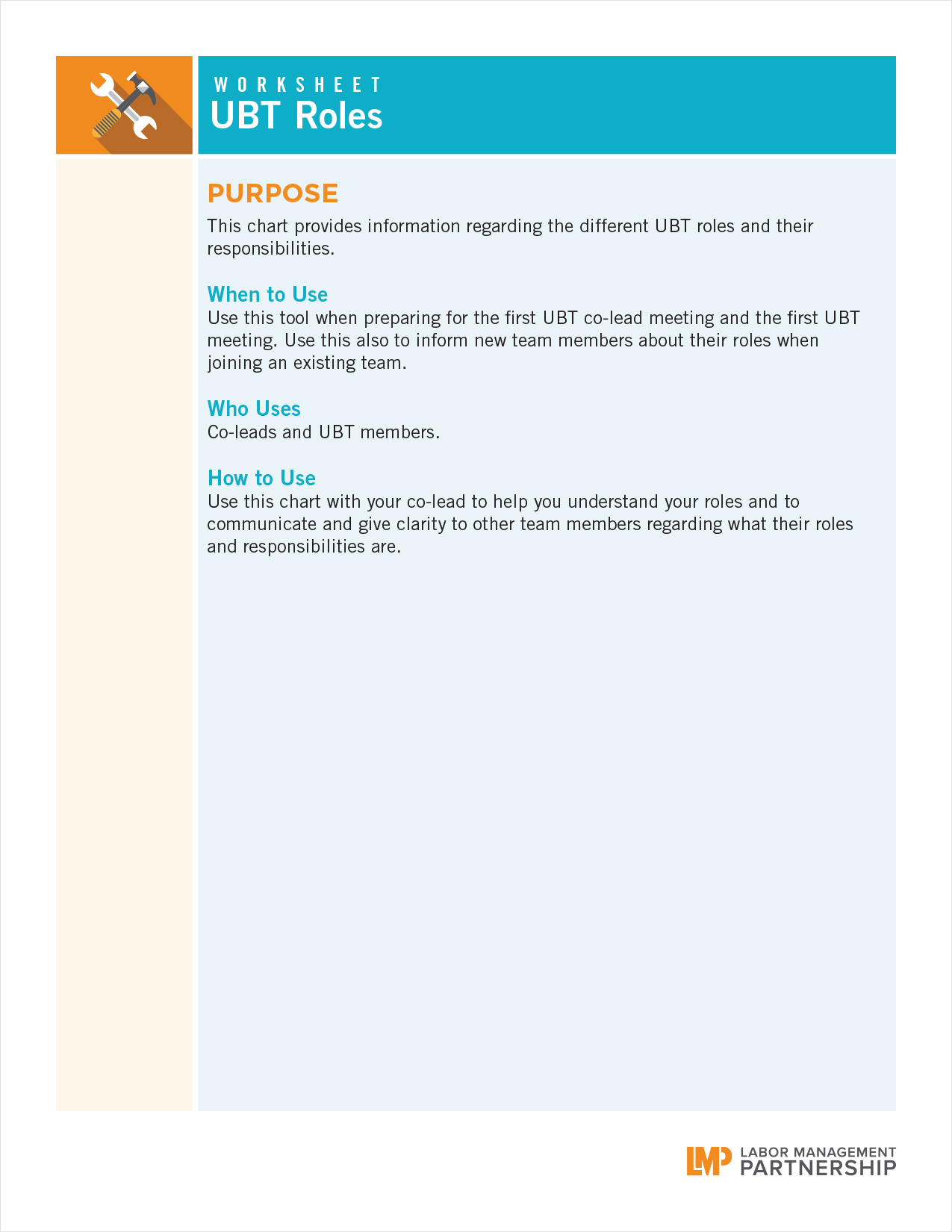
UBT Roles
Format:
PDF (color and black and white)
Size:
8.5" x 11"
Intended audience:
UBT co-leads and members
Best used:
This worksheet can help you prepare for your first co-lead meeting and the first UBT meeting to clarify team members' roles and responsibilities.
Pages
