
Performance Improvement
Help Video
How to Find UBT Basics on the LMP Website
LMP Website Overview
How to Find How-To Guides
This short animated video explains how to find and use our powerful how-to guides
How to Find and Use Team-Tested Practices
Does your team want to improve service? Or clinical quality? If you don't know where to start, check out the team-tested practices on the LMP website. This short video shows you how.
How to Use the Search Function on the LMP Website
Having trouble using the search function? Check out this short video to help you search like a pro!
How to Find the Tools on the LMP Website
Need to find a checklist, template or puzzle? Don't know where to start? Check out this short video to find the tools you need on the LMP website with just a few clicks.
Goals and Performance Level 1 or 2
Goals and Performance
UBTs use the Value Compass, which puts the member at the center of every decision, to focus the team’s performance improvement projects on achieving the highest quality, the best service, the most affordable care and the best place to work. UBT goals and improvement work should also be aligned with the priorities of the facility and region where the team is located.
Use of Tools
To identify change they want to make in their departments and test them to see if they work, unit-based teams use tools such as the Rapid Improvement Model (also known as RIM+), process mapping and waste walks. Using these performance improvement tools has allowed UBTs throughout Kaiser Permanente to improve service, quality, affordability and the work environment. UBT Tracker is an online tool teams use to track their projects and tests of change.
Story body part 1:
UBTs use a performance improvement method called the Rapid Improvement Model (RIM+). It’s a quick way of improving work processes that allows teams to make a small change, test and evaluate it, and then adopt it if it works — or reject it if it doesn’t.
Use these three questions to guide your team’s efforts to improve quality, service and affordability, and to make your department a great place to work:
- What are we trying to accomplish? Clarify the improvements your team wants to make and define how you want to change. Be specific.
- How will we know a change is an improvement? Identify what you will measure to make sure you know whether the change you make is truly an improvement.
- What changes will help us improve? What options are most likely to work? What do we think is a good idea? What have other people done? Keep objectives in mind. Use the team’s knowledge and experience as a guide.
Visit the Use of Tools toolkit to learn more.
Small tests of change
The plan, do, study, act (PDSA) cycle is part of the Rapid Improvement Model. It allows teams to rapidly test a change on a small scale. Risk taking is encouraged and failures are okay because the team learns from them.
The steps are:
- Plan: Plan the test or observation, including how you’ll collect data.
- Do: Try out the test on a small scale.
- Study: Set aside time to analyze the data and study the results.
- Act: Refine the change based on what team members learned from the test.
Then start preparing a plan for the next test!
Other performance improvement tools
In addition to PDSAs, there are a diversity of performance improvement tools — process maps, fishbone diagrams and more — that can help teams understand what’s not working about their team processes and which are the best ideas for improving them. The How-To Guide on performance improvement is a great place to start exploring performance improvement tools that go beyond PDSAs.
Consensus decision making and interest-based problem solving
In the course of doing performance improvement work, team members use specific methods to help them make decisions and understand one another’s point of view.
Teams use consensus decision making to decide things like which project the team is going to tackle and which improvement idea is going to be tested first. Consensus is a form of group decision making that is often used in collaborative work. Because everyone discusses the issues to be decided, the group benefits from the knowledge and experience of all members. Consensus occurs when every member of the group supports the decision.
Interest-based problem solving is a process that addresses individual and group differences. Participants work together to reach agreement by sharing information and remaining creative and flexible, rather than by taking adversarial positions.
The four steps to interest-based problem solving are:
- define the problem
- determine interests
- develop options
- select a solution
Visit the Team Member Engagement toolkit to learn more about consensus decision making and interest-based problem solving.
Videos
Partnership in 99 Seconds
Loading the player...
(1:39)
In just 99 seconds, learn how Kaiser Permanente's unique Labor Management Partnership makes it a better place to work — and receive care. Watch this animated video now.
TOOLS
Poster: Supreme Sponsor
Format:
PDF (color and black and white)
Size:
8.5" x 11"
Intended audience:
Frontline employees, managers and physicians
Best used:
Share on bulletin boards, in break rooms and in other staff areas to provide a lighthearted look at sponsorship.

Videos
Inventing Better Care
Loading the player...
(2:19)
Imagine a workplace where every member of every team has a say in how the work gets done. That is the goal of the more than 3,600 unit-based teams now up and running across Kaiser Permanente. Watch this short video for a quick explanation of what a unit-based team is, and to see how UBT members are working together to make KP a better place to work and receive care.
Around the Regions (Fall 2012)
Deck: In support of sponsors
Deck:
In support of sponsors
Story body part 1:
Colorado
The Regional Imaging teams in Colorado are lucky to have two effective sponsors: Joseph Gonzales, clinical operations for Regional Imaging, and Rebecca “Becky” Torres, a pharmacy technician and SEIU Local 105 member. Part of their success, the pair says, is the emphasis they have placed on sharing information—with each other and with their teams. The pair also figured out a way to spread effective practices. Using a PowerPoint template, the sponsors asked co-leads to explain what they’re working on, how it supports regional goals, whether it worked and the outcome. Then, the teams came together for a UBT Fair and shared their PowerPoints.
Georgia
David Jones, MD, has a title unique at Kaiser Permanente: assistant to the medical director for unit-based teams. He mobilizes his fellow physicians in the Georgia region to get involved with UBTs and unleash the power of partnership to improve performance and grow membership. “The first thing I tell physicians about the UBTs is that it is about improving the work that we’re already doing,” he says. “It’s not about adding more work, it’s about looking at the work you're doing and figuring out how to do it better.” Read more from Jones—including how his experience with UBTs has transformed the way he delivers care to his patients.
Hawaii
A small region, Hawaii needed a novel approach to sponsorship: Branch out rather than always branch up. Initially, a five-member unit-based team committee tried to troubleshoot issues for the region’s fledgling teams. Often, those committee members, who also had roles as team co-leads or contract specialists, were trying to wear too many hats and got jammed. So the region, which now has more than 40 teams, has tapped 19 people to receive sponsorship training. The group includes middle managers, directors and other executives, frontline nurses who serve on the Kaiser Permanente board of the Hawaii Nurses Association, OPEIU Local 50, and former labor team members and co-leads.
Mid-Atlantic States
While the Mid-Atlantic States region’s clinical unit-based teams have management and labor co-sponsors, large teams such as lab and radiology are sponsored in a different way: A UBT leadership group made up of labor and management from these area performs sponsorship functions as a united body. “We generated a vision of our UBT sponsorship. We got very specific on how we would work together,” says Jane Lewis, executive director of health plan regional services and a member of the group that sponsors eight pharmacy UBTs. The UBTs report their projects and team dynamics at monthly meetings. The leadership group reviews People Pulse, service scores, quality results and other metrics, identifies struggling teams, and recognizes teams that excel.
Northern California
The region has been on a roll with its “A Leader’s Role as UBT Sponsor” training. Launched in the spring, the tutorial gives management and labor leaders an easy-to-understand yet in-depth look at providing effective support to unit-based teams and their performance improvement work. The short, online training covers everything from outlining a sponsor’s role and how a sponsor can model partnership to tips on developing strong UBT co-leads and high-performing teams. Several facilities have combined the training with in-person, interactive exercises, and early feedback suggests the blended approach is striking a chord with sponsors. The online training can be found at KP Learn.
Northwest
“My role as a senior sponsor is to bring the message of UBTs to physician leadership,” says Rasjad Lints, MD, the region’s executive sponsor of UBTs. Lints is especially interested in helping teams focus on outcome metrics—a measure of the final result of something, such as how many patients with hypertension have their blood pressure under control—and to help everyone on the team understand that improving on process metrics often drives improvement on outcomes. It can be difficult to see the value in participating in process metrics if team members don’t see how it relates to the outcome measures. “At the end of the day, physicians have to drive the care,” Lints says. While working in UBTs presents physicians with some unique challenges, he believes that “if the physicians aren’t engaged, it’s a lost opportunity.”
Ohio
In an effort to improve the quality of team project information in UBT Tracker, the regional LMP support team solicited the help of the people who support the work of teams—sponsors. In June, an improvement adviser met with Ohio’s 20-plus sponsors and asked them to work with their teams to boost the input of that data. To illustrate the value and role of quality data in UBT Tracker, they used the data in Tracker to brief the sponsors on their UBTs’ projects and status. Their approach made an impact: The region has reported an increase in sponsor engagement, and several teams have reported performance and relationship improvements.
Southern California
The regional Labor Management Partnership department is launching a new sponsor training curriculum that covers the nuts and bolts of what sponsors do and how they do it. Topics include: the responsibilities of sponsoring bodies (such as helping define how the teams should be structured and guiding selection of co-leads); coaching skills to help develop UBT leaders; the similarities and differences between labor and management sponsorship; how managing in partnership differs from traditional management; and how the sponsor role differs from that of facilitators, project managers, trainers and consultants. Also included in the course are basics of the Labor Management Partnership and unit-based teams, such as the key elements for UBT success, the roles and responsibilities of UBT co-leads and members, and consensus decision making.
TOOLS
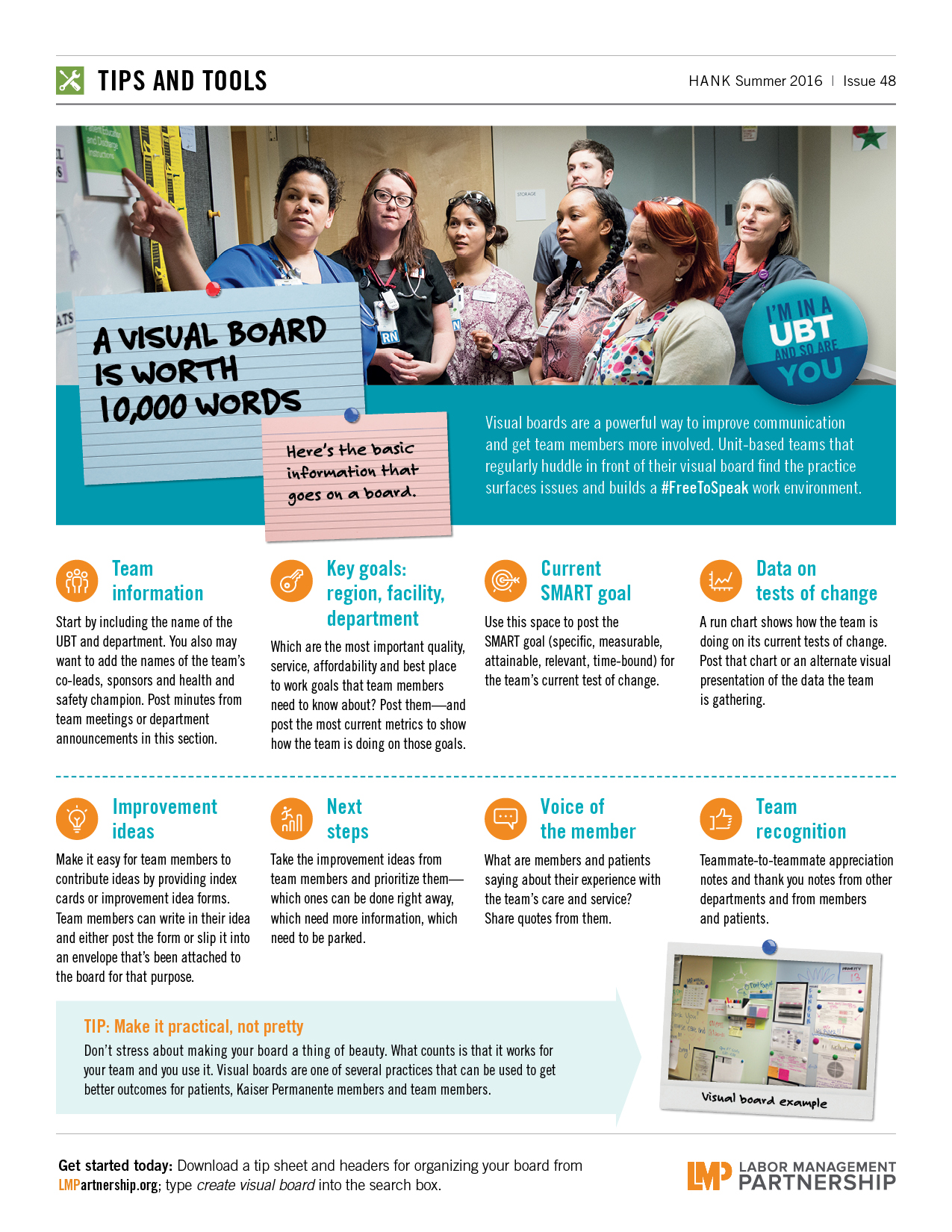
A Visual Board Is Worth 10,000 Words
Format:
PDF
Size:
8.5" x 11"
Intended audience:
Unit-based team consultants and team co-leads
Best used:
Create an effective visual board for your unit-based team. UBTs that regularly huddle in front of their visual board find the practice helps to surface issues.
You may also be interested in:
How to Create a Visual Board
Pages
