Performance Improvement

Help Video

How to Find UBT Basics on the LMP Website

Learn how to use the LMP website:

LMP Website Overview

Learn how to use the LMP website:

How to Find How-To Guides

This short animated video explains how to find and use our powerful how-to guides

Learn how to use the LMP website:

How to Find and Use Team-Tested Practices

Does your team want to improve service? Or clinical quality? If you don't know where to start, check out the team-tested practices on the LMP website. This short video shows you how. 

Learn how to use the LMP website:

How to Use the Search Function on the LMP Website

Having trouble using the search function? Check out this short video to help you search like a pro!

Learn how to use the LMP website:

How to Find the Tools on the LMP Website

Need to find a checklist, template or puzzle? Don't know where to start? Check out this short video to find the tools you need on the LMP website with just a few clicks. 

Learn how to use the LMP website:

How to Climb the Path to High Performance

Deck: 
Helping workers, KP, members and patients

Story body part 1: 

Kaiser Permanente and the Coalition of Kaiser Permanente Unions set an ambitious goal in the 2012 National Agreement: to have 75 percent of all unit-based teams achieve high performance by year-end 2014—for good reason. As teams develop, they deliver better, more affordable care and a better work experience.

There’s work to be done. More than 60 percent of teams in Georgia, Hawaii and the Northwest are meeting the goal, but overall, just 52 percent of KP’s 3,500 UBTs program-wide were rated high performing as of June 30.

The good news is that nearly 1,800 teams across KP have hit their mark, built performance improvement into their everyday work, and are showing other teams how to do the same.

Modeling the way

The Perioperative UBT at Ontario Medical Center in Southern California is one of those teams.

“It’s about having everyone involved and engaged,” says Michelle Tolentino, RN, one of the Perioperative UBT’s union co-leads and a member of UNAC/UHCP. “We attended UBT training together, got results on our first project (safely reducing patient stay times) and kept rolling.”

The 11-member representative team, which covers more than 60 nurses, surgical techs, medical assistants and others, reached Level 5 on the five-point Path to Performance soon after forming in 2012. Like many other teams in the region, it saw its rating drop in 2013 after a labor dispute led union members to suspend their UBT involvement. When the issue was resolved, the team regrouped and quickly regained its Level 5 rating.

The secret sauce

The team does a few key things right that helped it achieve and now maintain its high performance. Those can be modeled by other teams aspiring to Levels 4 and 5 status:

  • Performance improvement tools: “Using our performance improvement tools—process mappings; run charts; plan, do, study, act cycles—keeps us all sharp,” says Mary Rodriguez, assistant clinical director and UBT co-lead. “That’s been key for us: understand the process and use the tools.”
  • Constant tests of change: The Perioperative team now has seven active tests of change, most focusing on improving affordability and workflow efficiency. “Our projects often build off of other projects,” says Rodriquez. For instance, a recently completed project helped reduce turnaround time in the OR from 28 minutes to 20 minutes in three months. In a parallel project, the number of patients receiving medication at least 30 minutes before surgery—the ideal time for most patients—increased from 70 percent to 85 percent. Such projects draw on the whole team’s skills and perspectives, she says.
  • Physician involvement: Shawn Winnick, MD, an anesthesiologist, assistant clinical director and UBT member, points to another key to success: “Physician presence on a (clinical) UBT is extremely important,” he says. “It brings a different perspective to projects.”

Calling UBTs “the single most powerful vehicle we have at KP to empower employees and lead change,” he notes that physician leaders at the medical center have supported UBT development and helped overcome barriers.

“Staff and physicians need to have the time to consistently make it to UBT meetings,” he says. “Even if it means bringing in someone to cover part of a shift, that is more than paid back by the cost savings and organizational benefits that come out of UBTs.”

The benefits accrue to the workforce as well as patients.

“We have a say in our work process,” says Robert Kapadia, a certified registered nurse anesthetist and member of KPNAA. “I come to the table as an equal partner and advocate for others on the team, and for our patients. Our UBT is a way to solve problems and move forward, not just complain.”

Dr. Winnick adds: “There’s not a single member of our team who hasn’t contributed an idea or helped make us better. That’s a measure of a performance. We all have different skills and perspectives, and we bring all of that to our team.”
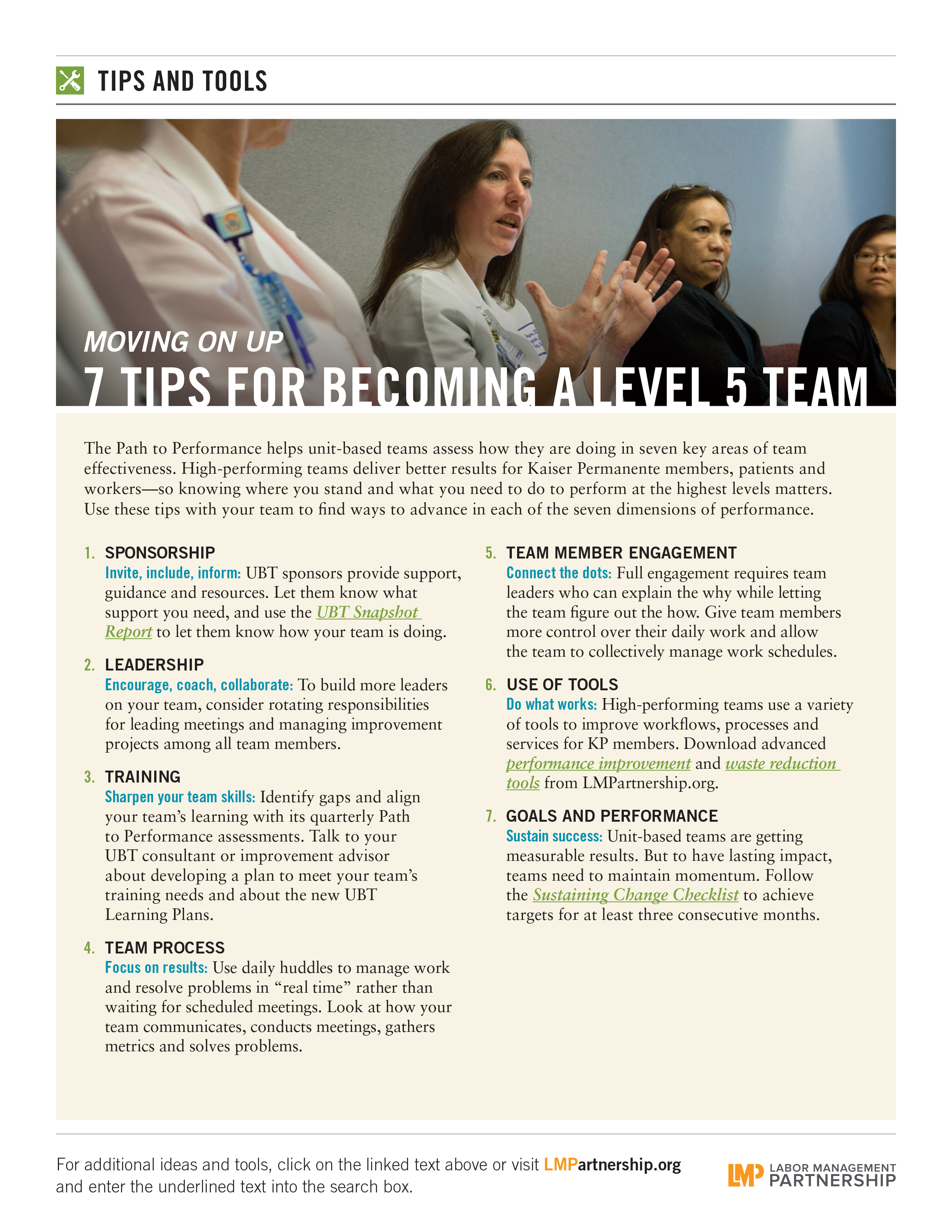

TOOLS

Moving on Up: 7 Tips for Becoming a Level 5 Team

Format:
PDF

Size:
8.5" x 11"

Intended audience:
Unit-based team members, co-leads, sponsors and consultants

Best used:
This tipsheet suggests ways teams can reach Level 4 or Level 5 in each dimension of the Path to Performance. Post on bulletin boards and discuss in team meetings; use these tips to engage your team in specific actions.

Related tools:

TOOLS

Poster: Going Green

Format:
PDF (color and black and white)

Size:
8.5” x 11”

Intended audience:
Frontline employees, managers and physicians

Best used:
Inform your UBT members about this EVS team that found it's easy to go green—and lower operating costs, improve patient and workplace safety, and increase employee satisfaction.

See the video here.

Related tools:

Teen Interns Jump-Start UBTs

Deck: 
Using the Community Benefit program to school interns in performance improvement

Story body part 1: 

Summer interns often are put to work fetching coffee or making copies. But last year, UBT consultant Geoffrey Gamble wanted to create a more valuable experience for the teens of KP’s Summer Youth Employment Program at the Modesto Medical Center. So he trained a small army of performance improvement consultants to help support unit-based teams.

Despite initial skepticism from some team members and managers, the results were stunning. By the end of the summer, 12 of the 13 teams supported by the interns advanced at least one level on the Path to Performance. What’s more, four of the 19 projects carried out by the UBTs yielded savings or cost avoidance totaling $400,000. The program was such a success, it has returned to Modesto this summer and has spread to the Sacramento and San Jose medical centers. And in the process, the interns are gaining on-the-job training that translates to their studies and to the work world.

“I went in thinking we were going to do grunt work, but in reality it was like, ‘Wow, I’m actually doing something I can apply,’” says Nate Aguirre, who interned in Modesto’s Emergency Department last year. “It was a life-changing experience.”

The Community Benefit program has offered training and work experience to teenagers in underserved communities since 1968. In the past, that experience included clerical work or coaching on speaking in front of a large group. When Modesto’s internship coordinator retired in 2013, Gamble agreed to oversee the program as long as it supported his work developing UBTs.

Overcoming doubt with results

“When I first proposed the idea, directors were very skeptical,” Gamble recalls. “People would say, We’re struggling to do this with professionals—how do you expect to get momentum from a 16-year-old?’”

But Gamble saw the opportunity to offer teams a fresh perspective and the daily support many need to get started. He also wanted to show team members that performance improvement didn’t have to be complicated and could be incorporated in their daily work.

“I told managers that I was going to treat (interns) like adults and give them the skills I would give employees,” Gamble says. “If you hold them to that expectation, they will rise to the occasion.”

In the first few days of the eight-week program, Gamble trained the 16-year-old interns in basic performance improvement tools, including the Rapid Improvement Model, process mapping and Labor Management Partnership basics. By the second week, the youth were assigned to Level 1, 2 and 3 unit-based teams and started helping the teams launch projects and enter data into UBT Tracker.  

Rosemary Sanchez, Modesto’s Emergency Department supervisor, was one of the loudest doubters.

“At first I was like, ‘Ugh, one more thing to do.’ But then I thought, ‘OK, this could work and help us accomplish our goals and share our knowledge.’” 

Intern Nate Aguirre was crucial in helping the team on its project to streamline and standardize supplies in the treatment rooms.

“Nate was awesome,” Sanchez says. “He was so enthusiastic collecting data.”  

Getting the ball rolling

Aguirre also spent time talking to employees in the department to learn about their jobs and the challenges they face in their work.

Meghan Baker, an Emergency Department clerk and union co-lead for the UBT, says that sparked interest and support from UBT members—a shift from before, when they had struggled to get employees involved.

“People were into having their voice heard by someone,” says Baker, who's a member of SEIU-UHW. “Now people are talking and getting the ball rolling on things. And we’re making it known that people are being heard.”

At the start of the program, the Emergency Department UBT was ranked at Level 3. The team advanced to Level 4 after completing the work.

Michelle Smith, manager of Specialty Surgery Reception, appreciated the new perspective and support her team received from its intern for its project to reduce surgery no-shows and last-minute cancellations.

“It was nice to have someone get our project going,” she says, “because we were at a standstill.”

The team’s intern walked the UBT members through mapping out their process. New workflows emerged that included calling patients ahead of scheduled surgeries, which reduced no-shows and increased service scores.

When the teams were asked what they thought helped them advance, many said it was because of the interns coming to the departments every day to help push and support the work. 

“We would have eventually worked on the project, but having her come in and start us off in a positive way was great,” Smith says. “She taught us how to be a team, because we realized we all had to be part of the work.”

Summits Supercharge Performance Improvement Efforts

Deck: 
In addition to the training they provide, the events build energy and communicate priorities

Story body part 1: 

Want to supercharge efforts to improve performance and help reach Kaiser Permanente’s strategic goals? Then bring unit-based team leaders together for a summit.

UBT consultants at several facilities in Southern California have organized summits that focused on Performance Sharing Program (PSP) goals, performance improvement strategies and affordability projects. All say they are seeing results in the forms of more robust UBT projects, clearer SMART goals, and stronger alignment between top medical center leadership and the work of UBTs.

After seeing teams improve service scores, reduce workplace injuries and save more than $160,000 in just four months in the San Diego service area, Sue Smith, a senior UBT consultant, concludes, “The overall experience was wonderful. Many teams had an exciting opportunity to network with other teams and learn new skills in a fun way.”

This spring, San Diego Medical Center hosted a UBT affordability summit, which brought together co-leads for a half-day to build the skills to tackle a new PSP goal for 2014 in the region: to increase the percentage of UBTs that successfully complete a project with hard dollar savings or improved revenue capture. (The projects are reviewed by finance departments to ensure they could lead to cost savings.)

Seated around large tables, UBT co-leads played a spirited game of “KP-opoly,” which offered a crash course in the organization’s finances. They heard from a UBT whose work resulted in cost savings. And they had time to work on driver diagrams and process maps for their own team’s affordability projects.

Co-leads gain PI skills

The year before, San Diego leaders—inspired by an event at the Riverside Medical Center—had held a more general, daylong UBT summit. That event brought UBT co-leads together for intensive training on performance improvement tools and created a space for them to refine their existing projects. Deadlines were set for finalizing driver diagrams and process maps, beginning tests of change and formulating sustainability plans.

The effort culminated in a UBT fair that showcased the projects that had begun as mere inklings at the summit: The ultrasound UBT demonstrated how it had gone injury-free for six months (it had been having at least one injury per month); the diagnostic imaging department boosted patient satisfaction scores from 87 percent in May 2013 to 93 percent in December.  

Leaders at the Woodland Hills Medical Center followed the same playbook, hosting an LMP summit in April that launched an array of of affordability projects to be showcased at a UBT fair scheduled for mid-July.

Mobilizing on PSP

At Fontana and Ontario medical centers, UBT staff used the summit model to mobilize the workforce around all of the region’s PSP goals. Top leaders from both management and the unions kicked off the day, then gave subject matter experts each 10 minutes to discuss the goal (whether it be service, workplace safety, attendance, etc.) and challenge co-leads to take on a performance improvement project to tackle it. A highlight was an impassioned and dramatic account from Roy Wiles, president of Steelworkers Local 7600, about a union member who did such a good job of saving up unused sick time that he recently retired with a five-figure nest egg in his Health Reimbursement Account.

The key to attracting co-leads to the summits, the consultants say, is to plan well in advance and to enlist top leadership to encourage participation. That lets managers and employees make plans for attending while ensuring their departments’ operational needs are met.

“This is part of their work,” says Priscilla Kania, senior UBT consultant at Ontario. “Your leaders are inviting you. People are excited to be in the room with top leaders.”

Has your facility or region held a summit? Let us know all about it!


TOOLS

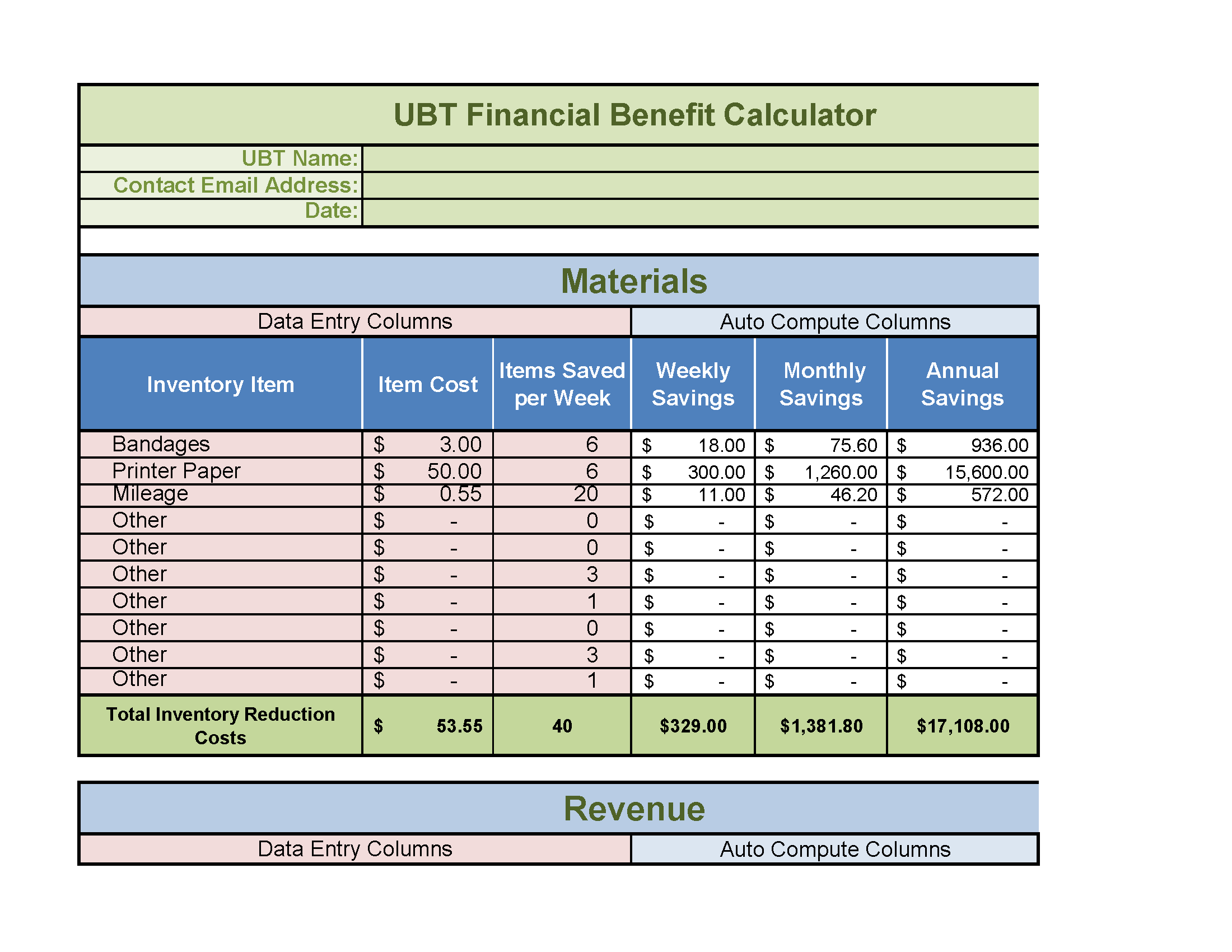
Handy Spreadsheet to Gauge UBT Savings

Format:
XLS (spreadsheet)

Size:
1 page

Intended audience:
UBT co-leads or team members

Best used:
Use this spreadsheet to track and determine the economic benefits of your team's performance improvement projects—you can easily see the impact of your efforts on the bottom line.

Note: Entries are placeholders; delete them and add your own information.


Related tools:

TOOLS

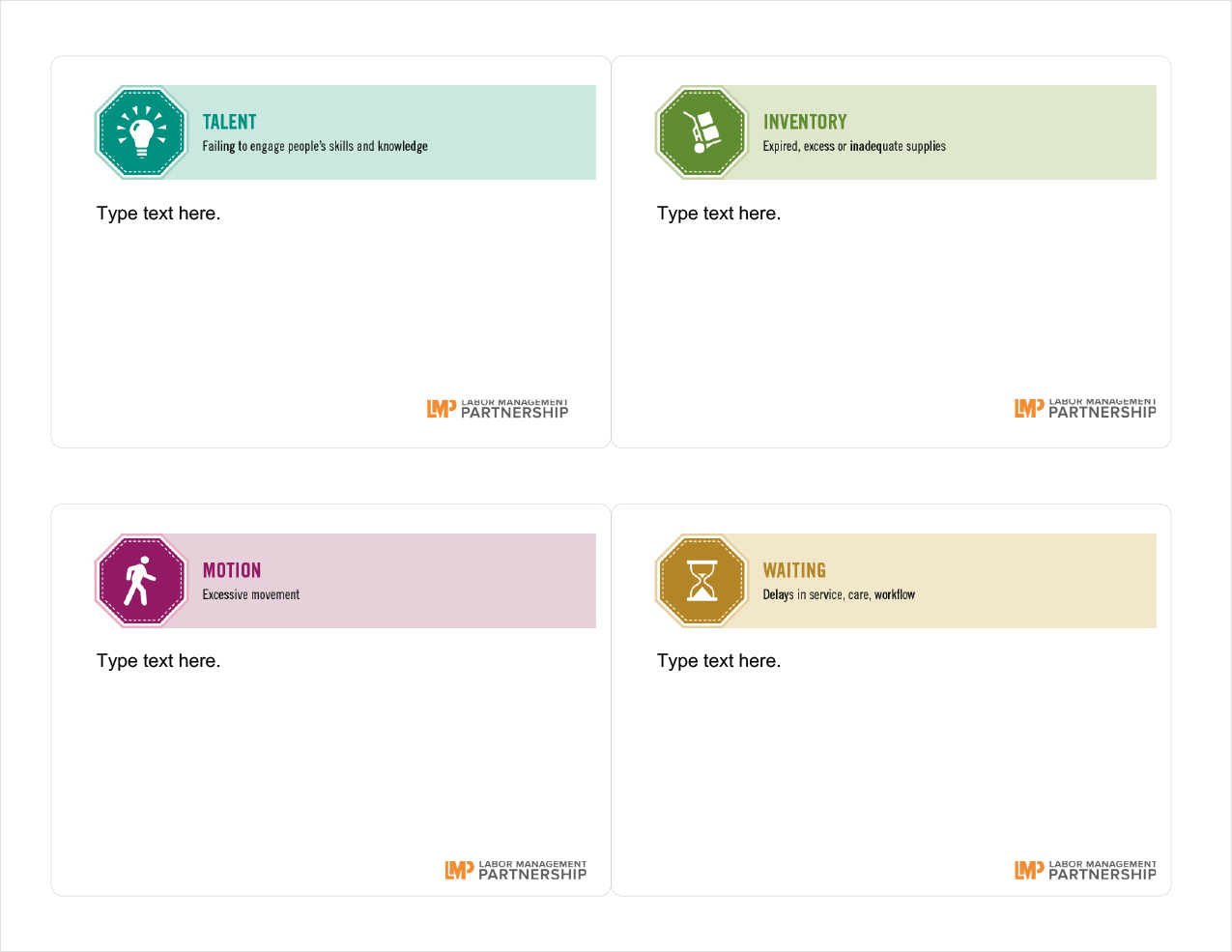
Waste Walk: Observation Sheets

Format:
DOC

Size:
8.5” x 11” (1 sheet, 2-sided, four categories per side)

Intended audience:
Level 2 and higher unit-based teams 

Best used:
Good introduction to performance improvement. Team members can use the sheets to capture notes under each waste category for further discussion and problem solving.

Use with:

Related tools:

TOOLS

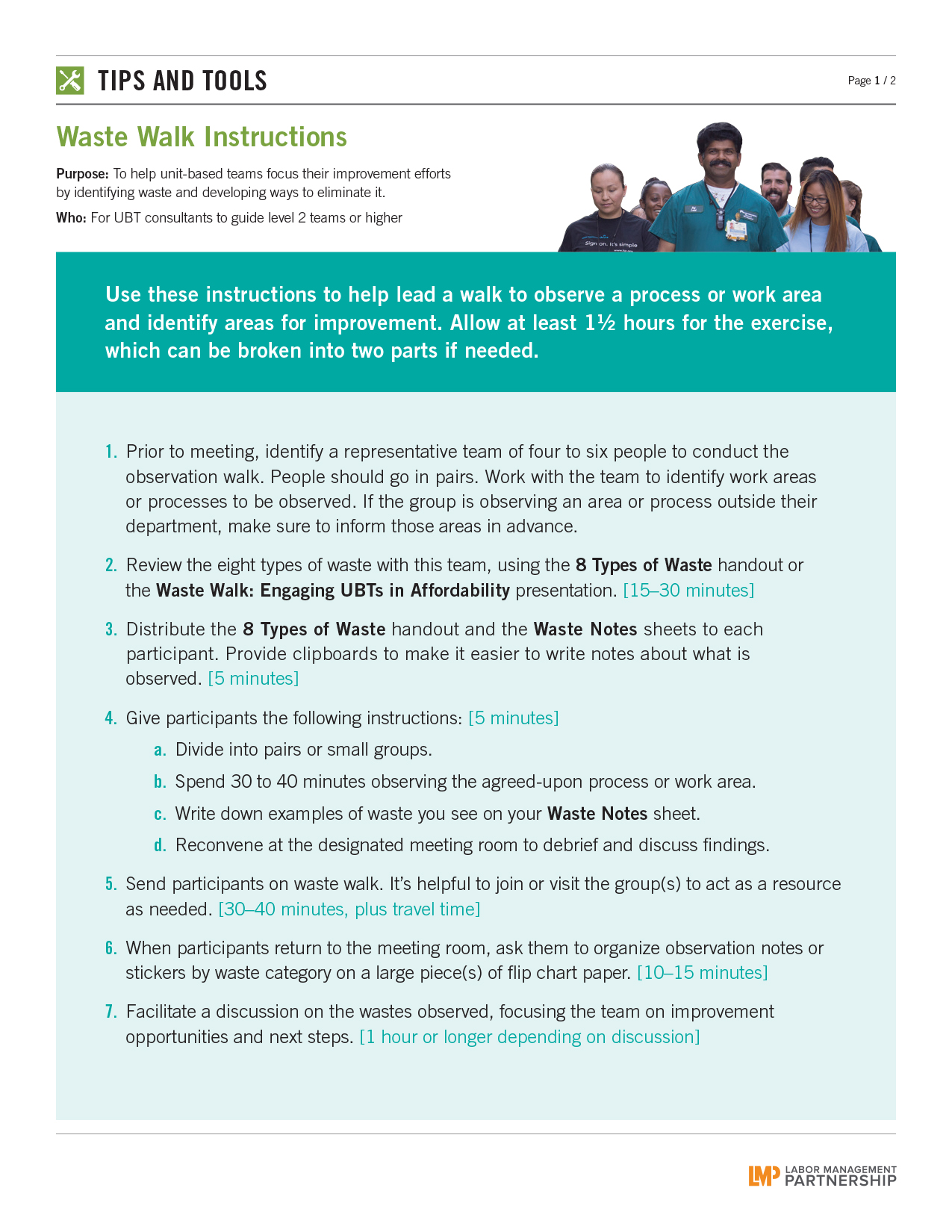
Waste Walk: Instructions

Format:
PDF

Size:
8.5” x 11”

Intended audience:
Level 2 and higher unit-based teams

Best used:
UBT consultants and UPRs can use these instructions to guide teams on finding projects that solve for affordability. Allow 1½ to 2 hours for the full exercise.

Use with:


Related tools:

How to Zoom From Level 1 to Level 4

Deck: 
Strategic tips from a Georgia team

Story body part 1: 

Sometimes the best way to spread effective practices is to spread experienced people. That’s what happened when the Alpharetta Ob-Gyn UBT in Georgia zoomed from Level 1 to Level 4 in just 10 months after two nurses from two different high-performing UBTs transferred there at the same time.

Jane Baxter and Ingrid Baillie had been UBT co-leads at two different clinics when they each got a new job with the Alpharetta Ob-Gyn department. They both drew on their experiences to guide their new team when they became co-leads at Alpharetta. “We knew the steps in the process and what to expect,” says Baxter, the department’s charge nurse.

Fledgling teams should begin with small performance improvement projects, they say. “We started with the low-hanging fruit,” says Baillie, RN, a member of UFCW Local 1996. “You don’t need to reach for the stars right out of the box.”

Pick your projects wisely

And, says Baillie, there’s no need to look any further than Kaiser Permanente’s organization-wide and regional priorities to find plenty of ideas for performance improvement projects—and a wealth of data that is being collected regularly.

“KP makes no secret about what is important to it,” says Baillie. “From that alone, you have all the data you need.”

For instance, the Alpharetta team’s first efforts were to improve clinic start time and get a second blood pressure test for patients with high initial readings. “These are important to KP, and they helped us gel as a team,” says Baillie.

“Small wins help develop confidence,” says Baxter. Now the team is taking on more complex cross-departmental initiatives, such as trying to make available online the big packet of paperwork patients need to complete before a first Ob-Gyn visit.

Getting physicians involved also has been part of this UBT’s success. You won’t find doctors who think UBTs are just for clinic staff on this team, says Baxter.

“Our providers are very invested,” she says. “They take minutes at meetings. We are all on an equal playing field.”

TOOLS

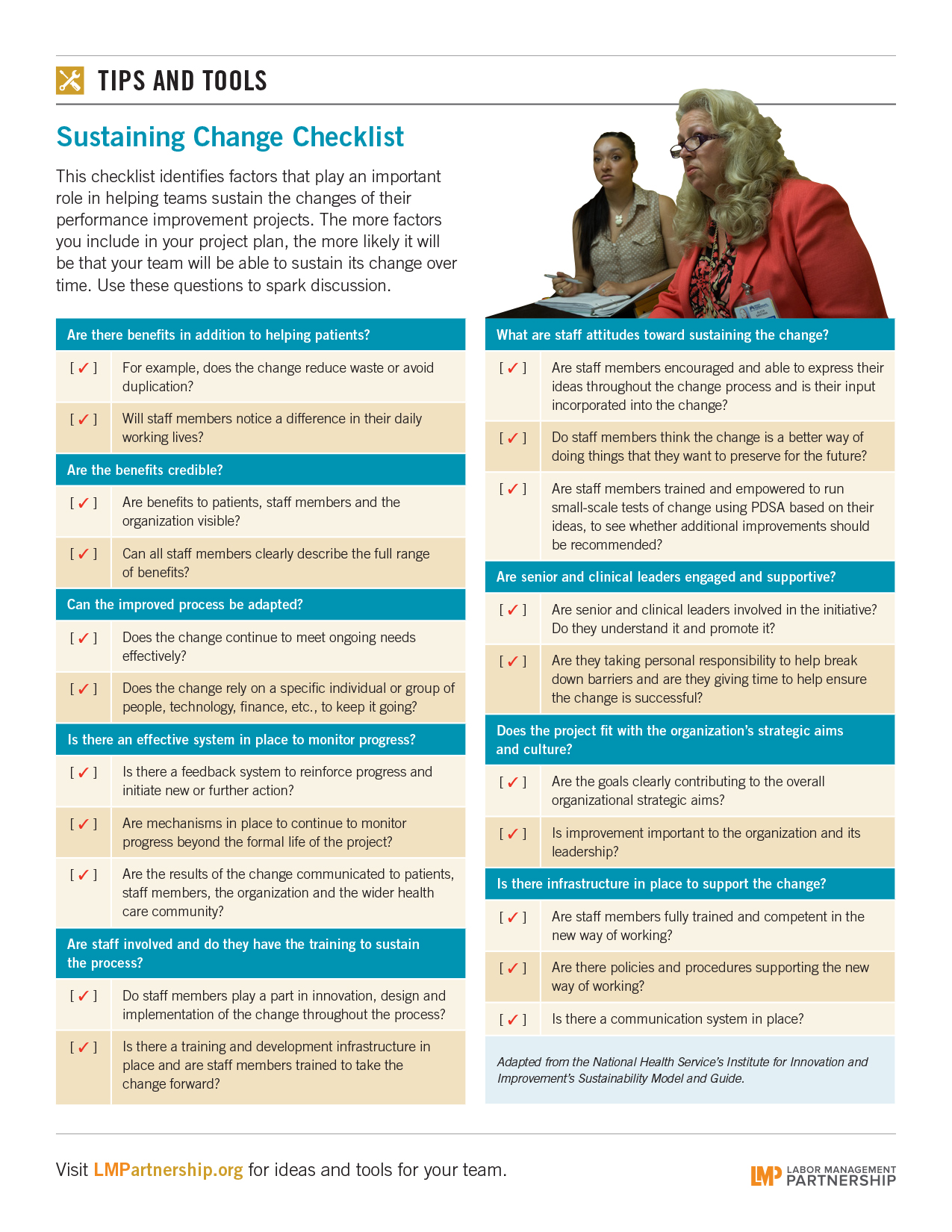
Sustaining Change Checklist

Format:
PDF

Size:
8.5" x 11" 

Intended audience:
Unit-based team co-leads and sponsors, UBT consultants

Best used:
Use this list of questions to generate discussion in your team before starting a test of change; these thought-provoking questions are from the British National Health Service’s Institute for Innovation and Improvement. 

Related tools:

Pages

Subscribe to RSS - Performance Improvement