Performance Improvement

Help Video

How to Find UBT Basics on the LMP Website

Learn how to use the LMP website:

LMP Website Overview

Learn how to use the LMP website:

How to Find How-To Guides

This short animated video explains how to find and use our powerful how-to guides

Learn how to use the LMP website:

How to Find and Use Team-Tested Practices

Does your team want to improve service? Or clinical quality? If you don't know where to start, check out the team-tested practices on the LMP website. This short video shows you how. 

Learn how to use the LMP website:

How to Use the Search Function on the LMP Website

Having trouble using the search function? Check out this short video to help you search like a pro!

Learn how to use the LMP website:

How to Find the Tools on the LMP Website

Need to find a checklist, template or puzzle? Don't know where to start? Check out this short video to find the tools you need on the LMP website with just a few clicks. 

Learn how to use the LMP website:

TOOLS

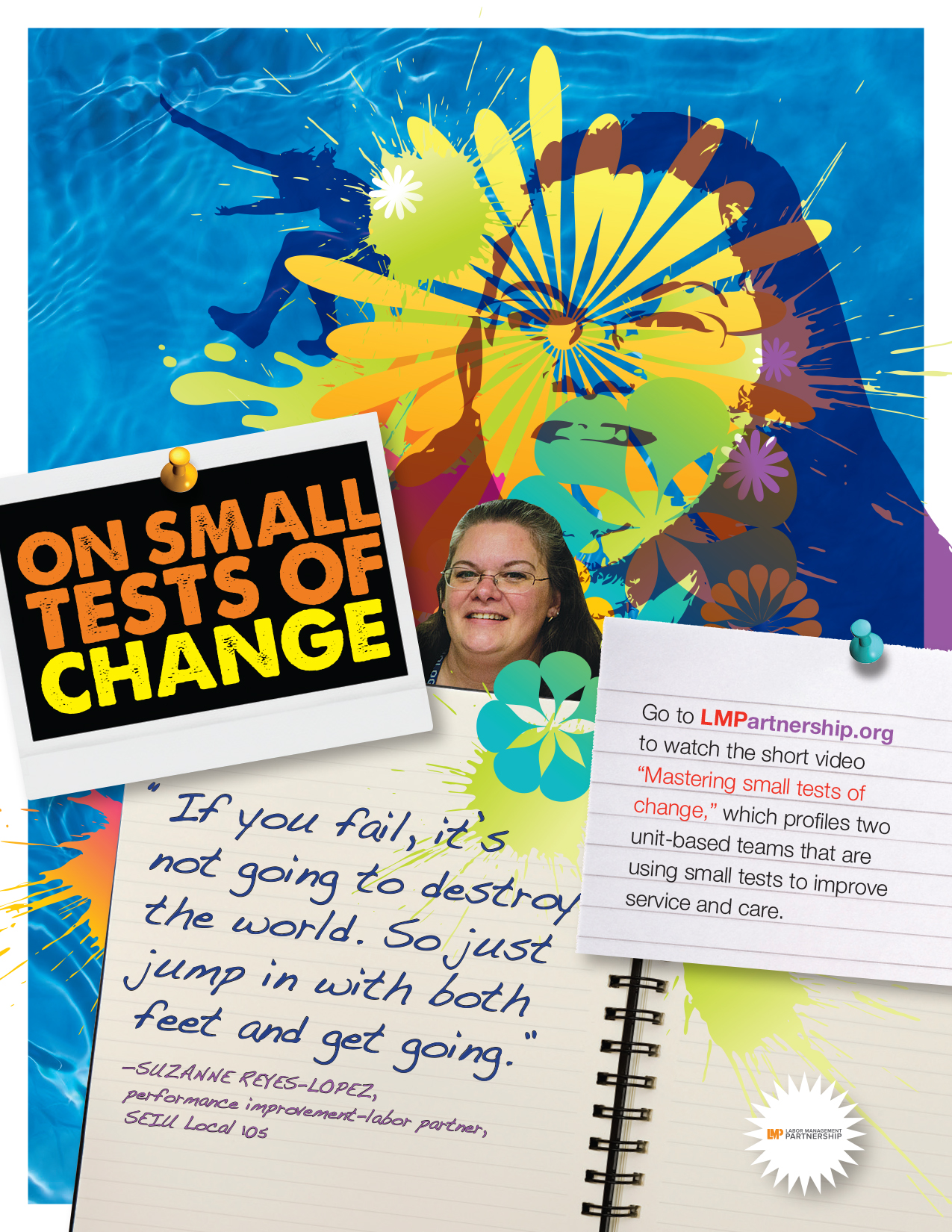
Poster: On Small Tests of Change

Format:
PDF (color and black and white)

Size:
8.5 x 11

Intended audience:
Frontline employees, managers and physicians

Best used:
This advice on small tests of change can help your team improve performance. Share on bulletin boards. in break rooms and in other staff areas.


Related tools:

TOOLS

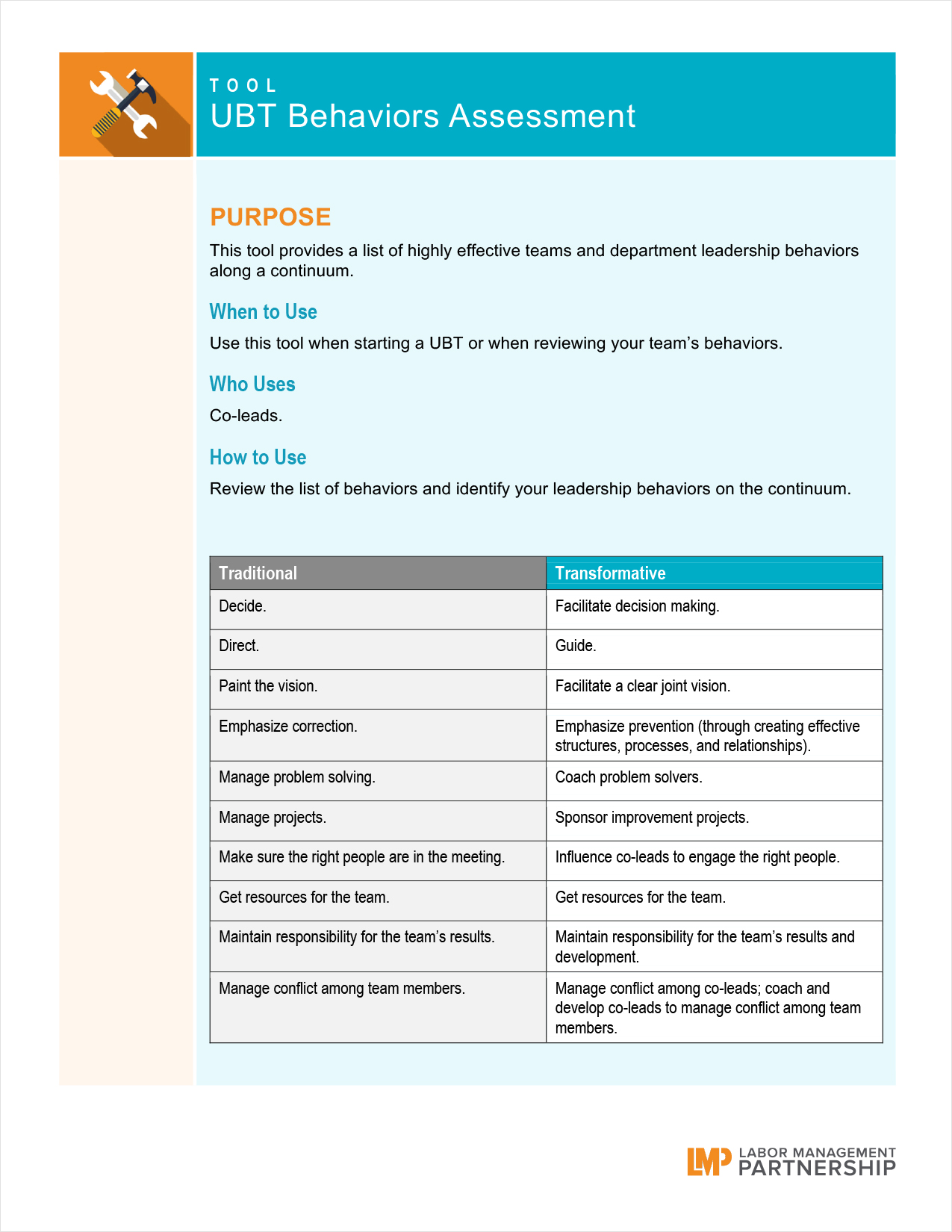
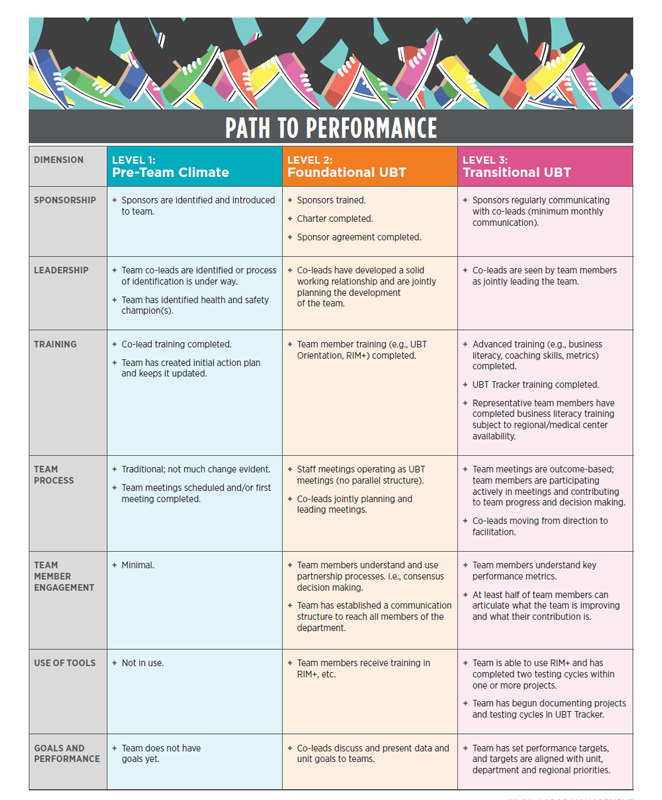
Path to Performance Poster

Formats and sizes:

  • interactive PDF, 8.5" x 11" (double-sided); with checkboxes to mark off as work is completed
  • regular PDF, 8.5" x 11" (double-sided)
  • regular PDF, 11" x 17" (single-sided)

Intended audience: 
Frontline members of unit-based teams and those who work with them

Best used: 
Share this Path to Performance poster, which comes in two sizes, with your UBT so team members can familiarize themselves with what's expected at each level of team development. 

Related tools:

TOOLS

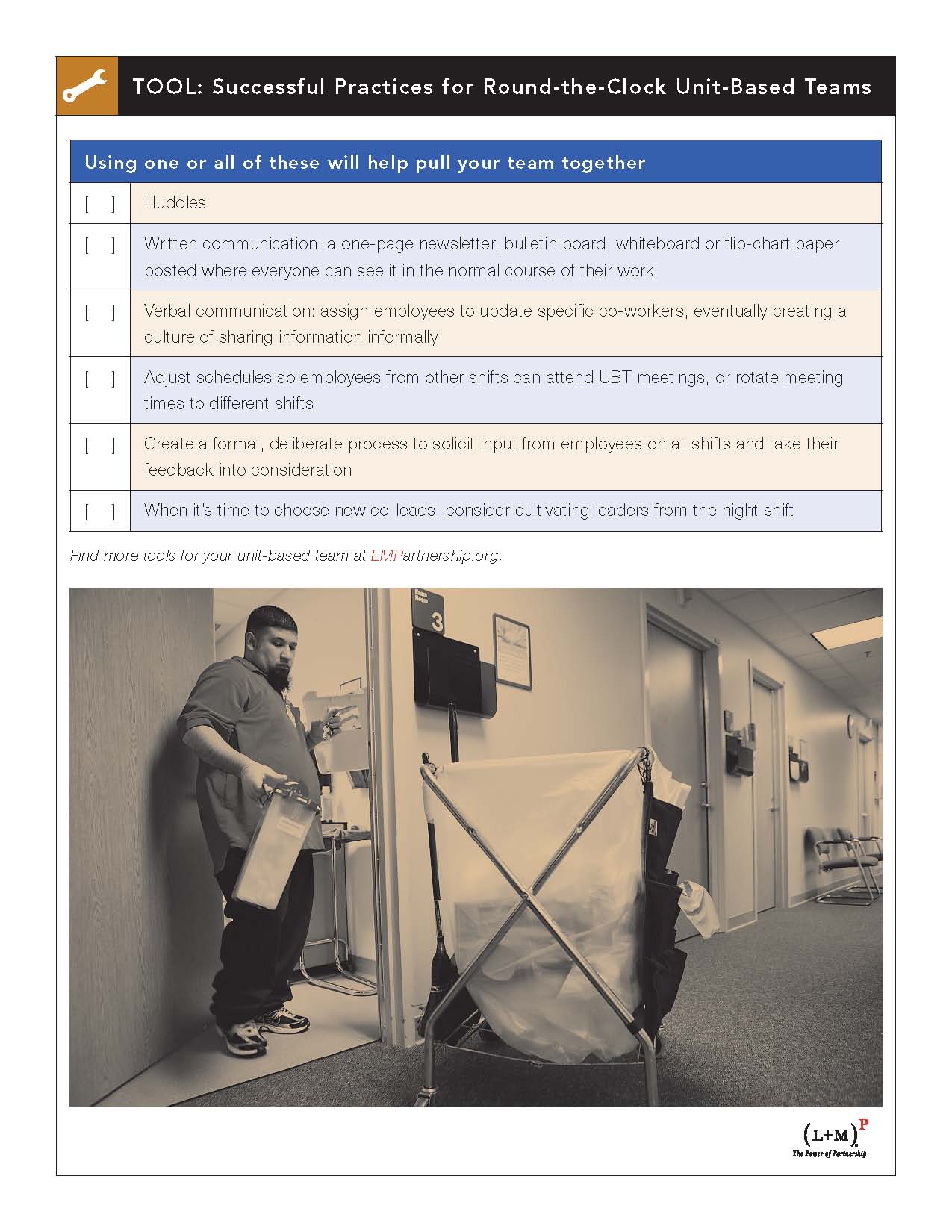
Successful Practices for Round-the-Clock UBTs

Format:
PDF

Size:
8.5" x 11"

Intended audience:
UBT co-leads and consultants

Best used:
This checklist will give you ideas on how to improve communication across shifts—and improve your team's performance in the process. Use to enhance the functionality of teams that work across multiple shifts.

Related tools:

TOOLS

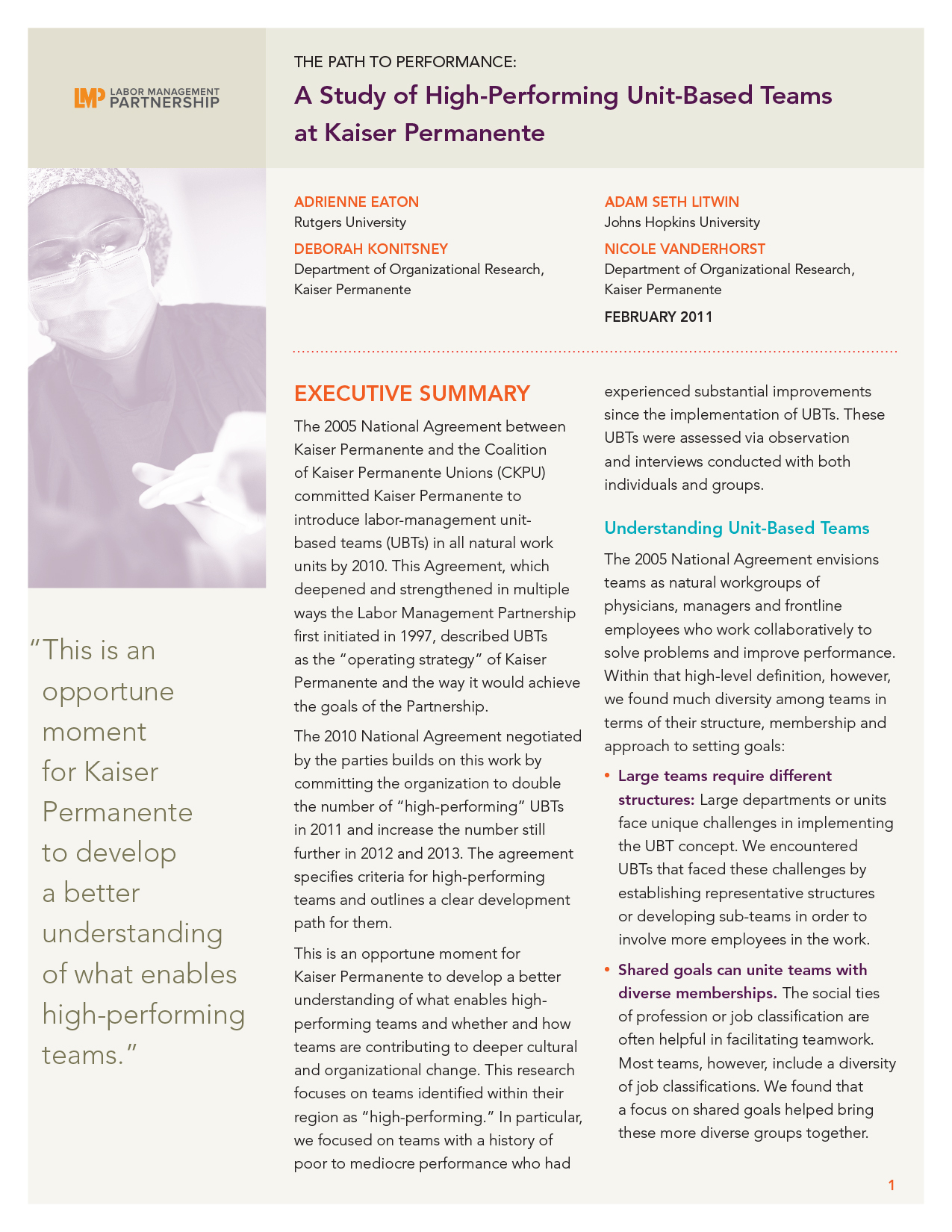
Study of KP's High-Performing Unit-Based Teams

Format:
PDF (15 or 3 pages)

Size:
8.5" x 11"

Intended audience: 
UBT sponsors, co-leads and members; KP and union leaders

Best used: 
To help unit-based team leaders and sponsors—and UBT members—better understand five elements that enable team performance and development.

Two options for reading:

  • The 15-page study by Rutgers University, Johns Hopkins and Kaiser Permanente researchers identifies five key enablers of unit-based team performance and development: leadership; line of sight; team cohesion; processes and methods; and infrastructure and support. The report includes examples of successful team practices in each area. It includes an executive summary and conclusions.
  • The 3-page executive summary of the study provides an overview of the findings, focusing on the five enablers of high performance. A good choice for those wanting a quick takeaway of these issues and for teams wanting to address issues raised by the study.
Related tools:

TOOLS

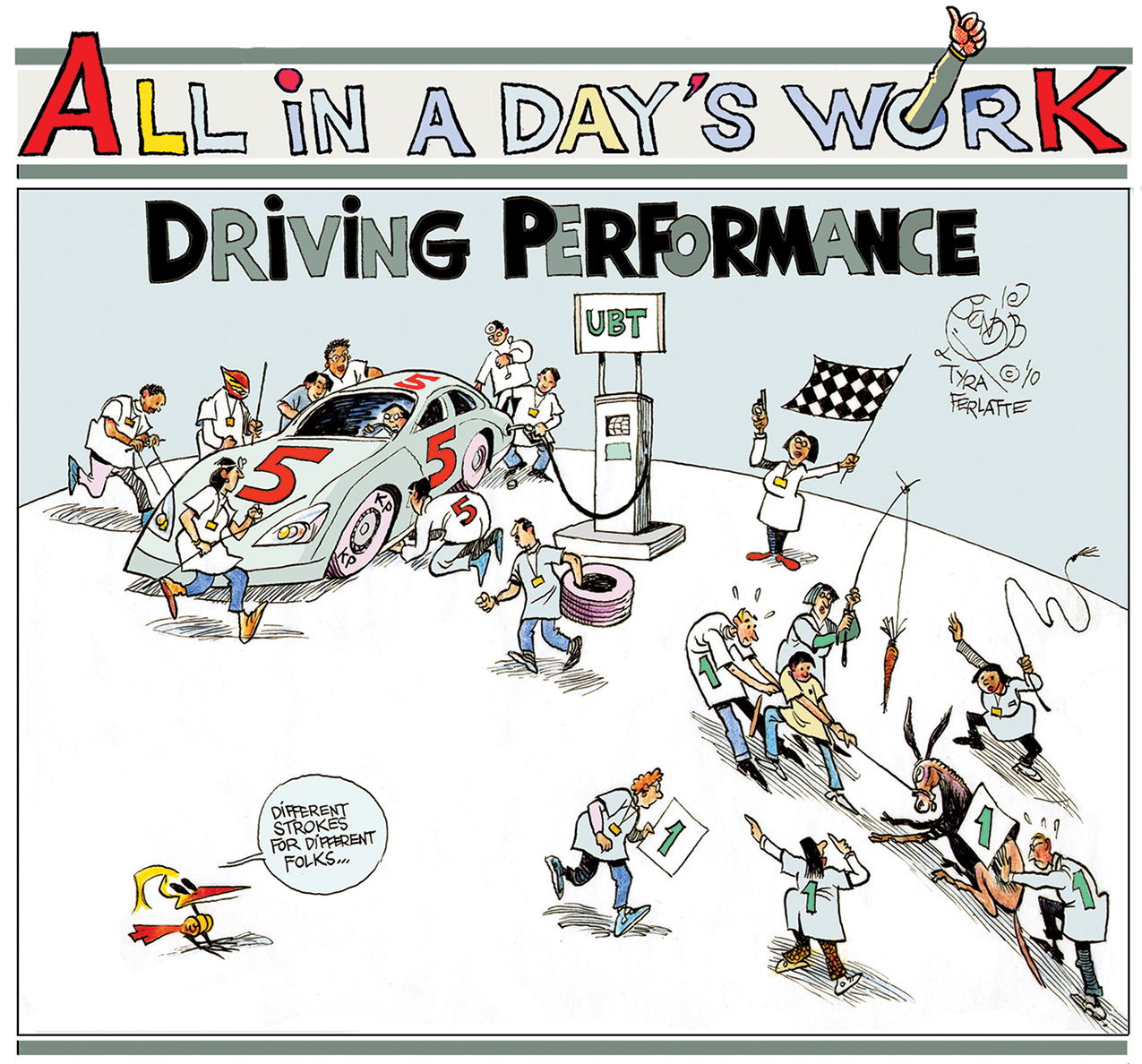
Cartoon: Driving Performance

Format:
PDF (color or black and white)

Size:
5" x 5" 

Intended audience:
Anyone with a sense of humor

Best used:
Download and post this cartoon on bulletin boards, your cubicle or in emails. 
What is your team's ability to work together and improve performance?


Related tools:

Smaller Teams Help Radiology Department Improve Performance

Story body part 1: 

After a false start, the diagnostic imaging department at Woodland Hills Medical Center has found its stride. Its results are impressive: By drawing on the wide experience of the team, it’s improving workflow and boosting attendance.

To get those results, the department created one large UBT with several subcommittees and involved a physician champion. Two radiology summits, which were held to set priorities, included the whole team: 

  • More than 160 employees and physicians who see a quarter-million patients a year.
  • Staff in eight far-flung clinics as well as throughout the medical center. They range in age from late teens to 40-year veterans of Kaiser Permanente.
  • Team members in eight areas of expertise, including ultrasound, MRI, CAT scan, nuclear medicine, mammography, general x-ray, and special procedures.  

From confusion to clarity

At first, the team’s diverse skills and experience flummoxed the department-based team (the term Woodland Hills uses instead of unit-based team).  

“We didn’t know the scope of our work,” says Selena Marchand, a lead sonographer and labor co-lead. “The old DBT got stalled talking about things like the doctors’ parking lot.”

Lessons for large teams

  • Ensure your representative group is truly representative: strive to create a structure that includes someone from each location, modality, shift, etc.
  • Include physicians
  • Reach out to trained facilitators for help
  • Focus on what your department has the power to change

A secret society?

In addition, says Marchand, the representative group—which was working without a facilitator—didn’t communicate with its co-workers about the DBT’s projects. “They thought we were some sort of secret society,” says Marchand, a member of SEIU UHW. 

The team restructured in October 2009, electing one delegate from each “modality,” as the areas of expertise are known, to the representative group.

“Pushing responsibility and accountability back to different modalities has been one of our successes,” says Mike Bruse, the department administrator and management co-lead. “We’re focused on things that we can control in our department.”

Summits get everyone involved

The co-leads convened two department-wide summits to focus on improving team performance and set priorities. Staff members brainstormed about what the challenging issues facing the department were and wrote them on flip chart pages on the wall. Then, each employee attached a sticky note to the issues that most concerned them. The team and managers set out to tackle the seven issues that received the most tags. As the work got under way, progress reports were posted in the employee break room to keep everyone on the team—not just the representatives—informed.

Better workflow

The department also improved the way it distributes film to radiologists, so that patients’ results get to primary care physicians faster. Before the change, technicians were forced to constantly interrupt doctors to read films. Now, there is a tally sheet on each radiologist’s door indicating how many films he or she is reading. This allows techs to know who is available to read a film—and allows radiologists to work undisturbed. An aide to the technologists tracks the process, acting as a traffic controller.

“It was a relatively simple thing that improved satisfaction and patient care a lot,” says Mark Schwartz, MD, who represents physicians on the UBT. “And it didn’t cost any money.”

Better attendance

The team also improved attendance, decreasing last-minute sick calls by 14 days from the end of 2009 to October 2010. They beat the Lab Department in a friendly competition two quarters in a row and were rewarded with a barbeque. To do this, team members simplified presentation of attendance data and posted up-to-the-minute metrics.  

Beyond these gains, management co-lead Bruse says the most significant change is employees’ confidence in their own ability to make improvements.

“Our meetings used to be ‘complain to Mike,’ ” he said. “These days, when people see a problem, they take steps to solve it themselves.”

Many Small UBTs Do What One Large One Can’t

Deck: 
The Charitable Health Coverage Operations department reorganizes—and achieves a goal that had eluded it for years

Story body part 1: 

The employees in Charitable Health Coverage Operations (CHCO) felt good about their Northern California department’s mission—but not so good about how long it took sometimes to help the thousands of low-income children who benefit from KP-subsidized health care.

The department handles the eligibility paperwork for a KP program that provides health coverage to people who don’t qualify for employer-based health coverage or public programs like Medicaid. At the team’s low point in 2005, it had a six-month applications backlog.

“Our primary customers are children,” said Nancy Waring, CHCO customer care manager. “We have over 80,000 children, most of them low income. About 50 percent of our population is Spanish speaking. And the program is completely subsidized by Kaiser.”

Too large a group

In the past, one representative unit-based team encompassed the whole department.  Because employees within the same department were doing very different types of work—processing mail, entering data, processing enrollments, providing customer service, and servicing the regions outside of California—they didn’t share a single set of problems. So the UBT tended to work on departmentwide problems like attendance.

But the single UBT struggled.

 “We basically failed from 2006 to 2009 to do anything,” says Suber Corley, the department’s director, “simply because we were looking at too large a group trying to solve too large a problem.”

So they reorganized. The department now has five UBTs that correspond with employees’ functions.

Setting priorities

The smaller teams set their sites on a number of changes, but they also coordinated with each other on one common goal: to process every application by the 20th of the month.

In their UBT, the mail-room employees decided to look at priorities differently.

“We identified that what we really needed to do was to have a prioritization scheme for every week of the month,” says Victor Romero, CHCO operations manager. He explains that during the first week of January, a recertification application that’s due on April 1 would be low priority in the mail room, whereas a new application—which would need to be processed by January 20 for insurance coverage to begin on February 1—would be high priority. After the 20th, attention moves to the low-priority documents.

The data entry, scanning and enrollment UBTs came up with other solutions, too.

“We instituted several changes in how the application is handled,” says Carl Artis, an enrollment processor team lead and OPEIU Local 29 shop steward. “If we couldn’t process an application, the application was sent back to the customers very early so they could make necessary corrections. We also streamlined our process—there were some things we were doing twice, which wasn’t necessary.”

Artis emphasizes that the changes were developed jointly by frontline workers and managers.

“I have to admit they (the managers) have some really great ideas,” he says, “and they were really able to listen to some great ideas.”

It worked. In October, for the first time in the department’s history, the team was able to process all its new applications by the 20th, so coverage for those applicants could start in November.

“The end result is that poor children did not go without health coverage,” Romero says.

Addressing burnout

In addition to the project to reduce the amount of time it takes to process new applications, the smaller teams have taken on other projects, like reducing burnout among customer service agents who spend all day answering phone calls. They’ve also done charity work together, raising funds to provide school supplies for low-income students at a local high school.

Artis passes on the story of his department’s flourishing UBTs to other members of Local 29.

“I’ve heard some people say, ‘Oh, that’s too much work to take on,’ or, ‘We don’t have the resources we need to address the issue’ or ‘Management would never go for that,’ ” Artis says. “But what I’ve learned is—just try it, and don’t be afraid to fail.”

Five Tips to Help Teams Achieve Their Goals

Deck: 
Senior Orange County executive share keys to success

Story body part 1: 

I have worked at Kaiser Permanente for 33 years, starting as a distribution worker in materials management. Being on the front lines helped me better understand the challenges staff face—and helped me, in my current role, see what it takes to spread and sustain change in a complex organization.

When we launched our first unit-based teams in 2007, I knew they could give our managers and teams a powerful tool for change. But to achieve their full potential, UBTs need the support of leaders at every level. In working with UBTs every day, I have found five practices that can help teams achieve their goals, and have helped me be a more effective leader.

Have patience

I’m not a patient person by nature, and it took a visit to the world-class health care system in Jonkoping, Sweden, for me to see that it takes patience to sustain meaningful change. When you’re solving problems in a team-based workplace, real systemic change takes time. But it also takes hold deeper into the organization.

Really see the work

Spend time with a UBT, or hear teams present their test of change, to understand what they’re working on and how you can support them. There’s no way you can feel the excitement and energy from the team members and not feel proud and motivated by their work.

Spread good work

In Orange County—which has two large hospitals, in Irvine and Anaheim—we expect all teams to continually test and then spread their ideas and successful practices. We call it “One OC” and we talk about it all the time. You’re never going to achieve greatness globally if you don’t spread good work locally.

Provide tools

Early on we formed an Integrated Leaders group of senior labor and management leaders who meet monthly to monitor and assist our 107 UBTs. If a team is struggling, the IL group doesn’t descend on them and try to fix the problem. We provide tools and resources that help the team work through a problem and get results. For instance, we put together a UBT Start-up Toolkit with information on everything from setting up teams to finding training. We’re also looking at toolkits on fishbone diagramming, conducting small tests of change and providing rewards and recognition. And we’re asking how to make it easier for teams to access resources quickly—for instance by identifying go-to people for questions on budgeting, patient satisfaction metrics and so on.

Then, get out of the way

 I have a saying: “Hire great people, give them the coaching and mentoring they need, then get the heck out of their way and let them do what they were hired to do.” I think that works at all levels of the organization, whether or not people are your direct hires. You don’t tell people to make a change or streamline a process without any encouragement or support, but you don’t need to micromanage them either. Delivering great health care is not just a job. It is a calling. Whether you’re a housekeeper preventing infection or a surgeon treating cancer, people’s lives are in our hands. That shared mission drives us to be the best.

Pages

Subscribe to RSS - Performance Improvement