Colorado

Help Video

How to Find UBT Basics on the LMP Website

Learn how to use the LMP website:

LMP Website Overview

Learn how to use the LMP website:

How to Find How-To Guides

This short animated video explains how to find and use our powerful how-to guides

Learn how to use the LMP website:

How to Find and Use Team-Tested Practices

Does your team want to improve service? Or clinical quality? If you don't know where to start, check out the team-tested practices on the LMP website. This short video shows you how. 

Learn how to use the LMP website:

How to Use the Search Function on the LMP Website

Having trouble using the search function? Check out this short video to help you search like a pro!

Learn how to use the LMP website:

How to Find the Tools on the LMP Website

Need to find a checklist, template or puzzle? Don't know where to start? Check out this short video to find the tools you need on the LMP website with just a few clicks. 

Learn how to use the LMP website:

TOOLS

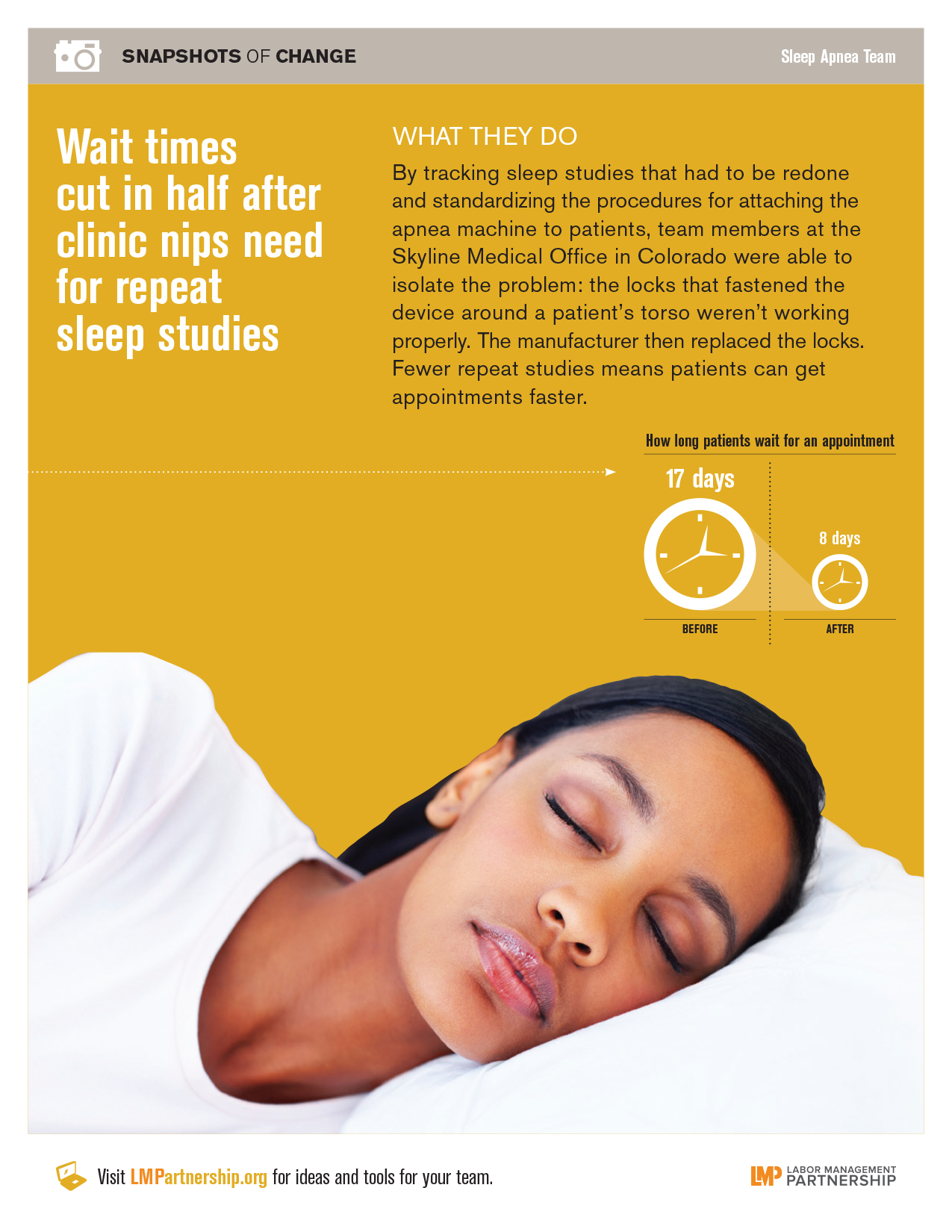
Poster: Sleep Clinic Uncovers Cause of Repeat Studies

Format:
PDF (color and black and white)

Size:
8.5" x 11"

Intended audience:
Frontline employees, managers and physicians

Best used:
This poster, for use on bulletin boards, in break rooms and other staff areas, spotlights a team that cut wait times in half by nipping the need for repeat studies.

Related tools:

TOOLS

Poster: Errors Drop With Pre-Op Double up

Format:
PDF (color and black and white)

Size:
8.5" x 11"

Intended audience:
Frontline employees, managers and physicians

Best used:
This poster, highlighting a team that reduced errors by having two nurses check antibiotic orders, can be placed on bulletin boards, in break rooms and in other staff areas.

Related tools:

Videos

Huddle Power

Loading the player...

(4:45)

Successful unit-based teams, those that continuously improve performance and lead change, use huddles to share information and stay on top of team business. This video highlights two KP teams that regularly huddle to tackle day-to-day issues, advance performance improvement projects and give "snaps" to colleagues who go the extra mile. See how huddles and snapping have helped these teams improve communication, morale and best of all—patient care.


TOOLS

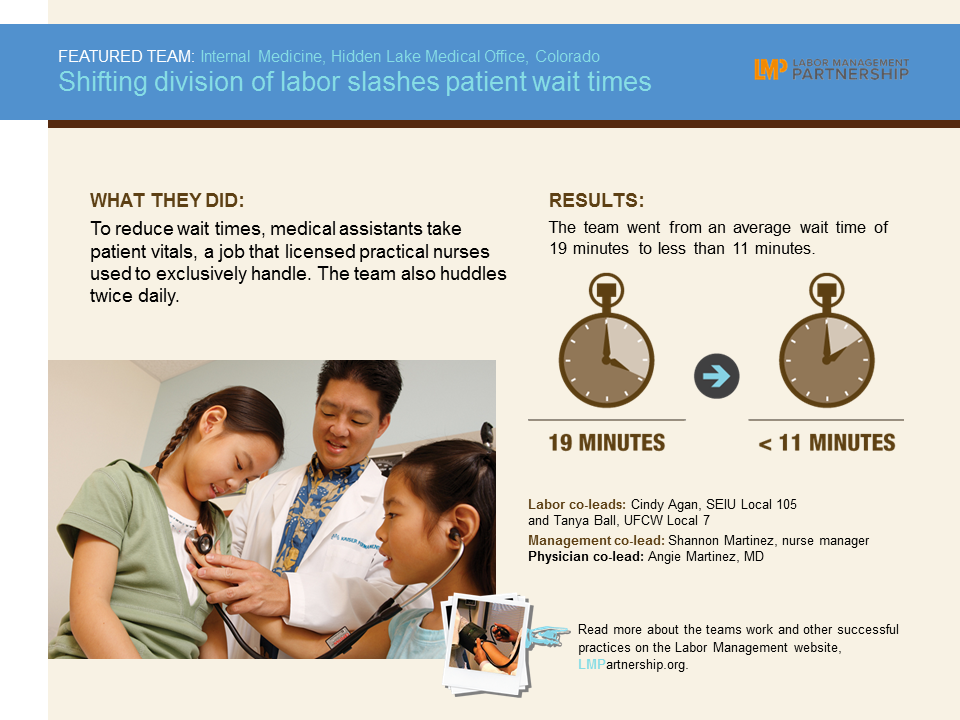
Colorado UBT Reduces Wait Times

Format:
PowerPoint slide

Size:
8.5" x 11"

Intended audience:
Frontline teams

Best used:
Include this one-page slide in UBT meetings presentations and huddles as an example of how to reduce patient wait times.

Related tools:

TOOLS

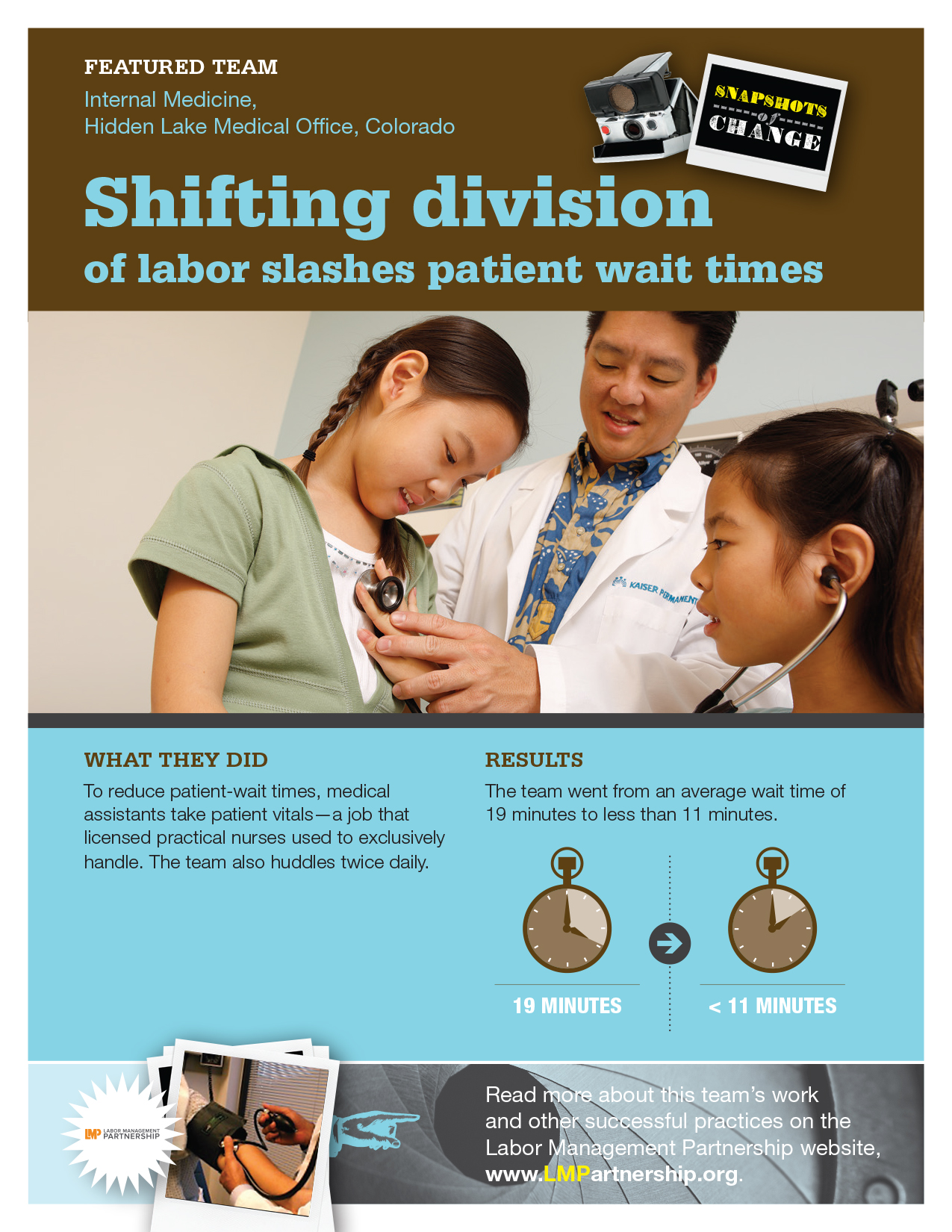
Poster: Slashing Patient Wait Times

Format:
PDF (color and black and white)

Size:
8.5" x 11"

Intended audience:
Frontline employees, managers and physicians

Best used:
Share this poster highlighting a team that reduced patient wait times by having medical assistants take patient vitals on bulletin boards, in break rooms and other staff areas.

Related tools:

Cracking the Case of the Missing Lab Orders

Deck: 
Enforcing the law of the lab improves workflow

Patients and specimen samples showing up without orders was a common occurrence at the East Denver Medical Office lab.

In some cases, orders weren’t in the system because there was confusion between the provider and the nurse about who ordered the test. Other times, patients were directed to the lab without verification of a lab order; and orders simply expired.

This lack of follow-through was inconvenient for the patient, who would have to go back to his or her doctor, or wait for a lab employee to contact the department. In some cases, the patient would have to make a second trip.

So, the East Denver team decided to crack down and got a little creative.

They developed an “enforcement” theme and dressed up in police uniforms to issue citations to “violators” as they tracked patients with no orders.

Departments with the most improvement were honored with coffee and donuts. Those that met the criteria for sustained success were recognized with lunch.

OB/GYN went from 42 “violations” in a seven-week period to 34 in a 10-week period. Pediatrics went from 16 occurrences to a single one in similar time frames.

“At first, we didn’t give them (other departments) the specific data,” lab clinical manager Lucy Tyler says. “Then OB asked for it so we started giving it to everyone.”

The team found by tracking the data, they discovered who needed help, and they worked with that team to solve the problem. By showing each department when they were sending patients and specimens to the lab without orders, they could see they were part of the problem.

In some cases it was a surprise.

“This work supports X-ray and pharmacy, too,” phlebotomist Alma Lahti says. “It’s improving orders in other departments.”

TOOLS

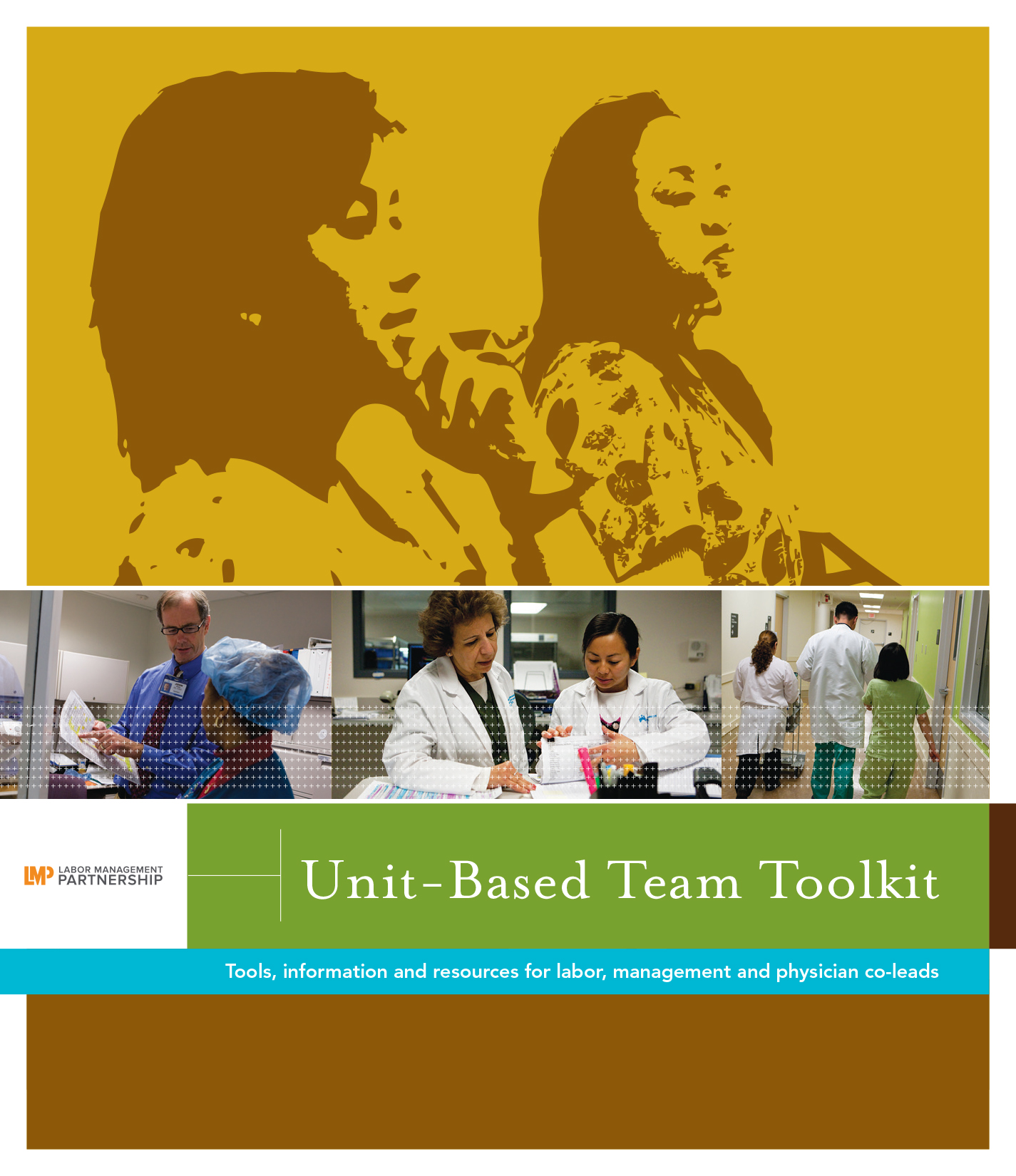
Unit-Based Team Toolkit (complete version)

Format:
PDF

Size:
138 pages, 8.5" x 11"

Intended audience:
Unit-based team members and co-leads, frontline managers, workers and physicians

Best used: 
To help UBT co-leads learn how to engage their team in performance improvement. Includes topics on communication, coaching and working with your sponsor.

Related tools:

Young Asthma Patients Need to Refill Their Meds

Deck: 
A call and a nudge helps kids stay out of ER

Colorado’s asthma care coordinators discovered that children were refilling their medications at the lowest rate in the region. The group works alongside physicians and staff to provide education and outreach to Kaiser Permanente members with asthma or chronic obstructive pulmonary disease.

Inhaled corticosteroids help control asthma by reducing inflammation and mucus production. Asthmatics who use the meds daily experience fewer attacks, use their emergency medicine less and make fewer visits to the emergency room.

There are some common threads among patients, who don’t refill their prescriptions. These include the costliness of inhalers, the fact some patients are reluctant to take a steroid, and often patients stop medication when they start to feel better.

“It took us a while to identify the most important thing our UBT could do,” said Cindy Lamb, RN, an asthma care coordinator and member of UFCW Local 7. “It was definitely a learning process.”

So, the asthma coordinators decided to improve the refill rate through an outreach program and targeted members ages 5-17. They made phone calls to five members a week who had not refilled their prescriptions in more than four months. As part of the discussion they included talking points about the benefits of inhaled corticosteroids. They used trackers and scoreboards to monitor the outreach and keep everyone informed.

The seven asthma care coordinators were spread throughout the region, so they held weekly phone huddles to share progress and best practices. They highlighted the convenience of the mail order pharmacy, and provided members with prescription refill numbers as well as the telephone number to the pharmacy. This information helped patients refill their medications more promptly.

The team also had communicated regularly with pediatric physicians and other staff by phone, conversations, meetings, and email.

None of it happened overnight, but the team discovered the collaborative effort really helped the process. In all, they reached 1,100 patients.

“Give the process the time it needs,” said Asthma Care Coordination manager Leah Brines. “Resist the temptation to come up with solutions for the team and instead, guide the conversation, and encourage participation and discovery. The team, given the time and confidence, will find the solution.”

Pages

Subscribe to RSS - Colorado