Colorado

Help Video

How to Find UBT Basics on the LMP Website

Learn how to use the LMP website:

LMP Website Overview

Learn how to use the LMP website:

How to Find How-To Guides

This short animated video explains how to find and use our powerful how-to guides

Learn how to use the LMP website:

How to Find and Use Team-Tested Practices

Does your team want to improve service? Or clinical quality? If you don't know where to start, check out the team-tested practices on the LMP website. This short video shows you how. 

Learn how to use the LMP website:

How to Use the Search Function on the LMP Website

Having trouble using the search function? Check out this short video to help you search like a pro!

Learn how to use the LMP website:

How to Find the Tools on the LMP Website

Need to find a checklist, template or puzzle? Don't know where to start? Check out this short video to find the tools you need on the LMP website with just a few clicks. 

Learn how to use the LMP website:

TOOLS

PPT: Primary Care UBT Gives Patient Gift of Time

Format:
PPT

Size:
1 Slide

Intended audience:
LMP employees, UBT consultants, improvement advisers

Best used:
This PowerPoint slide features a Colorado Primary Care team and a Northwest Regional Infusion Center that has given the gift of time by implementing a faster way of administrating medication used to treat rheumatoid arthritis. Use in presentations to show some of the methods used and the measurable results being achieved by unit-based teams across Kaiser Permanente. 

Related tools:

'One and Done'—It's the Super UBT

Deck: 
Faster than a speeding billing question, more powerful than a local center, able to resolve member needs in a single call!

Story body part 1: 

The dread is familiar: You have a question or a problem, and you need to call a service center to get the matter cleared up. Will the issue be fixed quickly? Or will the call be transferred from one person to the next—to the next—to the next?

As the second open enrollment period under the Affordable Care Act approached, Kaiser Permanente’s Customer & Member Services team knew that it didn’t want the thousands of new members joining KP to have that sort of frustrating experience. Just the year before, C&MS’ Member Service Contact Centers (MSCC) had been swamped by three times as many calls as expected. That had led to many handoffs to Membership Administration, which works with the MSCC customer service representatives to get questions answered. 

And so the first-ever “super unit-based team” sprang into action in September 2014. Its mission: To combat long wait times and better handle the anticipated surge in calls that would come with open enrollment.

What made it “super” was that it transcended locations and time zones, bringing together on a single team representatives from across the country—from the MSCCs in Denver, Colorado; Fulton, Maryland; and Corona, California, and from Membership Administration in Denver and San Diego. In the past, an individual UBT at one of the centers might develop a good practice, but it was left largely to chance that other centers would learn of it and follow suit. But under the umbrella of the Open Enrollment 2015 Readiness Initiative, 29 frontline and managers, supported by regional and national leaders, took a fresh approach to testing initiatives and spreading best practices.

Unifying approach

The combined team helps everyone operate as one team instead of separate entities, says Deashimikia Williams, a customer service representative at MSCC-Fulton and an OPEIU Local 2 member.

The collaborative effort was important because members don’t distinguish between different centers or different divisions. “They see us as One KP,” says Marie Monrad, vice president of strategy and operations for the Office of Labor Management Partnership, “and with this, we are doing performance improvement as One KP.”

The Super UBT’s biggest success so far is known as “one and done”—meaning that the member’s question is taken care of by the representative who picks up the phone. Before, a member’s request to stop an online payment, for example, might have taken up to a half-dozen calls. But with the introduction of the one and done process, the MSCCs were able to reduce the number of handoffs by 60 percent from January 2014 to January 2015.

The secret to success was looking to the customer service representatives for answers, says Jerry Coy, senior vice president of Customer & Member Services. “We asked the people who actually take the calls, ‘What questions are members asking?’ and ‘What would make your job easier?’” he says. “We are the front door to KP. We welcome the members and want them to be a member for life.”

“All of this work is in line with the Labor Management Partnership’s commitment to grow and maintain membership for KP,” notes Janelle Williams, consultant specialist for frontline engagement and growth. 

Answering calls from all over

The call centers that participate in the Super UBT answer the majority of KP member calls from the entire organization, fielding questions on a range of topics from billing to details of the health plan to helping members who haven’t received their membership cards.

Super UBT members received additional education and created a rapid resolution team within Membership Administration. While the representative stays on the phone with the member, he or she can consult with specialists via Lotus Notes SameTime chats or by opening another line. From mid-January through early March, the MSCCS handled nearly 5,400 calls—and more than 5,000 of them were successful rapid resolution calls, with the members helped in a single interaction. In addition, through staffing changes, operational improvements, and the implementation of the rapid resolution team, Membership Administration has reduced mean processing time for member issues from 26 days in January 2014 to three days in January 2015.

While Kaiser Permanente members benefit from the work, the frontline staff members benefit, too.

“We have a better understanding about the changes in different regions,” says Deashimikia Williams, who is the Fulton UBT’s labor co-lead. “Before the Super UBT, it was hard to get everybody engaged. Being engulfed in this work motivated us.”

LaDondra Hancock, senior account administration representative for Membership Administration in San Diego, also says the initiatives started by the Super UBT have improved the way she and her teammates work. “It has lessened the calls we get in from the different Member Services Contact Centers,” says Hancock, who serves as her local team’s labor co-lead and is a member of OPEIU Local 30.

Model practices

The success of this collective effort provides a model for other teams and departments looking to share and spread best practices, and underscores the importance of reaching out to other teams doing the same or similar work.

“Not only is this work of the Super UBT critically important for improving the member experience,” Monrad says, “but it also shows that it is critically important to test, model and explore new ways to bring improvement through our partnership that cuts across not only multiple regions, but multiple unions and multiple functions.”

Teams Collaborate to Ease Growing Workload

Deck: 
Two lab teams found a way to meet increased demand

Story body part 1: 

The Molecular and Cytology Lab unit-based teams in Stapleton, Colorado, were facing a challenging trifecta. Increased membership, changes in guidelines from the Centers for Disease Control and Prevention (CDC) and slow work processes made it tough to quickly process two widely used tests.

Membership in the Colorado region has grown by more than 60,000 members since 2013 in part because of the Affordable Care Act. Total membership in the region is now at its highest ever, with more than 600,000 members. The influx of new members is a strain on the system, and teams are digging in deeply to meet those members’ needs, from the first point of contact in the medical office to the last encounter as they pick up their prescriptions on the way out.

The lab teams are feeling the pressure, too—especially since they also process samples for the Georgia region, which is expected to grow, and they still do some work for facilities in the former Ohio region, which was sold to another health plan last year.

“We knew there would be an increase in the number of tests we would be doing. We also knew that our process was very labor intensive,” says Roxanne Whitesides, the Molecular and Specialty Testing manager. “Already this year, we’ve increased our workload 10 percent because of an increase in membership.”

Preventive care approach

The screens in question are for the human papillomavirus (HPV) and the Papanicolaou (Pap) test. Both detect disease at an early stage when treatment is highly effective, and so are central to Kaiser Permanente’s preventive care approach. As of June this year, the Molecular and Cytology teams—each of which has a role in processing the screens—already had processed 23,300 Pap screens and 16,800 HPV screens.

Meanwhile, CDC guidelines on HPV were revised in recent years and now recommend that women age 30 to 64 have an HPV screening and that girls as young as 11 receive the vaccine. The agency says HPV is the most common sexually transmitted infection in the United States. Some strains can cause cancer, and the CDC says about 21,000 of the HPV-related cancers each year could be prevented by the vaccine.

Because of the changed recommendations, even before the enrollment jump, the labs were seeing an increase in the number of HPV screens they processed. In 2012, the labs processed 650 HPV screens a month. By this spring, the monthly average had more than quadrupled: the average for March, April and May 2014 was 2,800 per month. In May alone, 3,354 samples were processed.

Labor-intensive processes

The final hurdle the teams faced was that their processes were labor intensive, requiring significant hands-on time from the technician. There was frequent back and forth between the Cytology and Molecular departments, which caused delays and interruptions. The complex work processes added to the pressure of the growing workload and caused frustration and tension.

The teams began an intensive study of what other labs were doing, including researching the latest technology. They visited other sites and vendors and decided to go with a cutting-edge Roche instrument. The pathologists—who work closely with the labs—supported getting the new equipment, and the lease was fast-tracked for installation. The instrument was in place within two months.

At that point, the teams set to work to figure out how their processes would change with the new equipment.

Cross-training provides insights

“We trained each other on the new equipment and on the processes within the two departments,” said Luann Martin, a cytology technologist, UFCW Local 7 member and co-lead of the Cytology unit-based team. “I could appreciate things going on in both departments.”

The collaboration between the Molecular and Cytology departments enabled them to improve their work processes and interactions—and ensured that as one problem was fixed, another wasn’t created.

“It’s important to keep talking. People have different expectations and comfort levels,” says Beth Fisher, a medical technologist, UFCW Local 7 member and co-lead of the Molecular UBT. “Be patient with one another,” says Melissa Baca, a cytologist lab assistant, SEIU Local 105 member and union co-lead of the Cytology UBT.

Most important, Fisher says, the new equipment is enabling the teams to meet the growing demand.

“The big payoff is that we're able to process all those HPV samples in less than half the time it used to take, so we've been able to absorb the workload increase with no new staff,” she says. “And we're able to identify the HPV strains that are most linked with cervical cancer as part of the initial screening. That saves money, because we don't have to send out all the positives for additional testing.”

TOOLS

Total Health Presentation—Rock Creek (Colorado)

Format:
PDF

Size:
"12-slide deck"

Intended audience:
Total Health champions; UBT sponsors, consultants and co-leads

Best used:
A UBT from the Rock Creek lab in Colorado, which gave this presentation at the Total Health virtual fair. Use to review information about this team's success in meeting Total Health goals and adapt to your team.

Related tools:

Simple Tool Helps Teams Track Savings

Deck: 
Using this spreadsheet enabled a pharmacy team to see it saved three times more than expected

Story body part 1: 

As more and more unit-based teams answer the call to improve affordability for health plan members, they are finding new tools that can help manage their cost-improvement projects.

One such tool, a handy spreadsheet, can help teams track and report their cost savings.

Teams track own savings

Developed by UBT consultants and financial analysts in Colorado and later adopted by UBTs in the Northwest, the tool can help teams determine the economic benefits of a performance improvement project with little or no assistance from a consultant or sponsor.

“It’s a great add-on to teams’ reporting in UBT Tracker,” says Luanne Petricich, chief pharmacist, Pharmacy Professional Affairs, in Colorado and a sponsor of 12 UBTs in the region. “It can be a very impactful way for co-leads to show their teams and others what their savings were and how they achieved them.”

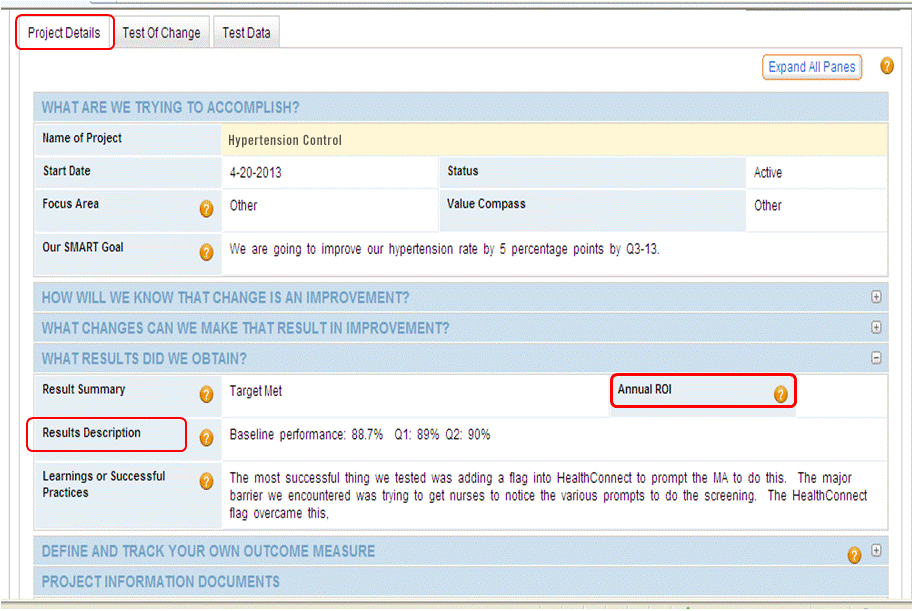
In addition, teams can now record their financial results directly into UBT Tracker thanks to a new data field, Annual ROI, that allows teams to share how much money a project saved or generated. The field can be found under the Project Details tab (see graphic below).

Tool use spreads

Petricich sends the spreadsheet to any of her teams working on a cost-reduction or efficiency project to help them document their results.

One team that used the tool was the pharmacy UBT at Baseline Medical Offices in Boulder. The team had completed an inventory-reduction project that far surpassed its goal—which was to reduce its drug inventory by 10 percent, or $50,000, in three months. By adjusting order quantities to better match usage and returning overstocked medication to the mail order pharmacy for use before the expiration date, the team saved $143,000—nearly three times its original goal.

“It’s important to track your results, and this tool can help teams do that in a simple way,” says Don Larson, Baseline’s pharmacy supervisor. “It’s something we would use the next time we do a similar project.”

Talking About Safety Reduces Injuries

Deck: 
Wheatridge Medical Office spreads safety

Story body part 1: 

For at least one Colorado facility, workplace safety started with awareness. And building awareness was a team effort.

Wheatridge Medical Office, with about 140 employees, had three workplace injuries in the first half of 2013. The Wheatridge Safety team, representing departments across the facility, agreed that was unacceptable. But team members weren’t sure where to start, and the team lacked a management representative, making it hard to find time or resources to implement ideas.

That changed when Jeanne Kraft, RN, nurse manager for Internal Medicine, joined the safety team. The team adopted two ideas that had worked elsewhere. One was to host a safety fair, following a tried-and-true format: People visited several booths where they got information and answers to a quiz on basic safety practices. Everyone who completed the quiz then got a ticket for a barbecue lunch on the patio.

TOOLS

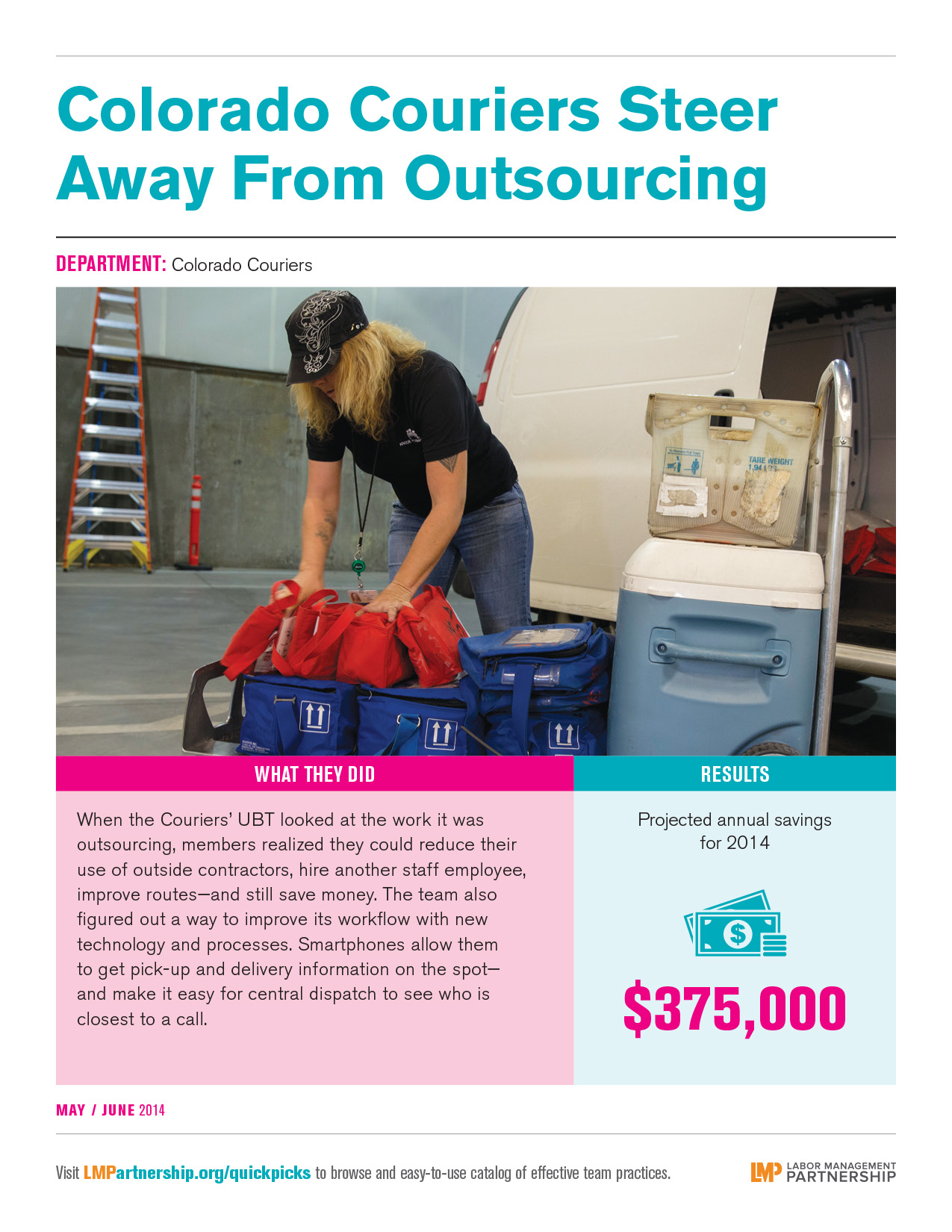
Poster: Colorado Couriers Steer Away from Outsourcing

Format:
PDF

Size:
8.5” x 11”

Intended audience:
Frontline employees, managers and physicians

Best used:
Show your staff these money-saving tips to improve workflows, upgrade technology and increase revenue. 

Related tools:

Reduce Outsourcing and Bring Courier Jobs in House

Deck: 
UBT saves big after objecting to outside contractors

Story body part 1: 

The Colorado Couriers team is busy with 41 Kaiser Permanente facilities, more than 400 non-KP locations, and about 180,000 pickups and deliveries a year.

When it comes to outside contractors, the SEIU Local 105 contract requires that Human Resources provide the union with specific information about outsourcing, including who is doing the work, the affected job classification, the number of hours involved and what facilities were impacted.

That information wasn’t being provided, so Dominic Jones, a courier driver and Local 105 steward, objected.

“I saw that we were contracting out regular courier service, and it didn’t make any sense,” Jones says. “I knew that it was costing the company more money.”

As a result, the unit-based team took a close look at the department’s processes.

Team members collaborated with couriers in Northern California, who had done similar work, and discovered they could hire another employee, improve routes, reduce use of outside contractors—and still save money.

First steps were to work with internal customers to assess their needs, then reconfigure and bring routes in-house that had been contracted out.

They hired an additional employee to reduce overtime and outside courier costs on the weekends, and purchased new technology for central dispatching that enabled better tracking of pickups and deliveries.

Drivers got smartphones to receive information in real time, which made it possible to monitor drivers’ locations using GPS and find the closest driver for an unscheduled pickup.

In addition to new technology, the team worked with the region’s labs to ensure pickup times met the lab workflow.

“I am very supportive of the work our unit-based team has accomplished,” says Jones, who feels his concerns were addressed by the changes. “We are still outsourcing stat work that we can’t get to, but we are in the process of hiring on-call drivers, which will ease that burden.”

The team exceeded its stretch goal and saved an average of $25,577 a month, a cost reduction of 48.2 percent. By the end of 2013, the team’s effort had resulted in a cost savings of $145,165, and projected a savings of more than $375,000 for the following year.

“We had many painful conversations about how to make this work,” says manager Terry Wagner. “But the team’s input was invaluable. Each individual has been a contributor at some point.”

For more about this team's work to share with your team and spark performance improvement ideas, download a poster.


Staff Directory

Full Directory
Simone Zimmer

Title: 
Director, National Growth and Attendance

Business Entity: 
Alliance of Health Care Unions

Email: 
Simone.Zimmer [at] ahcunions.org

From Frenzied to Focused

Deck: 
How UBT supporters are helping teams sort out competing priorities and demands

Story body part 1: 

Improve service scores. Reduce waste. Retain members. Gain new members. Cut wait times. Work safer. Perfect patient safety. Innovate care.

Teams are juggling constantly, trying to meet their own objectives, move forward on initiatives related to facility, regional and national goals, and comply with regulatory requirements—all in a competitive economic environment.

When the curve ball comes sliding in, it can be one thing too many, derailing a strong team or keeping a struggling team at ground level. So a host of unit-based team supporters are turning their attention to strategies to help unit-based teams prioritize competing demands—from personalized mentoring to intensive workshops for co-leads.

“I see my role as taking away the noise and the chaos…to help them figure out, ‘Realistically, how many things can we work on at once?’” says Denise Johnson, San Jose Medical Center continuum of care administrator and a UBT sponsor. “I have to help them not be crazy, because we don’t want a lot of projects that don’t make a difference.”

Here are four strategies for helping teams.

Strategy #1: Planning pays off

Every year, labor and management sponsors at the San Jose Medical Center sit down with their UBT co-leads to develop an operating plan. The plan flows from Kaiser Permanente’s organizational goals as well as from regional goals, facility priorities, and the needs of the department. Each sit-down includes the service area’s UBT consultant and its union partnership representative. Projects emerge naturally from that plan, with teams turning to the Value Compass and a tool called a PICK chart to fine-tune their priorities.

“They have to figure out what’s in their sphere of influence,” says Eric Abbott, the area’s union partnership representative. “What are the things they can change, and of those things, how much time do they have?”

When Johnson became sponsor of one San Jose team, it was immediately clear to her the UBT had too much on its plate. She worked with the team to winnow eight projects down to two.

“In my experience, people get bogged down with the to-do list and sometimes don’t stop and think about what’s really on that list and what effort does it serve,” she says. “They thought I was crazy. They came from a mentality where ‘more is better.’”

Strategy #2: Urgency can be a tool

Two years ago, San Diego’s interventional anesthesia unit-based team was humming along in its performance improvement work when it got hit with the news that co-pays for patients who suffer from chronic pain would be increasing sharply.

The 14-member team responded with a new service project, a multiphase communication plan to help members understand the new co-pay and their options. And then the next wave broke: The team learned it had a matter of days to move into a new specialty services building. It suspended the co-pay project to plan for and complete the move.

One key performance improvement tool—a process map—proved instrumental. The team created a detailed map that laid out every piece of work that needed to be done in preparation for the transition, from changing procedures to adapting to a new phone system to altering workflows based on the new floor plan.

“They simply became a single-issue team,” says their UBT consultant, Sylvia Wallace, of the 2011 move.

With the process map in hand, the team spotted an opportunity to weave communication about the new co-pays together with communication about the move. As a result, it didn’t miss a beat in providing its members with critical information about available financial assistance.

The comprehensive plan helped the unit’s service scores hold steady through the transition—and then increase at the new facility. The moving plan became a template for other departments, which are still moving into the Garfield Specialty Center.

“Everyone participated. All types of ideas were solicited and implemented,” says Grace Francisco, the assistant department administrator and the management co-lead at the time. “Everyone has a role and accountability for each step.”

Strategy #3: Take time to train

Teams stand a better chance of weathering competing demands when they have a solid understanding of partnership principles and processes as well as performance improvement tools and methods.

In Colorado, the UBT consultants used LMP Innovation grant funds to host a two-day workshop centered on two regional priorities. Co-lead pairs from throughout the region learned how best to serve new members and improve the affordability of KP care by reducing waste and inefficient practices. They walked away with a variety of team improvement tools and resources.

“We are trying to set the teams up to be successful by giving them the time to focus on topics that could have a huge impact in the region in the next few years,” says Linda Focht, a UBT consultant and UFCW Local 7 member.

In San Diego, regular UBT summits bring co-leads together for intensive sessions on given topics. Service area and local union leaders play a major role in structuring the agenda, so the team development matches up with high-level strategy. The joint planning creates a full picture, one that resonates better at the front line and sets up teams to work on projects that make a difference to KP’s reputation.

“Leaders see a lot more than what we see,” says Jenny Button, director of Business Strategy and Performance Improvement in San Diego. “Leaders see what is going on with the competition. They see across all of the different metrics we are working toward. They see at a broad level where our biggest gaps are.”

Strategy #4: One-on-one attention counts

At San Jose Medical Center, sponsors like Johnson and Hollie Parker-Winzenread, an assistant medical group administrator, are coaching UBTs one on one in performance improvement tools to help them set priorities.

 “Teams like to jump to the solution,” says Parker-Winzenread. “But they struggle with the process….The gain falls apart, because the process is not strong.”

San Jose’s clinical laboratory UBT is a success story, jumping from a Level 1 to a Level 4 in less than a year after new co-leads worked together to reach joint agreement on the department’s priorities. The team started with tests of change that made strides in attendance. Today, it has moved on to complex projects that require shifting schedules to accommodate demands for getting lab results earlier in the day.

Guidance from their sponsors has helped keep team members on track.

“We’d come up with all of these ideas and projects, and they made suggestions and really helped prioritize what we worked on so we didn’t bite off more than we could chew,” says Antoinette Sandez, a phlebotomist, the team’s union co-lead and an SEIU UHW member.

“You have to help teams to believe in the process,” Johnson says. “As a sponsor I can’t rush the process and say harder, faster, move, move, move. That won’t get us what we want in the long run. Because we’re looking for sustainability.”

Pages

Subscribe to RSS - Colorado