
Program-wide

Help Video

How to Find UBT Basics on the LMP Website

Learn how to use the LMP website:

LMP Website Overview

Learn how to use the LMP website:

How to Find How-To Guides

This short animated video explains how to find and use our powerful how-to guides

Learn how to use the LMP website:

How to Find and Use Team-Tested Practices

Does your team want to improve service? Or clinical quality? If you don't know where to start, check out the team-tested practices on the LMP website. This short video shows you how. 

Learn how to use the LMP website:

How to Use the Search Function on the LMP Website

Having trouble using the search function? Check out this short video to help you search like a pro!

Learn how to use the LMP website:

How to Find the Tools on the LMP Website

Need to find a checklist, template or puzzle? Don't know where to start? Check out this short video to find the tools you need on the LMP website with just a few clicks. 

Learn how to use the LMP website:

Tips for Improving Health Screenings

Deck: 
Identifying health risks is essential to Kaiser Permanente's mission

Story body part 1: 

Screenings for such diseases as colorectal and breast cancers, high blood pressure, diabetes and obesity help us proactively identify identifying health risks and early signs of disease Here are some ways everyone can help ensure our members stay as healthy as possible.

  1. During a visit, print out and review with the patient any screening gaps that are identified on his or her Proactive Office Visit summary.
  2. Use KP HealthConnect™ and/or panel management tools to identify and reach out to members who are due for a screening to check for high blood pressure or such diseases as colorectal or breast cancer.
  3. Have receptionists keep an eye out for age- and risk-appropriate members during office visits and target them for follow up by care providers.
  4. Create outreach scripting that personalizes the importance of preventive screenings.
  5. Designate a staff member to contact members who received at-home fecal immunochemical tests (known as FIT kits), to remind them to return them.
  6. Capture patients’ attention by posting or mailing brightly colored literature that explains how a test detects early signs of disease and can be life-saving.
  7. Work with your local radiology department to identify the best days and times for same-day mammograms, so patients can get the scan without an appointment.
  8. Contact hypertensive patients at pharmacy pick-up counters for blood pressure checks and consultations.
  9. Have clinical assistants and/or medical assistants increase the number of outreach calls and blood pressure checks.
  10. Invite a regional or local expert in prevention and screening to meet with your team to discuss how best to support regional and local initiatives without duplicating efforts.
 

Tips for Greening Your Work Life

Deck: 
Ways to help the environment while saving money

Story body part 1: 

Unit-based teams can play a part in greening our environment and saving money. Involve your team in tests of change around recycling or reducing supply waste.

  1. Coordinate with other departments, such as EVS, materials management or procurement and supply, on green tests of change — or “embed” a member of one of these departments in your UBT.
  2. Work with your facility’s waste-hauling vendors to find out what types of materials and supplies can be recycled, and place recycling bins strategically in cafeterias and near exits.
  3. Cut down on costly, wasteful single-use medical devices or supplies as part of performance improvement efforts.
  4. EVS teams: Switch to environmentally friendly cleaning products and supplies.
  5. Invite your teammates to shop for locally sourced, organic fruits and vegetables at the nearest KP weekly farmer’s market.
  6. Host a monthly healthy salad bar, like the UBT at San Diego’s Positive Choice clinic did in its successful effort to improve attendance.
  7. Replace thirsty plants for drought-tolerant alternatives, as several teams in Northern and Southern California have done.
  8. Go paperless: Don’t print out agendas and documents; send them out via email or show on a projector instead.
  9. Recruit a champion in your department to be on the lookout for new opportunities and coach others on greening their workplace.


TOOLS

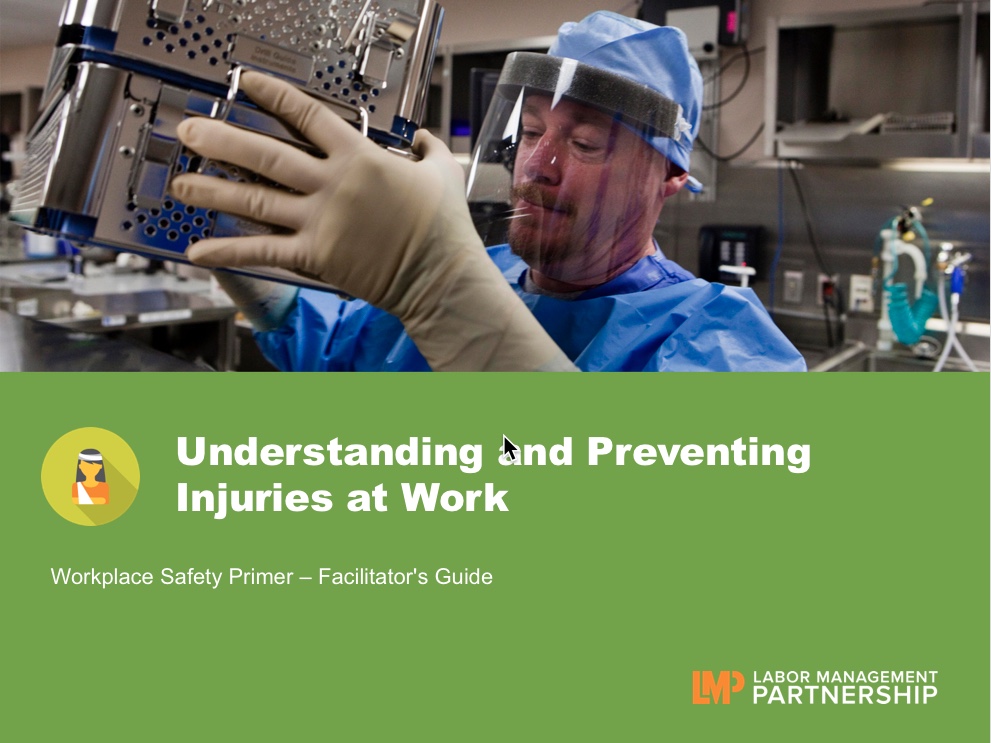
Workplace Safety Primer Facilitator's Guide

Format:
PowerPoint

Size:
24 pages, 8.5" x 11"

Intended audience:
Workplace safety co-leads, safety committee members, safety champions, and frontline workers and supervisors.

Best used:
This companion to the Workplace Safety Primer helps frontline leaders teach others key principles of workplace safety and accident prevention.

Related material:
Workplace Safety Primer


Related tools:

Tips for Flu Prevention

Deck: 
How to protect yourself and our members from this virus

Story body part 1: 

When flu season arrives, it’s important to stay well. As a matter of patient and workplace safety and professional pride, we can take steps to protect ourselves, our families, co-workers, and members and patients from flu and other infectious diseases. Here’s how. 

Vaccinate yourself and others

  • If you don’t get the flu, you won’t pass it on. The vaccine reduces the chance you will get the flu. Encourage others to get vaccinated, too.

Keep flu out of the air

  • Limit the time patients with suspected flu spend in open waiting rooms; separate them from others.
  • Offer surgical masks to people who are coughing or sneezing and encourage them to cover their coughs. Supply tissues, trash cans and hand sanitizer in waiting areas.
  • Place patients with flu in a private room.
  • Avoid unnecessary transport of infectious patients — and have them wear surgical masks outside their rooms.

Keep flu off of yourself. Follow standard and droplet precautions

  • Wear eye protection, gown and gloves.
  • Wear respiratory protection when in the room with the patient and until the air has cleared after the patient has left the room (about one hour), or if you are doing procedures that may aerosolize infectious particles.
  • Wash your hands often. Use hand sanitizer or wash with soap and water before and after all patient care.
  • Avoid touching your face, clothing or mask with your hands.

Keep the environment clean

  • Focus cleaning on high-contact surfaces: door knobs, elevator buttons, reception desks, exam tables, pharmacy furniture. 

Tips for Improving Copay Collection

Deck: 
Putting employees, patients at ease while keeping affordability in mind

Story body part 1: 

Keeping the affordability point on the Value Compass in mind, unit-based teams are taking a hard look at the obstacles to collecting copayments and conducting small tests of change around proposed improvements. New practices like these are generating hundreds of thousands of dollars in new revenue.

  1. Educate employees about the importance of copay collection.
  2. Train employees in how to ask for payment. Use role playing to help them become more comfortable with asking for payments, and create and distribute talking points or scripts.
  3. Provide visual reminders for members to check in at the front desk, so a receptionist can determine if a copayment is due.
  4. Post a sign with a telephone number directing patients with questions about co-payments and financial concerns to a financial counselor.
  5. Call patients a week in advance of a scheduled procedure to advise them a copay will be due and, if possible, to collect it before they are admitted.
  6. Add the copayment amount to patient’s outstanding balance and ask for the total amount. If balance is $100 or more, ask for payment on the account.
  7. Refer patients who can’t afford to pay to facility-based financial counselors.
  8. Station a full-time financial counselor in the Emergency Department.
  9. Make sure financial aid applications are processed promptly by having co-workers share the load. Report workload status at weekly huddles.
  10. Create a uniform note-taking system for financial forms and assign a counselor to every patient referred to financial services.


Tips for Improving Attendance

Deck: 
Being here for our patients and members

Story body part 1: 

Unit-based teams encourage employees to make wise use of the National Agreement's sick-leave provisions, which help ensure that individuals have income in the event of a long-term illness or disability. Absences can also create hardship on other employees and affect member service and care. Here are some tips for improving attendance in your department: 

  1. Survey your unit or department to determine if there’s confusion about the use of sick time. If needed, find ways to educate staff on sick leave, tardiness and clocking in and out.
  2. Create an “attendance star” board to recognize staff members with great attendance.
  3. Encourage colleagues to schedule routine appointments during off-hours or in conjunction with lunch or breaks when possible.
  4. Track call-outs and use anonymous surveys to test for reasons why they are occurring.
  5. Use cause-and-effect tools such as fishbone diagrams to address unforeseen circumstances, morale, physical environment, workload or personal reasons.
  6. Engage staff with frequent conversations and be alert for — and respond to — indications of unhappiness or tension.
  7. Recruit an attendance champion to be on the lookout for opportunities to coach others on the importance of banking sick leave.
  8. Help employees track sick-leave usage by printing out and distributing the attendance calendar.
  9. Use the attendance scorecard to learn about the six essentials of good attendance and to see how your team rates. Then  develop small tests of change to address the weak spots identified by the scorecard.

TOOLS

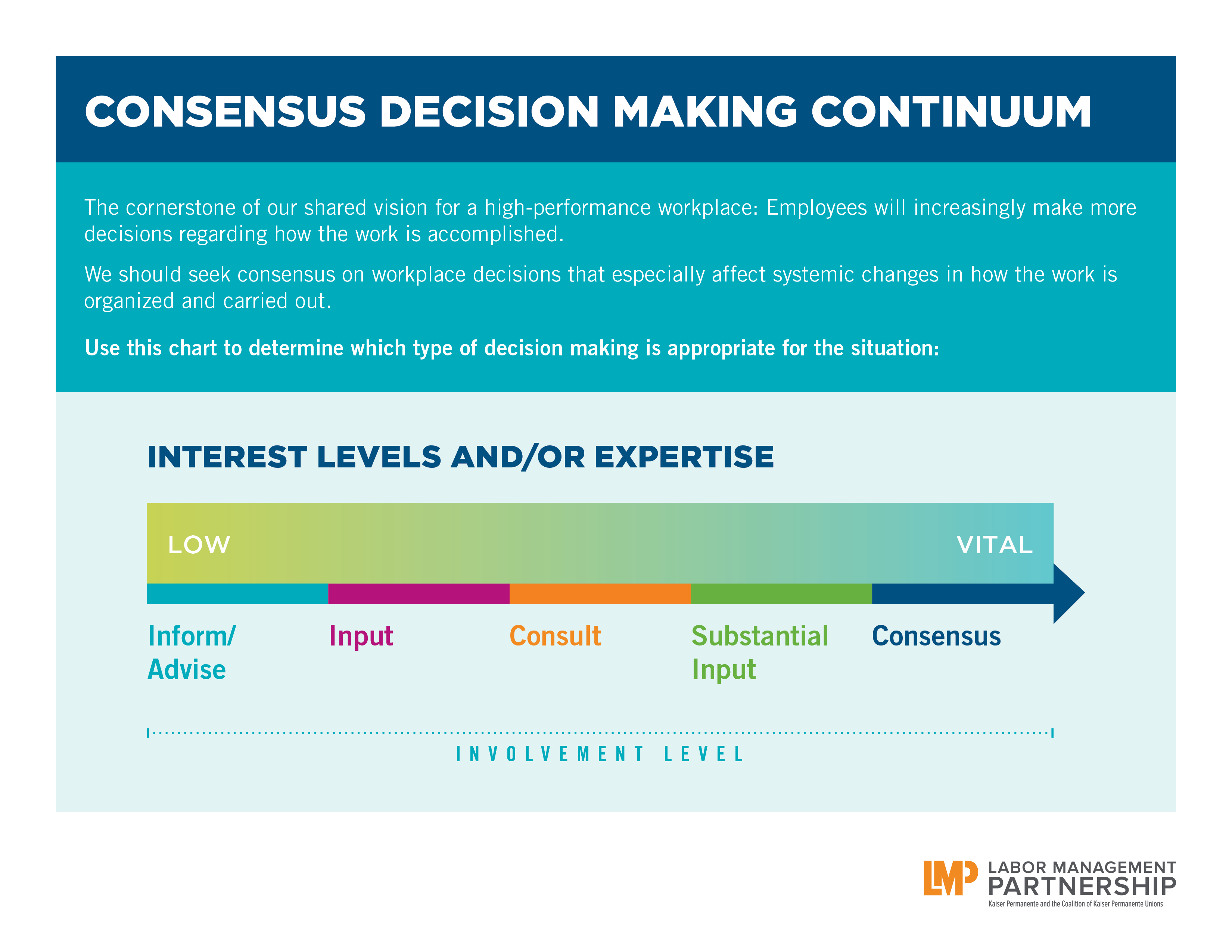
Consensus Decision Making Continuum

Format:
PDF and PPT slide

Size:
8.5" x 11"

Intended audience:
Leaders at any level who need to articulate what process will be used to make a decision. 

Best used:
Hand out at meetings or use in presentations when discussing consensus decision making and interest based problem solving. 

Related tools:

Meet Your National Agreement: Change Is Here, Be Prepared

Deck: 
As health care evolves, so do our skills

Story body part 1: 

In the early 2000s, Blockbuster ruled the video rental roost.

Now it’s all but gone.

Blockbuster didn’t adapt to customer needs and technology trends. Netflix did.

Kaiser Permanente and the Coalition of Kaiser Permanente Unions recognize that if you don’t change with the times, you can get left behind.

The National Agreement addresses the importance of preparing for the future in partnership; section 1D of the agreement covers workforce planning and development.

Under the 2015 agreement, two educational trusts — Ben Hudnall Memorial Trust and SEIU UHW-West & Joint Employer Education Fund — received additional funding to provide workers represented by a coalition union with a variety of services, and training and education programs. Joint work on addressing experience barriers, which have sometimes prevented newly trained workers from being hired into KP jobs, is also under way.

The agreement details the structure for coordinating workforce planning and development. A national team aligns, integrates and coordinates workforce development and training efforts in partnership with the regions. Each region has a workforce planning and development committee chaired by labor and management co-leads.

The five key components of this work are:

  • workforce planning and development
  • career development
  • education and training
  • redeployment
  • retention and recruitment

“The goal is to prepare union workers for changes to jobs,” says LeAnda Russell, the coalition’s national coordinator for job innovation. “We support the lifelong learning and career development of our workers.”

It’s paying off. Use of the educational trusts has increased to record levels.

Russell encourages employees to keep learning to build the job skills needed as health care evolves. In other words — don’t hit the rewind button. It’s time to press play.

“Technology is here,” Russell says. “Don’t be afraid.”


Navigating the Future

Story body part 1: 

For Carolina Aceves, technology and health care go hand in hand.

Shortly after completing a new online digital fluency course for Kaiser Permanente employees, she saw firsthand how technology can transform a life. Her mother needed a kidney transplant, but neither she nor her siblings were a match. In October 2017, however, in a series of matches orchestrated through a national computer system, she donated a kidney as part of a chain of donations that resulted in her mother receiving a kidney.

In December, she returned to work at the California Service Center in San Diego, where she is an account administrative representative, fielding calls from KP members and answering their questions. She also chairs a young leader council for OPEIU Local 30 — and is leveraging that role to mobilize all represented members of her unit-based team, urging colleagues of all ages to take the digital fluency course.

“Health care is changing,” Aceves says. “Be current. Do your homework. Advance your career.”

At ease with technology

Digital fluency is one of four critical skills that will be essential in the health care of the future. The new online program, which helps participants understand the role of technology in health care, is free to workers represented by a union in the Coalition of Kaiser Permanente Unions through the Ben Hudnall Memorial Trust, the SEIU UHW-West & Joint Employer Education Fund, and National Workforce Planning and Development.

The national workforce office also is developing programs for the other three critical skills — consumer focus, collaboration and process improvement — as part of a larger strategy to encourage employees to upgrade their skills, advance their careers and meet the changing demands of health care.

“Whether you work in a medical center, clinic or office, we encourage employees to take the digital fluency program,” says Monica Morris, the director of National Workforce Planning
and Development.

Digital fluency skills are good for workers, KP members and the organization, says Jessica Butz, the coalition’s national coordinator for Workforce Planning and Development. While some may fear technology will eliminate jobs, the push at KP is to use it not to replace workers but to enhance the care and service they deliver.

“Learning these critical skills will prepare our workers for jobs in the future and give them the tools to shape and improve care for our members and patients,” Butz says.

How Managers Can Support Career Development

Deck: 
5 tips to strengthen your team — and the organization

Story body part 1: 

One of a manager’s most important roles may not appear on the job description — but goes hand in hand with getting results.

“Managers have a key role in helping employees build successful careers,” says Maria Aldana, a career counselor with the SEIU UHW-West & Joint Employer Education Fund, one of two education trusts supported by the Labor Management Partnership between Kaiser Permanente and the Coalition of Kaiser Permanente Unions. “A great leader creates other leaders.”

Fortunately, Kaiser Permanente managers have many ways to support their employees’ development and ensure their department’s success. Here are five.

1. Have career conversations with employees. Talks can be brief and happen anytime and anywhere during the work day, not just during annual performance evaluations. Get tips at Kaiser Permanente’s leadership and management portal (sign-in required) and at Skillsoft @ KP (sign-in required), an on-demand, mobile-ready catalog of learning resources.

“We need to keep and grow our people so they are ready for the changes in health care,” says Beth Levin, a career counselor and outreach coordinator with the Ben Hudnall Memorial Trust, which serves all members of the Coalition of Kaiser Permanente Unions outside of SEIU UHW.

2. Know what resources are available. HRconnect and KP Learn have resources available for all KP employees, and the LMP website offers tips, tools and practices for individual and team development. Employees can learn about the four critical skills, explore career paths and access tuition reimbursement at kpcareerplanning.org.

The two education trusts offer courses at every level of development, many at no cost to employees, as well as career counseling, tuition assistance programs and more.

3. Work with career counselors. Education trust career counselors can tailor training, provide one-on-one career planning and coaching, and help with skill assessments.

For example, an indexing clerk manager in Colorado told Aldana how his employees needed more computer skills to keep doing their jobs effectively. She met with employees, discussed changes in their field, informed them of available resources and developed a plan that included onsite training.

4. Schedule time for employees to take classes. “Labor and management can come up with a schedule that works and we can offer the training,” Aldana says. “We usually can find vendors that come on site.”

5. Look for development opportunities for employees. Managers can suggest that an employee lead a huddle, serve on a committee, or become an active unit-based team participant or health and safety champion to “gain experience, build skills and network,” Levin says.

Building such engagement can get employees excited about change and encourage them to build their skills.

“When one person is successful, it inspires and motivates other people,” says Levin.

Pages

Subscribe to RSS - Program-wide