TOOLS
Southern California Attendance Program Standard
Format:
PDF
Size:
8.5"x11"
Intended audience:
Frontline employees, managers and teams
Best used:
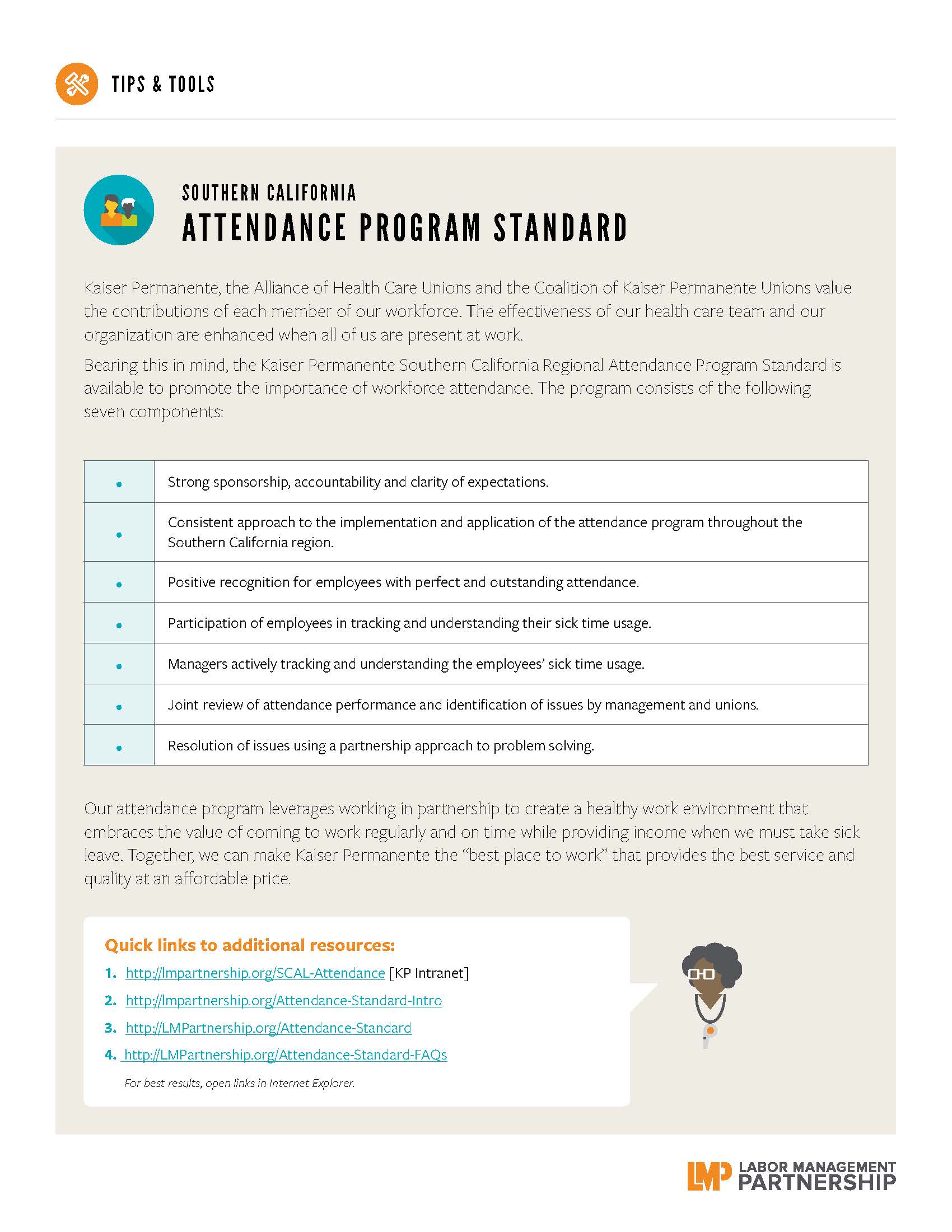
Use this tool to learn about the Southern California Attendance Program Standard.
This short animated video explains how to find and use our powerful how-to guides
Does your team want to improve service? Or clinical quality? If you don't know where to start, check out the team-tested practices on the LMP website. This short video shows you how.
Having trouble using the search function? Check out this short video to help you search like a pro!
Need to find a checklist, template or puzzle? Don't know where to start? Check out this short video to find the tools you need on the LMP website with just a few clicks.
Format:
PDF
Size:
8.5"x11"
Intended audience:
Frontline employees, managers and teams
Best used:
Use this tool to learn about the Southern California Attendance Program Standard.
Format:
PDF
Size:
Intended audience:
Frontline managers and unit-based team co-leads
Best used:
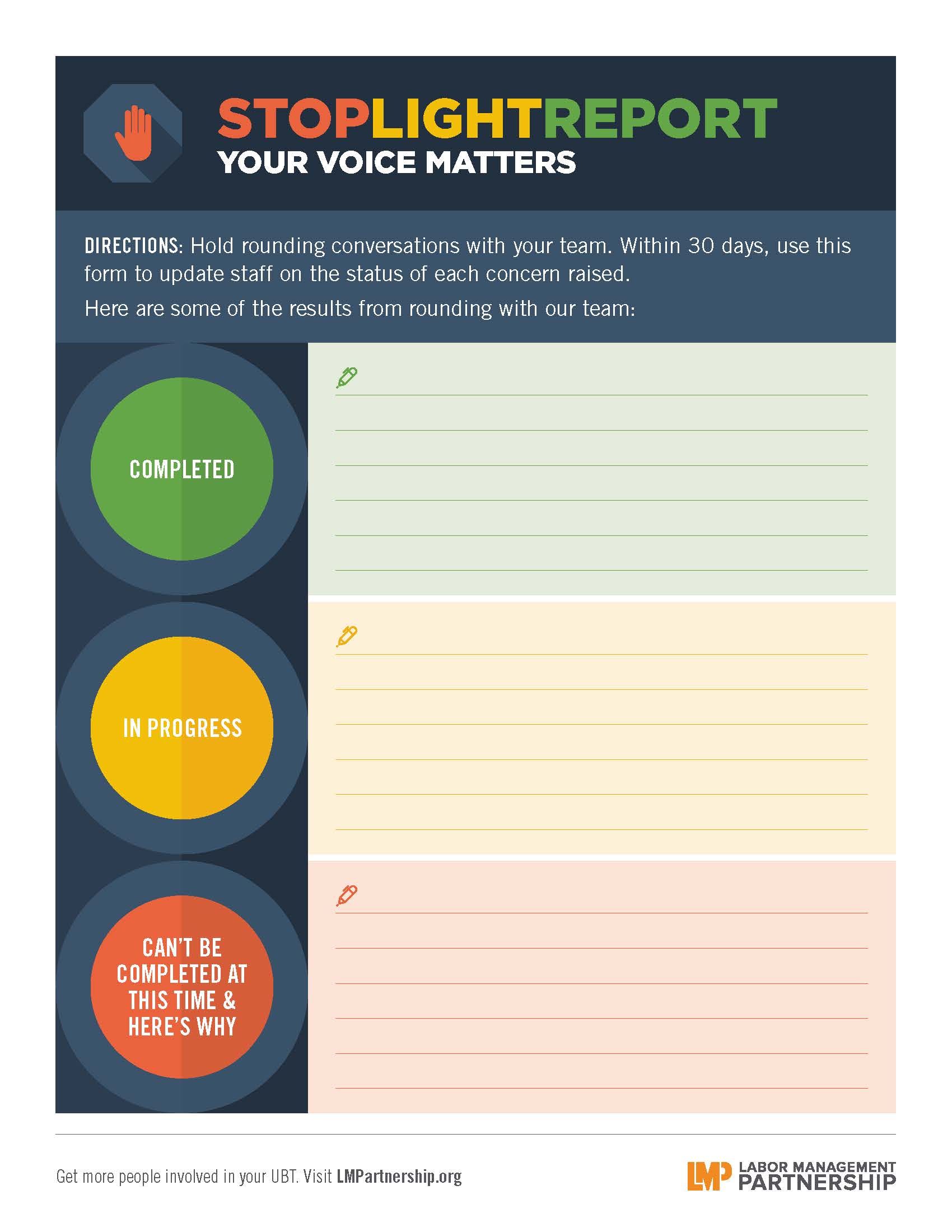
Use this visual aid to show team members the status of issues raised in rounding conversations; available in standard size and as a 24"x36" poster for large-format printers.
Alaine Lounsbury, RN, is proud of her nursing team at Downey Medical Center in Southern California. 4 West team members have worked together for decades, forming bonds that have led to high patient satisfaction rates and region-wide recognition.
Lounsbury, nursing assistant clinical director, attributes the team's success to rounding — the practice of engaging frontline workers in face-to-face conversations on the floor and listening to their concerns. Managers who round say it helps build a culture of engagement and dialogue, a key goal of the Labor Management Partnership between Kaiser Permanente and the Partnership unions.
“It’s about making a connection,” explains Lounsbury, who rounds quarterly on 90-plus staff members using Kaiser Permanente’s Rounding Plus online tool [KP Intranet]. “You want to hear the good with the bad.”
With the tool, managers can use their mobile device to identify, track and escalate issues surfaced during rounding conversations. Program-wide, nearly 10,000 leaders and managers use the program.
At Downey, nurses used rounding conversations to speak up about a workflow issue. Because 4 West is the only unit with nurses qualified to give chemotherapy to adults, it meant staff members sometimes had to leave their department to administer drugs to patients. Their frequent absences meant more work for others.
“I heard them in rounding say, ‘You need to figure this out,’” recalls Lounsbury. She and her team developed new protocols to enable others outside the unit to give the medication. “That was a big satisfier.”
To help her systematically follow up and act on her team’s questions and concerns, Lounsbury uses a colorful poster, called the Stoplight Report, that assigns green, yellow and red colors to track the status of issues.
The poster was conceived by Downey Quality Coordinator Suxian Hu, RN, based on the color-coded reports managers receive through the Rounding Plus program. Last year, all of Downey’s inpatient nursing units began using it.
In 4 West, the poster hangs prominently in the conference room, where everyone can see it.
“Staff members know something is being done,” says Donielle Tresvant, RN, a staff nurse and member of UNAC/UHCP, one of the unions in the Alliance of Health Care Unions. “They know they’re being heard.”
Nurses say the information shared on the poster also fosters team communication and collaboration. “It keeps us updated about things at work and it helps us improve our care by being focused,” says Brianna Schneider, RN, a member of UNAC/UHCP. “It makes for a cohesive atmosphere.”
Carol Fiskio takes pride in helping good employees move on.
As revenue cycle director for Kaiser Permanente’s Woodland Hills Medical Center, Fiskio has seen 3 of her department’s admitting clerks earn college degrees and advance to new positions.
Their formula: a desire to learn, flexible scheduling and a valuable employee benefit. Hers: supporting employees’ lifelong learning to make them, Kaiser Permanente and her department stronger players.
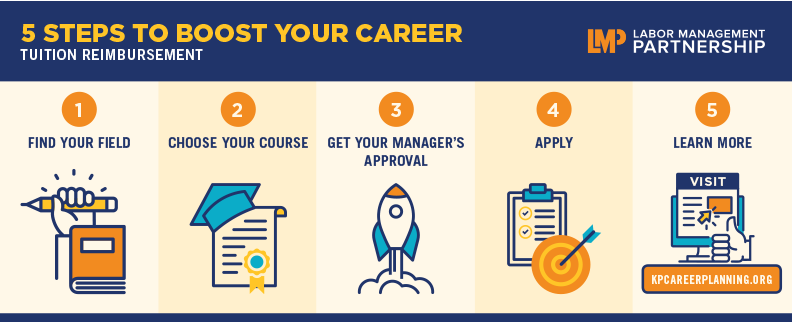
Kaiser Permanente encourages such learning, providing employees up to $3,000 each year for completing courses to continue their education, get a certificate or earn a degree. Tuition reimbursement course applications reached a record 73,224 in 2018, nearly doubling since 2015, when benefits increased for many employees after that year's Labor Management Partnership National Bargaining.
When Olayinka Rahman started as an admitting clerk at Woodland Hills Medical Center in 2007, she had a vision: to become a psychologist. She balanced working and going to school, using tuition reimbursement to earn bachelor’s (California State University, Northridge), master’s (Pepperdine University) and doctoral (Azusa Pacific University) degrees in psychology.
“I don’t think there would be a better place (than Kaiser Permanente) for me to get my degree and continue to work,” Rahman says. “They’re so supportive. I hear about other organizations that aren’t as flexible and don’t have tuition reimbursement.”
After a yearlong internship in Michigan, Rahman returned to Kaiser Permanente. She completed a postdoctoral psychology residency in San Francisco and now works as a psychological assistant in Antioch. She’s preparing for the licensing exams to become a staff psychologist.
Rahman encourages others to continue their education.
“It was definitely challenging but well worth it,” Rahman says. “Talk with your manager, and say, ‘How can we make this work?’ Open communication with management is key.”
Fiskio, who used tuition reimbursement herself to earn an MBA, praised Rahman and her other former direct reports for advancing their careers through education.
“It’s not easy to go to work and to school,” Fiskio says. “That takes real dedication. It’s a benefit to the organization.”
What can your team do to help employees feel safe speaking up?
(2:54)
A Food and Nutrition team creates an environment where employees feel free to voice their opinions and ideas—and can expect action to be taken on their input.
Produced by Sherry Crosby
Videography by Paul Erskine
Edited by Sherry Crosby and Kellie Applen
Beep! Beep! Beep! The electronic sound of Cary Brown’s alarm clock wakes him at 5 a.m.
The Kaiser Permanente member rises to shower and make breakfast, careful not to disturb his sleeping wife, Elissa, who is recovering at home after surgery on a broken leg at the Woodland Hills Medical Center in Southern California.
On top of completing household chores, the retired Hollywood TV director spends his day making sure Elissa is comfortable and pain-free.
The experience has taken a toll on him.
“The hours of staying awake and the repetitive nature of it—and not having any life at all outside of home—is very difficult,” says Brown, who worked on the hit TV series Doogie Howser, M.D.
Now he’s part of an ambitious effort by the Southern California region to enhance support for caregivers, who play a vital role helping to heal and comfort patients outside the hospital. By reducing caregivers’ social isolation, integrating them into the hospital care team and addressing their health needs, regional leaders hope to improve patient safety and quality in the home.
Under the initiative, frontline workers, physicians and managers are partnering with KP members and their families to design the ideal in-home care experience for patients and caregivers. Participants are using a creative approach to problem solving known as human-centered design, which starts with the people you’re designing for and ends with solutions that are customized to their needs.
“It’s a way to engage the folks who are most affected from day one,” said Dr. Nirav Shah, senior vice president and chief operating officer for Clinical Operations in Southern California. “No program that I could ever design will be as good as one that had the people who are most affected design it with us. It’s about empathy and understanding.”
Human-centered design is also an ideal tool for unit-based teams to use on performance improvement projects. It delivers on the fundamental concept of the Value Compass—to put the member and patient at the center of decision making—and both frontline workers and Labor Management Partnership leaders, from management and the Coalition of Kaiser Permanente Unions, have been supporting the caregiver project.
At a meeting in Pasadena, the participants—patients and caregivers, KP employees and physicians—gathered in small groups to share personal tales and draw storyboards to help identify barriers, come up with potential solutions and provide insights to regional Home Health leaders.
Shawna Wallace, a senior physical therapist for Home Health and member of UNAC/UHCP, said the experience was eye-opening.
“I’ve gone into homes where caregivers really care about their loved ones, and they are extremely overwhelmed,” she said. “This is a great opportunity for us to see where we can make better programs for our caregivers and members in these scenarios.”
Brown is hopeful that the approach will give caregivers—and their loved ones—the emotional and physical support they need to thrive.
“If you take care of the family as a unit,” Brown says, “you make it possible for each individual in the family to be better.”