Southern California

Help Video

How to Find UBT Basics on the LMP Website

Learn how to use the LMP website:

LMP Website Overview

Learn how to use the LMP website:

How to Find How-To Guides

This short animated video explains how to find and use our powerful how-to guides

Learn how to use the LMP website:

How to Find and Use Team-Tested Practices

Does your team want to improve service? Or clinical quality? If you don't know where to start, check out the team-tested practices on the LMP website. This short video shows you how. 

Learn how to use the LMP website:

How to Use the Search Function on the LMP Website

Having trouble using the search function? Check out this short video to help you search like a pro!

Learn how to use the LMP website:

How to Find the Tools on the LMP Website

Need to find a checklist, template or puzzle? Don't know where to start? Check out this short video to find the tools you need on the LMP website with just a few clicks. 

Learn how to use the LMP website:

TOOLS

Poster: Taking Care From A to Z

Format:
PDF (color and black and white)

Size:
8.5” x 11”

Intended audience:
UBT co-leads, union members and fronline managers

Best used: 
This poster features a Southern California surgery team that improved customer service by handing out more after-visit summaries to members. Post on bulletin boards, in break rooms and other staff areas.

Related tools:

Smaller Teams Help Radiology Department Improve Performance

Story body part 1: 

After a false start, the diagnostic imaging department at Woodland Hills Medical Center has found its stride. Its results are impressive: By drawing on the wide experience of the team, it’s improving workflow and boosting attendance.

To get those results, the department created one large UBT with several subcommittees and involved a physician champion. Two radiology summits, which were held to set priorities, included the whole team: 

  • More than 160 employees and physicians who see a quarter-million patients a year.
  • Staff in eight far-flung clinics as well as throughout the medical center. They range in age from late teens to 40-year veterans of Kaiser Permanente.
  • Team members in eight areas of expertise, including ultrasound, MRI, CAT scan, nuclear medicine, mammography, general x-ray, and special procedures.  

From confusion to clarity

At first, the team’s diverse skills and experience flummoxed the department-based team (the term Woodland Hills uses instead of unit-based team).  

“We didn’t know the scope of our work,” says Selena Marchand, a lead sonographer and labor co-lead. “The old DBT got stalled talking about things like the doctors’ parking lot.”

Lessons for large teams

  • Ensure your representative group is truly representative: strive to create a structure that includes someone from each location, modality, shift, etc.
  • Include physicians
  • Reach out to trained facilitators for help
  • Focus on what your department has the power to change

A secret society?

In addition, says Marchand, the representative group—which was working without a facilitator—didn’t communicate with its co-workers about the DBT’s projects. “They thought we were some sort of secret society,” says Marchand, a member of SEIU UHW. 

The team restructured in October 2009, electing one delegate from each “modality,” as the areas of expertise are known, to the representative group.

“Pushing responsibility and accountability back to different modalities has been one of our successes,” says Mike Bruse, the department administrator and management co-lead. “We’re focused on things that we can control in our department.”

Summits get everyone involved

The co-leads convened two department-wide summits to focus on improving team performance and set priorities. Staff members brainstormed about what the challenging issues facing the department were and wrote them on flip chart pages on the wall. Then, each employee attached a sticky note to the issues that most concerned them. The team and managers set out to tackle the seven issues that received the most tags. As the work got under way, progress reports were posted in the employee break room to keep everyone on the team—not just the representatives—informed.

Better workflow

The department also improved the way it distributes film to radiologists, so that patients’ results get to primary care physicians faster. Before the change, technicians were forced to constantly interrupt doctors to read films. Now, there is a tally sheet on each radiologist’s door indicating how many films he or she is reading. This allows techs to know who is available to read a film—and allows radiologists to work undisturbed. An aide to the technologists tracks the process, acting as a traffic controller.

“It was a relatively simple thing that improved satisfaction and patient care a lot,” says Mark Schwartz, MD, who represents physicians on the UBT. “And it didn’t cost any money.”

Better attendance

The team also improved attendance, decreasing last-minute sick calls by 14 days from the end of 2009 to October 2010. They beat the Lab Department in a friendly competition two quarters in a row and were rewarded with a barbeque. To do this, team members simplified presentation of attendance data and posted up-to-the-minute metrics.  

Beyond these gains, management co-lead Bruse says the most significant change is employees’ confidence in their own ability to make improvements.

“Our meetings used to be ‘complain to Mike,’ ” he said. “These days, when people see a problem, they take steps to solve it themselves.”
How to Be an Effective Union Co-Lead

Deck: 
Commit to the time it takes and to collaboration and planning

Story body part 1: 

I am one of the chairs the LMP leadership team, along with a union colleague from UFCW and two management leaders. I’m also the co-lead of the Woodland Hills’ union coalition. In addition, I’m a full-time certified registered nurse anesthetist in the operating room. To be an effective labor co-lead takes three things: time, collaboration and planning.

Time

I have been doing partnership work at Woodland Hills for 10 years. People respect the time I’ve invested. You have to be on fire for this because it’s an enormous responsibility. It’s going to cost you time, angst and effort. And you can’t build relationships passing in the hall. You have to make the investment of face time. That means showing up at the LMP council meetings, monthly, from 8:00 a.m. to noon.

Planning Ahead

It is important to bring in and plan for new blood. At Woodland Hills, we rotate the labor co-chair in our leadership team every two years. I believe this allows everyone to have a say. It builds trust and experience. And it ensures buy-in from each union—and each segment of each union. We build-in mentorship. For three months, the new person sits in and the current co-lead shows that person the ropes.

We also did this in the Kaiser Permanente Nurse Anesthetist Association when I was president in 2006. I would go with new facility reps to meetings. 

Collaboration

We really foster union efforts at the medical center level. We’ve got a group of long-term union coalition people and our unions speak with a single, powerful voice. There have been issues between unions, and we had to work things out until cooler heads prevailed. People say ‘I’m sorry’ and move on.

Working with management is both easy and difficult. It’s easy because they are so partnership oriented and respectful of the unions, and they welcome input. They lead by influence—not by authority by virtue of where they are on the food chain—just like we do. It is difficult sometimes because it requires us to work hard as partners. Sometimes it would be easier to just go along with their recommendations, but then we wouldn’t really be doing our jobs as union leaders. At certain points, you have to say, ‘Well, let me think about that,’ and ask your constituents what they think.

Hospitals are traditionally very hierarchical. The partnership is such an opportunity to have a voice.

Five Tips to Help Teams Achieve Their Goals

Deck: 
Senior Orange County executive share keys to success

Story body part 1: 

I have worked at Kaiser Permanente for 33 years, starting as a distribution worker in materials management. Being on the front lines helped me better understand the challenges staff face—and helped me, in my current role, see what it takes to spread and sustain change in a complex organization.

When we launched our first unit-based teams in 2007, I knew they could give our managers and teams a powerful tool for change. But to achieve their full potential, UBTs need the support of leaders at every level. In working with UBTs every day, I have found five practices that can help teams achieve their goals, and have helped me be a more effective leader.

Have patience

I’m not a patient person by nature, and it took a visit to the world-class health care system in Jonkoping, Sweden, for me to see that it takes patience to sustain meaningful change. When you’re solving problems in a team-based workplace, real systemic change takes time. But it also takes hold deeper into the organization.

Really see the work

Spend time with a UBT, or hear teams present their test of change, to understand what they’re working on and how you can support them. There’s no way you can feel the excitement and energy from the team members and not feel proud and motivated by their work.

Spread good work

In Orange County—which has two large hospitals, in Irvine and Anaheim—we expect all teams to continually test and then spread their ideas and successful practices. We call it “One OC” and we talk about it all the time. You’re never going to achieve greatness globally if you don’t spread good work locally.

Provide tools

Early on we formed an Integrated Leaders group of senior labor and management leaders who meet monthly to monitor and assist our 107 UBTs. If a team is struggling, the IL group doesn’t descend on them and try to fix the problem. We provide tools and resources that help the team work through a problem and get results. For instance, we put together a UBT Start-up Toolkit with information on everything from setting up teams to finding training. We’re also looking at toolkits on fishbone diagramming, conducting small tests of change and providing rewards and recognition. And we’re asking how to make it easier for teams to access resources quickly—for instance by identifying go-to people for questions on budgeting, patient satisfaction metrics and so on.

Then, get out of the way

 I have a saying: “Hire great people, give them the coaching and mentoring they need, then get the heck out of their way and let them do what they were hired to do.” I think that works at all levels of the organization, whether or not people are your direct hires. You don’t tell people to make a change or streamline a process without any encouragement or support, but you don’t need to micromanage them either. Delivering great health care is not just a job. It is a calling. Whether you’re a housekeeper preventing infection or a surgeon treating cancer, people’s lives are in our hands. That shared mission drives us to be the best.

TOOLS

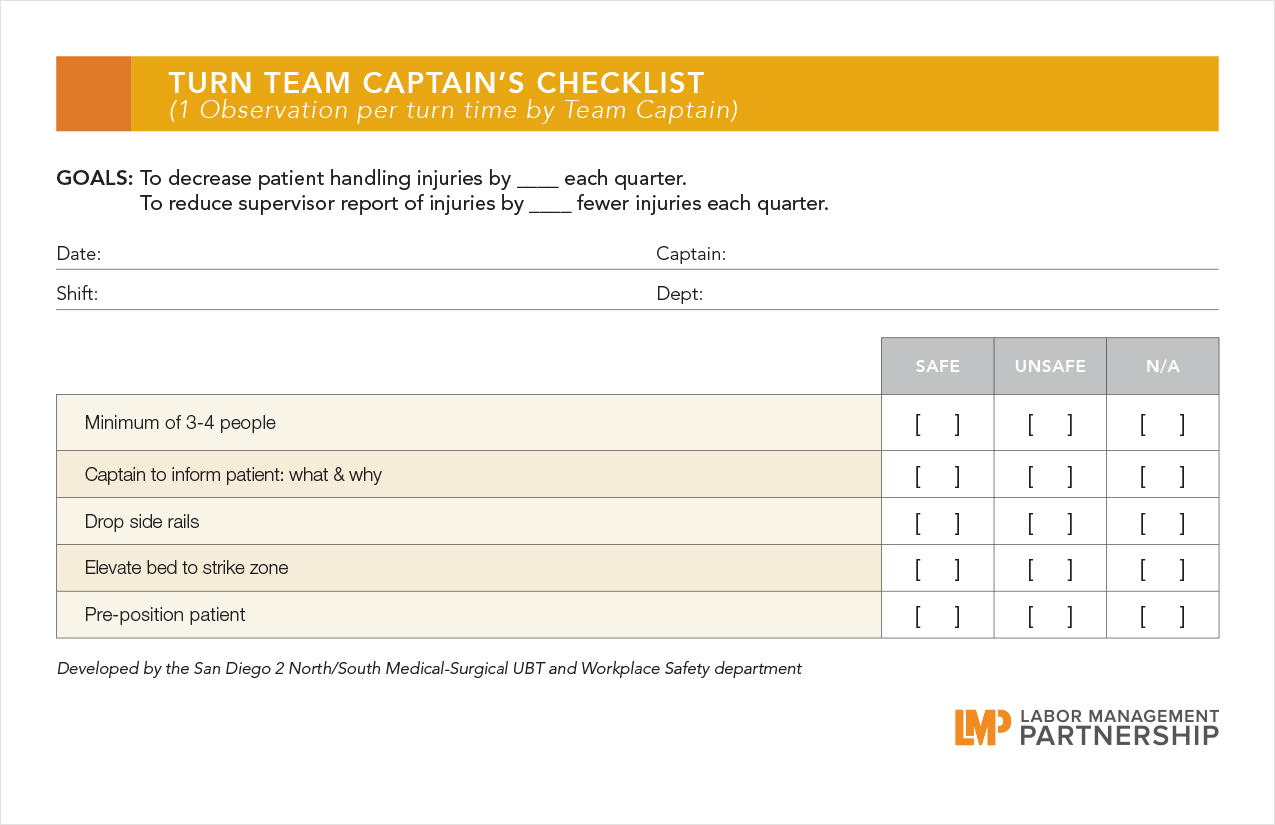
Checklist for Turn Team Captains

Format: 
PDF and Word DOC

Size:
8.5” x 11”

Intended audience:
Captains of turn teams

Best used:
Use this checklist when turning a patient to ensure the procedure is done safely and the chance of injury is minimized. 


Related tools:

TOOLS

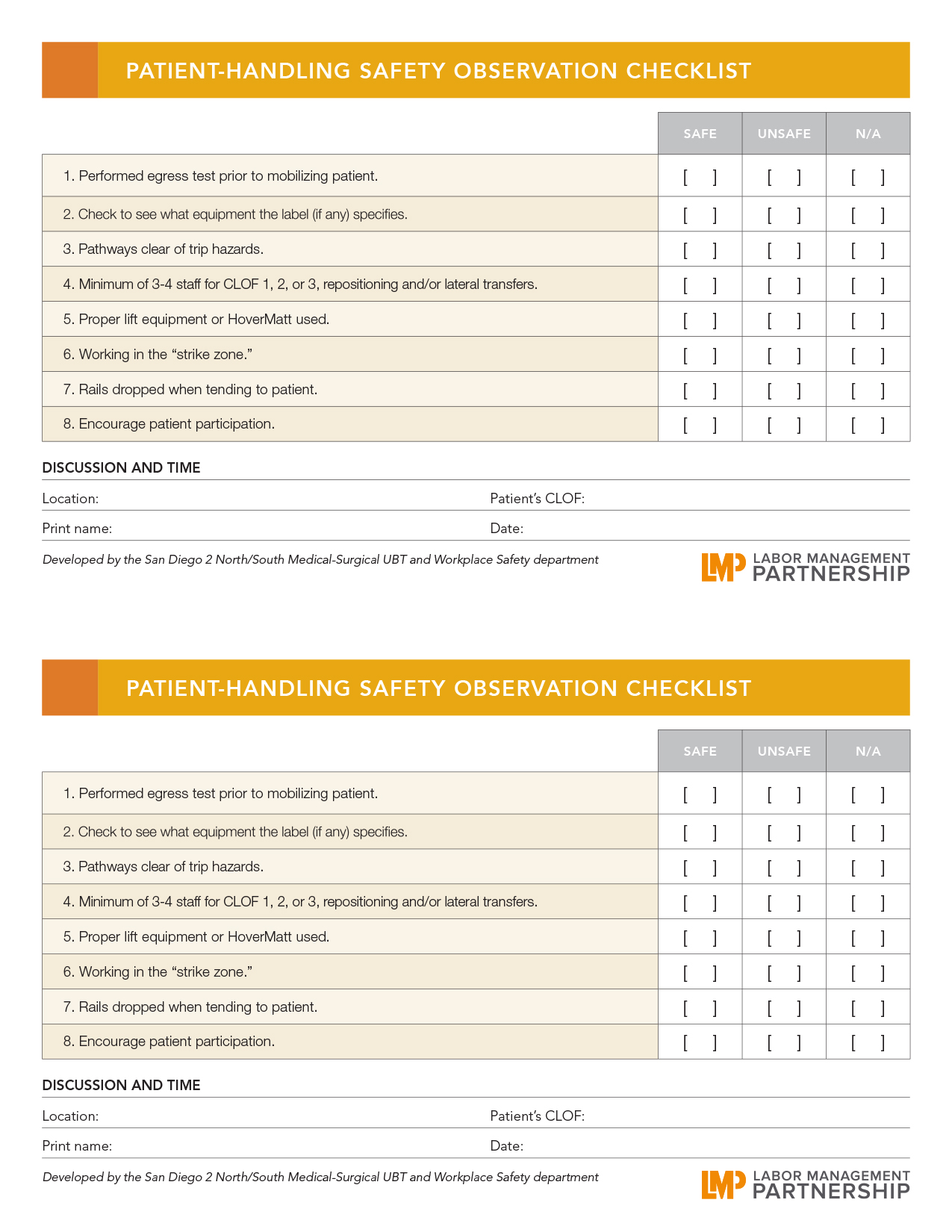
Safety Observation Checklist

Format:
PDF and Word DOC

Size:
8.5" x 11"

Intended audience:
Safety observers.

Best used: This checklist can heighten awareness and use of safe patient-handling procedures. Used by San Diego's 2 North-South Medical-Surgical teams in conducting safety observations while the team turns or lifts a patient. (The PDF prints two copies of the checklist, so if, for example, you want 10 copies, print the document 5 times.)
 

Related tools:

Keeping a Watch on Process Can Prevent Injury

Deck: 
The entire department observed proper patient-turning technique and safety improved

The 2 North-South medical-surgical units in San Diego were identified as high-injury departments.

One year, the combined team saw 16 patient-handling injuries. Before that, the number was 18. Repetitive back and shoulder injuries were most common. As a result, management was told to eliminate injuries—fast.

The first step in the action plan required staff members to undergo Workplace Safety training on how to conduct safety observations. Each person then conducted three observations a week on teams turning patients and submitted those observations to a collection box in the department. The observations were logged into the Workplace Safety web-tracking tool.

Previously, only charge nurses and managers conducted the observations. But getting everyone involved kept proper patient-handling techniques constantly at the forefront of team members’ minds.

Getting buy-in from staff members was another challenge, so it didn’t feel like another thing on top of their regular workload.

“Make sure you communicate—and with some degree of consistency—to everyone,” nurse manager and RN Erlinda Aquino says. “And hard-wiring it so people understand it’s not just the flavor of the month.”

The UBT adapted a checklist of key things that should be done when turning a patient, such as ensuring a patient’s bed rails have been lowered. Turn-team captains referred to this checklist at every patient turning.

To help morale and maintain safe patient-handling techniques, the UBT set small, attainable goals the department could celebrate.

The team had a pizza party when it reached the first 100 days without an injury, then again after accruing no injuries for the month of July, which historically had been the units’ highest injury month.

“In the beginning, you have to consistently remind people,” says Tess Patiag-Limcuando, RN. “People felt that doing those steps just added to the time, not realizing that it would cost them a whole lot more time if they hurt themselves.”

It was also important to focus on the positive.

“Instead of emphasizing the negative, present it like, ‘I care about you; I want you to be safe.’ Versus: ‘You’re in trouble,’” Aquino says.

Game Changer: Putting the Patient First

Deck: 
Teams in South San Francisco and San Diego work to keep patients front and center

Story body part 1: 

What happens when teams truly walk a mile in their patients’ shoes? They often discover their own actions are making that mile a rocky one for patients—and as a result make huge breakthroughs in the way they deliver care.

In the case of South San Francisco’s multidepartmental pre-admission team, observing their processes from the other side of the gurney spurred them to dramatically streamline the pre-surgery and admitting process for patients. With the member at the forefront of their thinking, the team members turned a two-inch-thick packet of confusing, redundant information into a streamlined, one-page checklist. And a funny thing happened—while redesigning the process to help patients, the team improved the way it works.

“Patients would often get confused and weren’t sure what the next step in the process was,” says Brian Tzeng, MD, the Peri-operative Medicine director. “We realized we didn’t have a clear path for the patient to follow.”

Other teams throughout Kaiser Permanente are making similar realizations, framing their performance improvement work by asking the question, “What’s best for the patient?” If a possible solution doesn’t work well for the member and patient, then there’s more brainstorming to be done. These teams are taking the Value Compass to heart—organizing their work not just around the four points but examining what they’re doing from the patient’s perspective.

What does that mean for frontline teams? At the San Diego Medical Center, the Emergency Department sees up to 300 patients every 24 hours. Physicians and staff members are always on the go, delivering on the ultimate bottom line—saved lives. What could be more important? Clinical quality is high; patients are seen in a timely manner and the rate of unscheduled return visits is good.

Yet the results of a recent patient satisfaction survey bothered the team. The department scored well overall, but their patients gave it only 63 percent approval on one question: While you were in the Emergency Department, were you kept informed about how long the treatment would take?

TOOLS

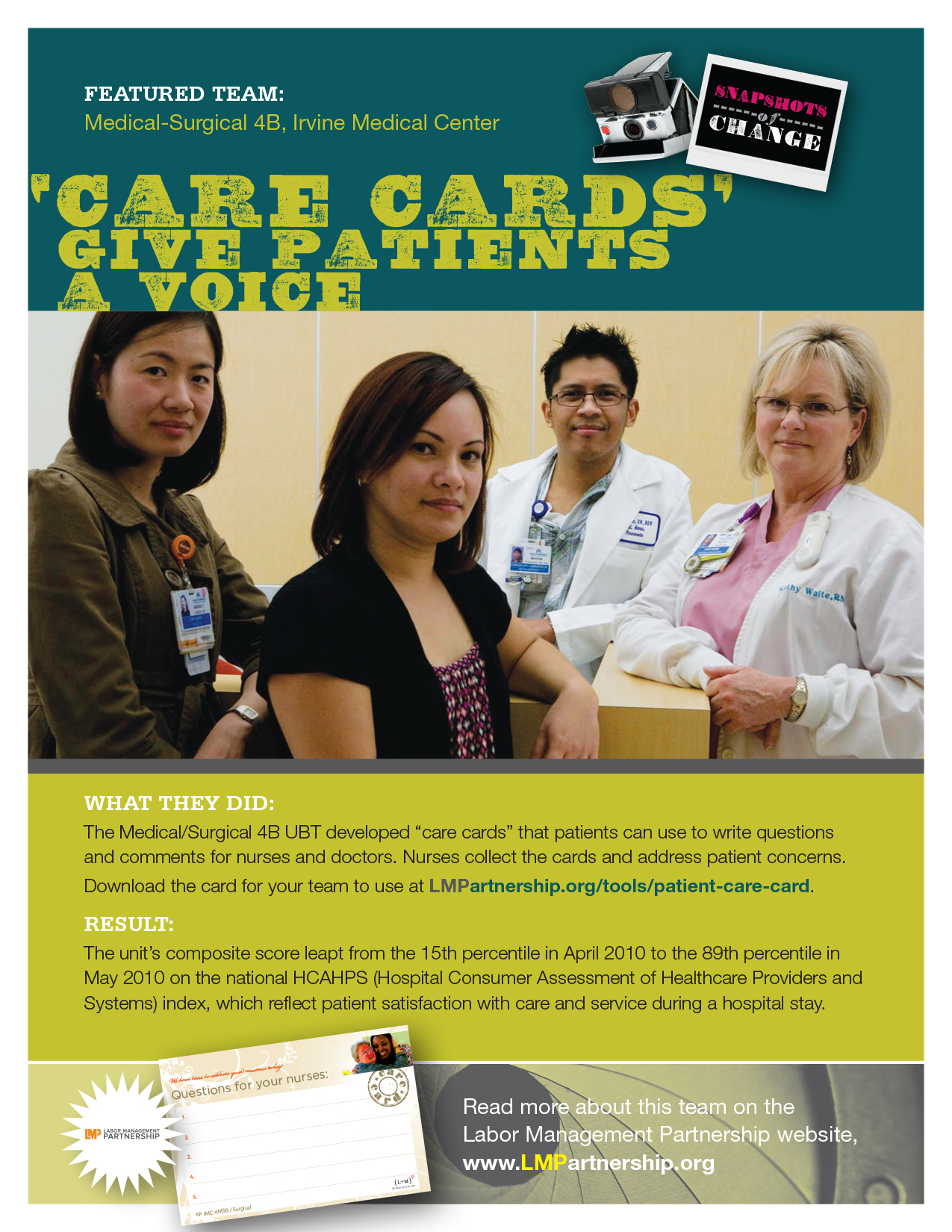
Poster: "Care Cards" Give Patients a Voice

Format:
PDF (color and black and white)

Size:
8.5” x 11”

Intended audience:
Union coalition-represented employees and frontline managers

Best used:
Posted on bulletin boards or in break rooms and other staff areas to inspire your team to discuss ways to boost patient satisfaction.


Related tools:

Need to Build Your Team? Join the Club

Deck: 
Or, says a Southern California manager, start a healthy eating club to bring your team together

Story body part 1: 

Managers newly charged with co-leading unit-based teams sometimes need to build team cohesion before diving into the nitty-gritty of setting goals and improving performance.

Brenda Johnson, optical site supervisor at the South Bay Medical Center in Southern California, has found a way to do just that—and improve her staff’s eating habits at the same time.

Inspired by a presentation at a regional leadership conference hosted by Jeffrey Weisz, MD, executive medical director of the Southern California Permanente Medical Group, she launched a healthy eating club in her department. Every week, staffers chip in $12 each—and get four healthy, fresh-cooked meals in return.

At the early spring meeting, Dr. Weisz discussed Kaiser Permanente’s Healthy Workforce initiative and distributed a booklet listing the calorie count of hundreds of food items.

Making change easier

“I looked at the book, and I thought, ‘Oh, my goodness,’” said Johnson, shocked at the number of calories in some of her favorite foods.

“I looked around at my employees,” she said. “Some have health issues. Some drink sodas by the 32-ounce cup every day.” The medical center is ringed by mini-malls with fast food restaurants. “We’ve been eating the same stuff for years,” she said. “The only question was who’s going to go pick it up.”

Gil Menendez admits he was one of the 32-ounce-cup soda drinkers—a habit he gave up when he joined the club. Menendez, an optical dispenser, SEIU UHW member and  labor co-lead of the UBT, was so motivated by the changes in his lunchtime habits that he also began a strict diet and exercise routine. He’s lost 20 pounds.

New ways to work together

Johnson cautions that the healthy eating club isn’t a diet club. She picks recipes out of a pamphlet produced by the California Department of Public Health, Champions for Change, and prepares the ingredients at home. Others sometimes prepare recipes from their families and cultures. She combines ingredients in the morning, steams them in a slow cooker the staff keeps at work, and a meal is ready by lunchtime.

“I have to cook for my family anyway,” says Johnson. At home, “We’ve changed our habits because of high blood pressure. I prepare this food with love because I’m preparing it for both of my families: my family at home and my family at work.” 

About 15 to 20 people participate in the club each week, up from 10 when it first began in May 2010. In addition to its health benefits, the club has helped her department be more productive and collegial, says Johnson.

“It’s going strong,” adds Mendez. “It brings us together.”

Pages

Subscribe to RSS - Southern California