Southern California

Help Video

How to Find UBT Basics on the LMP Website

Learn how to use the LMP website:

LMP Website Overview

Learn how to use the LMP website:

How to Find How-To Guides

This short animated video explains how to find and use our powerful how-to guides

Learn how to use the LMP website:

How to Find and Use Team-Tested Practices

Does your team want to improve service? Or clinical quality? If you don't know where to start, check out the team-tested practices on the LMP website. This short video shows you how. 

Learn how to use the LMP website:

How to Use the Search Function on the LMP Website

Having trouble using the search function? Check out this short video to help you search like a pro!

Learn how to use the LMP website:

How to Find the Tools on the LMP Website

Need to find a checklist, template or puzzle? Don't know where to start? Check out this short video to find the tools you need on the LMP website with just a few clicks. 

Learn how to use the LMP website:

TOOLS

PPT: Optical Team Makes Fewer Fixes to Glasses

Format:
PPT

Size:
1 Slide

Intended audience:
LMP employees, UBT consultants, improvement advisers

Best used:
This PowerPoint slide features an optical team that lowered glasses redo rates. Use in presentations to show some of the methods used and the measurable results being achieved by unit-based teams across Kaiser Permanente. 

Related tools:

Want a Healthy Workforce? Try an Instant Recess

Deck: 
Exercise breaks reduce injuries, stress and sick days

Story body part 1: 

At 10:30 a.m. sharp, South Bay Medical Center appointment clerk Carolina Meza removes her telephone headset. She fires up what looks like the world’s tiniest iPod, attached to a portable speaker that’s not much bigger. She gathers four of her co-workers in a patch of open space near the coffee room. They do some neck rolls, march in place and then do a move Meza calls “the incredible hulk”—a shoulder stretch that brings welcome relief to those facing a computer screen for most of their day.

“When we go back to our stations, we feel refreshed,” says Meza, a member of SEIU UHW.

It’s called Instant Recess, and it’s the brainchild of Toni Yancey, MD, co-director of the UCLA Kaiser Permanente Center for Health Equity. It involves a quick, daily group exercise and is aimed at incorporating physical activity into a normal workday. It comes at a time when research is showing that workplace fitness initiatives targeting individual behavior (such as counseling and gym memberships) aren’t working. An organization’s whole infrastructure needs to be addressed, says Yancey. 

That’s what makes Instant Recess so appealing. It demonstrates KP’s commitment to Total Health—including for a healthy and safe work life for KP employees as well as the members and communities we serve. It’s consistent with KP’s Healthy Workforce push, and also seems to help reduce workplace injuries and improve attendance.

At the South Bay call center, for instance, annualized sick days fell almost one full day per full-time equivalent between 2010 and 2011, when the department began Instant Recess. The number of ergonomic injuries went from three to zero.  

Overcoming obstacles

While they are seeing results now, team members were wary when senior leaders at their medical center approached them about trying Instant Recess. “I was very skeptical,” says Darlene Zelaya, operations manager. “We can’t prevent the calls from coming in.” In fact, hold times for patients did go up when the team first implemented Instant Recess.

The unit-based team worked together with project manager Tiffany Creighton to adapt Instant Recess to their members’ needs. For instance, before calling a recess, team members check the reader board to assess how many agents can be off the phones at one time. They hold many small exercise bursts throughout the day instead of one or two longer ones. And they keep the music turned down low to avoid disturbing agents on the phone with patients.

Making it work locally

In the South Bay lab, Instant Recess looks and sounds totally different—but is getting similarly promising results. That department blasts a boom box for 10 full minutes during the Instant Recesses it incorporates into its huddles at shift change twice a day. Clinical lab scientist Nora Soriano steps away from her microscope to join in. She’s lost 43 pounds recently, and she partly credits Instant Recess. Soriano, a member of UFCW Local 770, says the initiative inspired her to exercise more at home. “My son got me an Xbox,” she says. “I don’t stop for half an hour, sometimes 45 minutes.”

Not all of Soriano’s co-workers were so enthused when they first heard about Instant Recess. “I was kind of negative,” admits Julia Ann Scrivens, a lab assistant and UHW member. “I thought, ‘I am so busy. You want me to do what?’ ” Area lab manager Dennis Edora says, “It was a shock. No one knew what to expect.” But the lab’s staff had just been through some stressful changes—including getting new equipment and moving to a new floor—and team members were hungry for something that would help rebuild morale.

“We collaborated with all the different job codes,” says Edora. “Everyone added their different flavor,” she says, noting that employees rotate as a leader, some choosing Hawaiian dance moves, others yoga-inspired stretches. “Instant Recess really got us together. It wasn’t just exercise.” Moreover, it was helping reduce injuries: the lab reported only one repetitive motion injury in 2011, after beginning Instant Recess in April. There were five such injuries in 2010.   

And Scrivens is sold as well. “It is fun,” she says. “It makes me happy.”

Beyond Retail: Optician Saves Member’s Sight

Story body part 1: 

When Webster Parker brought his prescription glasses back to the clinic in Redlands (Southern California), he thought he just needed to replace a lens that had fallen out. But when Parker reported his eye was watering excessively, optician Alicia Rendon spotted a red flag in Parker’s Kaiser Permanente HealthConnect™ record and, within the hour, set up an eye-saving appointment with an ophthalmologist.

“The prescription was fine,” says Rendon, a Teamsters Local 166 member whose unit-based team recently embraced a new workflow, including use of KP’s electronic health record system, to troubleshoot their redos—instances where patients return eyewear purchases. “Once I looked into HealthConnect, there was this big stop sign.”

Her review of the record suggested that Parker, 85, might need a common surgical procedure to lower the intraocular pressure in his right eye, a condition often associated with glaucoma. An old eye injury exacerbated the problem, and Parker’s ophthalmologist had set up a flag in the system to watch for changes to the eye.

“I had surgery that week,” says Parker, a retired pharmacist who once ran a drugstore with his pharmacist wife. “The eye feels better. It feels normal. They did a wonderful job.”

Looking at the whole system

Focusing on redos not only saves KP in terms of the cost of materials and labor but also helps improve service scores. By bringing in ophthalmologists and optometrists, who examine eyes to treat disease as well as prescribe the lenses that opticians dispense, the team could better identify redos linked to eye-health problems rather than product defects—as in Parker’s case.

But opticians, used to handling paper charts and focusing on frame styles, were reluctant to try one of the team’s first tests of change: using KP HealthConnect to rule out medical reasons for unsatisfactory eyeglasses.

“We got buy-in” to overcome the initial resistance, says management co-lead Darren Smith, site supervisor for optical dispensing and a former optician. “It takes just two or three to really commit and spread the practice. Now, it’s not just a retail store where you come and buy something. Here, we are talking about your health.”

Educating patients and staff

To protect patient privacy, opticians' access in HealthConnect was mostly limited to conditions related to eyeglasses' prescriptions rather than a broader range of eye issues. Now the optometrists and ophthalmologists help the optical UBT members spot problems and counsel patients on practices that will protect their eyesight and enhance their eye care.

“Not everyone is going to be able to see 20/20,” says Trissy Bastin, business line manager for Vision Essentials. She directs the service area’s five optical clinics and serves as sponsor for the UBT. “The patients have to be reminded of that. You have to be able to see what kind of eye conditions they have.”

Parker has been a KP member for just seven years. But three decades in the health care industry fostered his appreciation for the electronic patient record—and cooperation and coordination among caregivers.

“What makes Kaiser special is that any doctor can have your complete record at his fingertips,” Parker says. “They can track problems and make recommendations.”

TOOLS

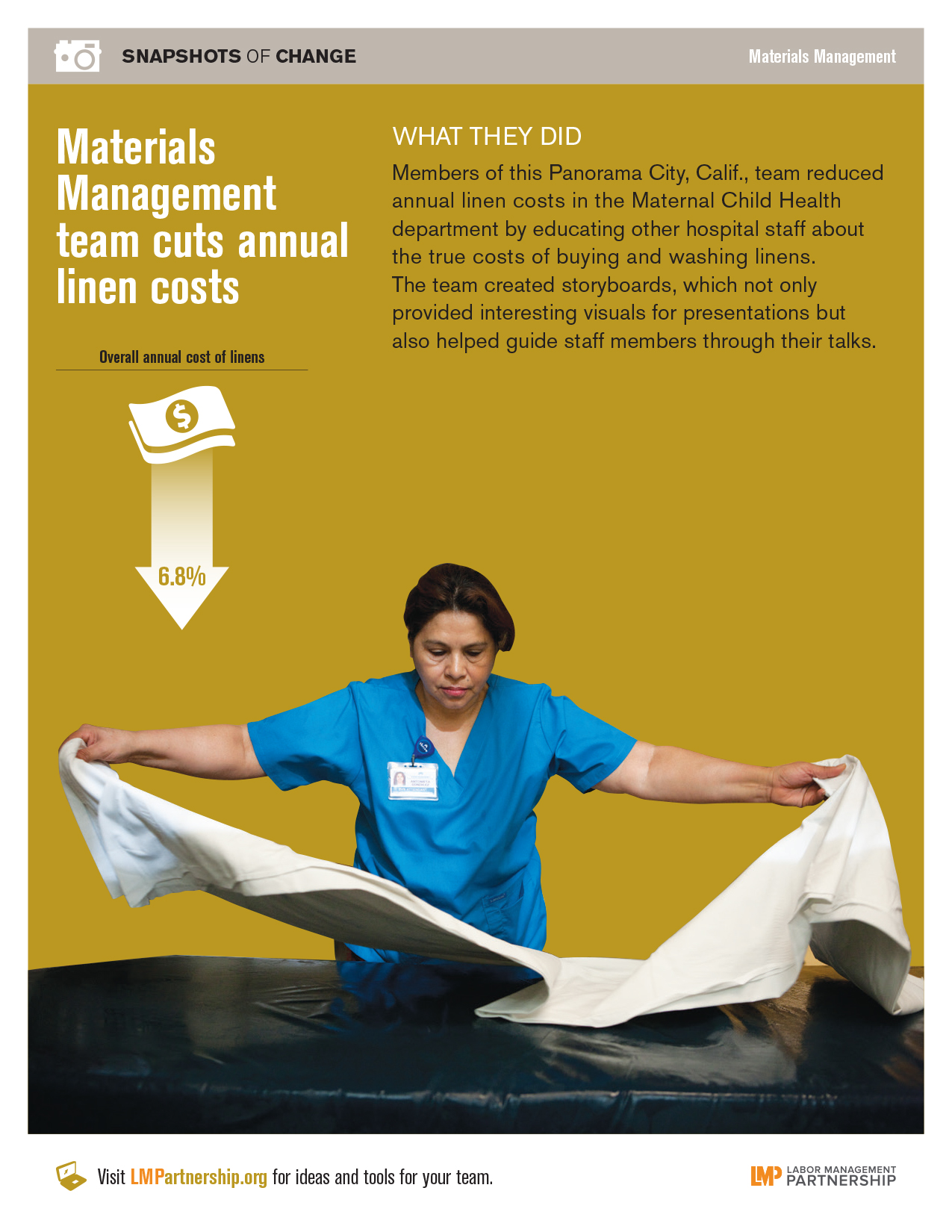
Poster: Materials Management Cuts Linen Costs

Format:
PDF (color and black and white)

Size:
8.5" x 11"

Intended audience:
Frontline employees, managers and physicians

Best used:
This poster, for use on bulletin boards in break rooms and other staff areas, features a Materials Management team that found a way to save in linen costs.

Related tools:

TOOLS

PPT: Zumba Helps Team Meet Health Assessment Goal

Format:
PPT

Size:
1 Slide

Intended audience:
LMP staff, UBT consultants, improvement advisers

Best used:
This poster features a Fontana UBT in which 95 percent of members have taken KP's health assessment. Use in presentations to show some of the methods used and the measurable results being achieved by unit-based teams across Kaiser Permanente. 

Related tools:

TOOLS

Powerpoint: Fighting the flu face to face

Format: PPT

Size: 1 Slide

Intended audience: LMP staff, UBT consultants, improvement advisers

Best used: In presentations to show some of the methods used and the measurable results being achieved by unit-based teams across Kaiser Permanente. 

Description: This PowerPoint slide features a facilitywide UBT that successfully encouraged more employees to get the flu shot.

Related tools:

TOOLS

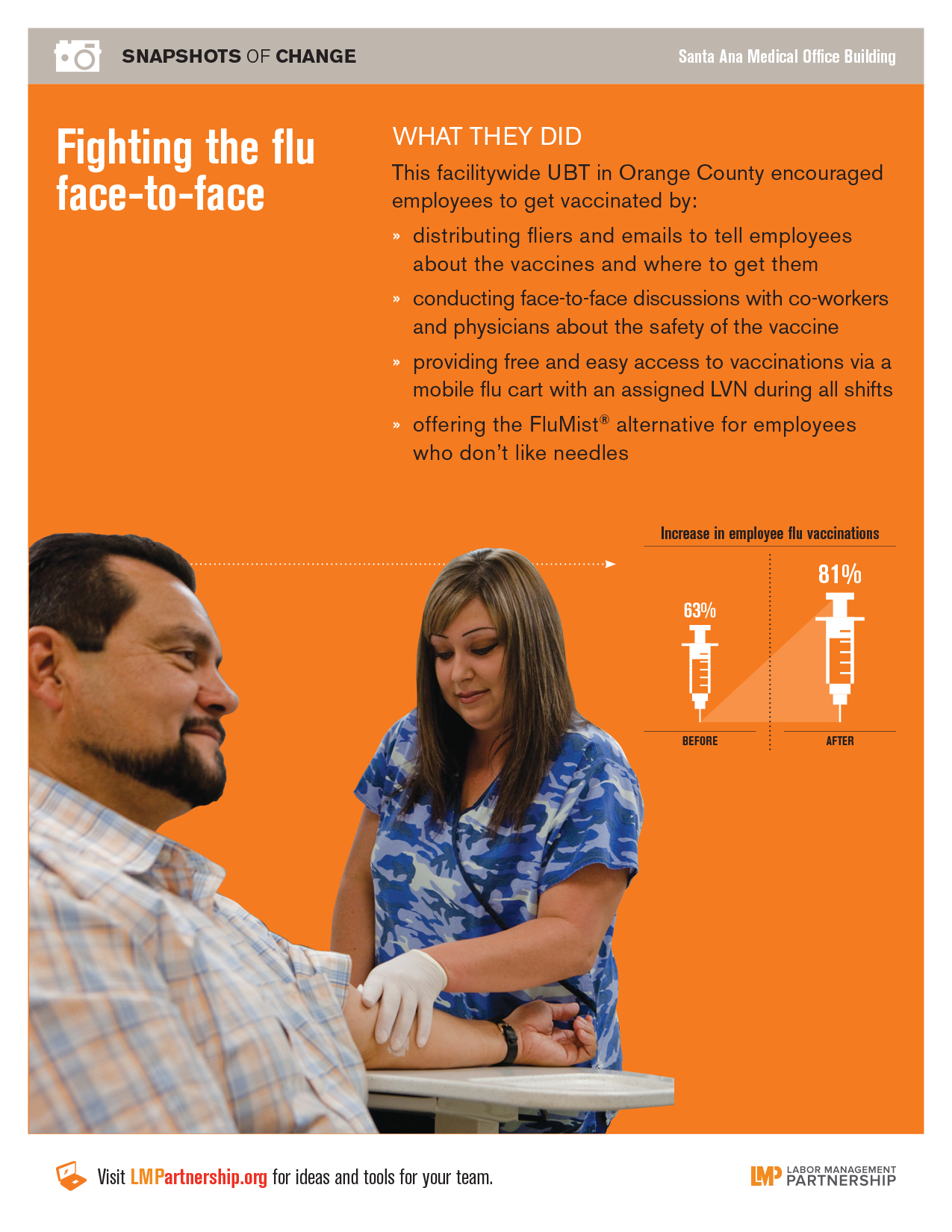
Poster: Fighting the Flu Face to Face

Format:
PDF (color and black and white)

Size:
8.5" x 11"

Intended audience:
Frontline employees, managers and physicians

Best used:
This poster, for bulletin boards, in break rooms and other staff areas, features an all-facility UBT that successfully encouraged more employees to get the flu shot.

Related tools:

TOOLS

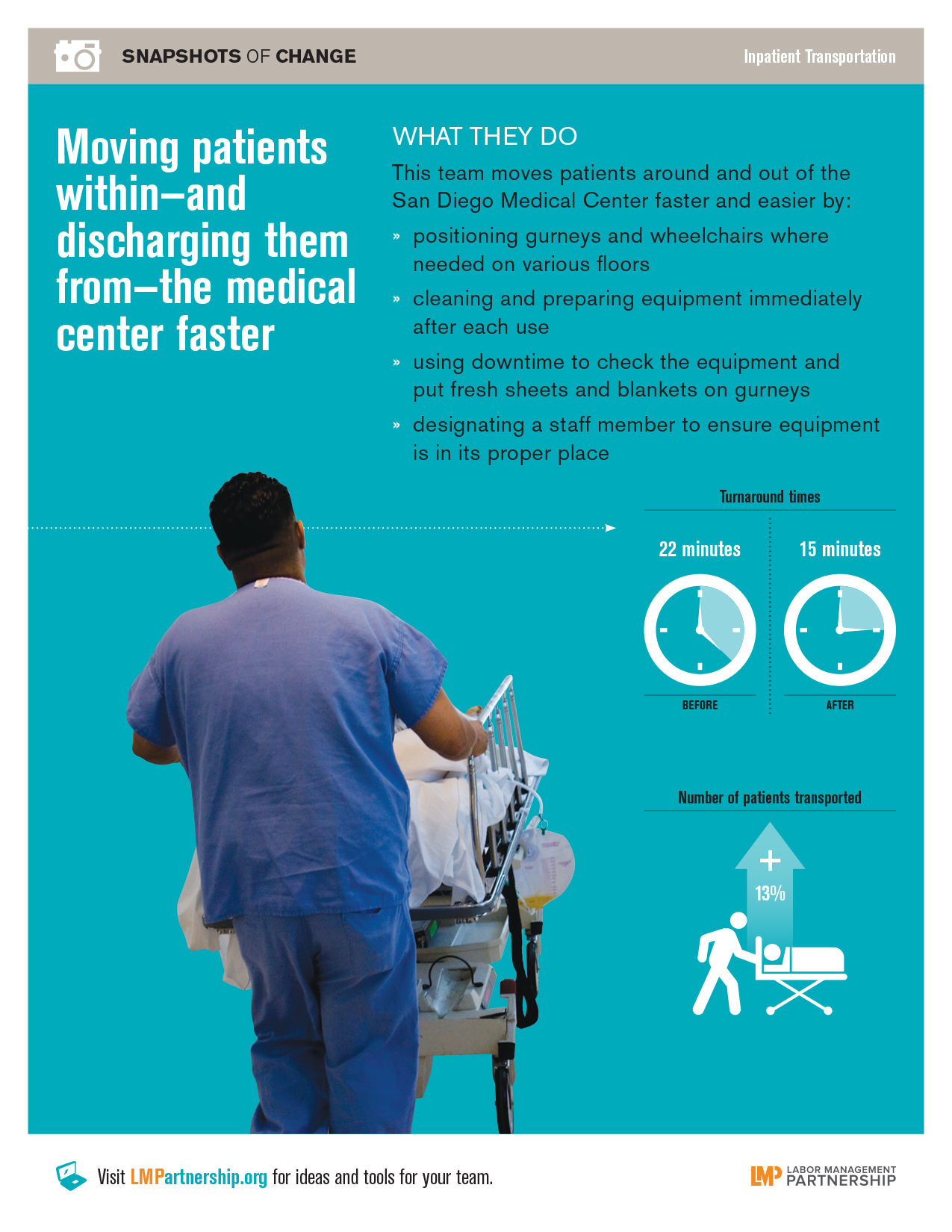
Poster: Transporting Patients on the Fast Track

Format:
PDF (color and black and white)

Size:
8.5” x 11”

Intended audience:
UBT members, co-leads and consultants

Best used:
Posted on bulletin boards, in break rooms and other staff areas, t
his poster highlights a transport team that improved turnaround times.


Related tools:

How I Learned to Stop Worrying and Love the Data

Deck: 
Hank’s seven ways to conquer your fear of data

Story body part 1: 

For more than a year, the service scores at the Moreno Valley Optometry department zigged and zagged in no discernable pattern. Asked whether receptionists were helpful and courteous, 100 percent of patients answering the Ambulatory Service Questionnaire gave the highest score one month.

But two months later, only 78 percent of respondents were that enthusiastic. Two months after that, scores were back up into the 90s. The huge swings were discovered in May 2011 by Stephanie Valencia, the department’s new manager, who excavated two years’ worth of data.

“We had never looked at it before,” she says. “There was no trend. The scores were inconsistent.” Worse, says Valencia, the feedback from the most recent months was headed “on a downhill streak.”

Working with labor co-lead Gina Hitt, an optician and a member of Teamsters Local 166, Valencia and the unit-based team gathered information and set a baseline. For two days in September, the medical assistants asked all patients whether they found the receptionists to be helpful and then tallied the results.

The team used these to measure the effectiveness of a rapid string of small tests of change. These included adding a smile, positive tone of voice and eye contact on successive days. Each of those days, Hitt and her colleagues asked patients whether their receptionist was courteous and helpful. With each successive effort, the chorus of “yes” got louder and more effusive.

The act of simply examining the service scores seemed to set the team on an upward trajectory: The April 2011 score of 79.55 percent jumped to 89.09 percent in September and then 92.73 percent in October.

 “It is so neat to see how involved people are,” Valencia says. “Everyone is in sync.”

So, that’s a happily-ever-after story, right? Once upon a time, there was an optometry team in Southern California that never looked at its service scores. Suddenly, team members learned their scores were inconsistent and heading in the wrong direction. They focused on key data and tried out small tests of change. Their new practices boosted the score. Everyone lived happily ever after.

This happens every day with every UBT throughout all of Kaiser Permanente.

Right?

Maybe not.

Some UBTs are adept at using data to guide their attempts to improve performance, whether it be raising service scores, reducing infections, creating a safer workplace or boosting attendance. But for others, fear and anxiety about data and numbers are a significant obstacle on teams’ path to high performance.

In order to qualify as a Level 4 team on the Path to Performance, the team has to collect its own data and review it to see whether changes are helping improve performance. To ascend to Level 5, teams must be measuring their progress using annotated run charts.

But what if you break out in a cold sweat and experience shortness of breath at the sight of anything vaguely resembling math or numbers? Do you simply resign yourself (and your team) to being roadkill on the Path to Performance?

No. Read on.

1) Realize you are plenty smart enough.  

Kaiser Permanente, like all large health care organizations, collects and stores vast amounts of data in a variety of complex databases and websites. It employs people with a huge variation in their knowledge of and comfort with data. Just because you’re not at ease with numbers now doesn’t mean you never can be.

Even Bob Lloyd, the executive director of performance improvement at the Institute for Healthcare Improvement, an independent nonprofit in Massachusetts, jokingly refers to statistics as “sadistics.”

Luckily, the data you will need to turbocharge your team’s efforts to improve performance is probably a lot less complex than you fear.

 “It’s not really ‘math’ with formulas, statistics and calculations,” says Michael Mertens, a Kaiser Permanente performance improvement mentor in Southern California. “It’s mostly about before and after, addition and subtraction.”

2) Whether you acknowledge it or not, you collect data every day.  

 “My role in the tests of change has been soliciting feedback from the patients,” says Hitt, the Moreno Valley optician. She didn’t need a computer program or spreadsheet. A piece of paper and pencil did the trick. 

 “We are all data collectors,” proclaims Stacy Dietz, the UBT consultant for regional operations in Southern California. “And every day, we alter our behavior based on data.” For instance, we ask, “What is the temperature outside?” Then we decide whether to wear a wool turtleneck or tank top. We ask, “What is the length of my commute?” Then we decide whether it makes more sense to drive or take the train.

If you can collect and analyze data to determine your wardrobe, you can also do it to improve the performance of your team.

3) Before diving into the numbers, focus on the “why.”

As the new Kaiser Permanente ads challenge viewers, “Find your motivation.” For unit-based teams, the Value Compass offers a handy cheat sheet on motivation: The patient is at the center. Every data point on every chart represents the impact—positive or negative—that a Kaiser Permanente team had on a patient.

IHI’s Bob Lloyd explains there are three distinct reasons in health care for collecting and examining data:

  • For research, such as KP’s recent study that found women in their late 60s who break a bone are five times more likely to die within a year than women that age who do not break a bone.
  • For judgment, a category that would include the federal government’s recent rankings of Medicare insurance plans on quality and service (several KP plans got five out of five stars). This category also includes scores that determine whether or not a medical center or department earns its Performance Sharing Program (PSP) bonus.
  • For improvement.

This last is the reason UBTs should be collecting and examining data.

 “The purpose of measurement in quality improvement work is for learning, not judgment,” Lloyd says. 

Data answers questions like, “How are we doing right now?” “Over time, are we getting better? Or getting worse?” “Is our small test of change making a difference? Or not?” In the absence of data, we have a tendency to fall back on relying on guesses, gut instinct, anecdotes—and to blame or give credit to specific individuals, justifiably or not.

 “You need data. Otherwise, you don’t have any solid information,” Hitt says. “You just have word of mouth.”

4) Only gather the data you actually need.

The holy grail of data for UBTs is the run chart. Don’t let the name throw you. It’s simply a chart that tracks some number (say, a service score, or number of last-minute sick calls) over time (day, week, month, quarter).

 “The most crucial question to ask is, ‘What are the few, vital pieces of information that are important?’ ” says Dennis Benton, executive director of the Panorama City Medical Center in Southern California. Any graph or data set that requires its intended audience to get special training to read is probably too complex for the task at hand, he says.

 “You can do a quick, just-in-time training at a UBT meeting,” says Benton. “We do it in leadership rounds. I point to the graphs and talk about them.” 

Run charts make it clear at a glance how your team's tests of change are working. Use this tool to walk through how to make one.

4 1/2) But, get the data often enough to support your improvement efforts.

For most teams’ small tests of change, data that can be collected daily, weekly or—at most—monthly will be most useful. Waiting for quarterly reports is generally not going to cut it. The Moreno Valley Optometry department did not wait for the Ambulatory Service Questionnaire results—which are posted monthly—to come in. It’s called the Rapid Improvement Model, folks. Not the Slow-as-Molasses Improvement Model.

Bottom line: The data should be useful for the team and be determined by the team.

5) Think art class, not math class.

 “I hate numbers,” admits Jenny Yang, a receptionist at the Moreno Valley Optometry department and a member of the UBT’s representative group. When the notion of using service scores to guide improvement first came up, Yang says she told her teammates, “I’m not going to do it. Make someone else do it.”

To help others like Yang, Benton says, when it comes to data, “Make a picture out of it. I am a big believer in graphs. With a graph, you can say, ‘We dipped here. What is the reason? What can we do about it?’ You can look at a trend relative to the goal.”

 “Graphs are visual,” Valencia adds. UBT members have a variety of learning styles and preferences: “Everyone learns differently.”  

And think in terms of moving video, not still photographs that capture single moments in time. IHI’s Lloyd asks, would nurses measure an ICU patient’s vital signs only when the patient arrived and when she left the unit? Or would they monitor vitals constantly via a telemetry machine? The second option is better, so caregivers can intervene in real time to help the patient’s recovery.  

6) You didn’t like art class? How about creative writing?

Numbers can tell a story. “There is narrative in data,” says Nancy Duarte, the author of “Slide:ology” and “Resonate,” two popular books about how to give compelling and memorable presentations. “What makes the numbers go up and down? How big are the numbers? How do the numbers contrast with other information?”

Yang agrees. Graphs with data “give you key points, high points and low points and trends,” she says. As a member of the representative UBT, Yang—a member of Steelworkers Local 7600—sees herself as a storyteller: “My audience is the UBT. The graphs help UBT members make sense of everything.”

Hey, if you liked math class, more power to you. “I love math,” says Hitt. “I am a number cruncher. But for me, charts and graphs? Not so much.”

7) It’s OK to ask for help.

So that graph you pored over in your UBT meeting is still making you break out into a cold sweat?

 “It’s OK to find a safe place to say, ‘I don’t get this,’ ” says UBT consultant Stacy Dietz. That might not be in a big group, but it could be one on one with a trusted peer.

Mertens, the Southern California performance improvement mentor, says the best way to learn to use data is to try it out. At the request of Susie Bulf, a UBT consultant, Mertens led a training for UBT co-leads in Fontana on how to create a run chart. He led an in-class exercise using sample data—and then another exercise where each team used its own data.

 “You get over the anxiety by doing it the first time,” Mertens says.

Each KP region boasts a roster of experienced performance improvement mentors. In addition, most UBT consultants have had some training in performance improvement strategies.

 

Career Counseling Helps With Job Changes

Deck: 
New training helps employees find new challenges

Story body part 1: 

Three years ago, when Joann Horton learned her job might be eliminated when HealthConnect™ came online, her first response was fear.

A medical clerk at the Hayward Medical Center in Northern California, Horton needed the income, but she also loved her job. “I was terrified,” she says.

Joyce Lee, an imaging transcriptionist at the Fontana Medical Center in Southern California, found herself in the same boat last year. With KP shifting to a new voice-to-text technology for transcribing radiology results, Lee’s skills were becoming obsolete.

“All of us were figuring out how we were going to do the transition,” she says.

Both of these “changing workplace” stories could have ended badly, especially in today’s shaky economy.

But now, Horton and Lee are fans of the job counseling and retraining provided to partnership union employees through the Employment and Income Security Agreement that allowed them to stay with KP.

Successful retraining 

The two women received one-on-one guidance from career counselors who helped them identify and train for in-demand positions.

Horton, who is now the department secretary for Home Health in Hayward, says career counselor Martha Edwards “gave me what I needed to build my skills up, but she also gave me a lot of emotional support.” Edwards works for the Ben Hudnall Memorial Trust, established under the 2005 National Agreement to provide career counseling and job training to members in 12 of the unions that are part of the Labor Management Partnership.

Lee, who now works as a phlebotomist at the Fontana Medical Center in Southern California, also received services through the Ben Hudnall trust. She says counselor Michele DeRosa “has a gift for networking; for figuring out all the pieces of the puzzle, for being the encourager.”

Ongoing outreach

The partnership’s career counseling benefits have benefited thousands of employees in a short amount of time. From its inception in 2007 through March 2011, roughly 10,000 employees had seen career counselors through the Ben Hudnall Trust, with many more attending workshops or promotional events.

The SEIU UHW-West & Joint Employer Education Fund offers similar services to SEIU-represented employees in the Northern California, Southern California, Colorado and Northwest regions. Since 2006, almost 16,000 KP employees have enrolled in training through the program and 6,885 have received counseling and referral services. 

Those who have used the programs’ services are enthusiastic proponents; however, ongoing outreach is required, Edwards says, especially since the concept of career counseling is new to many employees. 

“I think there’s a lot of mystery around the words ‘career counselor,’ ” she says, “and perhaps some intimidation and confusion.”

Obstacles to career counseling include a fear of being seen as vulnerable or needy, difficulty finding the time for training while working and concern that some managers might not appreciate an employee who is seeking to advance from their current position, Edwards says.

It’s an important part of the counselor’s work to help employees get over these hurdles so the program works best for their needs, she says.

Many employees first learn of the services when facing a major challenge, like Horton and Lee.

However, the programs are designed to offer help in many situations, from employees seeking to change careers to those wanting to gain skills in their field; from those struggling with a manger or co-worker to those struggling with work-family balance.

All services are confidential.

“Our goal is to have something for everyone,” says Lucy Runkel, director of the SEIU UHW fund. “We reach many employees, but we always want more.”

Managers are educational partners

Data from the programs show most employees learn of career counseling through word of mouth. Information also is available at events and online.

Both programs have started boosting educational outreach to managers, whom they view as key allies in spreading the word about the services.

“With a manager, we get more bang for our buck, because they can educate all of their staff,” says Runkel. 

Both Kaiser Permanente and its union-represented employees stand to gain, she says. “We think people who are better trained, happier, and have greater longevity on the job are going to provide better care than someone who is new, or unhappy or poorly trained.”

Career counselor Edwards put it this way: “It helps with Kaiser’s ‘best place to work’; seeing employees vital, motivated, moving and growing is a plus for the whole team.”


Pages

Subscribe to RSS - Southern California