Best Place to Work

Help Video

How to Find UBT Basics on the LMP Website

Learn how to use the LMP website:

LMP Website Overview

Learn how to use the LMP website:

How to Find How-To Guides

This short animated video explains how to find and use our powerful how-to guides

Learn how to use the LMP website:

How to Find and Use Team-Tested Practices

Does your team want to improve service? Or clinical quality? If you don't know where to start, check out the team-tested practices on the LMP website. This short video shows you how. 

Learn how to use the LMP website:

How to Use the Search Function on the LMP Website

Having trouble using the search function? Check out this short video to help you search like a pro!

Learn how to use the LMP website:

How to Find the Tools on the LMP Website

Need to find a checklist, template or puzzle? Don't know where to start? Check out this short video to find the tools you need on the LMP website with just a few clicks. 

Learn how to use the LMP website:

TOOLS

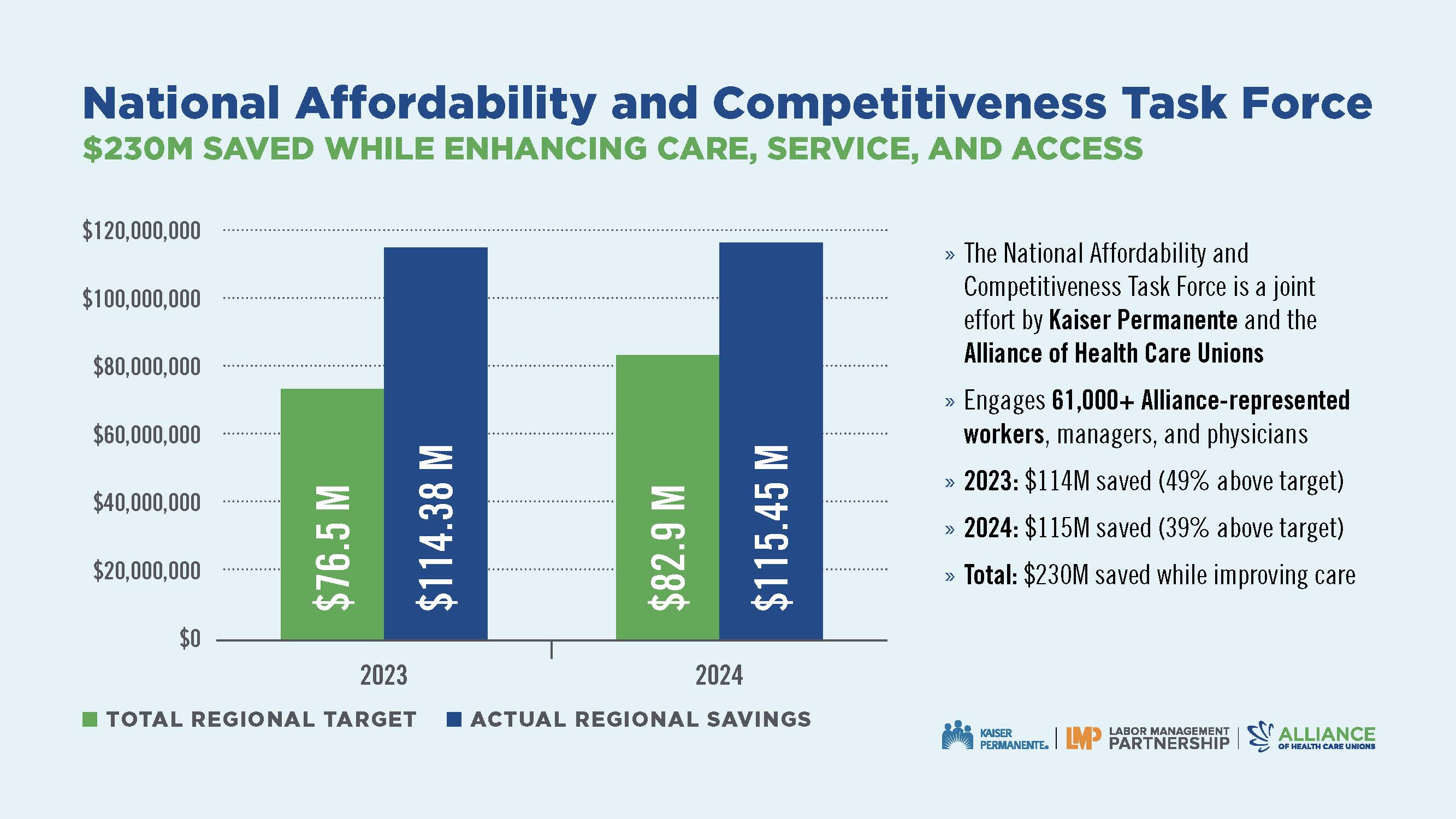
2024 Year-End Report: National Affordability and Competitiveness Task Force

Format:
PDF

Size:
11" x 8.5"

Intended audience:
Anyone with an interest in keeping Kaiser Permanente affordable and competitive

Best used:
See how Alliance-represented workers, with managers and physicians, saved $230 million over two years while improving quality, service and access. Share at huddles, LMP council meetings, and other partnership gatherings. Read the details.

Related tools:

Partnership Propels Staffing Turnaround

Deck: 
Fewer contract workers, higher satisfaction scores in Downey

Story body part 1: 

Staff overtime soared. Patient satisfaction scores plunged. Large numbers of contract nurses filled shifts each day to keep up with patient care.

By the end of 2022, staffing challenges at the Kaiser Permanente Downey Medical Center in Southern California called for drastic action.

Today, those struggles have eased, thanks to more staff nurses and a workplace innovation that tracks staffing data. Stakeholders from the executive suite to the front lines credit one thing for the turnaround: partnership.

“We worked closely with labor unions, made agreements, and stuck to them,” says Mitch Winnik, senior vice president and area manager for Downey. “The results have been amazing.”

“Patient care is getting better because labor and management are working together,” adds Paul Ciriacks, a registered nurse at Downey and UNAC/UHCP member.

How the change happened

The solution started with a simple step: setting up monthly meetings between hospital and union leaders to discuss staffing.

At these meetings, they quickly agreed on 2 main goals:

  • Hire more nurses to reduce overtime and rely less on contract workers. A key tactic was attracting hundreds of applicants through day-long hiring events organized by management and labor.
  • Follow existing staffing agreements to ensure frontline workers have a say in decisions. Make sure they arrive on time, take breaks, and avoid unnecessary overtime.

The results

Success by the numbers:

  • Six hiring events helped bring in about 1,000 new nurses.
  • Contract nurses dropped from 270 at the end of 2022 to just 20 in 2024.
  • Patient satisfaction scores at the hospital hit an all-time high — rising 35% in 2 years in the HCAHPS (Hospital Consumer Assessment of Healthcare Providers and Systems) survey.

Building trust through transparency

Supporting Downey’s success is a new staffing dashboard that covers all job classifications. It allows managers to share real-time data about staff vacancies, hiring progress and overtime usage with frontline workers.

Downey and Panorama City Medical Center are piloting the dashboard. By 2026, the staffing dashboard will be available to all Kaiser Permanente hospitals in Southern California.

Managers access the dashboard — containing sensitive personnel data — using a password. Entering a unit-based team’s name and ID number initiates an automated process that pulls recruitment and payroll data from HRconnect.

The result is an up-to-the-minute glimpse of the team’s staffing situation — and a comparison to the previous month to highlight personnel trends.

Charlene Young, a nurse manager, used the dashboard to explain a recent rise in overtime. It showed that 2 open positions were in the process of being filled. "That should help with the situation," she told her team in Downey’s medical-surgical-telemetry unit.

Andre Welch, a nurse assistant and SEIU-UHW member, says seeing the data makes him feel more confident. “For me, it always helps when they show me the hard numbers.”

TOOLS

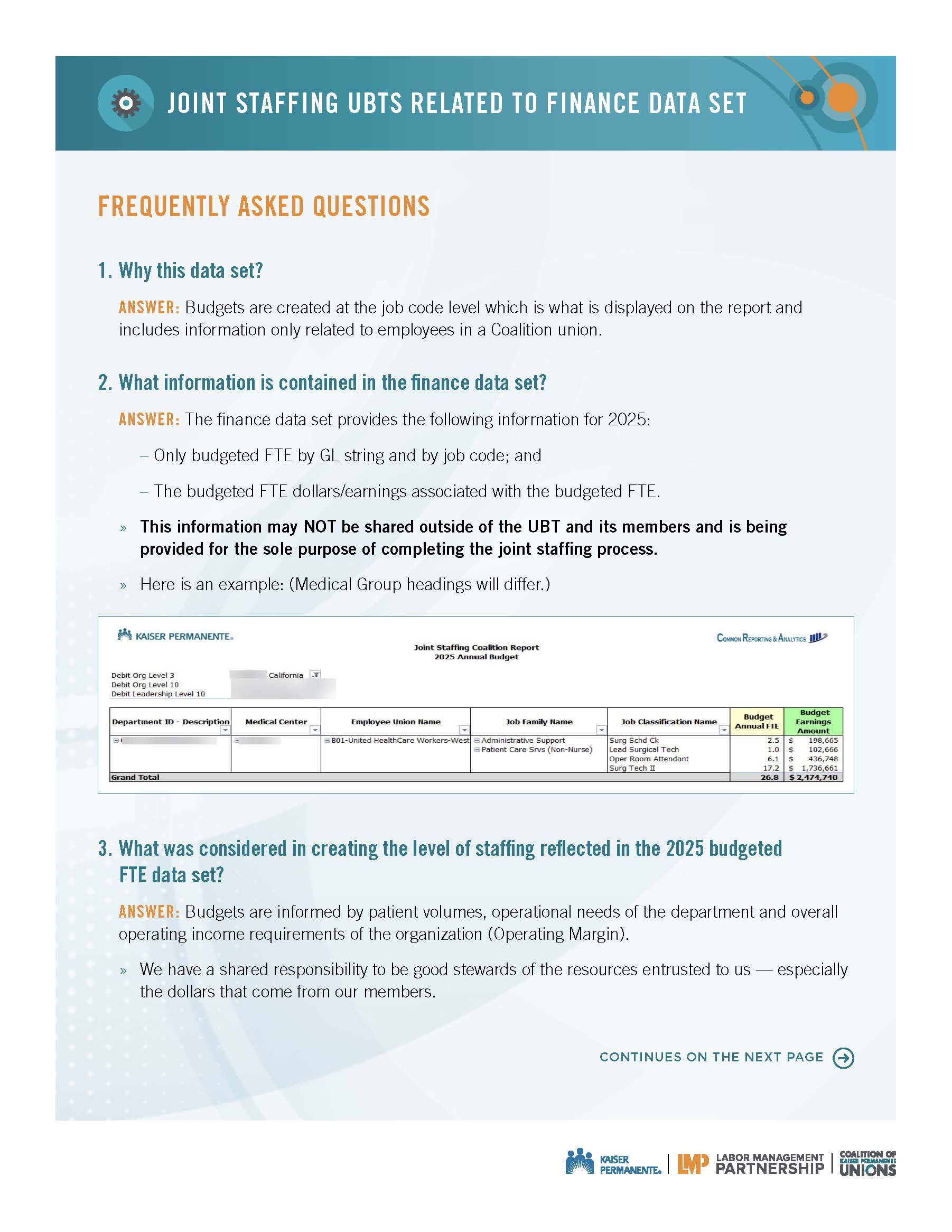
FAQs About Finance Data for Staffing Plans

Format:
PDF

Size:
2 pages, 8.5" x 11"

Intended audience:
Co-leads, UBT members and staffing champions involved in the Coalition joint staffing process.

Best used:
Review these frequently asked questions to understand how to use finance data in staffing plans involving Coalition-represented workers.

Related tools:

TOOLS

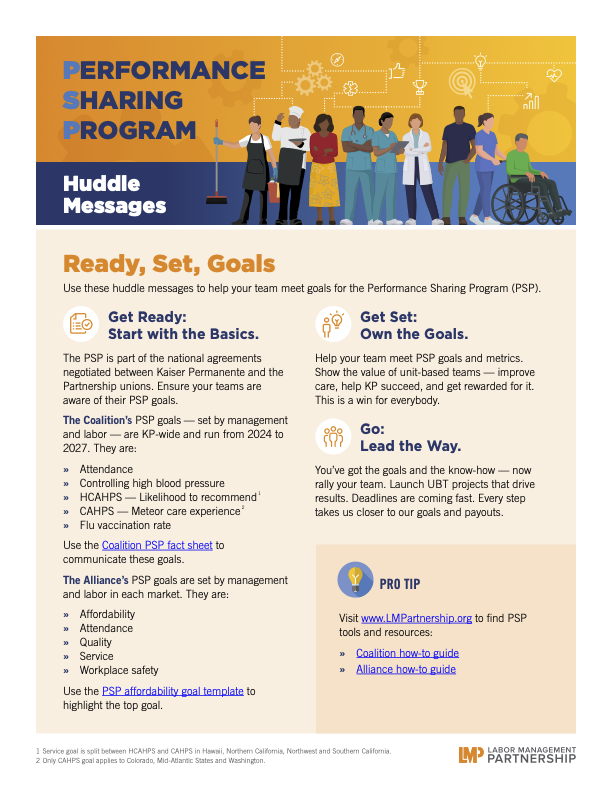
PSP: Ready, Set, Goals

Format:
PDF

Size:
8.5" x 11"

Intended audience:
Unit-based team co-leads, consultants, sponsors, Alliance partnership representatives and union partnership representatives

Best used:
Use these huddle messages to help teams achieve Performance Sharing Program goals for all Partnership union workers.

Related tools:

TOOLS

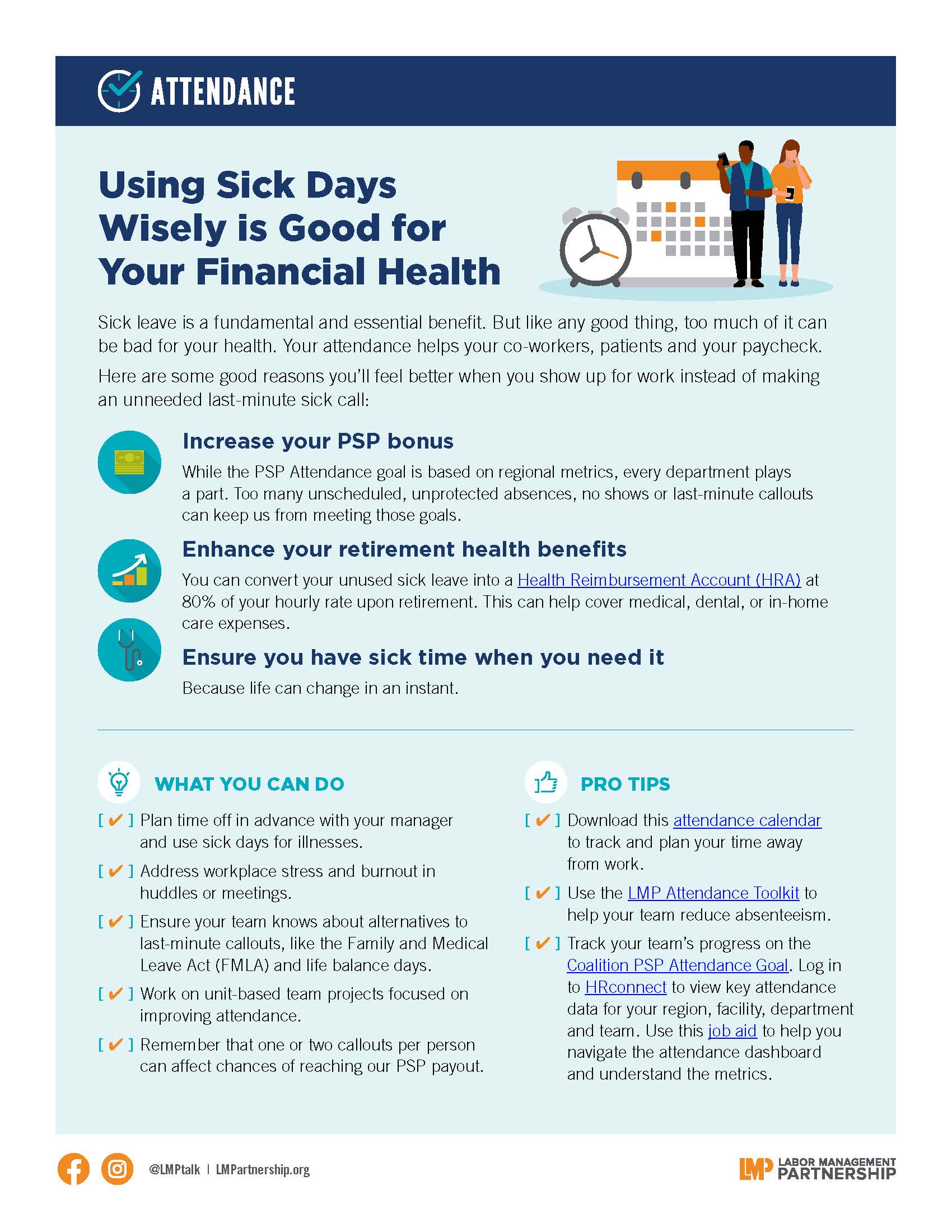
Attendance Financial Tip Sheet

Format:
PDF

Size:
8.5" x 11"

Intended audience:
Employees represented by Alliance and Coalition unions

Best used:
Use this tip sheet to help Partnership union workers understand the benefits of coming to work. Use in huddles and meetings or post it on your team's visual board.


Related tools:

TOOLS

PSP Palooza Virtual Guide

Format:
PDF

Size:

8.5" x 11" (4 pages) 

Intended audience:
UBT consultants, union partnership representatives, Alliance partnership representatives and others who support unit-based teams

Best used:
Use this tool to engage remote teams in a virtual fair celebrating Performance Sharing Program (PSP) goals. Visit the How-To Guide: PSP Palooza in a Box for more resources.

Related tools:

TOOLS

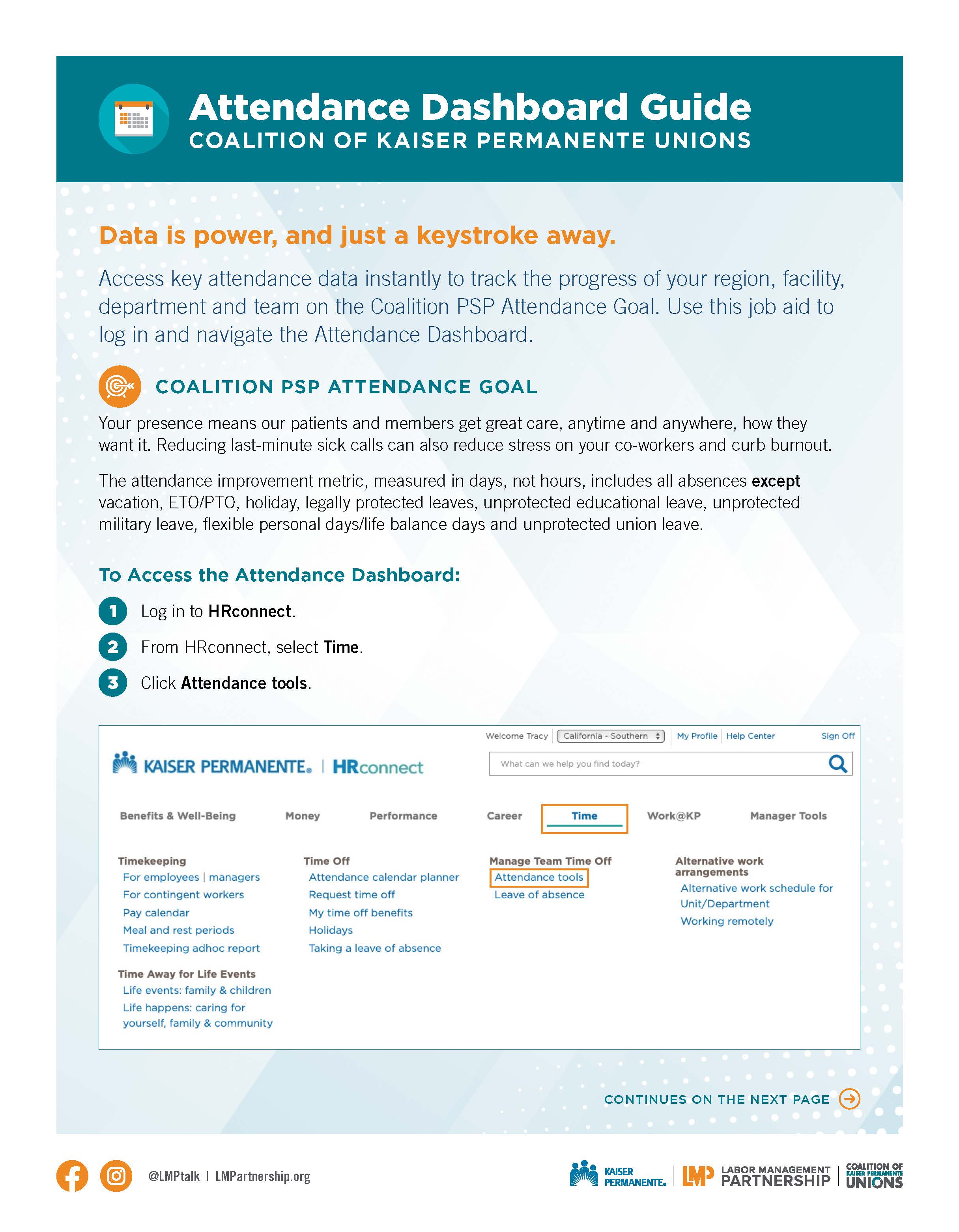
Coalition Attendance Dashboard Job Aid

Format:
PDF

Size:

2 pages, 8.5" x 11" 

Intended audience:
Frontline workers, co-leads, consultants and managers who work with Coalition-represented employees

Best used:
Use this tool to navigate the Coalition Attendance Dashboard on HRconnect [KP Intranet] and understand the data that supports the Coalition PSP attendance goal.


Related tools:

Key Findings on How Workers Perceive Technology

Deck: 
Unit-based teams have positive impact

Story body part 1: 

Frontline workers see technology as important to their work. But they vary widely in their views on how easy it is to use tech at work.

What can help workers feel more at ease with tech? Unit-based teams.

"Of surveyed employees, 82% saw the importance of technology enabling work in their unit. At the same time, 52% saw this as difficult to do. Those involved in UBTs were more positive on the importance of technology and saw lower difficulty in implementing new technology," says Spencer Lewis, a Brandeis University doctoral student.

Lewis analyzed results of the most recent survey commissioned by Kaiser Permanente and the Alliance of Health Care Unions. The survey asked workers how they perceive technology, the Labor Management Partnership, and UBTs.

Here are 4 key findings:

1. The greater an employee's UBT involvement, the more effective they perceived workplace tech to be.

2. Frontline workers interested but not yet involved in UBTs were among the most optimistic about tech's importance, effectiveness, and ease of implementation.

3. Employees without LMP training are more pessimistic about tech.

4. Employees uninvolved and uninterested in UBTs are the most pessimistic about tech's importance, effectiveness, and ability to be implemented.

Learn more about UBTs.

Related: Teams Tackle Technology One Byte at a Time


Teams Tackle Technology One Byte at a Time

Deck: 
Survey shows how unit-based teams can boost tech’s effectiveness

Story body part 1: 

When you think of technology in health care, what comes to mind?

Virtual care? Medical devices? Electronic health care records?

In Washington, a radiology team increased its health and impact with an app to track a step challenge.

In Virginia, advice nurses bonded through Microsoft Teams and a buddy system.

Across the Labor Management Partnership, unit-based teams are embracing technology step by step. By doing so, they're strengthening teamwork, improving service, and becoming more efficient.

That reflects findings of a survey by Kaiser Permanente and the Alliance of Health Care Unions. The survey asked workers how they perceive technology, LMP, and UBTs. A Brandeis University analysis of the survey linked UBT interest and involvement with views of the importance of technology.

UBTs are natural work groups that collaborate to improve patient care. The Partnership has 3,700 UBTs. Each team is co-led by a manager and a worker and a physician — if it includes doctors.

Stepping up team activities

The Olympia Radiology UBT formed in 2022.

The step challenge was an early project. To track steps, team members downloaded an app to phones and smart watches. This led the team to walk more and raised interest in the UBT.

"People get excited," says management co-lead Lydon Fitzgerald, a radiology manager. "They want to be a part of it."

The team has 50 members, including techs for CT, MRI, and X-ray. It plans to add sonographers and mammography techs.

"They want a voice," says labor co-lead Jesse Toth, a radiologic tech and UFCW Local 3000 steward. "It's about inclusion."

Know the code

The radiology team took more tech steps. It began to use Microsoft Teams to share files and host some meetings.

Then the team focused on patient satisfaction scores. It added QR codes, so patients could give real-time feedback.

But many older patients weren't familiar with QR codes. The team then added signs and created scripts to show patients how to use QR codes with their phone.

"We're trying to keep patients happy and on time," Toth says.

Make time to train

When the unit got 2 new machines, the co-leads made sure workers got trained. The team learned how to use the equipment and found ways to work smarter.

"Tech is integral to workflows. How can we make it better?" Fitzgerald says. "We embody the principles of LMP, working together at the lowest level to find solutions."

Pages

Subscribe to RSS - Best Place to Work