Culture

Help Video

How to Find UBT Basics on the LMP Website

Learn how to use the LMP website:

LMP Website Overview

Learn how to use the LMP website:

How to Find How-To Guides

This short animated video explains how to find and use our powerful how-to guides

Learn how to use the LMP website:

How to Find and Use Team-Tested Practices

Does your team want to improve service? Or clinical quality? If you don't know where to start, check out the team-tested practices on the LMP website. This short video shows you how. 

Learn how to use the LMP website:

How to Use the Search Function on the LMP Website

Having trouble using the search function? Check out this short video to help you search like a pro!

Learn how to use the LMP website:

How to Find the Tools on the LMP Website

Need to find a checklist, template or puzzle? Don't know where to start? Check out this short video to find the tools you need on the LMP website with just a few clicks. 

Learn how to use the LMP website:

TOOLS

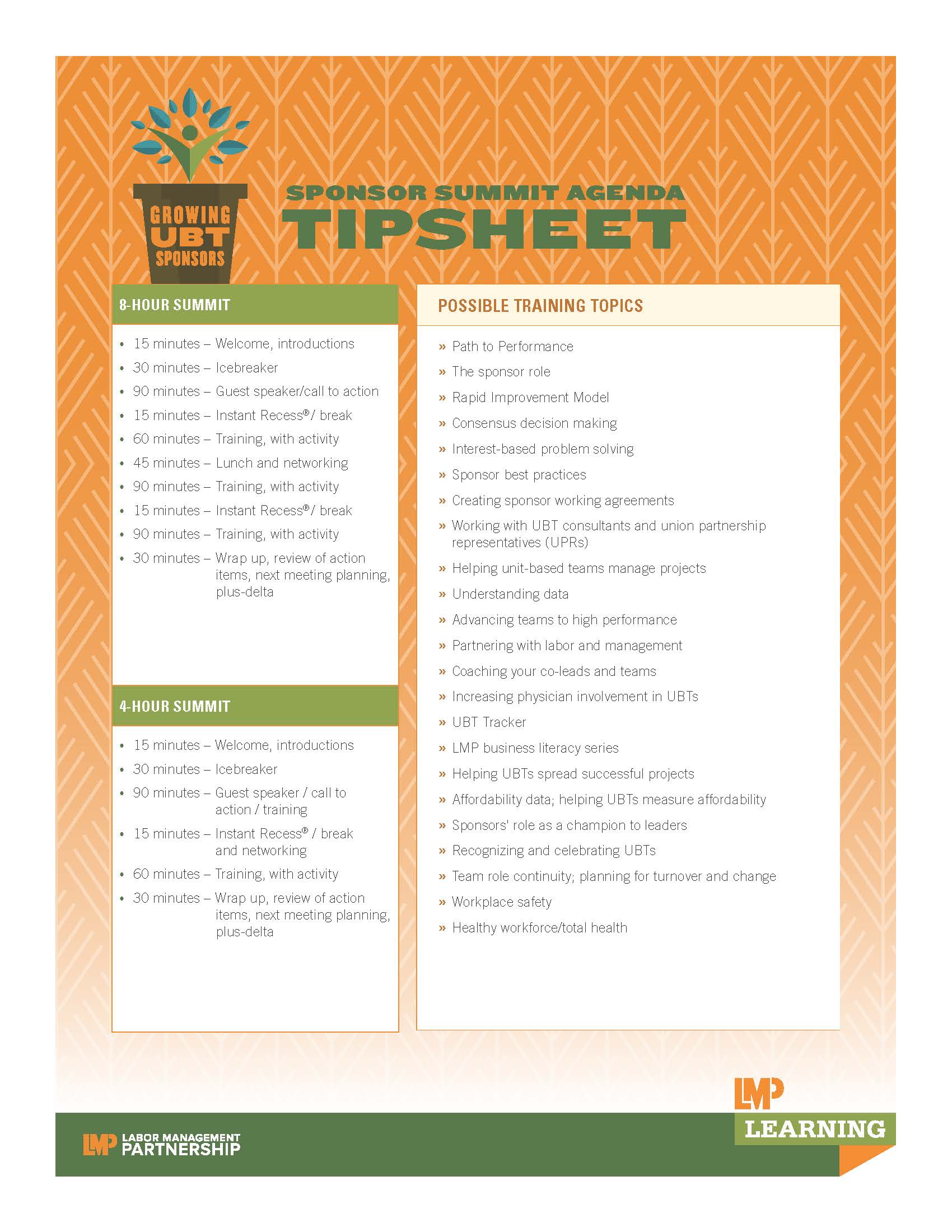
Tip Sheet for Developing a UBT Sponsor Summit Agenda

Format:
PDF

Size:
8.5" x 11" 

Intended audience:
UBT sponsors, UBT consultants, public affairs staff, regional and facility-level LMP staff, and others involved in planning a sponsor summit 

Best used:
Use this ideas to develop the agenda for your four- or eight-hour UBT sponsor summit. Includes a list of potential training topics. 

Related tools:

TOOLS

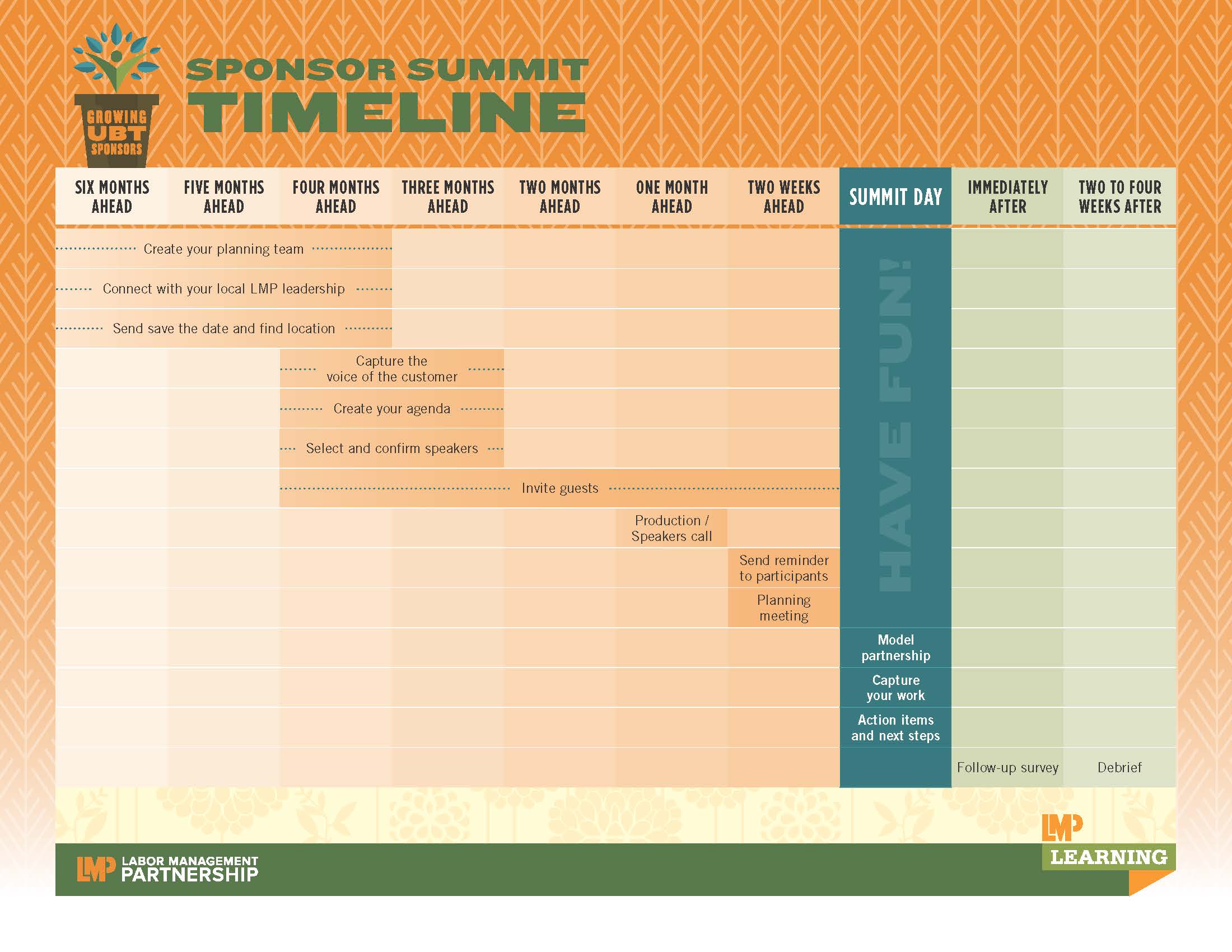
Timeline for a UBT Sponsor Summit

Format:
PDF

Size:
8.5" x 11" 

Intended audience:
UBT sponsors, UBT consultants, public affairs staff, regional and facility-level LMP staff, and others involved in planning a sponsor summit 

Best used:
Rely on this six-month timeline to keep the planning committee for a UBT sponsor summit on track, with each category of tasks arrayed on overlapping bars. Print out and use this timeline when you begin planning your summit and throughout your preparations to keep you on track for a successful event. Use with the companion planning guide, which details individual tasks.  

Related tools:

A Dose of Fun

Deck: 
Co-leads use laughter to help their team—and themselves

Story body part 1: 

When Terri Imbach, Family Practice manager at Mt. Scott Medical Office in the Northwest region, and labor co-lead Christina English, a licensed practical nurse and a member of SEIU Local 49, began to work together as UBT co-leads several years ago, they knew they needed to shake things up with the department’s unit-based team. 

The staff worked hard to meet the demanding needs of the fast-paced medical office, but morale wasn’t great—and team members weren’t taking ownership of improvement work. UBT meetings were poorly attended and often turned into complaining sessions.  

The co-leads’ first move was to go to UBT training classes together. That experience gave them an idea for their next move—which was to shake things up between the two of them by stepping away from work and getting to know each other outside the office. 

“Getting out of the work environment is a good way to get away from the stress of the department,” explains English. This mindset set the tone for how they would operate together and helped them sustain a good relationship over time.

The co-leads also adopted “fun” as part of their regular UBT agenda, and meetings now are attended by nearly 100 percent of the staff.  

“We think of fun ways to get to know each other in and out of the office, and we work to include fun elements in all of our meetings,” Imbach says. During the holidays, team members played relay games at their UBT meeting, and they participated in a fundraiser for a local youth organization that included playing basketball on donkeys. 

The creative energy of the co-leads has helped engage all 40 members of the Level 5 team, who are juggling more than a dozen quality projects. 

“Team members step up to take on projects now,” English says, “and there are friendly competitions to meet our goals.”


Partnership: Just What the Doctor Ordered

Deck: 
Georgia physician becomes an LMP advocate

Story body part 1: 

Emile Pinera, MD, a second-generation Kaiser Permanente employee, came to the company five years ago and immediately became co-lead of an adult medicine unit-based team in the Georgia region.

“I had the clinical part down,” says Pinera, who is now lead physician for diversity and inclusion in Georgia and an adviser on the region’s transgender task force. But being a co-lead and working in a UBT were unfamiliar. “I had to implement my medical knowledge in a team, as opposed to a top-down approach where the doctor tells everyone what to do.” 

He wasn’t convinced at first—but the partnership approach and physician participation helped elevate the team’s performance, and it posted some of the region’s highest quality scores for managing diabetes and blood pressure. 

“We achieved it through hard work and collaboration,” Pinera says. “I loved working with my management and labor co-leads. We were respectfully honest about what was achievable. Working in the UBT gave us the tools to effectively communicate, track, adjust and improve.”

Pinera currently guides and supports co-leads as a UBT sponsor for three teams and is lead physician for three adult medicine offices. His enthusiasm helps his teams, the members and the Georgia region. 

“I was skeptical at first about UBTs’ relevance, but we couldn’t achieve our success with hypertension and diabetes management without each other’s help. I’m a believer,” he says. “My tip for fellow providers is to be engaged as much as possible, because it will help us achieve better outcomes and help our patients thrive.”

Listening Is Key for Audiology Co-Leads

Deck: 
Appreciating each other’s different skills and background helps relationship sing

Story body part 1: 

“You have two ears and one mouth for a reason,” television’s Judge Judy frequently says, quoting an ancient Greek philosopher. “You should listen twice as much as you talk.” Successful co-leads realize that making a partnership work requires listening and learning from one another. 

Caroline Masikonde, RN, had been a management co-lead with the urgent care team at Largo Medical Center in the Mid-Atlantic States, an experience that helped her understand the importance of valuing her partner’s input. But when she accepted a new role as clinical operations manager in Northern Virginia Audiology in January 2016, she didn’t have any experience in audiology. So she’s relied heavily on her new labor co-lead, Lynn M. Reese, Au.D., a UFCW Local 400 member. Masikonde has learned why audiology UBT members escort patients outside (so they can try out new hearing aids in different conditions)—and her willingness to listen helped the co-leads bond quickly. 

“Lynn is very experienced,” says Masikonde. “I lean on her even now.” 

Reese, on the other hand, was new to the unit-based team structure, since the audiology UBT had just formed. That’s where Masikonde’s expertise came in. “We fit together pretty well,” says Reese. “Caroline is very open to listening and learning new things.”

Reese, too, expanded her knowledge, growing into an appreciation that she and Masikonde have equal say on what’s now a Level 4 UBT. “Everyone contributes,” says Reese. The ability to speak up led to Reese and the rest of the team requesting and receiving approval for an additional booth to test patients’ hearing. 

Relationship tested

Their new relationship was tested when a member—after waiting more than 12 weeks for a refund on a hearing aid that had cost more than $1,000—alerted them, loudly and angrily, to the problem. 

Instead of pointing fingers, UBT members figured out the issue: The refund request had to be processed through a department in Southern California, but the team had no way to follow up once the request was submitted. 

“This lady forced us to look at this and do better for our members,” Masikonde says. “It prompted us to come up with a better workflow,” and now the team has names and contact information for the people who work on the refunds.

“Even though it was a bad situation, she made us want to improve,” Reese says. 

Because the co-leads already were accustomed to relying on and listening to each other, they were able to quickly and calmly handle this tense situation with the unhappy member.

“We really learned our lesson,” Masikonde says. “Recently, we did a refund on a Monday—and by Friday, the member had the check. Lynn and I know our parts and do our dance.”

'No Big Me, little you'

Deck: 
Mutual respect sustains National Claims co-leads over the long haul

Story body part 1: 

They finish each other’s sentences; they call each other “Mrs.”; they praise in public and correct in private.

Antronette Moore-Mohead and Joanna Harris are a model couple. They’d make a marriage counselor proud. 

They’ve been together for three years, but they’re not married (to each other, that is)—they’re the unit-based team co-leads in the National Claims department, based in Oakland. Since co-leads frequently move on to new positions, Moore-Mohead and Harris are a long-term couple in the world of UBTs. 

“We are all for the team,” says Harris, a national claims processor and OPEIU Local 29 steward, the UBT’s labor co-lead. “Praising workers’ effort or accomplishments helps keep morale up and folks engaged in their work.” 

“Being transparent is key to succeeding as a team,” adds Moore-Mohead, the department’s processing supervisor and the management co-lead. “Also, honest, clear, concise communication is a must. So is having fun.”

'Let's talk it out'

They share stories and photos of their families, they tease each other about maybe not needing that sugary snack, and they can tell when the other is “in rare form.” Even on days when stress is high, the two know when to give each other space or when to say, “Let’s talk it out.”

“We are free to bounce ideas off of each other, without fear of being shot down,” Harris says.

The positive vibe and mutual respect between the co-leads is apparent, but they are clear that they don’t mix outside of work time to alleviate any appearance of favoritism. 

“I love that Antronette is passionate about her work. She operates from the perspective of ‘there is no Big Me, little you,’” explains Harris. 

The department they lead is responsible for collecting fees and processing claims from services performed outside of Kaiser Permanente facilities. Last year, the high-functioning Level 4 team of 39 claims processors and examiners, who are represented by OPEIU Local 29, saved more than $6 million by negotiating better rates for services rendered outside of the network. 

“It’s important to pay it forward,” says Moore-Mohead. “We want to make sure we are growing our team and others have opportunities to learn.”

Communication, Commitment, Consensus

Deck: 
Partnership basics cement co-leads’ bond

Story body part 1: 

Su-Xian Hu and Runeet Bhasin make partnership look easy. The telemetry team co-leads at Downey Medical Center in Southern California share a relaxed rapport that belies the time, planning and occasional friction that are part of running a busy inpatient unit. 

Together for more than a year, the pair attribute the success of their budding relationship to communication and a commitment to partnership principles—especially consensus decision making. Those core values came in handy recently when a disagreement arose about the best way to educate patients about medications. 

Nurses preferred a less overwhelming one-page sheet, but managers wanted to switch to a detailed three-page form that had been adopted by other units in the hospital. 

“It was a major issue,” says Bhasin, RN, a staff nurse and member of UNAC/UHCP who is the team’s labor co-lead. “We had to come up with a solution to fulfill management’s needs and labor’s needs.”

At the time of the disagreement, UBT members turned to consensus decision making to determine next steps they all could support. A subsequent test of change resulted in a short-term fix: Nurses used the short form with patients, while the longer handout was provided as a resource guide in patient rooms.

New to partnership

Managing in partnership was a new experience for Hu when she joined the team in April 2016 as assistant clinical director and became a co-lead. She previously had overseen a Kaiser Permanente inpatient nursing unit that was not part of the Labor Management Partnership. Bhasin, a co-lead with two years of experience, served as mentor and coach.

“Runeet was wonderful with helping to bring me onboard,” says Hu, who is also an RN. 

Both say LMP training has given them a shared understanding of their roles as co-leads, the purpose of UBTs and how to use consensus decision making. A business literacy class both took proved especially fruitful: With the information they brought back, the team tackled an affordability project that reduced overtime costs by more than $95,000 last year. 

“The UBT classes,” says Bhasin, “made me realize the real meaning of partnership, the collaboration of labor and management to work toward the same goal to provide high-quality care and to have a great work environment.”

The pair’s approach seems to be working. Their 75-member UBT is at Level 4 on the five-part Path to Performance, and it has earned accolades for outstanding patient care and gains in workplace safety and affordability. 

“We want what is best for patients and for staff,” says Hu. “We might have differences, but we always come together with open and professional communication, sitting down together to solve those issues.”

Videos

How Our Partnership Came to Be

Loading the player...

(9:19)

The story behind the creation of our Labor Management Partnership, which emerged in 1997 after years of strife between Kaiser Permanente and its unions. Leaders from Kaiser Permanente and some of the key Partnership unions, both past and present, share how they agreed to work collaboratively — a solution that ultimately improved care for members and provided job security for workers. Today, our partnership is the largest and most comprehensive of its kind.


Pages

Subscribe to RSS - Culture