Culture

Help Video

How to Find UBT Basics on the LMP Website

Learn how to use the LMP website:

LMP Website Overview

Learn how to use the LMP website:

How to Find How-To Guides

This short animated video explains how to find and use our powerful how-to guides

Learn how to use the LMP website:

How to Find and Use Team-Tested Practices

Does your team want to improve service? Or clinical quality? If you don't know where to start, check out the team-tested practices on the LMP website. This short video shows you how. 

Learn how to use the LMP website:

How to Use the Search Function on the LMP Website

Having trouble using the search function? Check out this short video to help you search like a pro!

Learn how to use the LMP website:

How to Find the Tools on the LMP Website

Need to find a checklist, template or puzzle? Don't know where to start? Check out this short video to find the tools you need on the LMP website with just a few clicks. 

Learn how to use the LMP website:

Decreasing Diabetes Disparities

Deck: 
Personalizing care improves outcomes for Latino patients

Story body part 1: 

When it comes to addressing health care disparities, medical office assistant Anna Jenkins thinks her unit-based team is up to the challenge. 

“I can go to my UBT members and say, ‘This is a care gap. Give me your feedback. Give me your ideas,’” says Jenkins, an OPEIU Local 30 member and labor co-lead for the Rancho San Diego Primary Care team. “Our administration listens to us. They’re very open to letting us try it our own way.” 

The Level 5 team is leveraging Labor Management Partnership principles and tools to communicate, coordinate and customize care for Latino patients with diabetes. The approach has led to better health outcomes and improved service for a group disproportionately impacted by diabetes. 

The unit-based team has increased the number of Latino patients ages 65 to 75 whose blood sugar levels are under control, according to recent clinical quality measures. 

“That partnership between management and labor is important,” says Silvia Hernandez, RN, medical office administrator and the team’s management sponsor. “This teamwork helps us to improve patient care and quality with excellent member satisfaction.” 

Adapting approaches 

Key to the team’s success is partnering with Complete Care Management, a specialized strike force that monitors the health of patients who struggle to control chronic conditions, such as diabetes and high blood pressure. 

To better support her Latino patients, care manager Lily Thamiz, RN, has adapted her approach. She books longer appointments for Spanish-speaking patients who need interpreters, refers others to bilingual diabetes education classes, and relies on phone calls to connect with those short on time. 

“The only time we can talk is when they’re driving,” says Thamiz, a member of Specialty Care Nurses of Southern California, an affiliate of UNAC/UHCP. “These are solutions I’d never considered before.” 

UBT members tailor treatment in other ways, too. To ensure continuity of care for Latino patients in their 60s and 70s, they standardized the steps needed to download and share data from glucose monitors. Providers use the devices to track patients’ blood sugar levels and adjust their medications. By consistently managing and sharing data, staff members guarantee they do not miss crucial patient information when communicating with one another. 

“They make you feel like you really matter,” says Mary Hart, 71, a Latina patient who has diabetes. “They really show their concern for your health.”


A Healthy Start

Deck: 
Giving Black moms and babies good beginnings

Story body part 1: 

LaTisha Thompson has nothing but positive things to say about breastfeeding her 1-year-old daughter, Teigen Roberts.

“It was a no-brainer for me,” says Thompson, an on-call pediatrics nurse at Kaiser Permanente’s Capitol Hill Medical Center in Washington, D.C. “I decided to do it because of the benefits that breastfeeding gives to my baby and me.”

Indeed, breastfeeding has many health benefits for babies and mothers. But Thompson stands out among African American mothers, who are less likely to nurse their children than women of other racial and ethnic groups because of cultural beliefs that formula is more filling than breast milk. Many Black moms also lack family support and access to breastfeeding resources.

“It’s a national problem,” says Lori Franklin, RN, a lactation consultant and member of UFCW Local 400 who is working to close the gap with her colleagues at the regional Newborn Care Center in the Mid-Atlantic States.

Learning from moms

To better understand the challenges African American women face, the Level 4 unit-based team surveyed 45 Black moms as part of a “voice of the customer” project in January 2019.

The results were revealing.

“They were looking for prenatal education,” says labor co-lead Francesca Klahr, RN, a lactation consultant and UFCW Local 400 member. “We went back to the drawing board, and when we offered it, they came.”

The team doubled the number of prenatal breastfeeding classes and partnered with ob-gyn nurses to encourage African American women to enroll. The response was dramatic.

The percentage of Black mothers taking prenatal breastfeeding classes jumped from 3% to 15% between September 2018 and September 2019.

Kathleen Fulp, a mother of 2, joined the class after experiencing initial difficulty nursing her firstborn child, Savannah, now 2 years old. She’s glad she did. “I probably would have given up had I not had support.”

Such enthusiasm spells success for Nia Williams, clinical operations manager and the team’s management co-lead.

“We can empower and encourage our African American moms to push through, and that has been really successful.”

Equity for All

Deck: 
Teams answer the call to address care gaps

Story body part 1: 

“Everyone must put on their leadership hat. It doesn’t relate to title or overall responsibility —  it’s what you control and influence from where you stand,” said Ronald Copeland, MD, senior vice president and chief equity, inclusion and diversity officer, at the National Equity, Inclusion, and Diversity Virtual Conference Series in October.

The Labor Management Partnership is designed to foster leaders at every level, to encourage everyone to use their voice and add their ideas to solving the challenges at hand. As our nation and our organization seek new ways to advance equity and diversity — including equity in health care — doing the right thing has never been more important.

“Action matters more than passion, and impact matters more than intent,” Dr. Copeland said. “It’s great to say, ‘I want everybody to achieve equity and inclusion,’ but we have to do the actions that make that occur.”

See equity in action in this issue of Hank with inspiring actions taken by 4 unit-based teams from across the organization. Together, their commitment to achieving equitable outcomes in maternal-child health, and in treating diabetes and high blood pressure, is reshaping what culturally sensitive care looks like for thousands of our members and patients.


Editor's Letter: Meeting the Moment

Deck: 
Partnership advances equity amid pandemic

Story body part 1: 

This past year has been filled with pain and loss, from COVID-19 to the killing of George Floyd. These crises have been immense and intense.

But thanks to the tireless efforts of our entire workforce, we at Kaiser Permanente have responded to meet the moment of today’s historic challenges.

This issue looks at how our Labor Management Partnership has addressed systemic racism amid the pandemic, advancing equity in care and in the workplace.

Kaiser Permanente and the Partnership unions believe in equity and inclusion for all, and are committed to delivering affordable, high-quality care and service. As we move along on our journey to equity for all, we’re highlighting examples of this work across our Partnership.

Our cover story focuses on unit-based teams working to minimize health care disparities for the most vulnerable among us, from improving maternal-child health to treating diabetes and high blood pressure. You’ll also find resources to foster workforce and health equity.

Read about teams cultivating an inclusive workplace. See how physicians play a key role in partnership, and how our education and training resources are expanding opportunities for employees to advance their careers.

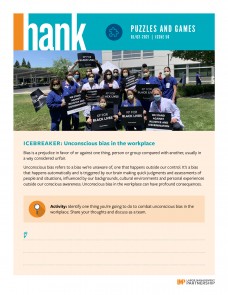
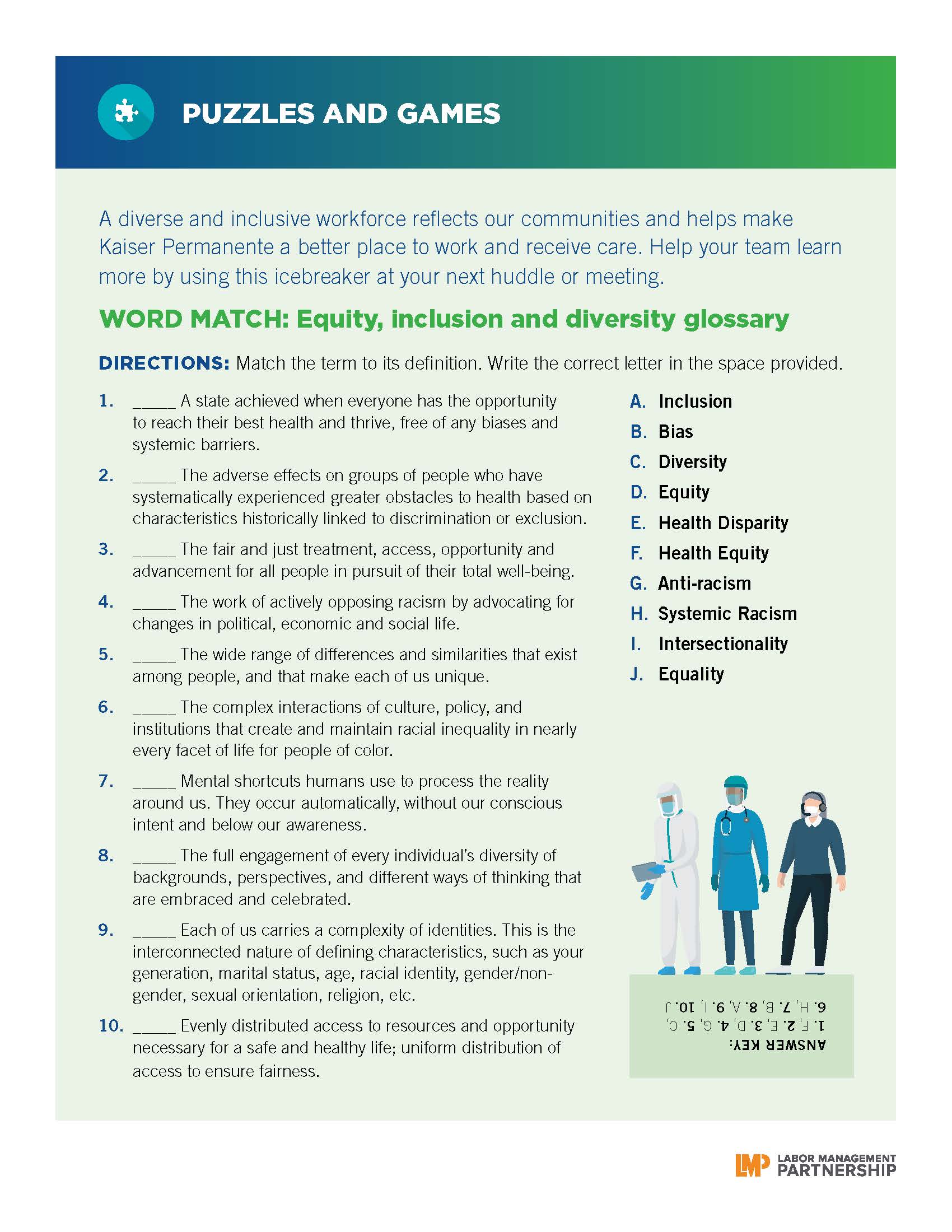
Try our puzzles and games to explore elements of equity. View our SuperScrubs comic for a thought-provoking take on the topic. And don’t miss our back cover for an inspirational quote from our chairman and CEO, Greg A. Adams.

Let’s build on these examples and commit to actions we can take to advance equity and partnership. Kaiser Permanente, and the members and communities we serve, will be better for it. 

Videos

High Hopes

Loading the player...

(1:20)

Watch this short video to hear what LMP team members in KP Washington have to say about the benefits of Partnership for frontline workers, managers, and physicians.


TOOLS

Poster: A Voice for Social Justice

Format:
PDF (color and black and white)

Size:
8.5” x 11”

Intended audience:
Frontline employees, managers and physicians

Best used:
Post on bulletin boards, in break rooms, and in other staff areas, and use as a discussion tool during meetings about how to be a voice for social justice.


Related tools:

Pages

Subscribe to RSS - Culture