TOOLS
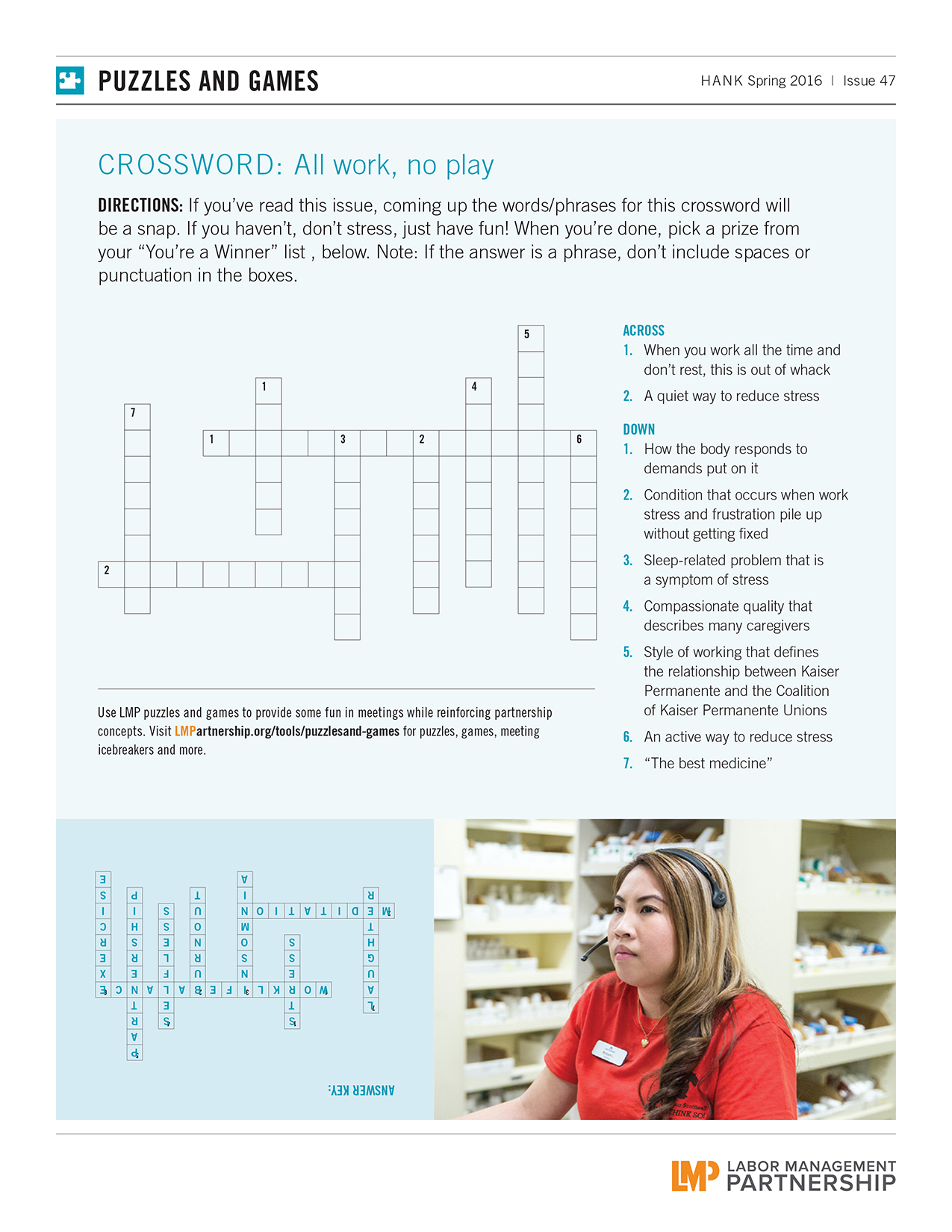
Crossword: All Work, No Play
Format:
PDF
Size:
8.5" x 11"
Intended audience:
Frontline employees, managers and physicians
Best used:
Unlock key words and phrases that describe factors related to stress.
This short animated video explains how to find and use our powerful how-to guides
Does your team want to improve service? Or clinical quality? If you don't know where to start, check out the team-tested practices on the LMP website. This short video shows you how.
Having trouble using the search function? Check out this short video to help you search like a pro!
Need to find a checklist, template or puzzle? Don't know where to start? Check out this short video to find the tools you need on the LMP website with just a few clicks.
Format:
PDF
Size:
8.5" x 11"
Intended audience:
Frontline employees, managers and physicians
Best used:
Unlock key words and phrases that describe factors related to stress.
Format:
PDF
Size:
8.5” x 11”
Intended audience:
Frontline employees, managers and physicians
Best used:
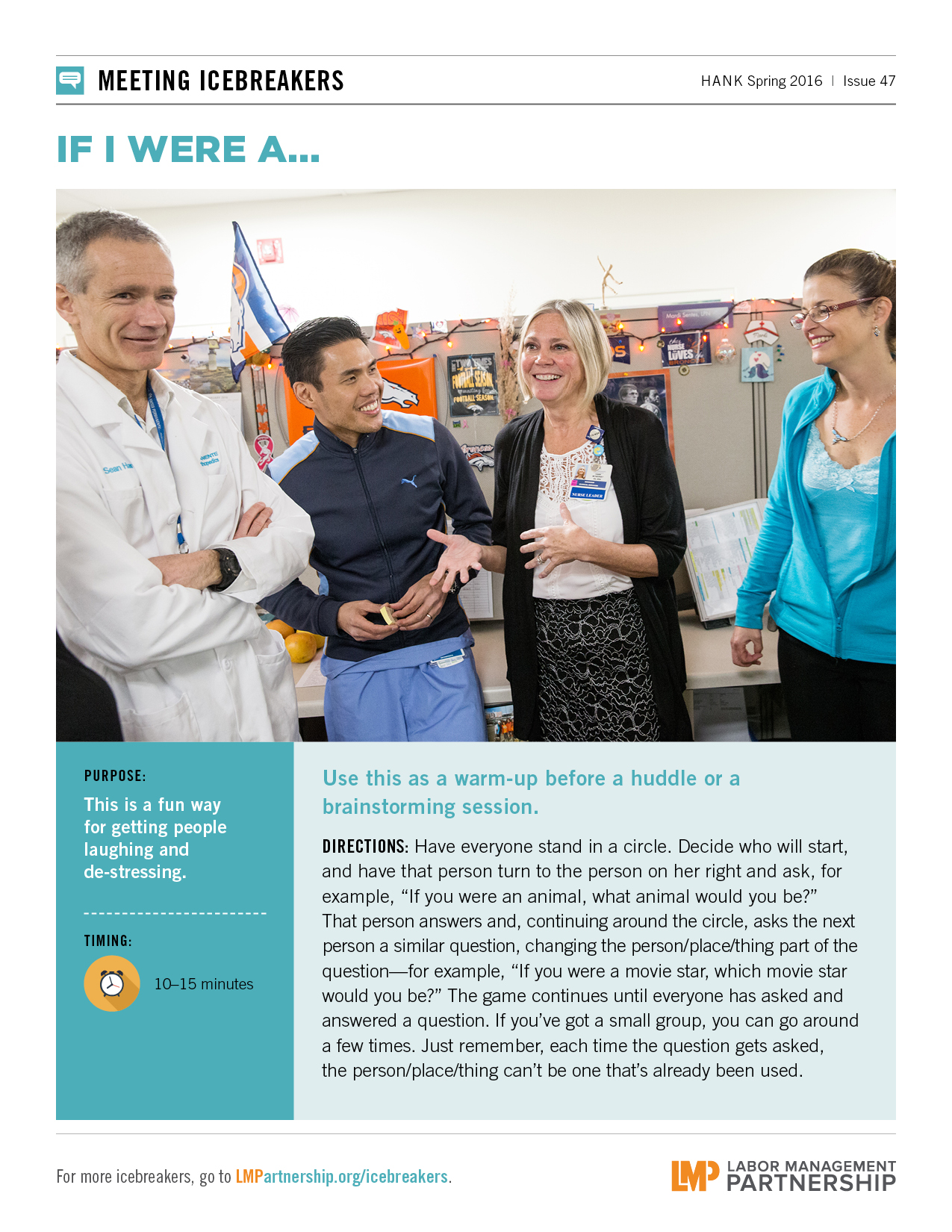
Use this meeting icebreaker as a fun way for getting people laughing and de-stressing.
Format:
PDF (color and black and white)
Size:
8.5” x 11”
Intended audience:
Frontline employees, managers and physicians
Best used:
Give yourself and your staff a break because attitude can be a matter of perspective. Take some down time, hit pause and reflect.
Format:
PDF
Size:
8.5" x 11"
Intended audience:
Frontline physicians and managers
Best used:
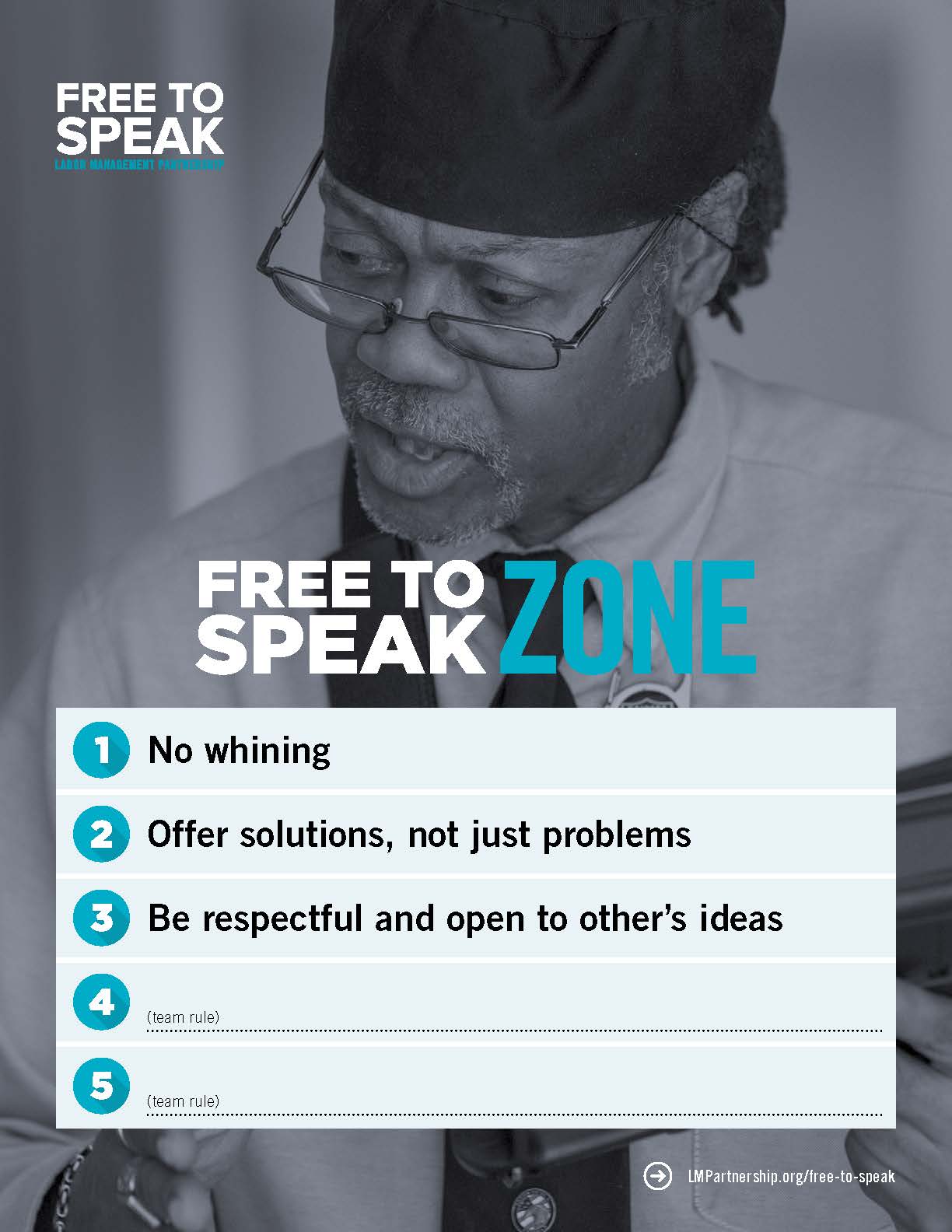
Post on bulletin boards in staff areas to designate your work area a Free to Speak Zone. This poster also lists some good ground rules for making discussions productive.
The new goal was dramatic: Reduce hospital stays to 23 hours for total joint patients.
Renee Portillo, RN, was worried.
“It was a shocker. Our staff was used to patients going home in two to three days,” says Portillo, former assistant clinical director and management co-lead of the 7 South medical-surgical team at Fontana Medical Center in Southern California.
The accelerated time frame meant that the unit’s nurses, who care for total joint patients following surgery, would have less time to prepare them for discharge. They’d also need to help choreograph care across multiple departments—Orthopedics, the operating room, Physical Therapy, Home Health—from pre-admission to discharge.
Who best to help the team through this change? The team itself.
“We used our UBT to help change the culture,” Portillo says.
“We helped our nurses be successful by having them anticipate patients’ needs and prepare them for discharge,” says Enrique Rivero, RN, a surgical nurse and UNAC/UHCP member who is the team’s union co-lead.
Fontana is among a growing number of hospitals across the United States to offer a combination of shorter hospital stays and more outpatient care for hip and knee replacement patients. The trend is driven by less-invasive surgical techniques, improved pain management and rehabilitation practices, and patients’ desire to return home as soon as possible.
“There were a lot of challenges. A lot of it had to do with bringing people together,” says Mary Hurley, MD, chief of Orthopedics, who championed the new approach. “They all had to buy in and be willing to support this in order to have a successful program.”
The new approach, which Fontana introduced in January 2014 after months of researching best practices, gets patients walking within hours of surgery and enables them to recover within the comfort of their own homes. The initiative takes advantage of Kaiser Permanente’s integrated model of care and is designed to improve clinical outcomes and reduce costly hospital stays.
On a warm fall afternoon, nearly 35 children are bouncing off the walls as they get ready to leave the classroom and head out to their elementary school’s garden. They’re all members of an after-school garden club and cooking class called Edible Olympic. It’s the brainchild of Maria Peyer, an oncology nurse and team co-lead at the Longview Kelso Medical Office in Kaiser Permanente’s Northwest region and her husband, elementary school teacher Michael Bixby.
The kids can barely contain their excitement as Bixby tries to calm them down so they can listen to the afternoon’s agenda.
“The sooner you settle down and be quiet, the quicker I can finish what I need to say and you can get outside,” he implores the class.
Quickly, the hubbub settles. Bixby goes over what needs to be done: plant blueberry bushes, dig a hole for a tree, and remove bamboo sticks. He also reviews the Garden Guidelines, which include listening with respect, walking (no running) in the garden, and asking for permission before picking anything. Then he asks, “Whose garden is it?” and gets a resounding and loud, “Ours!” as everyone heads outside to get to work.
The students attend Olympic Elementary School in Longview, Washington. They don’t have many advantages: More than 20 percent of the city’s population is below the federal poverty line, and 90 percent of the school’s students participate in the free or reduced-price lunch program. Many experience food insecurity regularly, not knowing if they’ll have enough—or any—food to eat.
There are well-documented health disparities related to low income, and these kids are at risk. Edible Olympic is helping address that vulnerability, teaching the kids about healthy food and how to prepare it, laying the foundation for good eating habits that last a lifetime. It’s an example of how partnership principles expand naturally and necessarily into the community; the new 2015 National Agreement includes commitments to jointly work on improving the health of the communities we serve.
The Longview project grew out of a Kaiser Permanente adult cooking class recommended for oncology patients, one that focuses on a plant-based diet. Peyer says that after moving to Longview, she and her husband were struck by the limited resources available to the children in the community.
“We wanted to affect change as directly as possible,” says Peyer, an OFNHP/ONA member. “So we dove headfirst into Edible Olympic. We didn’t want to spend time in meetings, we just wanted to get in the dirt and the kitchen—and that’s what we did.”
She sought support from Thriving Schools, one of Kaiser Permanente’s Community Benefit programs. She forged partnerships with the school’s Parent-Teacher Organization and the Lower Columbia School Gardens, a nonprofit that helps schools create garden programs. Local stores donated money. High school students from Longview and Portland also are participating.
“The kids, their parents and the greater community have embraced the efforts and confirmed that our hunches were right,” Peyer says. “Good, healthy, real food, prepared simply, with love and in community, can be life transforming.”
Members of the Oncology unit-based team are supporting the project, too, donating money and time; four KP employees help staff the cooking class.
“Volunteering in the community gives us at KP a chance to share our skills and our approach to supporting good health,” says Elizabeth Engberg, the Northwest’s Thriving Schools program manager. “It also helps us learn about our members—where they live, work, learn and play, because that’s a huge part of what affects their health. Schools are the best place to do this.”
The program has had overwhelming and unexpected participation.
“The idea was that this project would launch with eight to 10 kids. We had 60 kids come to the information session,” Peyer says, which prompted an instant expansion from one to two sessions. The kids work in the garden on Thursday afternoons, and on Fridays, they walk across the field to the middle school, where they are able to use the home economics classroom for cooking class. The sessions run for five weeks and end with a celebration where the kids cook a complete meal and share with their friends and family.
The first session got under way last spring. A grassy patch of the school’s property was selected as the site for the garden, and the children got seeds started indoors. As weather allowed, the ground was prepared. While they waited for their seedlings to be ready to plant, the kids were introduced to kitchen safety and how to prepare the food they were just beginning to grow.
In the cooking class, kids have a healthy snack, then work in small groups to prepare the dish of the week. When the cooking is done, they gather together and enjoy their meal. The kids leave with a bag of groceries so they can cook the meal at home.
“In some cases, this may be the healthiest meal the family may eat during the week,” Peyer says.
On that fall day out in the garden, the kids in the second session organized quickly after studying the garden map Bixby brought along for reference. They divided themselves into groups and got to work with shovels, buckets and plants to complete the day’s activities.
One of the choices they faced was whether to extend the blueberries to the fence or stop a few feet in to allow for a foot path. Several kids piped up with ideas. The decision got made after 11-year-old Christian Aguibar offered his opinion.
“We can grow more things if we don’t have a walkway,” Christian said, “so let’s not have one.”
The Colorado region is improving patient care and saving millions by providing high-risk patients extra attention after discharge, leading to a reduction in readmission rates. In the Post Acute Care Transitions (PACT) program, nurse practitioners visit patients in their homes after discharge from a hospital or skilled nursing facility, giving them a chance to alter the patient’s care plan if needed. The PACT team has visited approximately 4,200 high-risk patients since the program began in January 2013. At that time, 22 percent of high-risk patients were readmitted within 30 days, at a cost of $11.7 million. The PACT team has reduced readmission rates by 50 percent, saving Kaiser Permanente approximately $6 million since the program began.
To make sure no good deed goes uncopied, the Georgia region launched a Spread and Sustain system to move best practices throughout the region—and showed off the results to KP’s board of directors at a UBT fair early last summer. Georgia took a spread blueprint from the Southern California region and fine-tuned it to meet its needs. Now its unit-based teams, sponsors and regional leaders identify projects with good spread potential, determine other locations where the new process could work, share the practice and check back to see how they’re being sustained. Several projects have been successfully spread region-wide—addressing such issues as hypertension, HPV vaccinations and lab specimen collection.
Hawaii is a beautiful place to live, but Kaiser Permanente members who live on the less-populated islands sometimes find it challenging to get the care they need. To address that, KP offers a special benefit called Travel Concierge Service. If health plan members need medical care that isn’t available on their island, KP assists them in traveling to the Moanalua Medical Center in Oahu or to a specialty care medical office. KP makes the travel arrangements and picks up the tab for travel, including airfare, shuttle service and discounted hotel rates. For minors who need specialty care, KP also pays for companion travel. “Our members love this service,” says Lori Nanone, a sales and account manager in the region.
For several years, co-leads in the Mid-Atlantic States have compiled monthly reports of their UBT activities, goals and progress using Microsoft Word and Excel. Now, the region is rolling out a dashboard that automatically compiles the same information from UBT Tracker into an easy-to-reference SharePoint site, Kaiser Permanente’s new online social collaboration tool. The new dashboard will encourage more frequent updates to UBT Tracker and eliminate the need for co-leads to create separate documents, says Jennifer Walker, lead UBT consultant and improvement advisor. “Now the information we get is more timely and easier to assess,” Walker says. “Before, the information was up to a month old.”
The Santa Rosa Medical Center Diversity Design committee is equipping employees with tools to help them provide better service to Spanish-speaking patients. The group, composed of labor and management, has been piloting a handout featuring a list of common Spanish phrases, such as ¿Necesita un intérprete? (“Do you need an interpreter?”), as well as instructions on using the phone interpreter system. The idea came from a Spanish-speaking patient on the facility’s Latino patient advisory committee, who recalled the time she was lost in the facility and no one could direct her in Spanish. The Spanish language flier is the latest in the committee’s work to help ensure all patients receive the same optimal service and care.
Unit-based teams in the Continuing Care Services department are focusing on improving the experience for some of Kaiser Permanente’s most vulnerable members: those in skilled nursing facilities or receiving home health, hospice or palliative care. Teams are focusing on ensuring better transitions for patients as they go from inpatient to ambulatory care. By identifying issues before they become problems, labor and management hope to coordinate care more effectively, reduce emergency department visits and cut down on outside medical costs.
Harmony comes easily when you use the tools of partnership. Just ask the Biohazards, a band of union members and a manager that uses partnership principles to guide performances. “We call ourselves an LMP project,” says Mary Anne Umekubo, a clinical laboratory scientist and Regional Laboratory assistant director who sings and plays percussion and guitar. She is among six band members who represent a variety of departments, shifts and unions, including SEIU-UHW and UFCW Local 770. Performing for friends and colleagues, band members use consensus decision making to choose songs, interest-based problem solving to fix mistakes and the Rapid Improvement Model to tweak performances. “We’re from different departments,” says drummer Eric Cuarez, a regional courier driver and SEIU-UHW member. “We come together to play music.”
“This whole project was a mere idea written on a piece of paper only a few months ago,” says Juan Piantino, MD, “and now it’s a reality.”
Shortly after Dr. Piantino, a neurologist, came to Kaiser Permanente in July 2014, he was approached by another member of the department—Debbie Newcomb, an electro-neurodiagnostic technologist and UFCW Local 555 member. Newcomb’s work includes performing electroencephalograms (EEGs), a test that monitors a patient’s brain waves and helps diagnose patients with epilepsy.
She was interested in implementing ambulatory EEGs (AEEGs), an advanced technology that is relatively new. Because the test is conducted over a longer time period than a routine EEG, it is more likely to capture events that provide the medical team with information needed for a good diagnosis. AEEGs also are less expensive than an inpatient telemetry EEG. But Newcomb needed a physician partner to move forward.
“I wasn’t intimidated about approaching him,” says Newcomb, who’s the labor co-lead of the neurology UBT. “The partnership has given me the confidence to speak up—and in fact, I consider it part of my role as a union steward.”
Dr. Piantino had experience with the test with other health care systems—as did Newcomb—and was enthusiastic. The pair began figuring out how the test could be implemented in the Northwest region. Newcomb collaborated with the staff at the Stanford Comprehensive Epilepsy Center to understand the specific details of its program. She worked with KP Purchasing to identify the type and cost of the machines that would be needed.
Armed with information, Dr. Piantino met with leadership of the Northwest Permanente Medical Group—and within a few short months, in December 2014, the region was equipped to do continuous ambulatory EEGs.
So far this year, 16 patients have had their treatment guided by the ambulatory EEG as outpatients. Because the test is administered with a camera, the physician reading the results can see the patient in real time and correlate the brain activity to the physical movements of the patient. In addition, being able to conduct the test in the patient’s own environment avoids a potentially stressful and expensive hospital stay.
One adult patient had been in and out of the Emergency department five times in two weeks. Newcomb performed the ambulatory EEG on him; he had five events, all pseudo-seizures. “He is now seeing the proper doctor for his problems—no more trips to the ED,” Newcomb says.
By the end of July, the program already had paid for the cost of equipment. The benefits of an accurate diagnosis for the patient are immeasurable.
“It was the positive attitude and the willingness to improve patient care that made this happen in record time,” says Dr. Piantino.
Not all epilepsy is easily identifiable. One young, active child who was recently diagnosed was brought into the Neurology clinic because he was not meeting developmental milestones, and his parents and physician were concerned. The team turned to the ambulatory EEG.
“We got a really good study,” says Dr. Piantino. “This will guide his therapy.”
In another instance, neonatologists at Sunnyside Medical Center were able to control a newborn baby’s seizures within 48 hours when they turned to the ambulatory/continuous monitoring EEG test—after the routine EEG didn’t reveal any unusual brain activity.
“I have been a pediatric neuro-intensivist at two big centers, in Seattle and Chicago,” Dr. Piantino says, “and I can say with confidence that this child received state-of-the-art treatment.”
(2:22)
With the advent of the Labor Management Partnership, the physician “is not in charge," but rather just “another perspective at the table,” says Brent Arnold, MD. Watch this short video to see one physician's perspective of the LMP.
Ten weeks of national bargaining between Kaiser Permanente and the Coalition of Kaiser Permanente Unions concluded Saturday, June 6, when 150 union and management representatives approved a tentative 2015 National Agreement. The agreement now goes to the 28 union locals that compose the coalition for ratification and to Kaiser Permanente senior leaders for approval.
The three-year tentative agreement is designed to help unionized workers and managers achieve quality, affordability and safety of care; prepare for jobs of the future; and develop innovative solutions to health care challenges. The agreement also will enable our 3,500 unit-based teams to better deliver award-winning care and service to Kaiser Permanente’s more than 10 million members and patients.
“This is an outstanding agreement that deepens our ability to provide affordable, high-quality care to our members and patients,” says Dennis Dabney, the senior vice president of National Labor Relations and Office of the Labor Management Partnership. “Kaiser Permanente leads the industry because it is a great place to work and a great place to receive care—and the two are inseparable.”
“We’re on year 18 of a remarkably successful strategy,” says Hal Ruddick, executive director of union coalition. “Our contract is better than ever, Kaiser Permanente’s quality and service scores are higher than ever, and the organization and unions are both healthy and growing. Partnership pays off for workers, consumers and mission-driven organizations like Kaiser Permanente.”
The agreement includes wage increases in each year of the agreement (see specifics below), provides operational flexibility and bolsters joint problem-solving capabilities. It builds on the successful 2012 National Agreement, strengthening provisions for workplace health and safety, providing additional funds for workforce training and development and ensuring the consistent application of partnership principles.
The new three-year tentative agreement includes:
Our agreement is the largest private-sector contract in the United States this year. Once it is approved by Kaiser Permanente senior leaders and ratified by union members this summer, it will take effect Oct. 1, 2015, and be in effect through Sept. 30, 2018.
The impact of the agreement “goes beyond the words on paper,” says Jerry Vincent, the Northern California region’s director of Labor Relations. “It lays the foundation for us to continue to provide quality, affordable care for many years.”
“There were some tough moments,” Denise Duncan, RN, the executive vice president of UNAC/UHCP, says of the negotiations. “But people came back together. It was a reminder that our national agreement—and our partnership—is very strong, and we keep making it better. There’s nothing like it anywhere else.”
For more information, see www.bargaining2015.org.