Frontline Physicians

Help Video

How to Find UBT Basics on the LMP Website

Learn how to use the LMP website:

LMP Website Overview

Learn how to use the LMP website:

How to Find How-To Guides

This short animated video explains how to find and use our powerful how-to guides

Learn how to use the LMP website:

How to Find and Use Team-Tested Practices

Does your team want to improve service? Or clinical quality? If you don't know where to start, check out the team-tested practices on the LMP website. This short video shows you how. 

Learn how to use the LMP website:

How to Use the Search Function on the LMP Website

Having trouble using the search function? Check out this short video to help you search like a pro!

Learn how to use the LMP website:

How to Find the Tools on the LMP Website

Need to find a checklist, template or puzzle? Don't know where to start? Check out this short video to find the tools you need on the LMP website with just a few clicks. 

Learn how to use the LMP website:

Quality

Kaiser Permanente is a leader in multiple measures of clinical quality — and unit-based teams are a key to that success. Partnering together in high-performing teams, frontline workers, managers and physicians are improving patient access, expanding preventive care and increasing patient safety.


Free to Speak

When we speak up, good things happen.

Where there’s open communication, we have better care outcomes, fewer workplace injuries and lost work days, and more satisfied patients.

That’s why supporting a culture where people are free to speak is essential to our success at Kaiser Permanente.

Dancing the Stress Away

Deck: 
Call centers typically breed burnout—but KP’s teams are finding ways to be the exception to the rule

Story body part 1: 

At 8 a.m. every workday, an alarm sounds at the Member Services Call Center in Denver. Instantly, Olivia Johnson and her entire unit-based team of customer service representatives to leap out of their seats.

And dance.

The dance break tradition started when one of Johnson’s co-workers set a regular medication alarm that plays music.

“He started dancing when his alarm went off, then another person started dancing with him. Now it’s all of us dancing every morning,” says Johnson, a member of SEIU Local 105. “Afterwards we clap and tell each other it’s going to be a good day.”

Shaking their groove thing, having regular potlucks and sharing information that might make work easier for others are ways Johnson’s team combats potential stress at work. Constant stress can result in faster breathing and an increased heart rate, which the American Heart Association says can lead to physical pain, depression and unhealthy behaviors to compensate.

The members of Johnson’s UBT also alternate work assignments, so that representatives aren’t doing the same thing every week. One week, half of the team fields the calls from Kaiser Permanente members, while the other half answers questions from all of Colorado’s customer service representatives via SameTime chat. The next week, they switch. The variety helps keep the demands of the job manageable.

Stress comes with the job

Terrence J. Cooper, who manages the Maple Lawn Call Center in Fulton, Maryland, says one reason working in a call center can be stressful is, simply, the nature of the work.

“We take complaints here,” says Cooper, who has been at Kaiser Permanente since 2006. “Complaints alone can be stressful.”

Cooper, who manages 20 people, tries to keep his team upbeat by injecting humor into his UBT’s daily huddles and team meetings. The team also host potlucks and does team-building activities outside of work, such as bowling.

“This allows us to catch up as a team,” Cooper says. “We talk about the weekend or the kids. It gives everyone an opportunity to take their minds off that last call.”

Cooper also serves as the local co-lead for the Kaiser Permanente wellness program “Live Well, Be Well” and tries to promote a healthy work environment to reduce stress. Frequently, fitness video games, board games or music are available in the break room to help folks “de-stress,” he says. “We try to lighten the mood.”

There’s a serious side to adding fun and festivities to the job: A study in the 2006 Ivey Business Journal Online found that workers who feel empowered and engaged—one of the outcomes of the light-hearted endeavors—are more productive and have fewer safety incidents.

Giving people a say

Another key element to reducing stress is giving people the ability to make more decisions at work, says Deashimikia Williams, a customer service representative in Maryland and member of OPEIU Local 2. Williams also serves as her UBT’s union co-lead and is a member of the national call center “Super UBT,” whose membership crosses regional boundaries.

Williams says empowering workers and improving their work processes can have a positive impact on stress at work. Making customer service representatives, CSRs, aware of what they can do to resolve a member’s issue also reduces frustration, says Williams, whose role on the Super UBT includes exploring different improvements.

“We look at the issues CSRs and managers experience on the floor. If we streamline a process, it may not be as stressful,” Williams says. “If we can let them know what can be done by each department and who can help resolve a member’s problem, it reduces frustration.” 

Doctor Makes House Calls to Help Teams Avoid Injuries

Deck: 
Father’s trauma inspires joint effort to create safer workplace

Story body part 1: 

Quan Nguyen, DO, learned in seventh grade how devastating a workplace injury can be. His father, a carpenter, severed part of his thumb when he lost control of the power saw he was using. The accident put him out of work for a time and forced the family to stretch its skintight budget even further.

Years later, the memory inspired him to join Orange County’s Workplace Safety Steering Committee, says Dr. Nguyen.

“I’ve witnessed, firsthand, how things at work can lead to pain and suffering for the person and his family,” says Dr. Nguyen, a physical medicine and rehabilitation physician at the Chapman Medical Offices in Orange, California. “We’re like a big family at work and I don’t want to see people hurt.”

Team visits worksites to improve safety

As the sole physician on the 12-member committee, Dr. Nguyen uses his singular perspective to engage physicians and others to build a culture of workplace health and safety.

“He’s very unique,” says Jim Ovieda, assistant medical group administrator and the committee’s management tri-chair. “He brings another voice of authority to the conversation.”

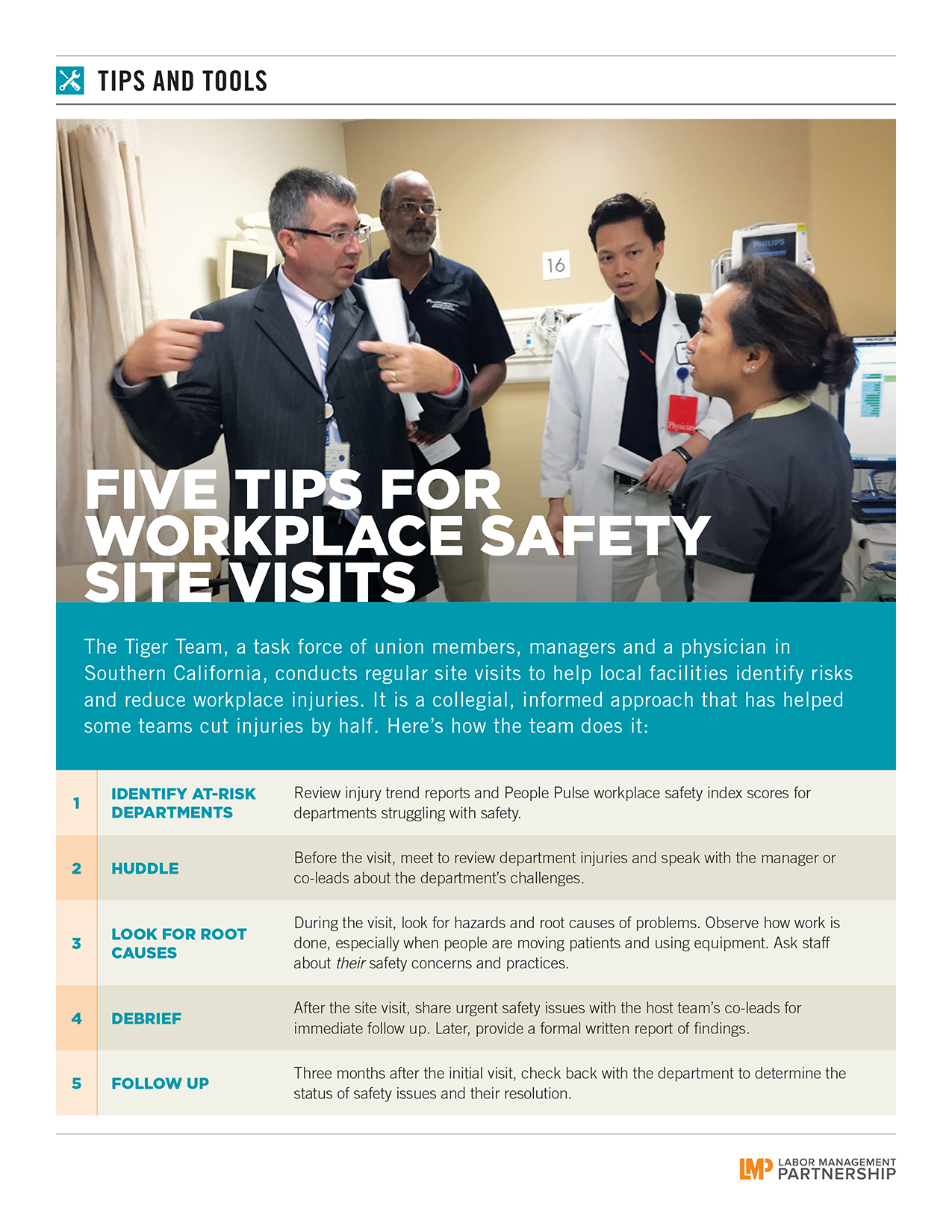
Four years ago, Dr. Nguyen helped form the Tiger Team, a task force of union members and managers who visit units with high injury rates and offer expert advice on how to reduce risks. They developed a simple process to identify and address workplace hazards at the local level (see “Five Tips for Workplace Safety Site Visits”).

“It’s not a punishment. We’re there to help departments succeed and to help our staff and physicians to be safe,” says Dr. Nguyen, who named the Tiger Team in honor of “Tigger,” the fictional tiger character who bounces around and helps others.

Collaborating with frontline union members is vital to keeping everyone safe, says Dr. Nguyen.

“There seems to be two cultures inside the hospital – the physician and non-physician. We’re trying to bridge those two cultures by bringing together a diversity of voices to improve the culture of health and safety for everyone,” says Dr. Nguyen. 

Host teams say the visits and ensuing discussions help create an environment where everyone feels comfortable speaking up—essential to building safety into daily work.

Partnership approach gets results

The team aims for six site visits a year and had conducted 31 visits as of November 2015. Most of those departments reported significantly fewer injuries in the months after the visit; many reduced injuries by 50 percent or more. The approach has gained attention region-wide and other medical centers in Southern California are adopting the practice. The team also presented its partnership approach at the 2016 National Workplace Safety Summit.

“It’s a way of taking the pulse of the department,” Ronald Jackson, a medical assistant, SEIU-UHW member and the steering committee’s labor tri-chair, says of the team's site visits.

“We bring a fresh set of eyes to the department,” says Albert Alota, workplace safety coordinator for Orange County.

Three practical solutions

Recently, the committee’s labor and management members sat side by side reviewing workplace safety records for the Irvine Medical Center’s recovery room. The department had accrued nine injuries in as many months, three of them involving employees and gurneys. The team identified several hazards related to work space and storage and recommended ways to fix them. For example:

  • To address heavy traffic down narrow hallways and around blind corners: Provide standardized traffic flow for gurneys, mirrors at key intersections and a recognized verbal cue to alert bystanders to passing gurneys and equipment
  • To unclog crowded patient bays that forced staff to work at laptops in busy hallways: Install wall-mounted computers and exam stools to replace the office chairs in the room
  • To reduce injuries caused by incorrect use of new gurneys: Ask vendors to help train staff how to safely operate new equipment

Employees appreciate the attention. “It’s good to have the team come in,” says Sol Estrella, RN, a staff nurse and UNAC/UHCP member. “It shows that management and higher-ups are responding to our staff needs.”


How-To Guide: Do a Waste Walk

Taking a waste walk with your team is a good way to get started on performance improvement.

The first step is to educate your team about the different kinds of waste, using the "8 Types of Waste" tool.

Then follow the step-by-step instructions to complete a walk. Finish by targeting elements of your workflow or workspace that can be streamlined.

TOOLS

Five Tips for Conducting a Workplace Safety Site Visit

Format:
PDF

Size:
8.5" x 11"

Intended audience:
Workplace safety leaders and teams conducting site visits to identify and remedy safety risks

Best used:
Practical, how-to advice for helping teams plan an effective site visit and improve safety.


Related tools:

Pages

Subscribe to RSS - Frontline Physicians