
Frontline Workers
Help Video
How to Find UBT Basics on the LMP Website
LMP Website Overview
How to Find How-To Guides
This short animated video explains how to find and use our powerful how-to guides
How to Find and Use Team-Tested Practices
Does your team want to improve service? Or clinical quality? If you don't know where to start, check out the team-tested practices on the LMP website. This short video shows you how.
How to Use the Search Function on the LMP Website
Having trouble using the search function? Check out this short video to help you search like a pro!
How to Find the Tools on the LMP Website
Need to find a checklist, template or puzzle? Don't know where to start? Check out this short video to find the tools you need on the LMP website with just a few clicks.
Humans of Partnership:
Technicians Turned Detectives Conquer Swirl of Scratches
- Expanding training of technicians to ensure everyone follows procedure
- Looking closely to detect problems in preparing eyeglass lenses
- Increasing maintenance of machine parts
What can your team do to detect a problem and find a solution?
LMP Insider
LMP Insider Print Edition
LMP Insider is our monthly email newsletter, sharing the latest tips, tools and stories that help you make the Partnership come to life.
This print edition is specially crafted for employees and managers who don't spend a lot of time at computers and might miss out on this important information.
Humans of Partnership:
TOOLS
Icebreaker: Intersectionality
Format:
PDF
Size:
11" x 8.5"
Intended audience:
Frontline workers, managers, and physicians
Best used:
Use this icebreaker activity to connect with teammates on a deeper level and build empathy and understanding.

Speaking the Same Language Improves Care and Understanding
- Asking members about their race, ethnicity, and preferred language helps caregivers identify and address health risks and provide culturally competent care
- Using a prompt card at the start to remind team members to ask patients for their demographic information
- Holding friendly competitions to keep team members engaged
What can your team do to standardize collection of demographic information and make it part of the workflow?
Ask about Sexual Orientation, Gender Identity to Improve Care
- Adding questions about sexual orientation, gender identity, and preferred pronouns to the intake form for new patients
- Asking patients about their backgrounds to better understand their unique health risks and challenges
- Spreading the practice to Northwest teams specializing in mental health and addiction medicine
What can your team do: Demographic data can include sexual orientation, gender identity, race and ethnicity, ability status, military veteran status, and language proficiency.
Story body part 1:
Course description
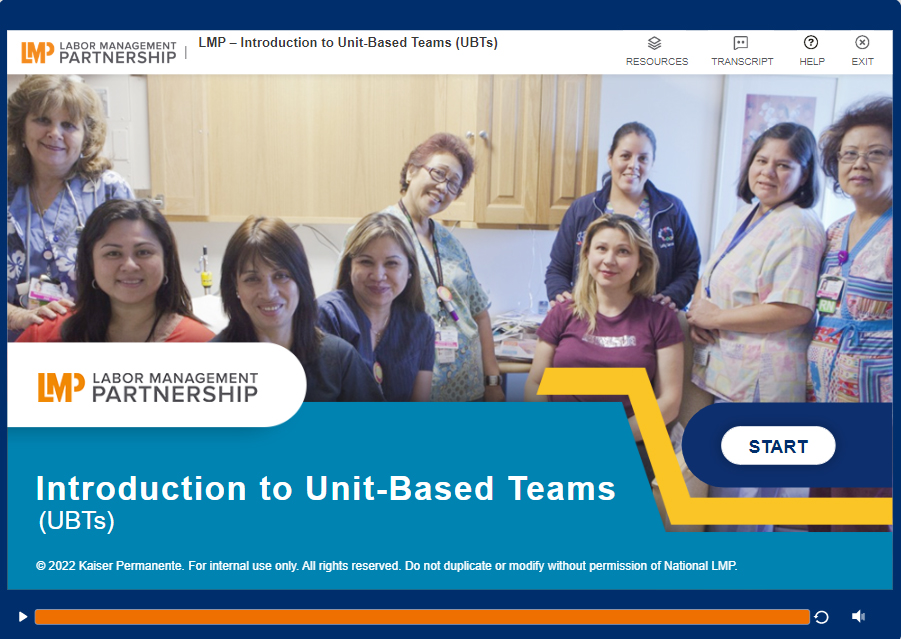
In this class, participants will learn about the what, the who, and the how of unit-based teams (UBTs) in two short lessons:
- Lesson 1 covers the basics of UBTs: What they are, their origin, types of teams, and their scope of work
- Lesson 2 introduces roles and responsibilities, core skills, and proven methods KP UBTs use to do their work.
This dynamic course includes interactive knowledge checks, audio, key takeaways, and resources. It is designed to help understand/reinforce UBT work. It does not replace the LMP Orientation training required by teams in the Path to Performance.
Duration
- 30 minutes (online)
Who should attend
Labor and management members of a unit-based team and anyone in the organization interested to learn about our successful LMP, UBT model.
Deck: Avoid burnout: plan time off, use sick days for illness
Deck:
Avoid burnout: plan time off, use sick days for illness
Story body part 1:
It was a vicious cycle: As last-minute sick calls surged, so did overtime costs and burnout among staff working extra shifts in Urgent Care at Panorama City Medical Center in Southern California.
The sick calls “impacted our entire team on multiple fronts,” said Fisayo Bhebe, department manager.
So UBT members came up with a plan. They realized that people were more likely to call in sick when work was stressful. So they urged employees to schedule time off in advance and save their sick days for illness.
Department leaders were then able to plan and maximize staffing resources – reducing stress and burnout for workers. They also rewarded those with outstanding attendance.
And, after realizing patient volumes were rising, they reviewed the budget and hired more staff. Over 10 months, last-minute sick calls dropped 40%, from an annual average of 4 days to 2.5 days per full time employee.
“Every member of the team contributed to the success of this project,” said Rosimar Carpenter, an LVN and Coalition union partnership representative. “You can definitely see how proud they are.”
A two-pronged approach
The Level 3 team includes employees represented by the Alliance of Health Care Unions and the Coalition of Kaiser Permanente Unions. They staff Urgent Care, a fast-paced department that can receive as many as 300 patients a day, 7 days a week.
Sick calls mean paying overtime to employees available to fill staffing gaps and take on extra shifts. When replacements can’t be found, staff members work short-handed as patients keep coming.
“It can be a continuous loop,” said Javier Barrios, RN, a member of UNAC/UHCP. “When people are out you carry a heavier load and it makes the day feel a lot longer.”
In 2022, challenged by last-minute sick calls, members of the unit-based team began exploring ways to reduce such calls and ensure staff members got time off. They took a two-pronged approach: partnering with leadership to bring in per-diem workers to plug staffing gaps and focusing on last-minute sick calls during UBT meetings.
Team co-leads ─ Jeanelle Concepcion, RN Supervisor, and Teresita “Tita” Obusan, an LVN and SEIU-UHW member ─ were sympathetic to the team’s struggles. They encouraged team members to plan time off in advance to avoid last-minute staffing scrambles. They also recognized workers for outstanding attendance.
Excited to work
The strategy worked. The team met its 6-month target to reduce last-minute sick calls from an annual average of 4 days to 3 days per full time employee.
What’s more, success came despite surging service demands. Member visits to the department increased by 20% in 2022 over the previous year. After reviewing the budget, the department received authorization to hire 3 new part-time licensed vocational nurses to handle the increased patient volume.
Last-minute sick calls continue to drop. In November 2022, the team recorded an annual average of 2.5 days per full time employee – a 40% reduction over 10 months.
Even better, the sense of burnout has waned. Said Obusan, “We feel less burdened and are excited again to come to work.”
Pages
