All Roles

Help Video

How to Find UBT Basics on the LMP Website

Learn how to use the LMP website:

LMP Website Overview

Learn how to use the LMP website:

How to Find How-To Guides

This short animated video explains how to find and use our powerful how-to guides

Learn how to use the LMP website:

How to Find and Use Team-Tested Practices

Does your team want to improve service? Or clinical quality? If you don't know where to start, check out the team-tested practices on the LMP website. This short video shows you how. 

Learn how to use the LMP website:

How to Use the Search Function on the LMP Website

Having trouble using the search function? Check out this short video to help you search like a pro!

Learn how to use the LMP website:

How to Find the Tools on the LMP Website

Need to find a checklist, template or puzzle? Don't know where to start? Check out this short video to find the tools you need on the LMP website with just a few clicks. 

Learn how to use the LMP website:

Getting Personal to Improve Patient Care

Deck: 
Teams collect patient demographic information

Story body part 1: 

Jenna Li and Autum Tomlin serve in different specialties at opposite ends of the country. Yet each plays a central part in efforts to harness patient data to improve care and eliminate health disparities at Kaiser Permanente.

Li is a chemical dependency counselor with the Mid-Valley Addiction Medicine team in Salem, Oregon. Members of her unit-based team, represented by Alliance-affiliated unions, make standard practice of asking patients about their sexual orientation, gender identity and preferred pronouns.

Tomlin is an urgent care technician at Reston Medical Center in Virginia. She and her team – represented by Alliance- and Coalition-affiliated unions – collect information about patients’ race, ethnicity, and preferred language. She has seen, first-hand, the power of speaking to patients in words they can understand.

“Usually, you can see the patient is at ease and feels a sense of relief that they are able to communicate in their preferred language,” says Tomlin, the team’s labor co-lead and a member of OPEIU Local 2, part of the Coalition of Kaiser Permanente Unions.

Like others across the organization, the Level 5 unit-based teams are seeking to address disparities in health and access to quality care that persist across a range of dimensions – including race, language, gender, and sexual orientation. By asking patients about their backgrounds in a safe, respectful, and compassionate way, the teams are changing how they deliver care and service to members – and relate to one another.

“The effort is minimal, and the effectiveness can be really high when we help a patient feel seen and understood,” says Li, labor co-lead for the Mid-Valley team and a member of OFNHP Local 5017, part of the Alliance of Health Care Unions.

Making members feel welcome

To better understand patients’ health risks and needs, the Mid-Valley team began asking members about their sexual orientation and gender information. They asked the questions during the intake assessment and entered patients’ responses into their electronic health records, making important background information available to all KP providers.

The practice is already changing how the Northwest team delivers care to LGBTQ+ patients.

For instance, Mid-Valley is referring more members to a weekly group therapy session for LGBTQ+ patients to discuss their unique challenges. Misunderstandings about sexual orientation or gender identity are among the obstacles such patients face in accessing effective care. They also are at elevated risk from health threats including alcohol and substance abuse.

Recently, the team hustled to track down a teen-ager in crisis who had fled their clinic’s waiting room. Knowing the teen identified as nonbinary, staff members convinced them to return after expressing sensitivity to their fears and addressing them with their preferred pronouns.

Gestures to support these patients are especially important because they come to treatment reeling from the “double whammy” of stigmatization for their addiction struggles and LGTBQ+ identity.

“We can do a lot to make a member feel welcome by using language they are open to hearing,” says Carri McCrary, Mid-Valley clinical services manager and the team’s management co-lead.

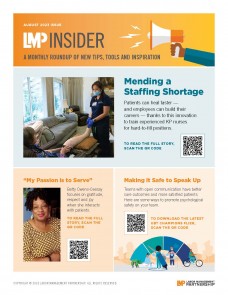
Mending a Staffing Shortage

Deck: 
KP and Alliance team up to train wound care nurses

Story body part 1: 

Time heals all wounds. But sometimes those wounds need help from specially trained nurses.

Nurses who are certified to care for wounds and ostomies are in short supply, at Kaiser Permanente and all over the country. And many are set to retire soon. There are only a few training programs, and they’re expensive and hard to get into.

The shortage of wound care nurses is an example of a much larger staffing crisis not only at KP but throughout the health care industry. KP, however, has a strategic advantage over its competitors: the Labor Management Partnership, which provides leaders and unions with the tools, structure and long-term relationships to respond to challenges creatively.

“We decided to look at what KP does best: We work with our labor partners to come up with a solution,” says Hazel Torres, RN, director of Regional Professional Development and Research Ambulatory Services for the Southern California Permanente Medical Group.

KP, several Alliance unions and other organizations came together to tackle this staffing shortage. Now more patients are healing faster, and union members are advancing in their careers at KP.

“I always wanted to do this but couldn’t,” says nurse Indra Winarso, a UNAC/UHCP member who had worked at KP for 22 years before entering the training program.  “The schools were far away, my husband traveled a lot for work, and I had a young son to take care of.”

She’s now a certified wound ostomy nurse providing home health in Orange County for KP patients.

Fortified with her new certification, Winarso says, “I have more knowledge and can do more. Colleagues ask me for consults, and they believe in me.” The benefits go beyond professional growth and a higher wage: “They see that I am different from before.”

All together for a solution

KP regional leaders from Southern California, Colorado and Hawaii joined with representatives from 3 Alliance unions and the Ben Hudnall Memorial Trust – a union-negotiated benefit – to customize a training program with San Jose State University. Participating unions include UNAC/UHCP, UFCW Local 7, and Hawaii Nurses and Healthcare Professionals.

“It was star-studded,” says UNAC/UHCP member Ianessa Ramirez, a newly certified wound ostomy nurse, marveling at the hard-won coordination. Before taking the training program, Ramirez was a home health nurse and intake coordinator at KP for 11 years.

The students augmented online training with 4 days of hands-on training at KP’s Irvine Medical Center in summer 2021 for 22 students. After that, they spent time with trained preceptors — experienced wound care nurses and union members working at KP — and then were hired into trainee positions at KP.

This innovation shows one way to overcome the barrier of experience requirements. It also illustrates the value of skilling up our current workforce.

“We showed how true the Labor Management Partnership is,” says Torres. “It’s not just a logo on a T-shirt. We believe in it because it gets our patients the best care possible.”

The entire program was at no cost to participants. Most are now working full time in their new careers at KP after years of working here in other capacities.

As a home health nurse, “I am a detective and a problem-solver,” says Winarso. “It’s like a box of chocolates — you never know what you are going to get.”

 

TOOLS

Keeping KP Affordable and Competitive

Format:
PPT

Size:
19 slides

Intended audience:
Unit-based team members 

Best used:
Download and share this slide deck, packed with inspirational stories, tips and tools for unit-based teams to make care more affordable for our members, patients and the communities we serve.

Related tools:

Videos

LMP at 25 with Dr. Tandua Washington ─ What's Working in Partnership

Loading the player...

(:35)

Celebrate 25 years of the Labor Management Partnership by listening to the people who work in partnership. Dr. Tandua Washington says the Partnership gives everyone on the team a say in how to make improvements for members and patients.

Videos

LMP at 25 with Joshua Holt ─ What's Working in Partnership

Loading the player...

(:42)

Celebrate 25 years of the Labor Management Partnership by listening to the people who work in partnership. Joshua Holt says the commitment labor and management make to each other is key to the LMP's enduring strength.

Videos

LMP at 25 with Mariela Garcia ─ What's Working in Partnership

Loading the player...

(:36)

Celebrate 25 years of the Labor Management Partnership by listening to the people who work in partnership. Mariela Garcia says people drive the Partnership's success by navigating challenges while maintaining mutual respect.

Videos

LMP at 25 with Heddy Steinman

Loading the player...

(:38)

Celebrate 25 years of the Labor Management Partnership by listening to the people who work in partnership. Heddy Steinman looks to unit-based teams moving forward on the Path to Performance as proof of LMP's success. 

Videos

LMP at 25 with Sandra Yamamoto

Loading the player...

(:27)

Celebrate 25 years of the Labor Management Partnership by listening to the people who work in partnership. Sandra Yamamoto hopes to continue to spread the word about the Partnership and our speak-up culture. 

Pages

Subscribe to RSS - All Roles