TOOLS
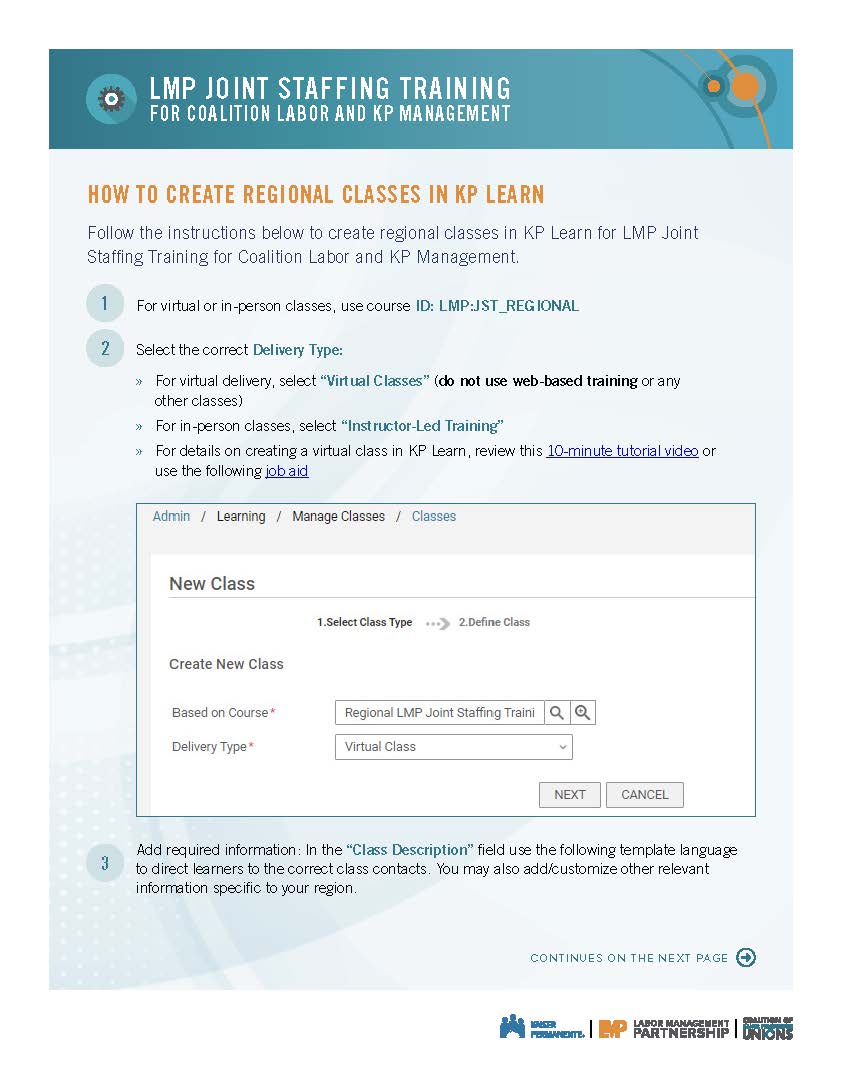
Joint Staffing Training: Create Regional Classes
Format:
PDF
Size:
8.5" x 11"
Intended audience:
KP Learn administrators
Best used:
Create regional classes for LMP Joint Staffing Training for Coalition Labor and KP Management.
This short animated video explains how to find and use our powerful how-to guides
Does your team want to improve service? Or clinical quality? If you don't know where to start, check out the team-tested practices on the LMP website. This short video shows you how.
Having trouble using the search function? Check out this short video to help you search like a pro!
Need to find a checklist, template or puzzle? Don't know where to start? Check out this short video to find the tools you need on the LMP website with just a few clicks.
Format:
PDF
Size:
8.5" x 11"
Intended audience:
KP Learn administrators
Best used:
Create regional classes for LMP Joint Staffing Training for Coalition Labor and KP Management.
Format:
PPTX
Size:
1280 x 720 pixels
Intended audience:
Communicators, workforce development professionals, managers, union leaders, executives
Best used:
Use this presentation with notes and accompanying video in team meetings to discuss workforce development resources.
Format:
PDF
Size:
8.5” x 11” (landscape)
Intended audience:
Regional and facility-level LMP staff, co-leads, consultants, and others involved in planning a PSP Palooza.
Best used:
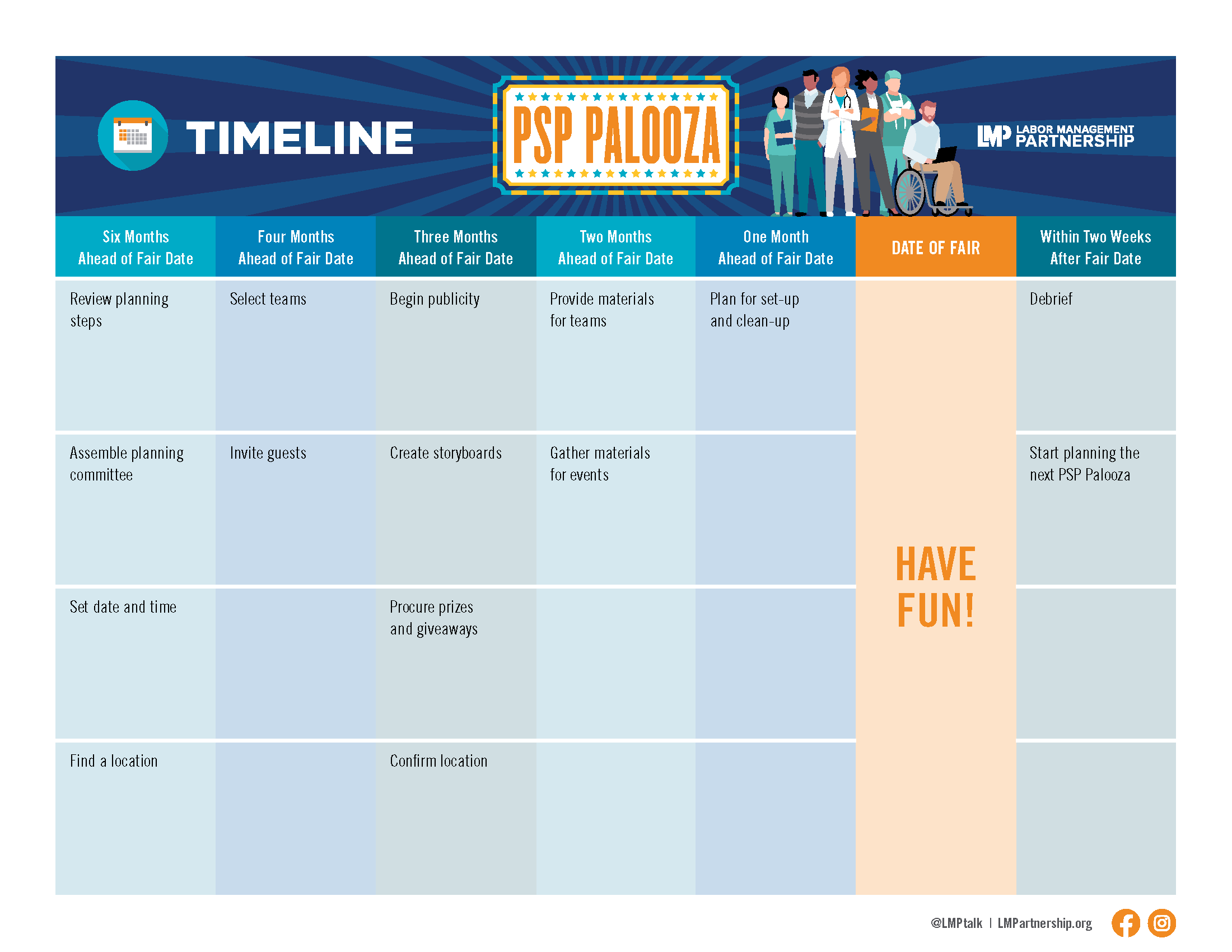
Use this six-month timeline to keep the planning committee for a PSP Palooza on track, with each category of tasks arrayed on overlapping bars. Use along with the PSP Palooza companion planning guide, which details individual tasks.
For more tools, please visit the How-To Guide: PSP Palooza in a Box.
Performance Sharing programs (PSP) empower partnership union-represented employees to make meaningful contributions to Kaiser Permanente’s success. They also enable workers to share in the organization’s performance gains by meeting or exceeding mutually agreed-upon goals.
Elevate a traditional unit-based team fair by hosting a PSP Palooza. These gatherings focus on team projects that align with PSP goals. Use PSP Palooza fairs to spread successful practices and share ideas to achieve PSP goals.
Resources here include:
What can your team do to solicit member feedback and make Kaiser Permanente the best place to receive care?
Cancer is a scary diagnosis. Patients who receive this devastating news find support and hope from the Central Interstate Oncology and Infusion team.
The Portland-based team manages an infusion clinic where an average of 70 patients receive chemotherapy daily.
Thanks to a UBT project launched in 2023, the team is helping patients better manage chemotherapy side effects. Results have led to a steep drop in the number of patients sent to the hospital because of severe reactions.
The results illustrate the power of the Labor Management Partnership. The project brought together physicians, managers, and frontline staff to find ways to lower hospitalizations and ease the burden on patients.
“This is just one highlight of how amazingly well our cancer team works as a whole,” says Christine Barnett, MD, chief of Oncology at Central Interstate.
The oncology and infusion unit-based team set out to reduce the number of patients hospitalized for severe chemotherapy reactions.
They began by closely reviewing an unexplained rise in patients receiving infusion treatment in the hospital.
The team found that about half of these patients could have continued with outpatient infusion treatment, which typically lasts 2 to 3 hours. Hospital infusions can take up to 11 hours and involve patient monitoring and additional medication measures.
“It really spoke to the need for providing more thorough onboarding and training and review for existing staff,” says Monica Hahn, manager of Central Interstate’s Cancer Service Line and Medical Oncology back office.
Significant turnover on the team during the COVID-19 pandemic led to gaps in understanding of the different treatment options available to patients, says Hahn, the team’s management co-lead.
The team’s journey pointed to a larger issue as well. During the pandemic, many teams paused important UBT work to meet increased demand for patient care.
The Central Interstate team was no exception. By early 2023, the team had dropped from Level 5 to Level 1 on the Path to Performance as completed UBT projects fell off. The Path to Performance is a five-stage “growth chart” teams use to measure success.
The care experience project marked one step in the team’s renewed focus on UBT work. They returned to Level 5 in just 10 months.
To reduce unneeded hospital visits, the team developed a skills refresher for everyone.
Pharmacy staff conducted in-service training to help employees understand the range of medications available to ease difficult side effects.
Unit-based team leaders also received training. They reviewed ways to assess chemotherapy reactions and determine which patients required hospitalization.
The training was led by Dr. Barnett, Chyna Turnbull, a nurse practitioner, and Jennie Burns, a registered nurse, both members of OFNHP Local 5017.
This educational push led team leaders to develop a 2-page handout of clinical practices. Staff members review the information with patients to help them understand expected side effects.
After taking these steps, the team saw hospitalizations for chemotherapy drop by more than 90% over 2 months in 2023. The team continues to maintain the lower level of hospitalizations.
This is good news for patients, who often must pay high deductibles for hospital admissions. And it’s good news for Kaiser Permanente, which is saving an estimated $198,000 annually due to reduced hospitalizations.
Patients also have a better care experience. They develop trusting relationships with infusion team members and maximize recuperation time at home.
“They come in for their treatment and they’re home in time for dinner,” says Burns, the team’s lead registered nurse.
“The patients see that we are all together in this,” says Rebel Herbert, the team’s labor co-lead, who is a medical assistant and member of SEIU Local 49. “We’re always just a phone call or an email message away.”
Format:
PDF
Size:
18 pages; 8.5" x 11"
Intended audience:
Labor, management and physician sponsors who support unit-based teams
Best used:
This interactive handbook provides the fundamentals for sponsors to successfully work in partnership.
Use these toolkit materials to communicate about jointly approved Alliance PSP goals and help frontline teams understand how they contribute to the success of Kaiser Permanente.
Resources include:
How to use these materials:
Format:
PDF
Size:
8.5"x11" (2 pages)
Intended audience:
Frontline union members, managers, and leaders involved in the Coalition Performance Sharing Program
Best used: Understand the goals, metrics, and eligibility for bonuses under the Coalition Performance Sharing Program for plan years 2024 to 2027.
Format:
PDF
Size:
8.5" x 11" (2 pages)
Intended audience:
Unit-based team members, co-leads and consultants
Best used:
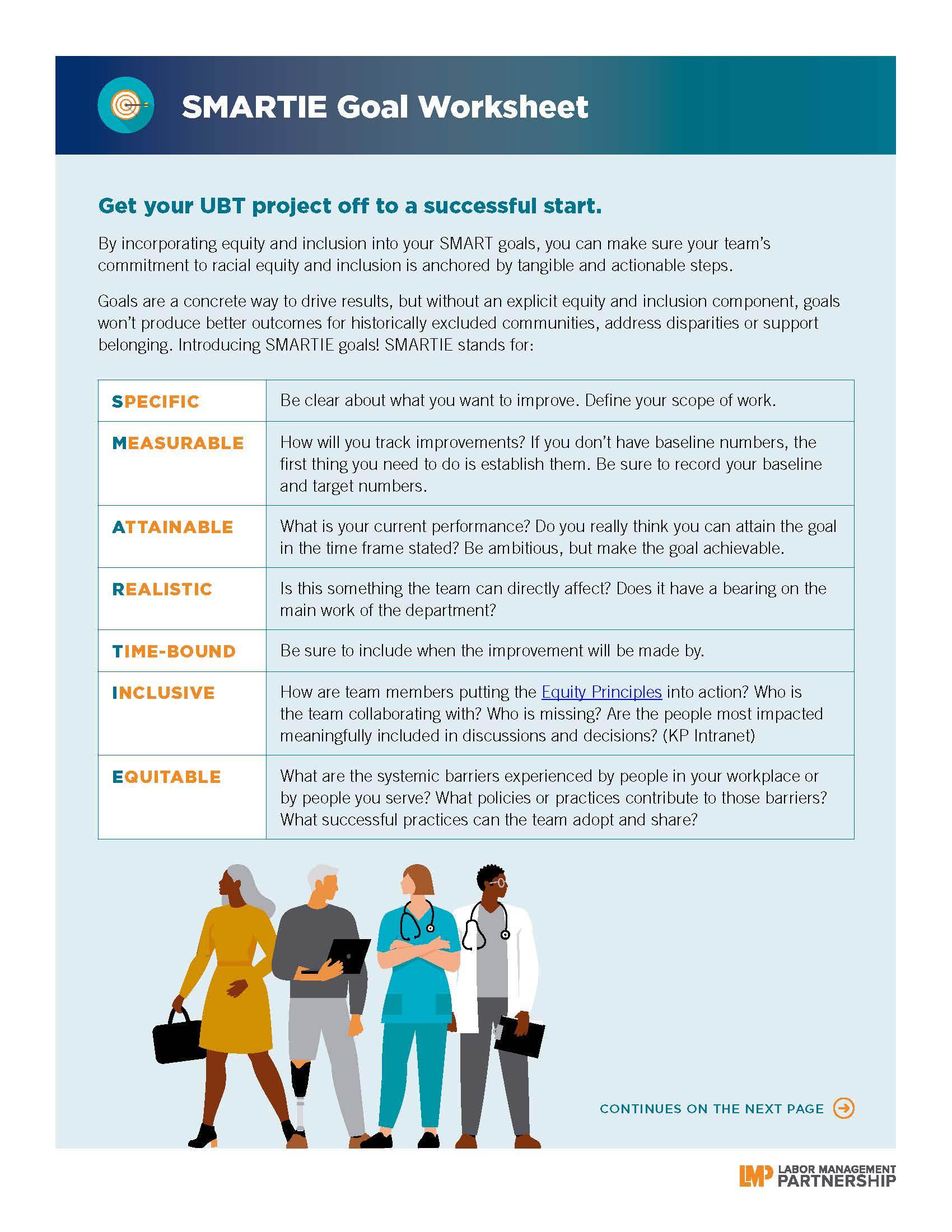
Guide team members to add inclusion and equity to their SMART goals when pursuing performance improvement projects. This editable worksheet is part of the UBT Health Equity Toolkit.