Team Member Engagement

Help Video

How to Find UBT Basics on the LMP Website

Learn how to use the LMP website:

LMP Website Overview

Learn how to use the LMP website:

How to Find How-To Guides

This short animated video explains how to find and use our powerful how-to guides

Learn how to use the LMP website:

How to Find and Use Team-Tested Practices

Does your team want to improve service? Or clinical quality? If you don't know where to start, check out the team-tested practices on the LMP website. This short video shows you how. 

Learn how to use the LMP website:

How to Use the Search Function on the LMP Website

Having trouble using the search function? Check out this short video to help you search like a pro!

Learn how to use the LMP website:

How to Find the Tools on the LMP Website

Need to find a checklist, template or puzzle? Don't know where to start? Check out this short video to find the tools you need on the LMP website with just a few clicks. 

Learn how to use the LMP website:

TOOLS

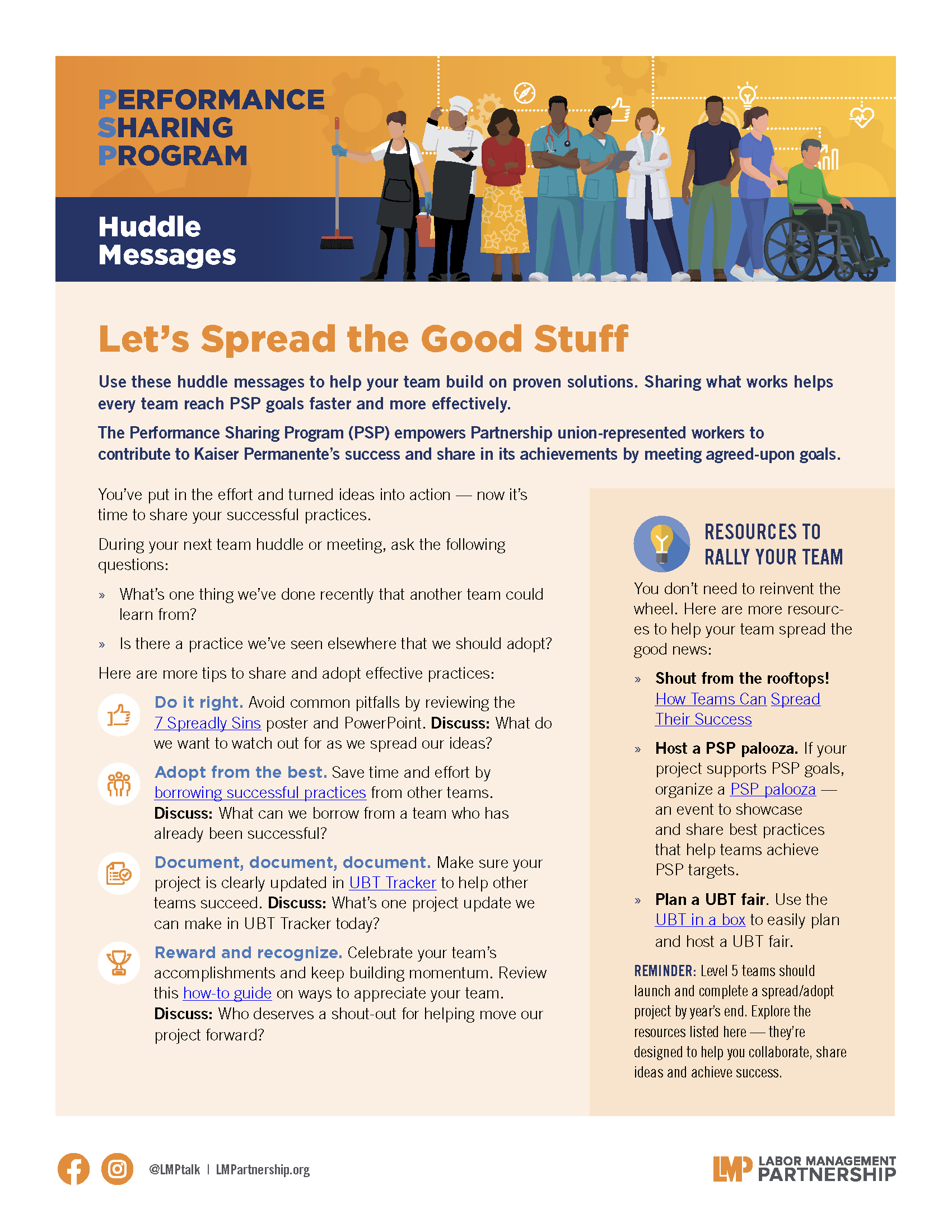
PSP: Let's Spread the Good Stuff

Format:
PDF

Size:
8.5" x 11"

Intended audience:
Unit-based team co-leads, consultants, sponsors, Alliance partnership representatives and union partnership representatives 

Best used:
Use these huddle messages to help your team share, spread and adapt UBT projects that contribute to reaching Performance Sharing Program goals. 

Related tools:

TOOLS

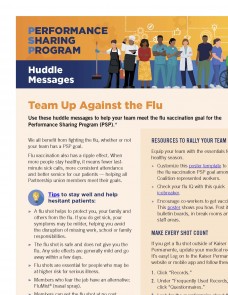
PSP: Team Up Against the Flu

Format:
PDF

Size:
8.5" x 11"

Intended audience:
Unit-based team co-leads, consultants, sponsors, Alliance partnership representatives and union partnership representatives 

Best used:
Use these huddle messages to help your team meet the flu vaccination goal for the Performance Sharing Program. Flu vaccination PSP goals apply to Coalition-represented workers throughout Kaiser Permanente and Alliance-represented workers in Hawaii, Mid-Atlantic States and Southern California. Georgia has a quality PSP goal that includes flu vaccination.

Related tools:

TOOLS

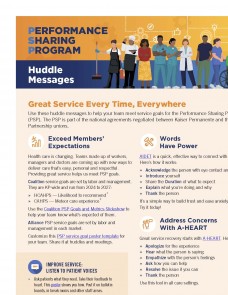
PSP: Great Service Every Time, Everywhere

Format:
PDF

Size:
8.5" x 11"

Intended audience:
Unit-based team co-leads, consultants, sponsors, Alliance partnership representatives and union partnership representatives

Best used:
Use these huddle messages to help teams achieve Performance Sharing Program service goals for all Partnership union workers.

Related tools:

Partnership Propels Staffing Turnaround

Deck: 
Fewer contract workers, higher satisfaction scores in Downey

Story body part 1: 

Staff overtime soared. Patient satisfaction scores plunged. Large numbers of contract nurses filled shifts each day to keep up with patient care.

By the end of 2022, staffing challenges at the Kaiser Permanente Downey Medical Center in Southern California called for drastic action.

Today, those struggles have eased, thanks to more staff nurses and a workplace innovation that tracks staffing data. Stakeholders from the executive suite to the front lines credit one thing for the turnaround: partnership.

“We worked closely with labor unions, made agreements, and stuck to them,” says Mitch Winnik, senior vice president and area manager for Downey. “The results have been amazing.”

“Patient care is getting better because labor and management are working together,” adds Paul Ciriacks, a registered nurse at Downey and UNAC/UHCP member.

How the change happened

The solution started with a simple step: setting up monthly meetings between hospital and union leaders to discuss staffing.

At these meetings, they quickly agreed on 2 main goals:

  • Hire more nurses to reduce overtime and rely less on contract workers. A key tactic was attracting hundreds of applicants through day-long hiring events organized by management and labor.
  • Follow existing staffing agreements to ensure frontline workers have a say in decisions. Make sure they arrive on time, take breaks, and avoid unnecessary overtime.

The results

Success by the numbers:

  • Six hiring events helped bring in about 1,000 new nurses.
  • Contract nurses dropped from 270 at the end of 2022 to just 20 in 2024.
  • Patient satisfaction scores at the hospital hit an all-time high — rising 35% in 2 years in the HCAHPS (Hospital Consumer Assessment of Healthcare Providers and Systems) survey.

Building trust through transparency

Supporting Downey’s success is a new staffing dashboard that covers all job classifications. It allows managers to share real-time data about staff vacancies, hiring progress and overtime usage with frontline workers.

Downey and Panorama City Medical Center are piloting the dashboard. By 2026, the staffing dashboard will be available to all Kaiser Permanente hospitals in Southern California.

Managers access the dashboard — containing sensitive personnel data — using a password. Entering a unit-based team’s name and ID number initiates an automated process that pulls recruitment and payroll data from HRconnect.

The result is an up-to-the-minute glimpse of the team’s staffing situation — and a comparison to the previous month to highlight personnel trends.

Charlene Young, a nurse manager, used the dashboard to explain a recent rise in overtime. It showed that 2 open positions were in the process of being filled. "That should help with the situation," she told her team in Downey’s medical-surgical-telemetry unit.

Andre Welch, a nurse assistant and SEIU-UHW member, says seeing the data makes him feel more confident. “For me, it always helps when they show me the hard numbers.”

TOOLS

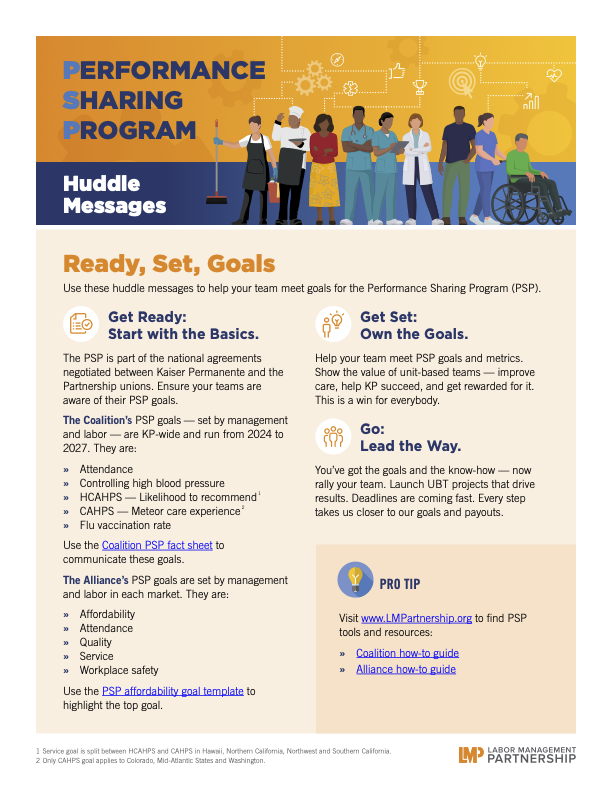
PSP: Ready, Set, Goals

Format:
PDF

Size:
8.5" x 11"

Intended audience:
Unit-based team co-leads, consultants, sponsors, Alliance partnership representatives and union partnership representatives

Best used:
Use these huddle messages to help teams achieve Performance Sharing Program goals for all Partnership union workers.

Related tools:

TOOLS

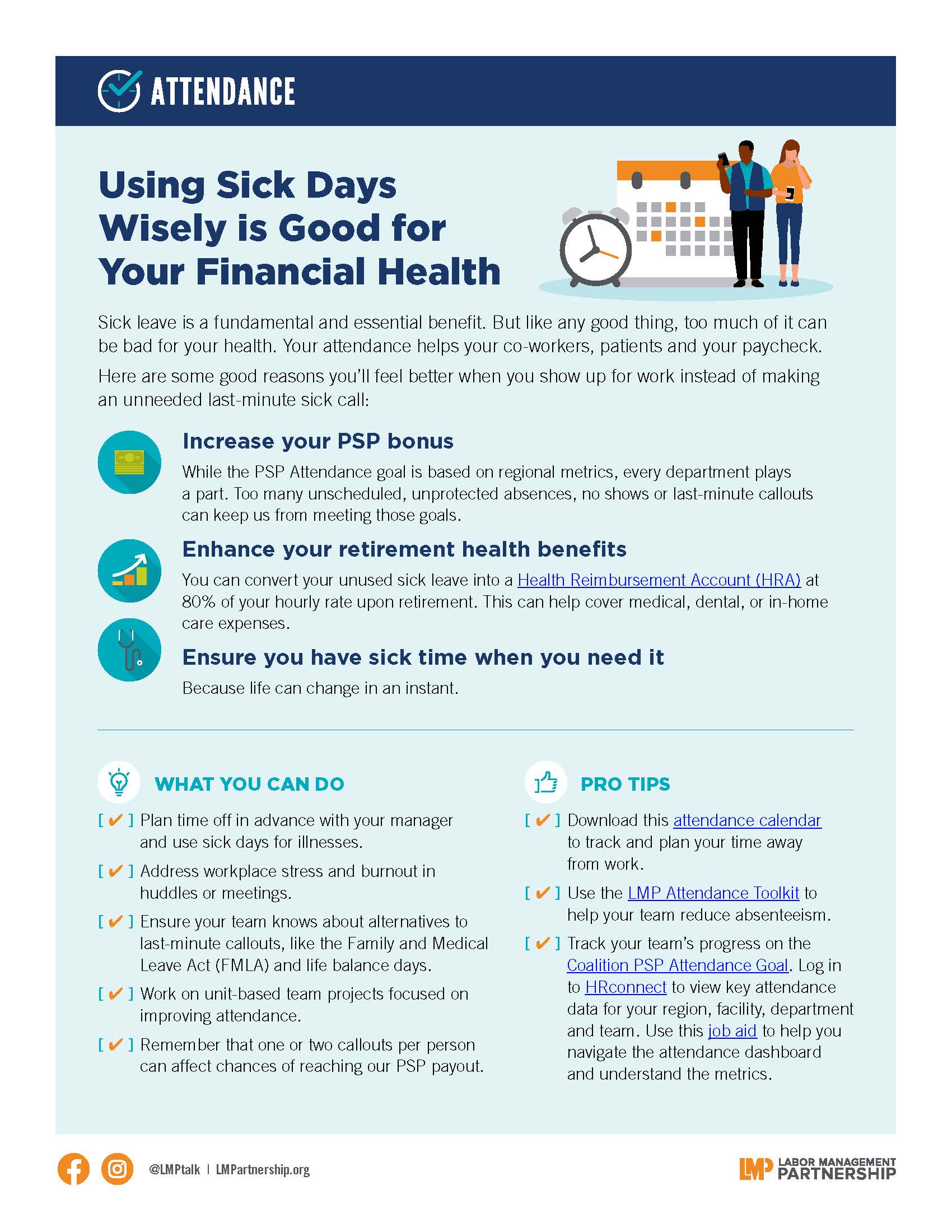
Attendance Financial Tip Sheet

Format:
PDF

Size:
8.5" x 11"

Intended audience:
Employees represented by Alliance and Coalition unions

Best used:
Use this tip sheet to help Partnership union workers understand the benefits of coming to work. Use in huddles and meetings or post it on your team's visual board.


Related tools:

TOOLS

PSP Palooza Virtual Guide

Format:
PDF

Size:

8.5" x 11" (4 pages) 

Intended audience:
UBT consultants, union partnership representatives, Alliance partnership representatives and others who support unit-based teams

Best used:
Use this tool to engage remote teams in a virtual fair celebrating Performance Sharing Program (PSP) goals. Visit the How-To Guide: PSP Palooza in a Box for more resources.

Related tools:

TOOLS

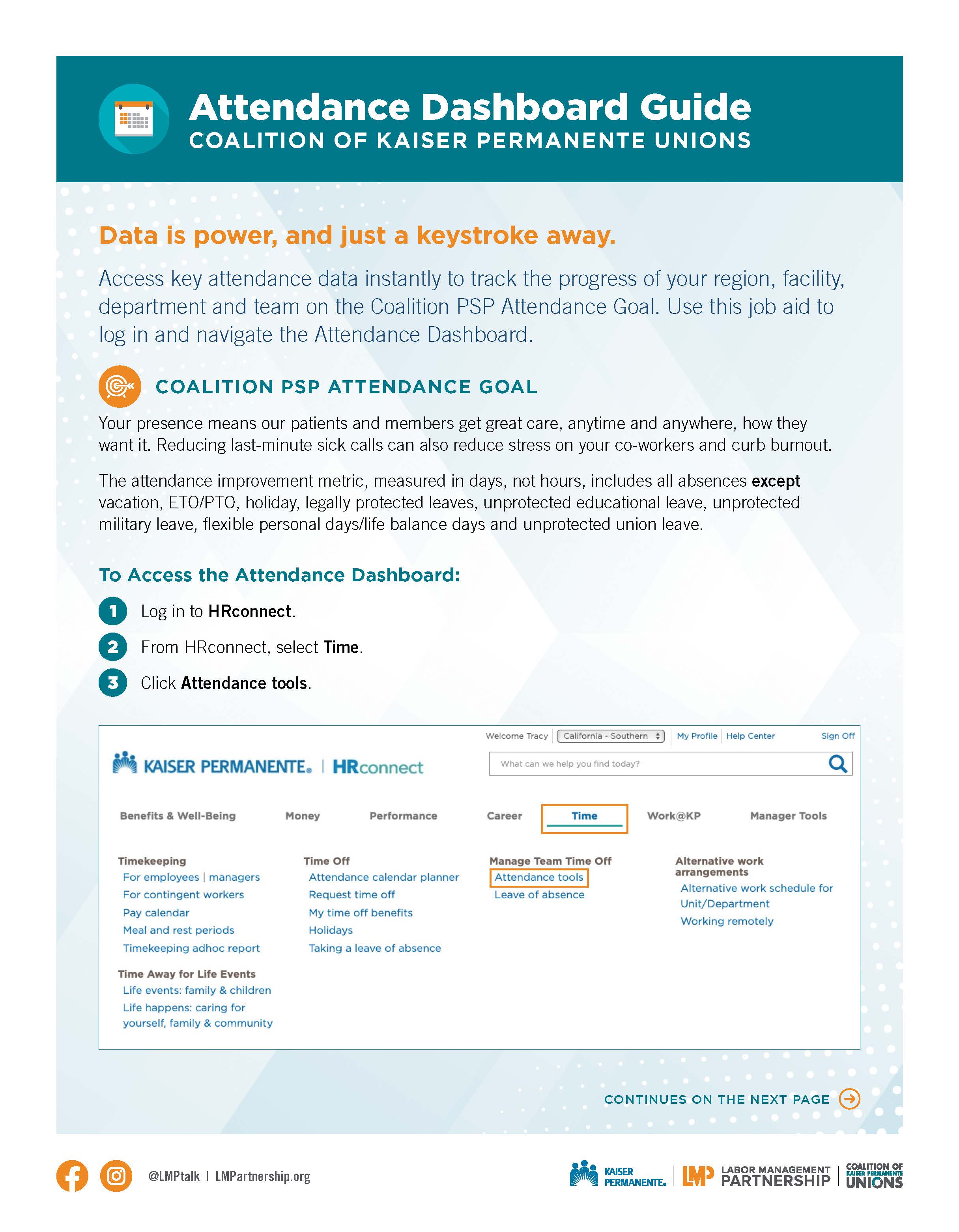
Coalition Attendance Dashboard Job Aid

Format:
PDF

Size:

2 pages, 8.5" x 11" 

Intended audience:
Frontline workers, co-leads, consultants and managers who work with Coalition-represented employees

Best used:
Use this tool to navigate the Coalition Attendance Dashboard on HRconnect [KP Intranet] and understand the data that supports the Coalition PSP attendance goal.


Related tools:

Pharmacy Collaboration Saves Big and Improves Patient Care

Deck: 
Maximizing supplies, reducing waste

Story body part 1: 

With a little inspiration from Goldilocks, Kaiser Permanente pharmacies strive to get their medication supplies just right.

They aim to avoid overstocking costly drugs that might go unused, while also ensuring they don't understock and leave KP members without necessary medications.

The goal to find the right inventory balance may sound as elusive as a fairy tale. However, a Southern California unit-based team project shows how KP pharmacies come close by maximizing supplies and reducing waste.

The 24-hour pharmacy at Kaiser Permanente Woodland Hills Medical Center in Southern California leads the project. The pharmacy fills prescription orders with unused supplies from KP pharmacies across the market. It also ships its unused supplies to KP pharmacies that need them.

The collaborative effort follows common practice across the organization, where pharmacies routinely track inventories to reduce waste. This ensures members receive the medications they need. It also saves Kaiser Permanente millions of dollars each year, contributing to our mission of delivering high-quality, affordable health care.

“Say we have a medication that costs $10,000,” says Nogie Demirjian, outpatient pharmacy operations manager at Woodland Hills. “When we aren’t using it but the pharmacy in West LA has a patient that needs it, we will ship it over there. This way they don’t have to spend money to buy it, and we won’t be sitting on it until it expires and has to be thrown away.”

Supplies reviewed weekly

Weekly inventory reports show how unused medicines at one KP pharmacy may be in demand at another.

The process begins every Monday. Veronica Hoover, an inventory control assistant and UFCW 770 member, reviews all medications in Woodland Hills that have not been dispensed in at least 120 days.

Hoover checks to see if Woodland Hills' excess supplies are needed at a KP pharmacy in Southern California. When there’s a match, she calls the second pharmacy and arranges to send the medicine there.

Hoover says she recently sent a bottle of chemotherapy drugs to another KP pharmacy. The medicine costs $20,000 per bottle.

“If we don’t use that, that’s a pretty big hit,” Hoover says.

Sensible practice, substantial savings

The effort is part of an affordability initiative led by Kaiser Permanente and the Alliance of Health Care Unions.

In 2023 and 2024, they saved nearly $230 million through affordability initiatives. Of this, $43.7 million came from Southern California unit-based team projects, including the Woodland Hills project.

Patty Rivas, a UFCW Local 770 member and pharmacy assistant in Woodland Hills, is impressed by her team's efficiency.

“Once we started adding up the numbers,” she says, “we were amazed to see how much we were saving.”

Key Findings on How Workers Perceive Technology

Deck: 
Unit-based teams have positive impact

Story body part 1: 

Frontline workers see technology as important to their work. But they vary widely in their views on how easy it is to use tech at work.

What can help workers feel more at ease with tech? Unit-based teams.

"Of surveyed employees, 82% saw the importance of technology enabling work in their unit. At the same time, 52% saw this as difficult to do. Those involved in UBTs were more positive on the importance of technology and saw lower difficulty in implementing new technology," says Spencer Lewis, a Brandeis University doctoral student.

Lewis analyzed results of the most recent survey commissioned by Kaiser Permanente and the Alliance of Health Care Unions. The survey asked workers how they perceive technology, the Labor Management Partnership, and UBTs.

Here are 4 key findings:

1. The greater an employee's UBT involvement, the more effective they perceived workplace tech to be.

2. Frontline workers interested but not yet involved in UBTs were among the most optimistic about tech's importance, effectiveness, and ease of implementation.

3. Employees without LMP training are more pessimistic about tech.

4. Employees uninvolved and uninterested in UBTs are the most pessimistic about tech's importance, effectiveness, and ability to be implemented.

Learn more about UBTs.

Related: Teams Tackle Technology One Byte at a Time


Pages

Subscribe to RSS - Team Member Engagement