Team Member Engagement

Help Video

How to Find UBT Basics on the LMP Website

Learn how to use the LMP website:

LMP Website Overview

Learn how to use the LMP website:

How to Find How-To Guides

This short animated video explains how to find and use our powerful how-to guides

Learn how to use the LMP website:

How to Find and Use Team-Tested Practices

Does your team want to improve service? Or clinical quality? If you don't know where to start, check out the team-tested practices on the LMP website. This short video shows you how. 

Learn how to use the LMP website:

How to Use the Search Function on the LMP Website

Having trouble using the search function? Check out this short video to help you search like a pro!

Learn how to use the LMP website:

How to Find the Tools on the LMP Website

Need to find a checklist, template or puzzle? Don't know where to start? Check out this short video to find the tools you need on the LMP website with just a few clicks. 

Learn how to use the LMP website:

TOOLS

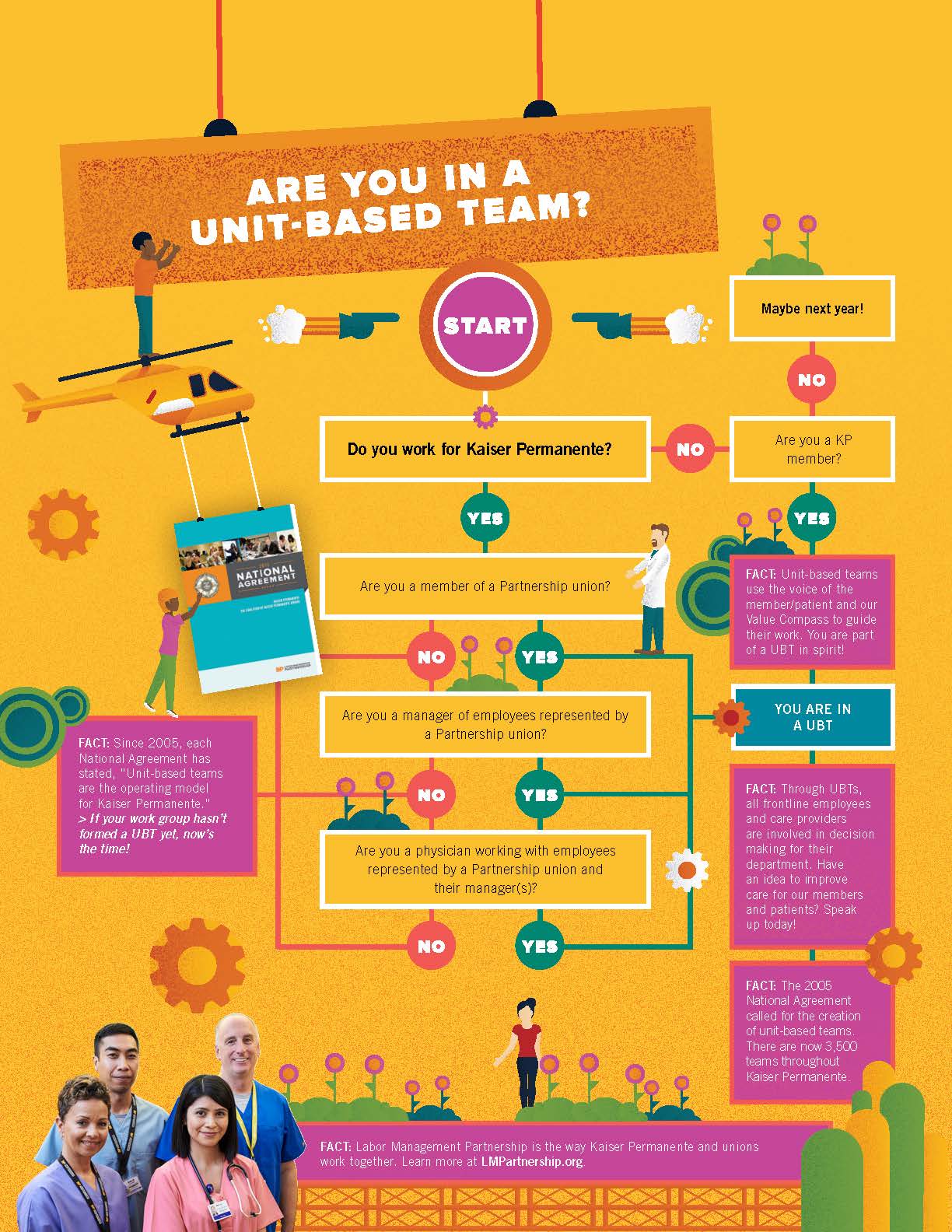
Poster: Are You in a Unit-Based Team?

Format:
PDF 

Size:
8.5” x 11”

Intended audience:
Frontline employees, managers and physicians

Best used: 
This colorful "decision tree" will help department members understand that everyone in the "natural work group" is part of the UBT. Share on a bulletin board or in your break room. 


Related tools:

TOOLS

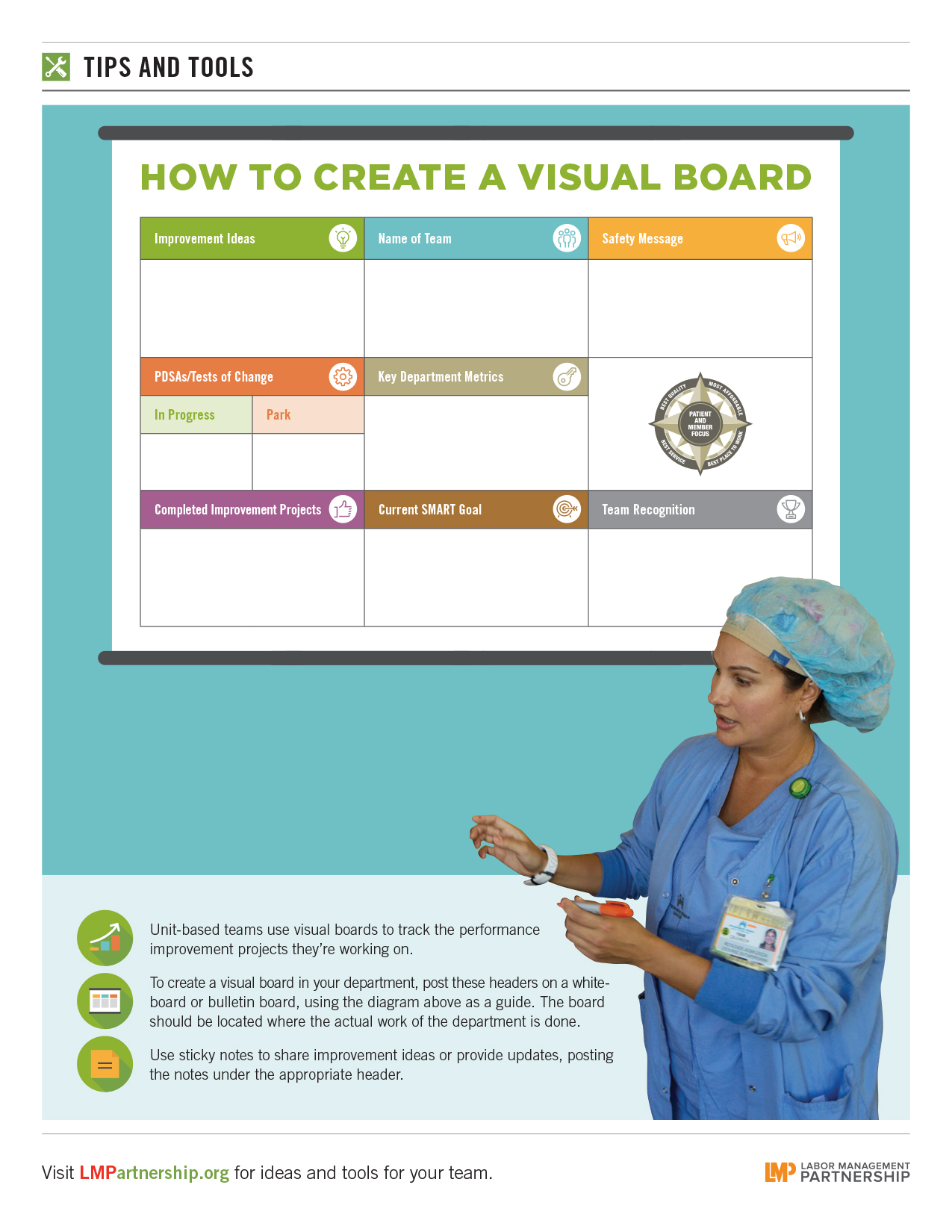
How to Create a Visual Board

Format:
8.5" x 11" PDF, plus headers (in color and black and white)

Intended audience: 
Unit-based team consultants and team co-leads

Best used:
This diagram is your guide to creating a visual board for your UBT's improvement projects, using a white board or bulletin board in a spot where your team can gather easily. Use these headers to organize your information.

You may also be interested in:
A Visual Board Is Worth 10,000 Words

Related tools:

Nowhere to Go but Up

Deck: 
Interest-based problem solving and sponsorship involvement help team turn itself around

Story body part 1: 

Some departments glide effortlessly into becoming high-performing teams. Not so for the San Rafael Health Information Management team.

Now at a Level 5 on the Path to Performance, the team had to overcome numerous hurdles to get to where it is today.

“They went through a lot of hell to get there,” says Richard Orlanes, a regional LMP consultant who worked with the team during some of its darkest days. “To see the transformation they made in about a year—it was almost like they fired the old people in the department and brought new people in.”

As recently as 2011, the team members, whose work is to maintain KP’s medical records, were negative and distrustful, their morale was low, and they didn’t participate during UBT meetings.

“You could hear a pin drop at the meetings—nobody said anything,” says Richard Incaviglia, an outpatient ambulatory coder, SEIU UHW member and the team’s labor co-lead. “At one time people even said they wanted to dissolve the UBT.”

Sponsor involvement is key

But instead, the co-leads—with assistance from Joan Mah, the local UBT consultant—reached out to the LMP regional office for help. They brought in Orlanes to observe the department and lead a series of interest-based problem-solving exercises. He also suggested including sponsors in the exercises; when the management sponsor accepted and also brought her boss to the meetings, it sent a message to the team that leadership really wanted to turn things around. To provide a sponsor perspective on the union side, the co-leads involved Kisha Fant, a union partnership representative, and Zachary Adams, a contract specialist.

“Bringing in the sponsor means everything. Her being there told us that this was a serious effort,” Incavigilia says.

The management sponsor, Freida Smith, the Marin/Sonoma HIM director, is now the team’s management co-lead. As she remembers it, she wasn’t so much invited to participate in the problem-solving sessions—she invited herself.

“I stuck my nose in,” Smith says. “I had to step in and assume some responsibility because the sponsor needs to be involved and is ultimately responsible.”

Discussing positions and interests

Smith believes that the turning point for the team came when they discussed their positions and interests with Orlanes as the facilitator.

“We had to decide as a team that there was nothing we could do about what happened in the past,” Smith says, “but we could step out on faith and move forward.”

After working with the LMP regional consultant for several months, the team members were finally ready to start working together on their common interests. They prioritized the issues of communication, trust and honesty, and transparency, and worked to transform the negativity in the department. One of their early tests of change was to introduce a daily 8 a.m. huddle. The team huddles over the phone because half the team members work remotely. After the huddle, Smith sends an email to the whole department summarizing what was discussed.

“Once we started communicating and voicing opinions, and we realized we didn’t need to worry about retaliation, everybody started participating,” Incaviglia says.

On to high performance

Now the team has a long list of successful performance improvement projects under its belt, including a project to reduce the number of medical records that have missing documentation and another to make sure charts are coded within four days or less.

Smith believes that being transparent was the key to success.

“No matter how small or large the issue, be transparent,” she says. “I share every single thing that impacts the team’s day-to-day existence, including the budget.”

These days Smith is not only the management co-lead of the San Rafael HIM team but also the sponsor of a team in Santa Rosa. Her advice for other sponsors of dysfunctional teams? “I think the key is to communicate with the UBT co-leads first and then, if things don’t improve, take it to the whole team.”

Beyond 'Teamwork'

Deck: 
Teaming as the essential skill for innovation, learning

Story body part 1: 

“Team” is a noun. “Teaming” is a verb, defined by the woman who coined it as teamwork on the fly, coordinating and collaborating across boundaries, without the luxury of stable team structures.

That woman, Harvard Business School Professor Amy Edmondson, talked to the 2012 Union Delegates Conference about why teaming is such a crucial skill, especially for those in health care settings where work is complex and unpredictable.

“In health care, many times people are interacting with each other in an emergency room, for instance, now, for five minutes, but they don’t know each other,” says Edmondson. “The catch is we have to act as if we trust each other…because we often don’t have the luxury of having a lot of time to get to know each other.”

A “team” is a static, stable entity. But, says Edmondson, “In health care, if we wait until we have the perfectly designed ‘team,’ the moment has passed. We have to get together quickly, do what needs to be done, and then disband and do other things.”

In the absence of long-term work relationships, Edmondson says allegiance to an organization with a compelling vision can be the glue that holds these teams-on-the-fly together. “There is the pride in working for KP,” for instance, she says. “That is a real bond.”

Looking at the performance improvement work of unit-based teams at Kaiser Permanente, the principles of teaming still apply. While not as fluid as an emergency room, UBTs still see plenty of flux. Just think about the manager that gets promoted or retires, or the labor co-lead who rotates out of that role. The team has to be able to keep focused on improving performance even as the cast of characters changes.

UBTs can be stable teams that do great work. They are a very powerful tool,” Edmondson says. “And yet, I also want people to be able to quickly get up to speed, do what needs to be done with other people in the absence of those stable structures.”

A UBT needs to be a scaffold that is strong enough to withstand the flux, says Edmondson.

“If there is clarity about what the structure looks like—independent of the people who are in that structure—you are better off,” says Edmondson, a point explored in research she’s conducted with Harvard colleague Melissa Valentine. “We won’t always have the same human beings in those roles, but the roles are reasonably static.”

Behaviors that support teaming

  • Speak up: ask questions, acknowledge errors, offer ideas.
  • Listen intensely.
  • Integrate different facts and points of view.
  • Experiment: take a step-by-step approach, learning as you go.
  • Reflect on your ideas and actions.


Videos

Huddle Power

Loading the player...

(4:45)

Successful unit-based teams, those that continuously improve performance and lead change, use huddles to share information and stay on top of team business. This video highlights two KP teams that regularly huddle to tackle day-to-day issues, advance performance improvement projects and give "snaps" to colleagues who go the extra mile. See how huddles and snapping have helped these teams improve communication, morale and best of all—patient care.


Pages

Subscribe to RSS - Team Member Engagement