Team Member Engagement

Help Video

How to Find UBT Basics on the LMP Website

Learn how to use the LMP website:

LMP Website Overview

Learn how to use the LMP website:

How to Find How-To Guides

This short animated video explains how to find and use our powerful how-to guides

Learn how to use the LMP website:

How to Find and Use Team-Tested Practices

Does your team want to improve service? Or clinical quality? If you don't know where to start, check out the team-tested practices on the LMP website. This short video shows you how. 

Learn how to use the LMP website:

How to Use the Search Function on the LMP Website

Having trouble using the search function? Check out this short video to help you search like a pro!

Learn how to use the LMP website:

How to Find the Tools on the LMP Website

Need to find a checklist, template or puzzle? Don't know where to start? Check out this short video to find the tools you need on the LMP website with just a few clicks. 

Learn how to use the LMP website:

Teams Tackle Technology One Byte at a Time

Deck: 
Survey shows how unit-based teams can boost tech’s effectiveness

Story body part 1: 

When you think of technology in health care, what comes to mind?

Virtual care? Medical devices? Electronic health care records?

In Washington, a radiology team increased its health and impact with an app to track a step challenge.

In Virginia, advice nurses bonded through Microsoft Teams and a buddy system.

Across the Labor Management Partnership, unit-based teams are embracing technology step by step. By doing so, they're strengthening teamwork, improving service, and becoming more efficient.

That reflects findings of a survey by Kaiser Permanente and the Alliance of Health Care Unions. The survey asked workers how they perceive technology, LMP, and UBTs. A Brandeis University analysis of the survey linked UBT interest and involvement with views of the importance of technology.

UBTs are natural work groups that collaborate to improve patient care. The Partnership has 3,700 UBTs. Each team is co-led by a manager and a worker and a physician — if it includes doctors.

Stepping up team activities

The Olympia Radiology UBT formed in 2022.

The step challenge was an early project. To track steps, team members downloaded an app to phones and smart watches. This led the team to walk more and raised interest in the UBT.

"People get excited," says management co-lead Lydon Fitzgerald, a radiology manager. "They want to be a part of it."

The team has 50 members, including techs for CT, MRI, and X-ray. It plans to add sonographers and mammography techs.

"They want a voice," says labor co-lead Jesse Toth, a radiologic tech and UFCW Local 3000 steward. "It's about inclusion."

Know the code

The radiology team took more tech steps. It began to use Microsoft Teams to share files and host some meetings.

Then the team focused on patient satisfaction scores. It added QR codes, so patients could give real-time feedback.

But many older patients weren't familiar with QR codes. The team then added signs and created scripts to show patients how to use QR codes with their phone.

"We're trying to keep patients happy and on time," Toth says.

Make time to train

When the unit got 2 new machines, the co-leads made sure workers got trained. The team learned how to use the equipment and found ways to work smarter.

"Tech is integral to workflows. How can we make it better?" Fitzgerald says. "We embody the principles of LMP, working together at the lowest level to find solutions."
Breaking the Sick-Time Cycle

Deck: 
Avoid burnout: plan time off, use sick days for illness

Story body part 1: 

It was a vicious cycle: As last-minute sick calls surged, so did overtime costs and burnout among staff working extra shifts in Urgent Care at Panorama City Medical Center in Southern California.

The sick calls “impacted our entire team on multiple fronts,” said Fisayo Bhebe, department manager.

So UBT members came up with a plan. They realized that people were more likely to call in sick when work was stressful. So they urged employees to schedule time off in advance and save their sick days for illness. 

Department leaders were then able to plan and maximize staffing resources – reducing stress and burnout for workers. They also rewarded those with outstanding attendance.

And, after realizing patient volumes were rising, they reviewed the budget and hired more staff. Over 10 months, last-minute sick calls dropped 40%, from an annual average of 4 days to 2.5 days per full time employee.

“Every member of the team contributed to the success of this project,” said Rosimar Carpenter, an LVN and Coalition union partnership representative. “You can definitely see how proud they are.”

A two-pronged approach

The Level 3 team includes employees represented by the Alliance of Health Care Unions and the Coalition of Kaiser Permanente Unions. They staff Urgent Care, a fast-paced department that can receive as many as 300 patients a day, 7 days a week.

Sick calls mean paying overtime to employees available to fill staffing gaps and take on extra shifts. When replacements can’t be found, staff members work short-handed as patients keep coming.

“It can be a continuous loop,” said Javier Barrios, RN, a member of UNAC/UHCP. “When people are out you carry a heavier load and it makes the day feel a lot longer.”

In 2022, challenged by last-minute sick calls, members of the unit-based team began exploring ways to reduce such calls and ensure staff members got time off. They took a two-pronged approach: partnering with leadership to bring in per-diem workers to plug staffing gaps and focusing on last-minute sick calls during UBT meetings.

Team co-leads ─ Jeanelle Concepcion, RN Supervisor, and Teresita “Tita” Obusan, an LVN and SEIU-UHW member ─ were sympathetic to the team’s struggles. They encouraged team members to plan time off in advance to avoid last-minute staffing scrambles. They also recognized workers for outstanding attendance.

Excited to work

The strategy worked. The team met its 6-month target to reduce last-minute sick calls from an annual average of 4 days to 3 days per full time employee.

What’s more, success came despite surging service demands. Member visits to the department increased by 20% in 2022 over the previous year. After reviewing the budget, the department received authorization to hire 3 new part-time licensed vocational nurses to handle the increased patient volume.

Last-minute sick calls continue to drop. In November 2022, the team recorded an annual average of 2.5 days per full time employee – a 40% reduction over 10 months.

Even better, the sense of burnout has waned. Said Obusan, “We feel less burdened and are excited again to come to work.” 


    Videos

    LMP Skills Booster Video

    Loading the player...

    (7:00)

    Get to the heart of the matter by asking great questions! This skills booster will help you uncover the unknown by encouraging people to share more details, allow everyone the opportunity to share their opinions, and come up with better solutions.

    TOOLS

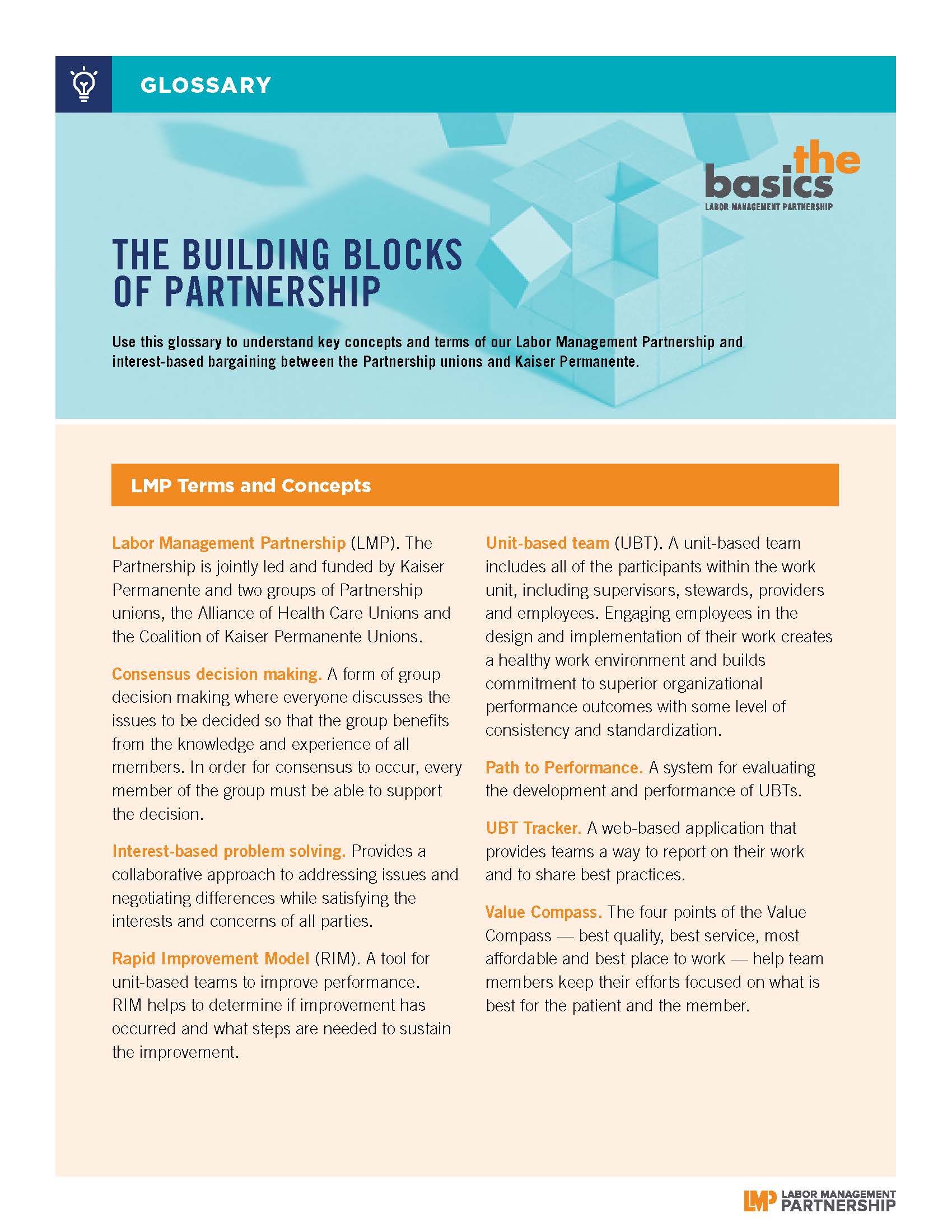
    Glossary: The Building Blocks of Partnership

    Format:
    PDF

    Size:
    2 pages, 8.5” x 11”

    Intended audience:
    Members and leaders of unit-based teams

    Best Used:
    Use this glossary to understand key concepts and terms related to the Labor Management Partnership and interest-based bargaining.

    Related tools:

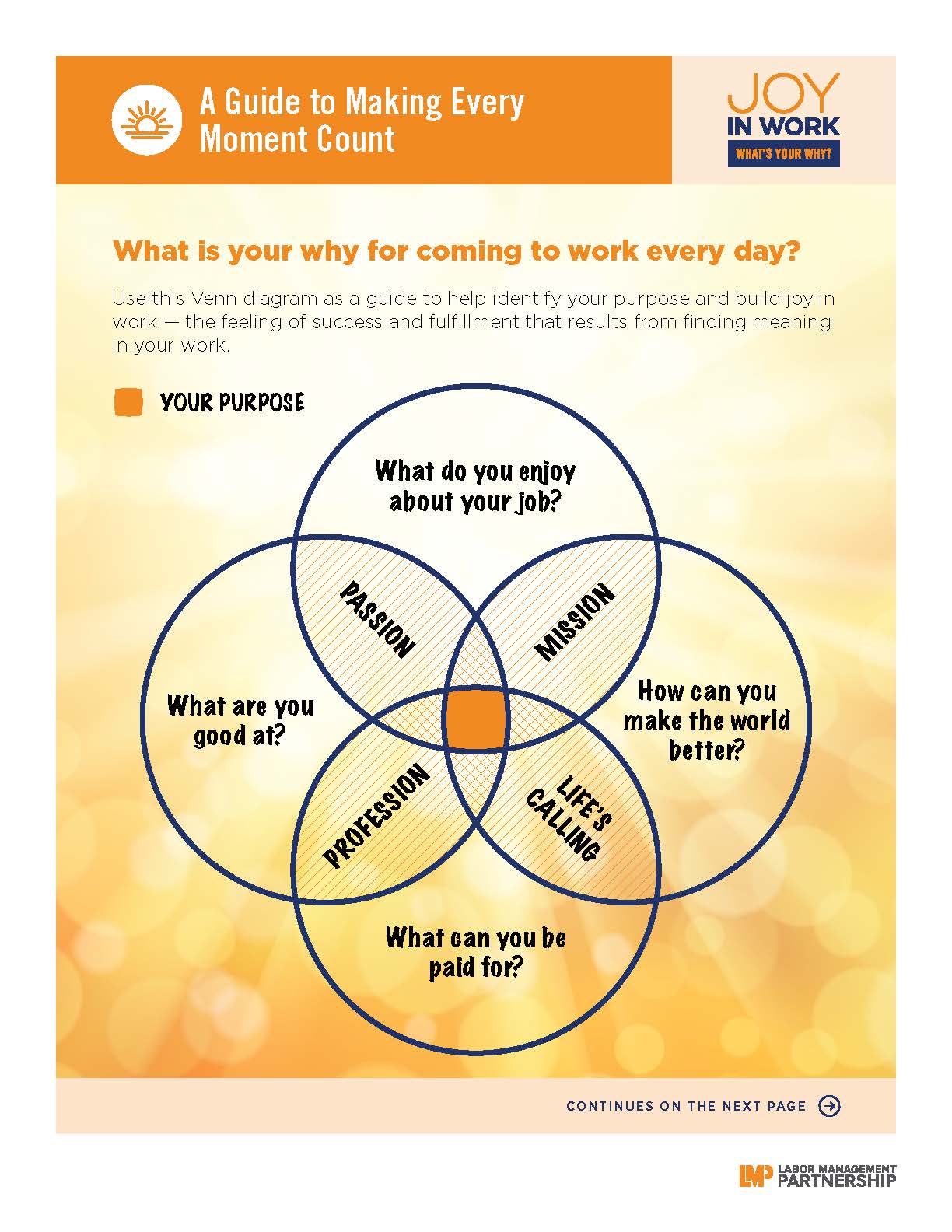
    Joy in Work; What's Your Why?

    Joy in work might seem like an idea that’s superficial or unattainable. But it’s vital, and more important than ever.

    Joy in work is about being connected with what you do and why you do it. It’s the feeling of success and fulfillment that comes from doing work that matters. It connects us with colleagues and patients through a sense of shared purpose.

    Pages

    Subscribe to RSS - Team Member Engagement