
Team Member Engagement
Help Video
How to Find UBT Basics on the LMP Website
LMP Website Overview
How to Find How-To Guides
This short animated video explains how to find and use our powerful how-to guides
How to Find and Use Team-Tested Practices
Does your team want to improve service? Or clinical quality? If you don't know where to start, check out the team-tested practices on the LMP website. This short video shows you how.
How to Use the Search Function on the LMP Website
Having trouble using the search function? Check out this short video to help you search like a pro!
How to Find the Tools on the LMP Website
Need to find a checklist, template or puzzle? Don't know where to start? Check out this short video to find the tools you need on the LMP website with just a few clicks.
Team Member Engagement
When UBT members are actively involved with their team, they speak up with their best ideas about how to improve the department. They take advantage of partnership processes like consensus decision-making and interest-based problem solving to make the department a great place to work. They look at how the department is doing on key metrics—like those around service and quality—and use that information to come up with ideas for improvement.
Story body part 1:
A unit-based team includes all managers, physicians, dentists and partnership union members in the work unit. All employees in the unit participate and support the team in meeting its goals and objectives.
UBT members
For the team to move up and become high performing, its important for all team members to:
- complete UBT training
- attend and participate in meetings
- represent the interests and perspectives of others — not just their own
- use UBT processes collaboratively and with an open mind toward mutually acceptable results
- maintain open, direct, and respectful communication
- support partnership principles
- communicate regularly with staff in the department
- honor confidentiality agreements
- actively support all team decisions
Visit the Team Member Engagement toolkit to learn more.
UBT co-leads
Each UBT has a management and labor co-lead. In departments with physicians, it’s ideal to have a physician co-lead as well. Co-leads organize the team’s meetings and huddles and make sure the team’s performance improvement work stays on track.
The role of UBT co-leads is to:
- advocate for partnership success
- prepare for meetings and huddles
- use appropriate meeting management tools
- communicate early and often
- troubleshoot where appropriate
- act as point person for information
- keep team records
- ensure team is following charter and charter is relevant
- communicate with others (including sponsors and stakeholders)
- make off-line decisions when needed
- build relationships and share expectations with co-lead partner(s)
Visit the Leadership toolkit to learn more.
UBT sponsors
Sponsors are the go-to people for UBT co-leads, providing resources, guidance and oversight for teams.
The role of UBT sponsors is to:
- review the team’s progress on department’s UBT goals
- promote the use of the Rapid Improvement Model (RIM+) to improve department performance
- support full team engagement
- remove barriers and assist, as needed, with attaining data for team’s performance improvement projects
- recognize the team’s accomplishments
- spread successful practices
Visit the Sponsorship toolkit to learn more.
Free to Speak
When we speak up, good things happen.
Where there’s open communication, we have better care outcomes, fewer workplace injuries and lost work days, and more satisfied patients.
That’s why supporting a culture where people are free to speak is essential to our success at Kaiser Permanente.
TOOLS
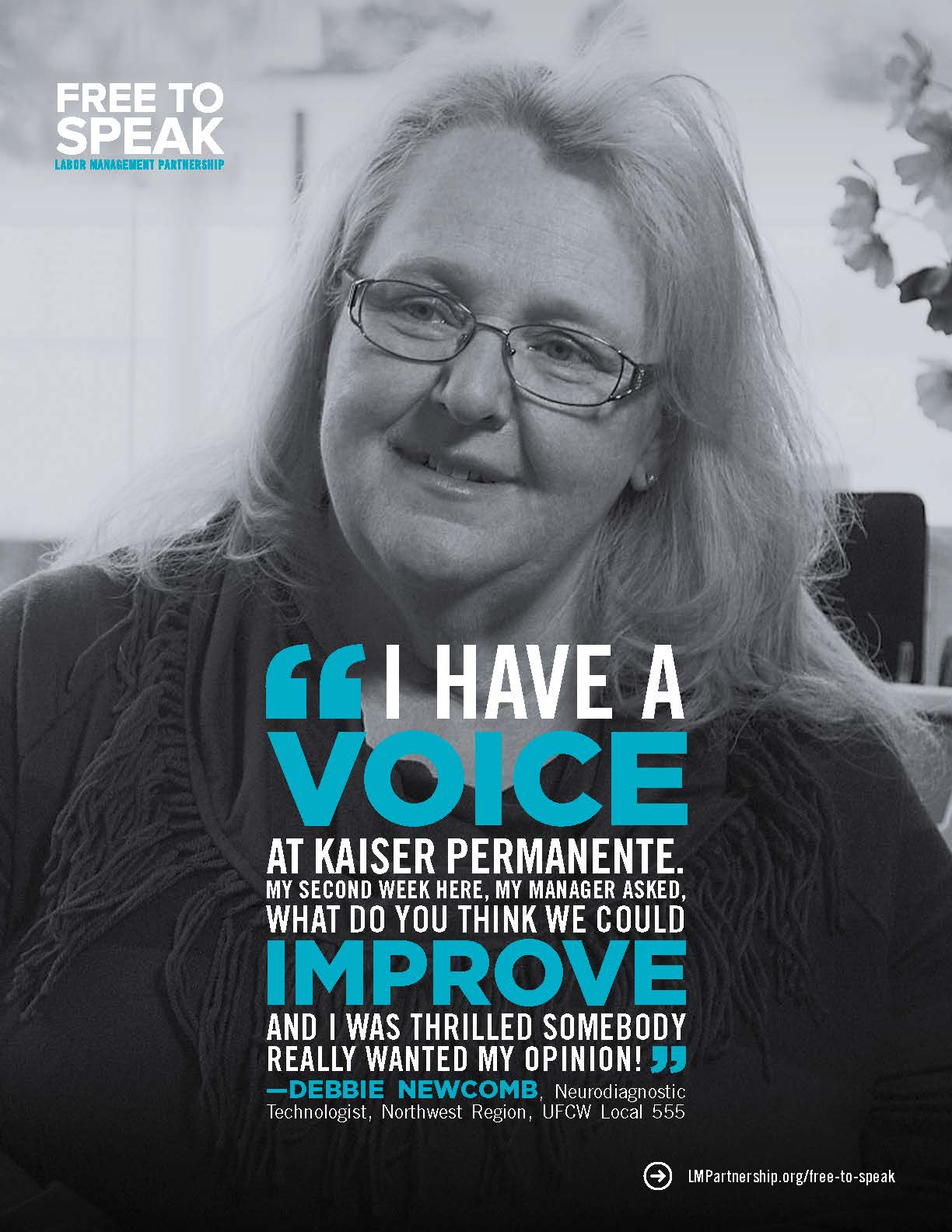
Free to Speak: A Union Worker Shows the Way
Format:
PDF
Size:
8.5" x 11"
Intended audience:
Frontline workers, unit-based teams
Best used:
Post these inspiring words from a union worker on our #FreeToSpeak culture on your team's bulletin board or in a break room.
TOOLS
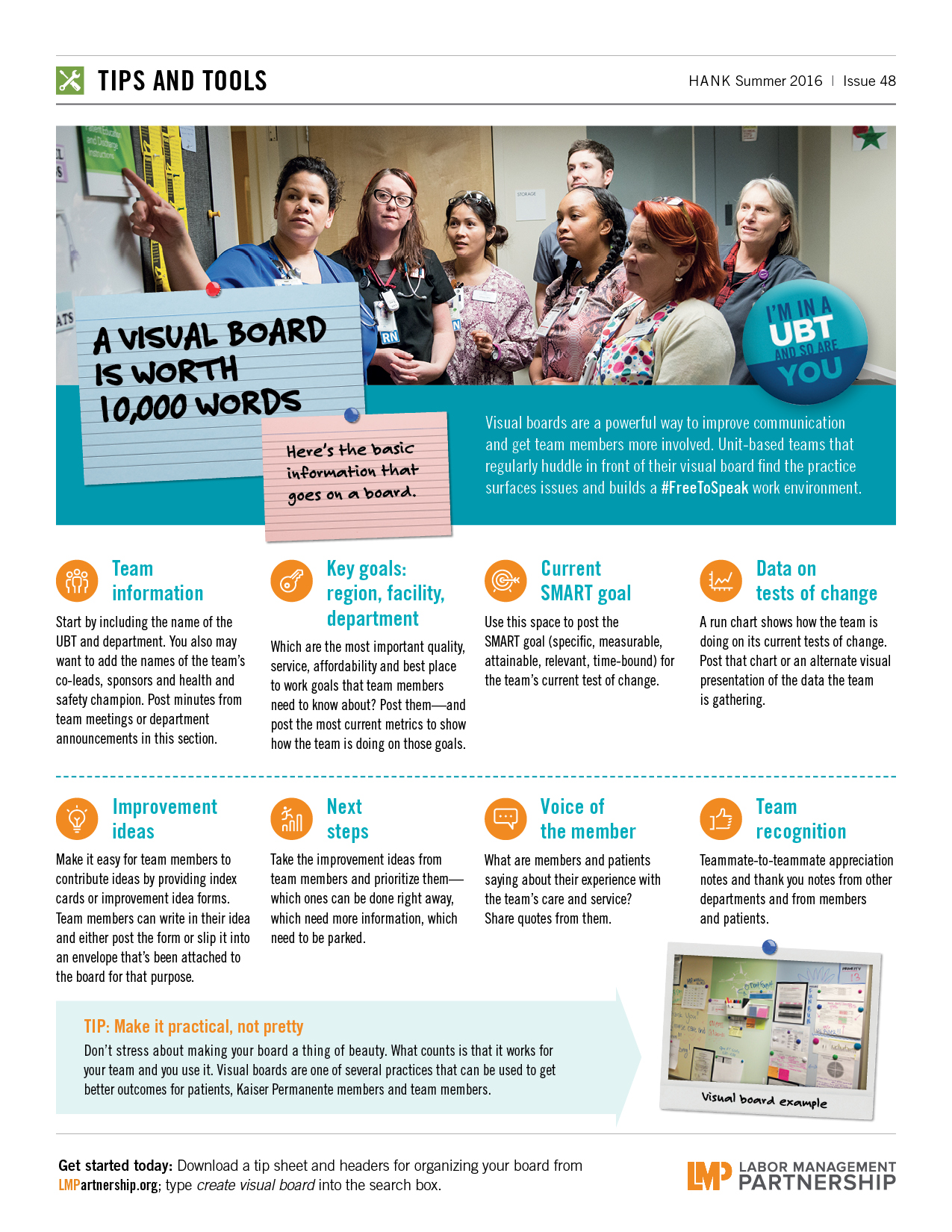
A Visual Board Is Worth 10,000 Words
Format:
PDF
Size:
8.5" x 11"
Intended audience:
Unit-based team consultants and team co-leads
Best used:
Create an effective visual board for your unit-based team. UBTs that regularly huddle in front of their visual board find the practice helps to surface issues.
You may also be interested in:
How to Create a Visual Board
Meet Your National Agreement: Spreading the Word
Deck: How do you get everyone on your team to know they’re on a UBT? Talk to them!
Deck:
How do you get everyone on your team to know they’re on a UBT? Talk to them!
Story body part 1:
I’m in a UBT, you’re in a UBT, we’re all in a UBT! Hooray! Let’s start our performance improvement project, collect our data and make a PowerPoint presentation to explain our results.
…Whoa. Not so fast. Unit-based teams were launched as part of the 2005 National Agreement, but we all still hear stories about frontline union members, managers and physicians who don’t realize they’re on a UBT. This is a big deal. When people don’t know they’re on a UBT, they’re missing out on an opportunity to take part in improving service and quality for our members and patients.
That’s why negotiators hammering out the 2015 National Agreement added a requirement: In order for a UBT to move up to Level 3, it has to have “a communications structure to reach all members of the department” in place.
Over time, this will help everyone in the department realize they’re part of the UBT—and will lay to rest the myth that “the UBT” is a small group of people who lock themselves in a meeting room, drink coffee and eat doughnuts and solve problems for everyone else. Your team needs you contributing ideas; our members and patients need you.
TOOLS
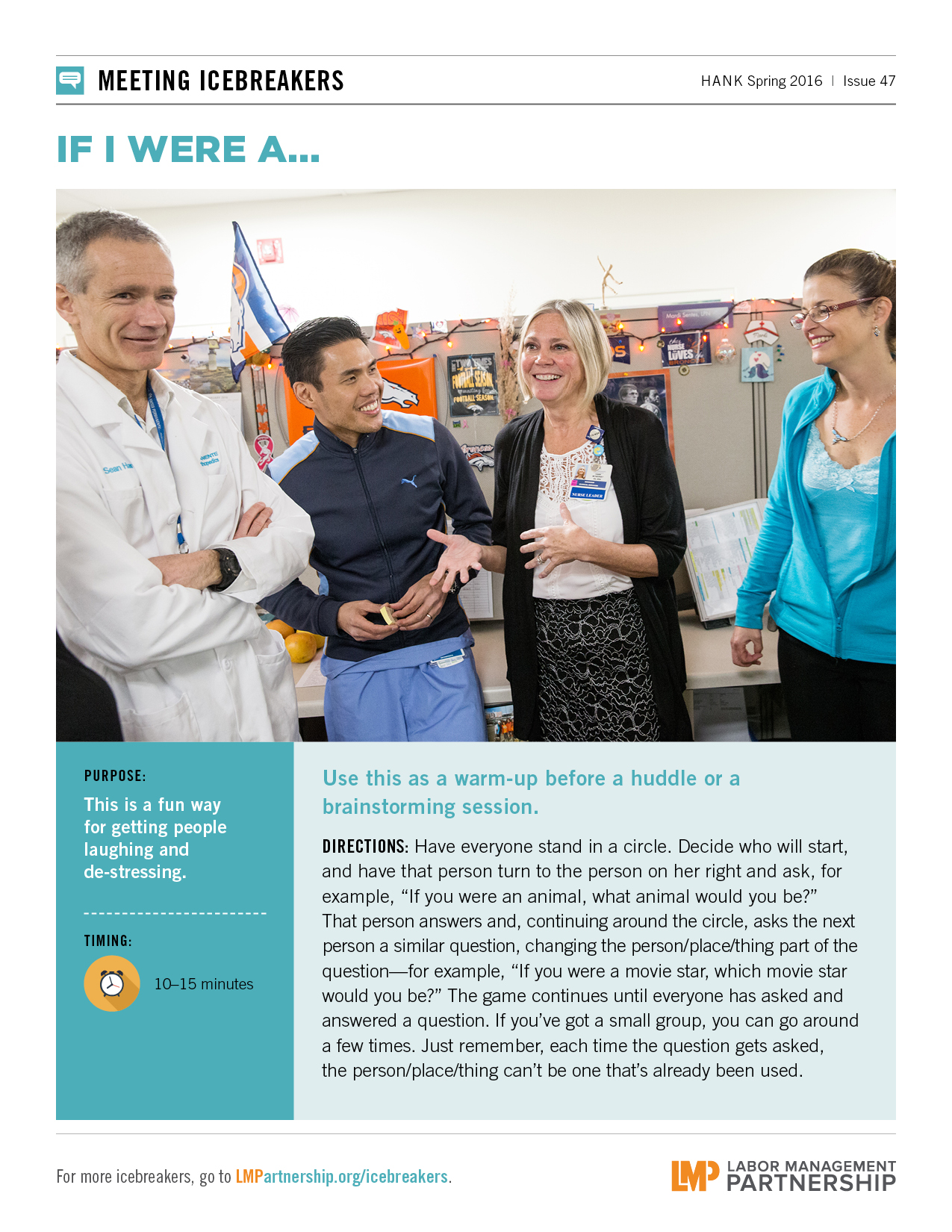
Icebreaker: If I Were a. . .
Format:
PDF
Size:
8.5” x 11”
Intended audience:
Frontline employees, managers and physicians
Best used:
Use this meeting icebreaker as a fun way for getting people laughing and de-stressing.
TOOLS
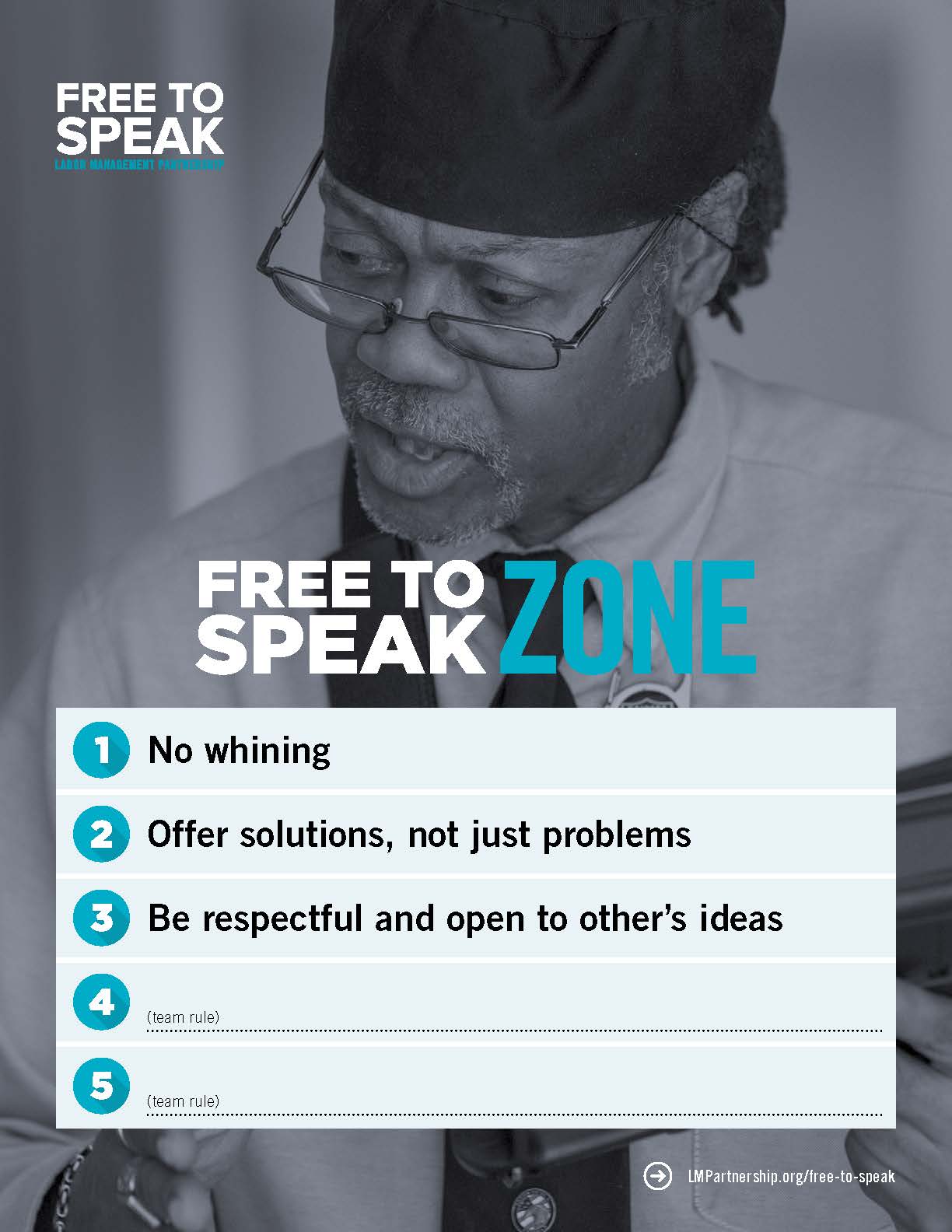
Free to Speak Zone Poster
Format:
PDF
Size:
8.5" x 11"
Intended audience:
Frontline physicians and managers
Best used:
Post on bulletin boards in staff areas to designate your work area a Free to Speak Zone. This poster also lists some good ground rules for making discussions productive.
Around the Regions (Winter 2016)
Deck: Newsy bits from the landscape of Kaiser Permanente
Deck:
Newsy bits from the landscape of Kaiser Permanente
Story body part 1:
Colorado
The Colorado region is improving patient care and saving millions by providing high-risk patients extra attention after discharge, leading to a reduction in readmission rates. In the Post Acute Care Transitions (PACT) program, nurse practitioners visit patients in their homes after discharge from a hospital or skilled nursing facility, giving them a chance to alter the patient’s care plan if needed. The PACT team has visited approximately 4,200 high-risk patients since the program began in January 2013. At that time, 22 percent of high-risk patients were readmitted within 30 days, at a cost of $11.7 million. The PACT team has reduced readmission rates by 50 percent, saving Kaiser Permanente approximately $6 million since the program began.
Georgia
To make sure no good deed goes uncopied, the Georgia region launched a Spread and Sustain system to move best practices throughout the region—and showed off the results to KP’s board of directors at a UBT fair early last summer. Georgia took a spread blueprint from the Southern California region and fine-tuned it to meet its needs. Now its unit-based teams, sponsors and regional leaders identify projects with good spread potential, determine other locations where the new process could work, share the practice and check back to see how they’re being sustained. Several projects have been successfully spread region-wide—addressing such issues as hypertension, HPV vaccinations and lab specimen collection.
Hawaii
Hawaii is a beautiful place to live, but Kaiser Permanente members who live on the less-populated islands sometimes find it challenging to get the care they need. To address that, KP offers a special benefit called Travel Concierge Service. If health plan members need medical care that isn’t available on their island, KP assists them in traveling to the Moanalua Medical Center in Oahu or to a specialty care medical office. KP makes the travel arrangements and picks up the tab for travel, including airfare, shuttle service and discounted hotel rates. For minors who need specialty care, KP also pays for companion travel. “Our members love this service,” says Lori Nanone, a sales and account manager in the region.
Mid-Atlantic States
For several years, co-leads in the Mid-Atlantic States have compiled monthly reports of their UBT activities, goals and progress using Microsoft Word and Excel. Now, the region is rolling out a dashboard that automatically compiles the same information from UBT Tracker into an easy-to-reference SharePoint site, Kaiser Permanente’s new online social collaboration tool. The new dashboard will encourage more frequent updates to UBT Tracker and eliminate the need for co-leads to create separate documents, says Jennifer Walker, lead UBT consultant and improvement advisor. “Now the information we get is more timely and easier to assess,” Walker says. “Before, the information was up to a month old.”
Northern California
The Santa Rosa Medical Center Diversity Design committee is equipping employees with tools to help them provide better service to Spanish-speaking patients. The group, composed of labor and management, has been piloting a handout featuring a list of common Spanish phrases, such as ¿Necesita un intérprete? (“Do you need an interpreter?”), as well as instructions on using the phone interpreter system. The idea came from a Spanish-speaking patient on the facility’s Latino patient advisory committee, who recalled the time she was lost in the facility and no one could direct her in Spanish. The Spanish language flier is the latest in the committee’s work to help ensure all patients receive the same optimal service and care.
Northwest
Unit-based teams in the Continuing Care Services department are focusing on improving the experience for some of Kaiser Permanente’s most vulnerable members: those in skilled nursing facilities or receiving home health, hospice or palliative care. Teams are focusing on ensuring better transitions for patients as they go from inpatient to ambulatory care. By identifying issues before they become problems, labor and management hope to coordinate care more effectively, reduce emergency department visits and cut down on outside medical costs.
Southern California
Harmony comes easily when you use the tools of partnership. Just ask the Biohazards, a band of union members and a manager that uses partnership principles to guide performances. “We call ourselves an LMP project,” says Mary Anne Umekubo, a clinical laboratory scientist and Regional Laboratory assistant director who sings and plays percussion and guitar. She is among six band members who represent a variety of departments, shifts and unions, including SEIU-UHW and UFCW Local 770. Performing for friends and colleagues, band members use consensus decision making to choose songs, interest-based problem solving to fix mistakes and the Rapid Improvement Model to tweak performances. “We’re from different departments,” says drummer Eric Cuarez, a regional courier driver and SEIU-UHW member. “We come together to play music.”
Pages
