Mid-Atlantic States

Help Video

How to Find UBT Basics on the LMP Website

Learn how to use the LMP website:

LMP Website Overview

Learn how to use the LMP website:

How to Find How-To Guides

This short animated video explains how to find and use our powerful how-to guides

Learn how to use the LMP website:

How to Find and Use Team-Tested Practices

Does your team want to improve service? Or clinical quality? If you don't know where to start, check out the team-tested practices on the LMP website. This short video shows you how. 

Learn how to use the LMP website:

How to Use the Search Function on the LMP Website

Having trouble using the search function? Check out this short video to help you search like a pro!

Learn how to use the LMP website:

How to Find the Tools on the LMP Website

Need to find a checklist, template or puzzle? Don't know where to start? Check out this short video to find the tools you need on the LMP website with just a few clicks. 

Learn how to use the LMP website:

Videos

Not My Father's Union

Loading the player...

(3:02)

"Not My Father's Union" is a three-minute video highlighting what's different about the unions working in partnership at Kaiser Permanente. Union members involved in the Labor Management Partnership do more than fight for wages and benefits. They are directly involved in solving problems and making the decisions that make KP the best place to receive care.


TOOLS

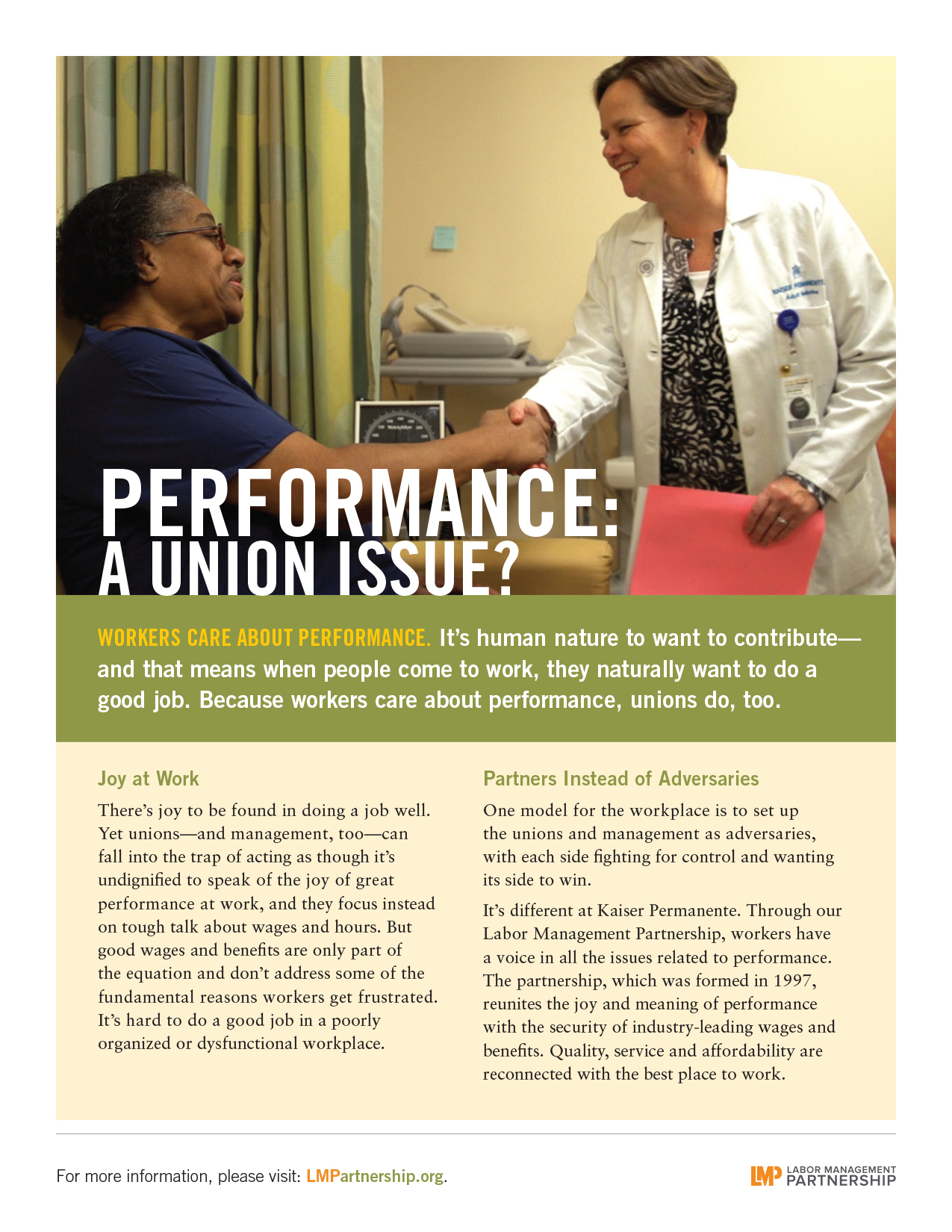
Performance: A Union Issue?

Format:
PDF

Size:
8.5" x 11"

Intended audience:
Union employees, union members, external audiences

Best used:
This poster describes why performance is a union issue. It’s human nature to want to contribute—and that means when people come to work, they naturally want to do a good job. Because workers care about performance, unions do, too. Post at LMP and UBT trainings, UBT meetings, union conferences, and new employee trainings.

Related tools:

Transforming Transport

Deck: 
Capitol Hill cuts length of wheelchair trips by more than half

Story body part 1: 

Department: Adult Medicine, Capitol Hill Medical Center (Mid-Atlantic States)

Value Compass: Service

Problem: Some individual patient transport trips were taking an hour or more, inconveniencing patients and impacting the unit's smooth operation. Staff members sometimes had to wait for a patient to receive medications or had to return to the unit to retrieve a wheelchair adequate for the height and weight of the patient.

SMART goal: Reduce staff time spent transporting a patient by wheelchair from the unit to the lab, pharmacy, hospital entrance or public transit stop from an average of 30 minutes to 15 minutes between May and September 2012.

Union co-lead: Louise Casa, nurse practitioner, UFCW Local 400

Management co-lead: Jacqueline Marshall, RN, clinical operations manager for Adult Medicine

Small tests of change:

  • A trained, dedicated transporter position
  • New, wider wheelchairs
  • Coordinating transport times with other departments
  • Lab and pharmacy patient priority cards

Results: Reduced staff time to transport patients from an average of more than 30 minutes to 10 minutes.

Biggest challenges

A brisk walk by an able-bodied person from the unit to the train station takes about 15 minutes roundtrip—but struggling with an infirm patient in an outdated or inappropriately sized wheelchair could easily double that time.

Other issues included patient dissatisfaction, staff injuries and the added risk of patient treatment delays or falls, says labor co-lead Casa, noting that “we had to look at the problem from many angles.”

Background

The Capitol Hill Medical Center opened with great fanfare in 2011. Hailed as a beacon for affordable and accessible care just as the national debate heated up on these issues, the center attracted attention—and many new members. One key factor that made the new facility so attractive—its proximity to a major public transit station in the District of Columbia—also turned into a potential Achilles heel.

That was until the Adult Medicine UBT rolled in with the right solutions.

The Adult Medicine team started by using performance improvement charting tools to log the time each staff member took to transport a patient to and from the Union Station subway stop or to ancillary departments within the medical center.

The team discovered many of the elderly or wheelchair-using members struggled to make the long trek from the exit doors of Union Station to the waiting room of the Adult Medicine unit, a medical center starting point for most patients.

The team lobbied for new wheelchairs—and for a new transporter position, an OPEIU Local 2 member who transports many of the patients and coordinates the trips that staff members make to the other departments.

In addition, the team now calls ahead to the lab or pharmacy to ensure tests and medications will be ready, or nearly so, when the patient is brought in. It also gives patients red cards to signal their priority status to lab and pharmacy staff.

TOOLS

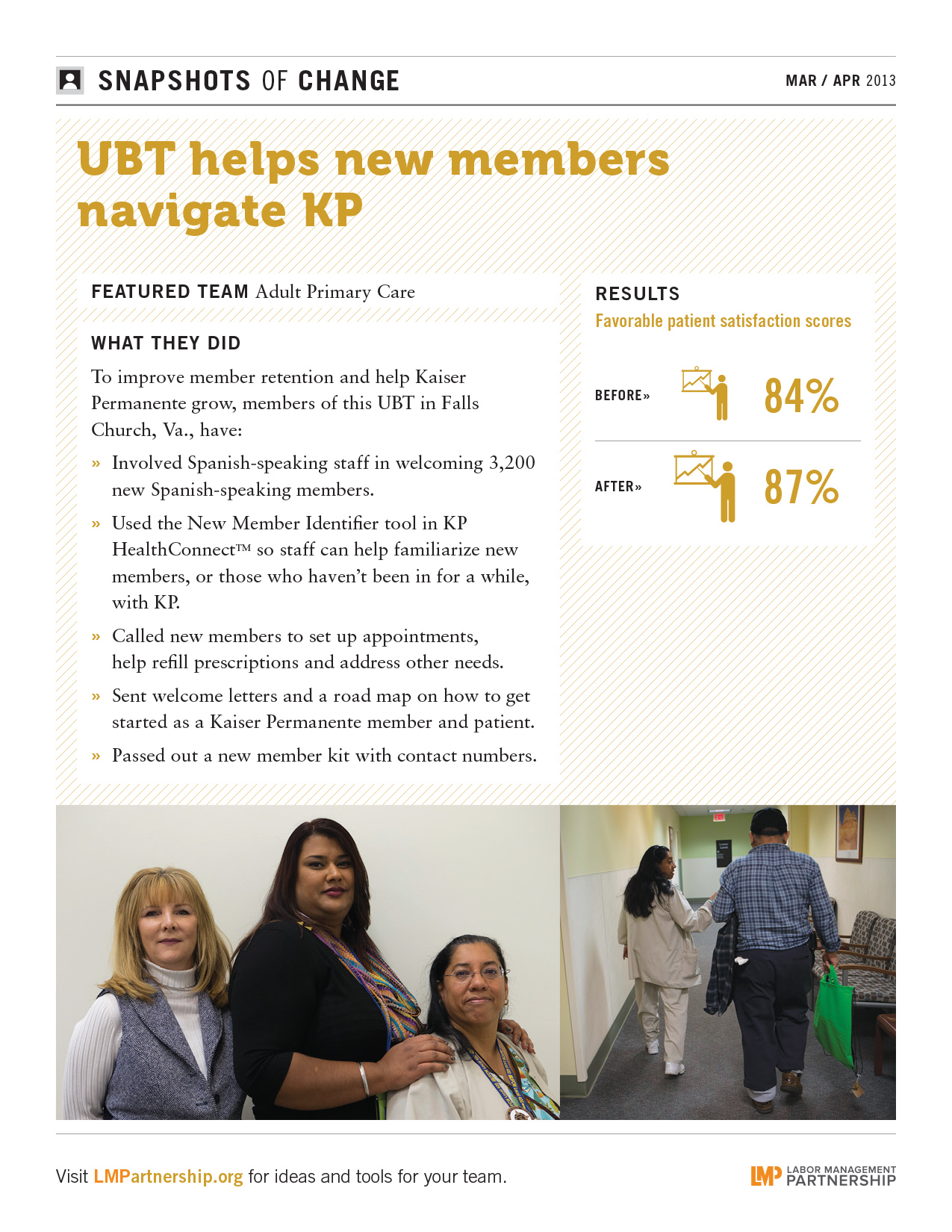
Poster: UBT Helps New Members Navigate KP

Format:
PDF

Size:
8.5" x 11"

Intended audience:
Frontline employees, managers and physicians

Best used:
This poster features a Mid-Atlantic States team that has found a way to help new members transition smoothly to KP. Post on bulletin boards in break rooms and other staff areas.

Related tools:

TOOLS

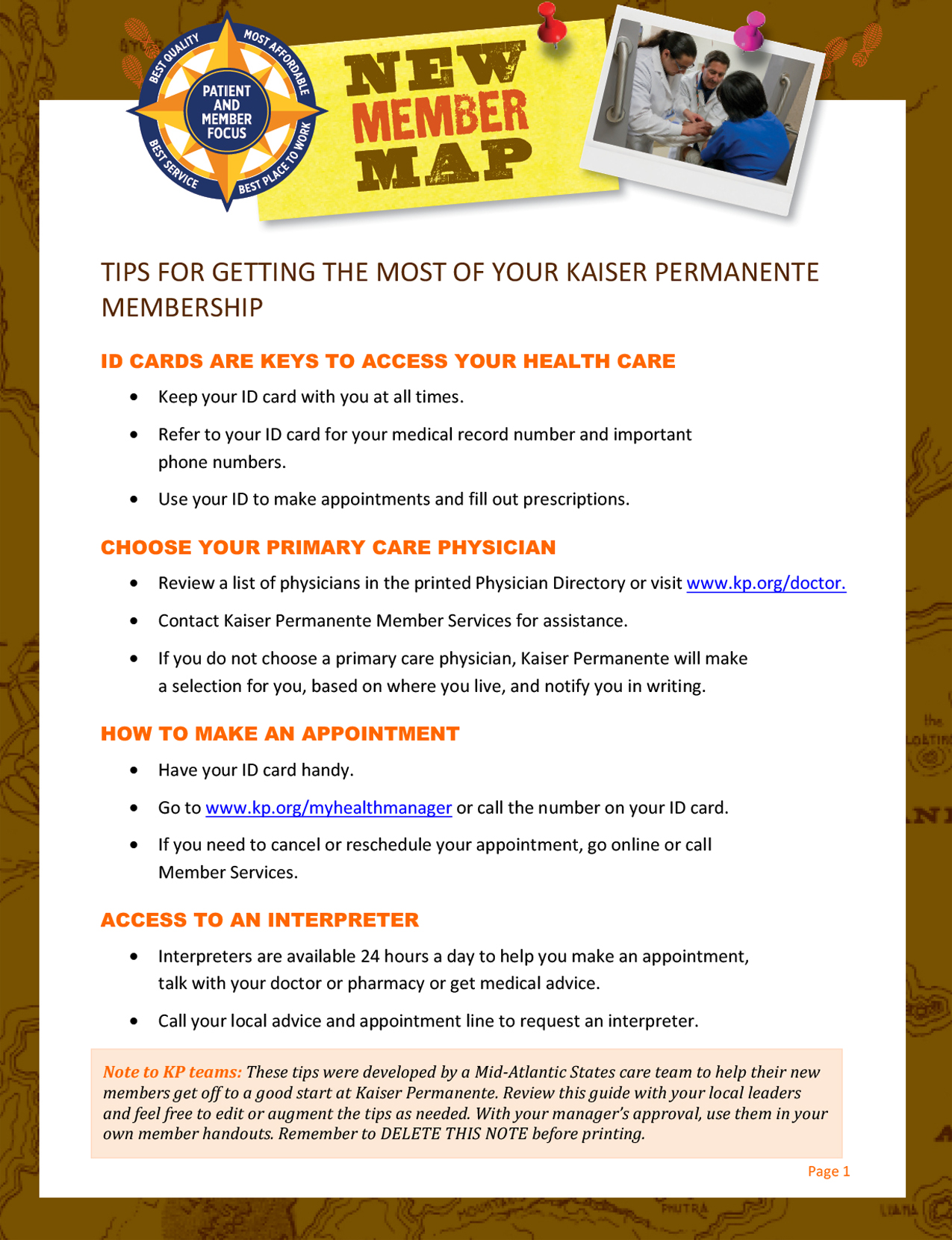
New Member Map

Format:
DOC

Size:
1 page, 2 sides, 8.5" x 11"

Intended audience:
Frontline teams seeing new members in KP clinics

Best used:
This New Member Map, based on a tool developed by a team in KP's Mid-Atlantic States Region, helps new members find their way through the KP system. It can be adapted as necessary to meet the needs of patients and members in other regions. Use as a handout or template to help new members easily access KP services.

Related tools:

TOOLS

PPT: Communication Improves Mammogram Rates

Format:
PPT

Size:
1 Slide

Intended audience:
LMP employees, UBT consultants, improvement advisers

Best used: 
This PowerPoint slide features a Maryland team that improved mammogram rates through better communication. Use in presentations to show some of the methods used and the measurable results being achieved by unit-based teams across Kaiser Permanente. 

Related tools:

TOOLS

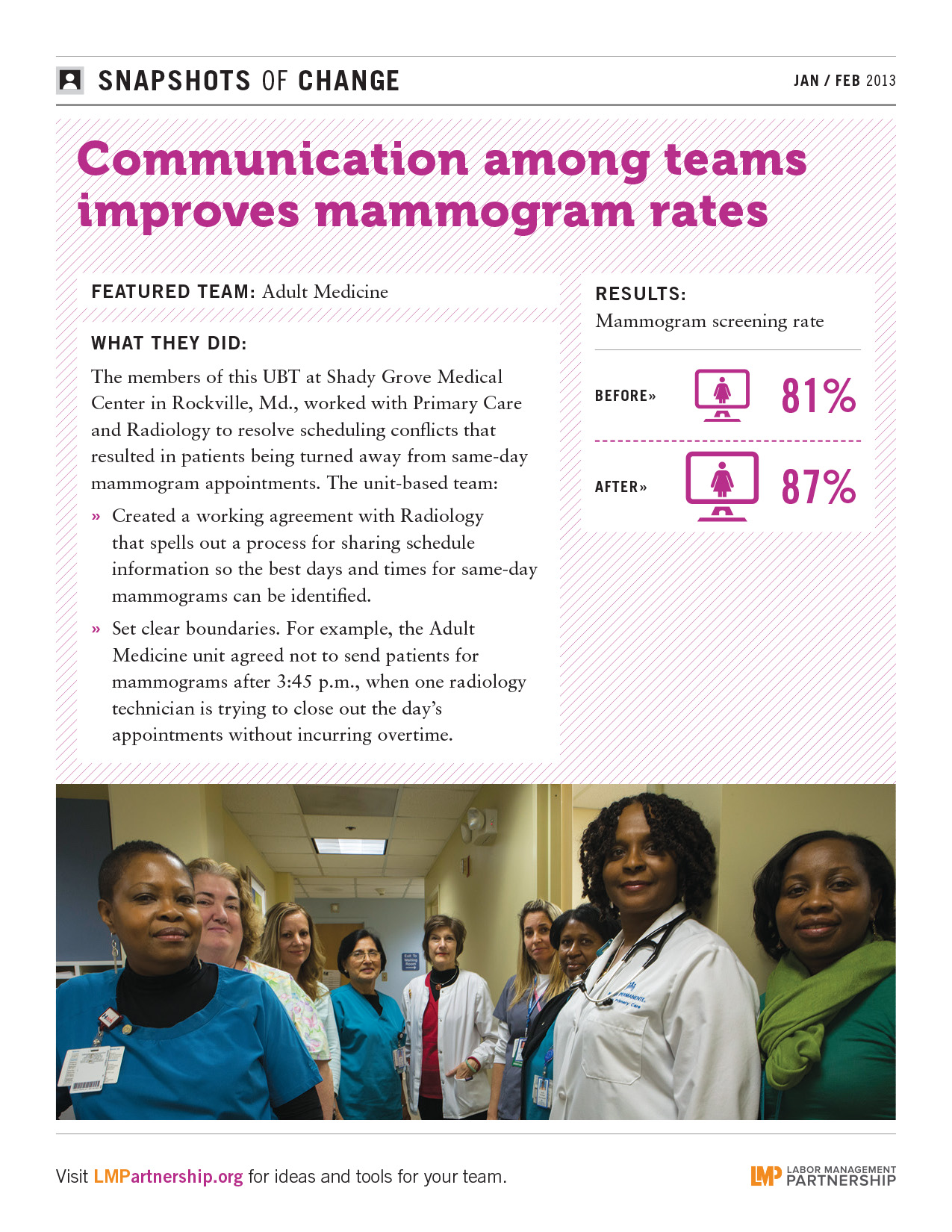
Poster: Improving Mammogram Rates

Format:
PDF

Size:
8.5” x 11”

Intended audience:
Frontline employees, managers and physicians

Best used:
Post on bulletin boards, in break rooms and other staff areas to share with your team how effective communication keeps the patient at the center of our work.


Related tools:

TOOLS

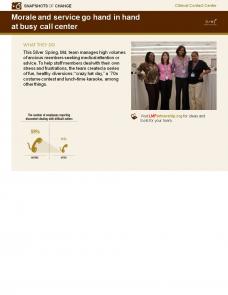
Powerpoint: Busy Call Center Boosts Morale With Fun

Format:
PPT

Size:
1 Slide

Intended audience:
LMP staff, UBT consultants, improvement advisers

Best used:
This PowerPoint slide highlights a call center team that improved employee morale with fun, healthy diversions. Use in presentations to show some of the methods used and the measurable results being achieved by unit-based teams across Kaiser Permanente.

Related tools:

Pages

Subscribe to RSS - Mid-Atlantic States