Northwest

Help Video

How to Find UBT Basics on the LMP Website

Learn how to use the LMP website:

LMP Website Overview

Learn how to use the LMP website:

How to Find How-To Guides

This short animated video explains how to find and use our powerful how-to guides

Learn how to use the LMP website:

How to Find and Use Team-Tested Practices

Does your team want to improve service? Or clinical quality? If you don't know where to start, check out the team-tested practices on the LMP website. This short video shows you how. 

Learn how to use the LMP website:

How to Use the Search Function on the LMP Website

Having trouble using the search function? Check out this short video to help you search like a pro!

Learn how to use the LMP website:

How to Find the Tools on the LMP Website

Need to find a checklist, template or puzzle? Don't know where to start? Check out this short video to find the tools you need on the LMP website with just a few clicks. 

Learn how to use the LMP website:

Looking to the (Google) Stars for Exceptional Patient Care

Deck: 
Project focuses on patient feedback at Colorado clinic

Story body part 1: 

Great patient care shouldn't be a secret.

That’s why staff members at Ridgeline Behavioral Health in Colorado encourage patients to post Google star reviews about their care experiences.

“We want our patients to know we care about their experience and are listening to what they have to say,” says Annje Ciarrocchi, lead outpatient behavioral health associate and SEIU Local 105 member. She serves as the team’s labor co-lead.

The level 4 unit-based team led a successful project to raise the facility’s average Google star rating to 4 or higher out of 5. They sought feedback from patients and asked them to post reviews about clinic staff and operations.

Great ratings can drive patient confidence and membership growth. They can also raise visibility.

Promoting KP’s reputation

Every time you use Google to find a Kaiser Permanente facility, a business profile appears that includes its address and hours of operation. It also displays a 1- to 5-star consumer rating by the facility’s name.

Kaiser Permanente aims for an average 4.3 Google rating at its more than 650 medical care facilities. Here's why: search for a “hospital (or clinic) near me" on Google and those facilities scoring at or above 4.3 are likely to appear at the top of the query results. Seeing high Google star ratings can help members feel good about choosing — and keeping — KP as their health plan.


TOOLS

Affordability UBT Project Idea

Format:
PDF

Size:
8.5" x 11"

Intended audience:
Pharmacy unit-based team members

Best used:
Use this project idea from Southern California to improve over-the-counter pharmacy sales and help meet the 2025 Alliance PSP affordability goal. For more tools, please visit the How-To Guide: Alliance PSP in a Box.

Related tools:

TOOLS

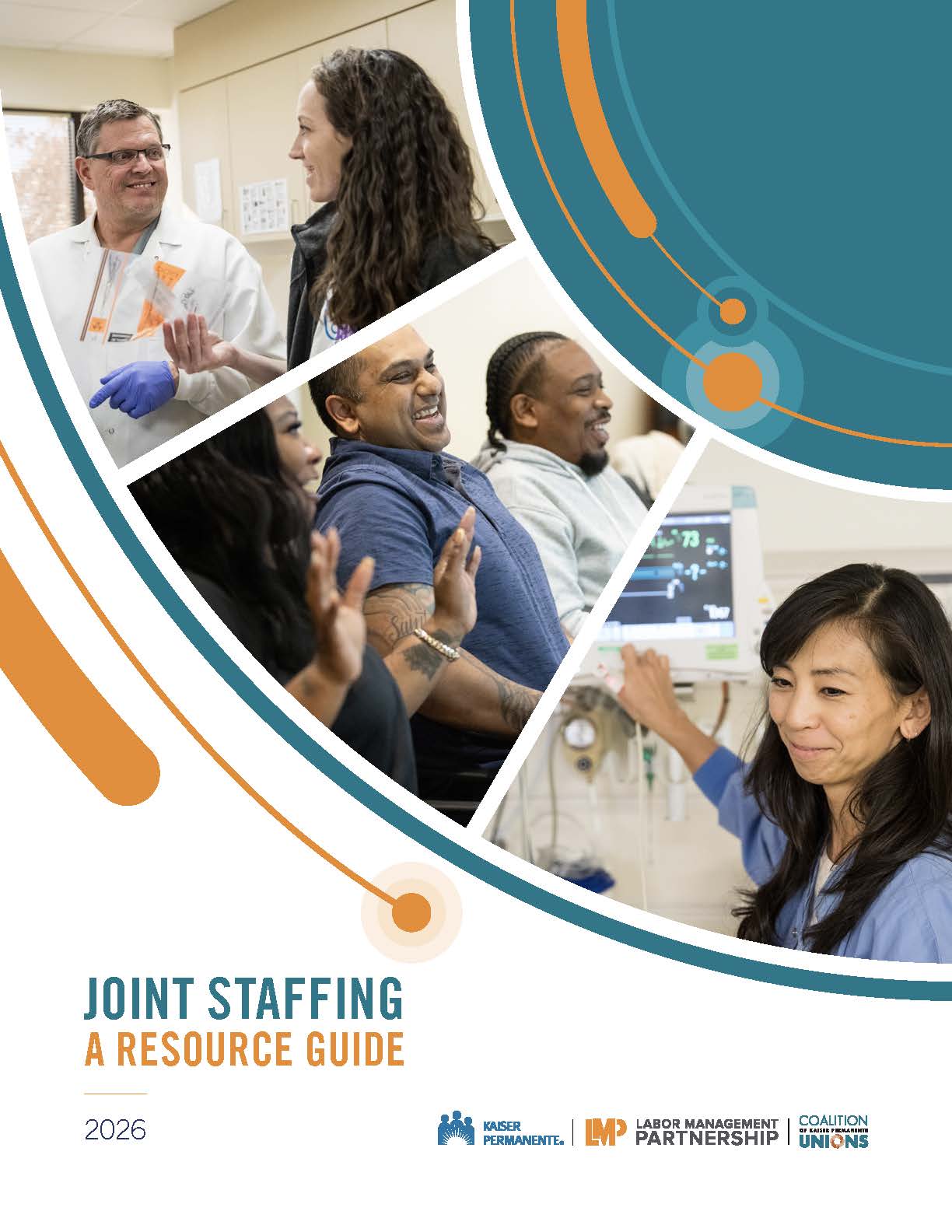
Coalition Joint Staffing: A Resource Guide

Format:
PDF

Size:
37 pages

Intended audience:
Unit-based teams with Coalition-represented workers 

Best used:
Use this resource guide to understand joint staffing and what is expected at each stage of the process.

Related tools:

Northwest Team Creates Better Cancer-Care Experience

Deck: 
Educating staff minimizes patient disruptions, maintains highest quality

Story body part 1: 

Cancer is a scary diagnosis. Patients who receive this devastating news find support and hope from the Central Interstate Oncology and Infusion team.

The Portland-based team manages an infusion clinic where an average of 70 patients receive chemotherapy daily.

Thanks to a UBT project launched in 2023, the team is helping patients better manage chemotherapy side effects. Results have led to a steep drop in the number of patients sent to the hospital because of severe reactions.

The results illustrate the power of the Labor Management Partnership. The project brought together physicians, managers, and frontline staff to find ways to lower hospitalizations and ease the burden on patients.

“This is just one highlight of how amazingly well our cancer team works as a whole,” says Christine Barnett, MD, chief of Oncology at Central Interstate.

Rising hospitalizations

The oncology and infusion unit-based team set out to reduce the number of patients hospitalized for severe chemotherapy reactions.

They began by closely reviewing an unexplained rise in patients receiving infusion treatment in the hospital.

The team found that about half of these patients could have continued with outpatient infusion treatment, which typically lasts 2 to 3 hours. Hospital infusions can take up to 11 hours and involve patient monitoring and additional medication measures.

“It really spoke to the need for providing more thorough onboarding and training and review for existing staff,” says Monica Hahn, manager of Central Interstate’s Cancer Service Line and Medical Oncology back office.

Significant turnover on the team during the COVID-19 pandemic led to gaps in understanding of the different treatment options available to patients, says Hahn, the team’s management co-lead.

The team’s journey pointed to a larger issue as well. During the pandemic, many teams paused important UBT work to meet increased demand for patient care.

The Central Interstate team was no exception. By early 2023, the team had dropped from Level 5 to Level 1 on the Path to Performance as completed UBT projects fell off. The Path to Performance is a five-stage “growth chart” teams use to measure success.

The care experience project marked one step in the team’s renewed focus on UBT work. They returned to Level 5 in just 10 months.

Refreshing skills

To reduce unneeded hospital visits, the team developed a skills refresher for everyone.

Pharmacy staff conducted in-service training to help employees understand the range of medications available to ease difficult side effects.

Unit-based team leaders also received training. They reviewed ways to assess chemotherapy reactions and determine which patients required hospitalization.

The training was led by Dr. Barnett, Chyna Turnbull, a nurse practitioner, and Jennie Burns, a registered nurse, both members of OFNHP Local 5017.

This educational push led team leaders to develop a 2-page handout of clinical practices. Staff members review the information with patients to help them understand expected side effects.

After taking these steps, the team saw hospitalizations for chemotherapy drop by more than 90% over 2 months in 2023. The team continues to maintain the lower level of hospitalizations.

This is good news for patients, who often must pay high deductibles for hospital admissions. And it’s good news for Kaiser Permanente, which is saving an estimated $198,000 annually due to reduced hospitalizations.

Patients also have a better care experience. They develop trusting relationships with infusion team members and maximize recuperation time at home.

“They come in for their treatment and they’re home in time for dinner,” says Burns, the team’s lead registered nurse.

“The patients see that we are all together in this,” says Rebel Herbert, the team’s labor co-lead, who is a medical assistant and member of SEIU Local 49. “We’re always just a phone call or an email message away.”

Humans of Partnership:

As an oncology nurse navigator, I coordinate cancer care as well as provide education and resources to patients. A few years ago, one of my colleagues, an Alliance-represented union member, enrolled in the Ben Hudnall Memorial Trust program and was working on her master’s degree. Ben Hudnall Memorial Trust is one of 3 education trusts backed by the Labor Management Partnership. The Alliance, the Coalition, and Kaiser Permanente negotiated these benefits so members of partnership unions can access education, training, and career advice. I decided to take advantage of this opportunity and received my Master of Science in Nursing degree with a specialty in care coordination in April 2023. I feel very blessed. I had support from Kaiser Permanente, the union, and my leadership team to pursue my professional goal of receiving a graduate degree. The Ben Hudnall Memorial Trust paid for my tuition, books, and time. This experience gave me more than just a better understanding of the health care system and skills to improve my practice, it rejuvenated my nursing soul.

, , ()

Optical Team Solves Swirling Mystery

Deck: 
Techs overcome problem damaging new eyeglass lenses

Story body part 1: 

If one word inspires dread in the Optical Lab Surface department, it is “swirl.”

The Northwest team helps make eyeglasses for Kaiser Permanente members. Their work is sometimes complicated by swirls – circular scratches on the lenses that can occur during the production process.

In 2022, the team - based at Kaiser Permanente Sunnyside Medical Center outside Portland - grappled with a mysterious increase of swirls.

“Normally, we will get about one swirl per day that we can’t polish out,” says Rodney Edwards, department supervisor and the team’s management co-lead. “But suddenly we were seeing 12 or 13 per day. We knew we were dealing with something very strange.”

When extra polishing can't remove a swirl, the team must fashion a new set of lenses. This raises costs and slows production, delaying delivery of eyeglasses to KP members.

By conducting a painstaking review of its processes, the team uncovered the cause of the swirl surge and improved care and service.  

When everyone participates in performance improvement, the better the results and the stronger the work environment. Collaborating on performance improvement also advances a culture at KP in which continuous learning and improvement come naturally.

From technicians to sleuths

Finding the source of the swirls was not easy. The Level 4 team prepares about 700 eyeglass lenses each day.

“It’s tough for us to troubleshoot these things," says Dustin Rushing, an optical lab technician and OFNHP Local 5017 member, who is the team's labor co-lead. "We’re operating at such a high volume we can’t really stop the presses."

To identify the problem, the team performed multiple tests of change.

Team members analyzed vats of liquid lens polish. They improvised new polish filtration devices. They scrutinized surfacing procedures and the calibrations of each piece of machinery. The tests and tweaks occurred while the team tried to keep up with high demand for eyeglasses.

Weeks of testing uncovered the problem: wear and tear on machinery was leaving metal shavings in liquid used to polish new lenses. The solution? Modifying worker procedures and intensifying maintenance and replacement of machine parts.

As a result, the team saw a 94% reduction in swirls during the first 4 months of 2023. That success continues. The team reduced monthly costs to replace damaged lenses, from $525 to $31, for a projected annual savings of $6,000.

While the cost savings may seem small, it illustrates the impact of unit-based teams. Enterprisewide, more than 3,600 teams contribute to KP’s national leadership in measures of affordability, quality, service, and care.

The project earned the optical lab team a UBT Excellence Award from regional leaders.

“The biggest reason for this project’s success was the openness and communication between us all,” Edwards says. “That really opened up some doors for us as a team.”

Pages

Subscribe to RSS - Northwest